
MTC: Law School, Laptops, and AI: Why Banning Computers Misses the Point!
/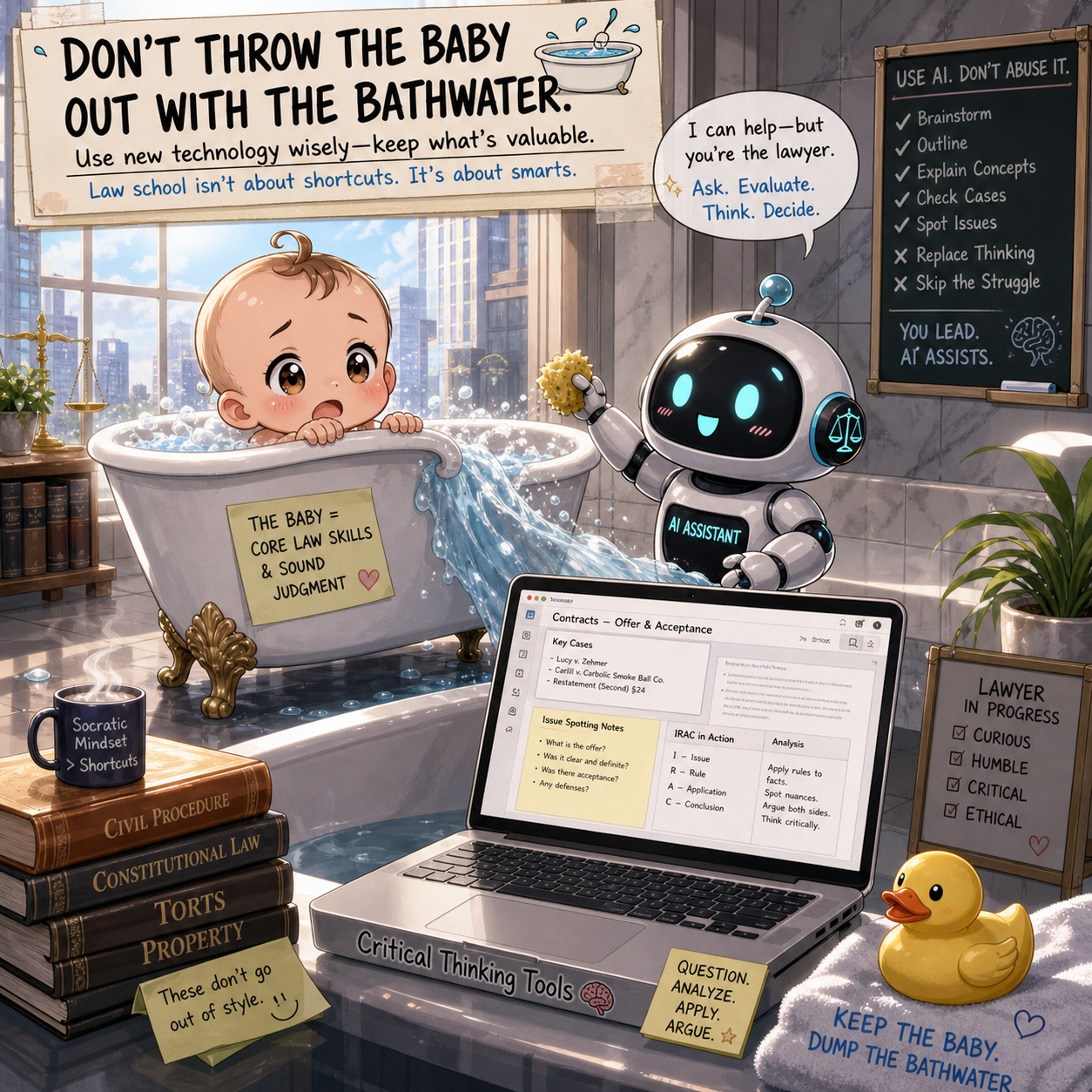
Law schools are throwing out the baby with the bathwater by banning laptops from the classroom as an effort to combat improper ai use.
On July 10, 2026, the conversation around artificial intelligence in legal education reached a new level. Reports of universities banning both AI tools and laptops in classrooms reflect a growing anxiety: how do we preserve critical thinking in an age of automation? ⚖️
It is a fair question. It is also the wrong solution.
Let me be clear at the outset. A first-year ban on AI tools makes sense. A blanket ban on laptops does not.
The Case for Limiting AI—At First
Legal education has always been about building judgment. That means learning how to analyze facts, synthesize doctrine, and construct arguments from scratch. AI short-circuits that process if used too early.
Under ABA Model Rule 1.1 (Competence), lawyers must provide knowledgeable and skilled representation. That competence begins in law school. If students rely on AI before they understand the law themselves, they risk becoming operators instead of thinkers.
As I have noted in prior discussions on legal technology, AI should augment—not replace—legal reasoning.
So yes, a structured limitation on AI during the first year is defensible. It creates a foundation. It forces students to wrestle with ambiguity. It builds intellectual muscle. 💡
But Banning Laptops? That Is an Overreach
This is where the policy breaks down.
When I entered law school then graduated in 2002, laptops were just beginning to appear in classrooms. They were not universal. They were not always welcome.
For me, the laptop was not a distraction. It was essential.
My handwriting was and sadly still is poor. My ability to type, organize notes, and revise quickly made the difference between struggling and succeeding. My laptop was not a shortcut. It was an accessibility tool before we used that term widely.
Fast forward to today. Students are typing far more than they write. Many have never learned cursive. Their academic workflows are digital from the start.
To remove laptops is not to level the playing field. It is to shift it—often unfairly.
The Practical Reality of Modern Learning
Legal education does not exist in a vacuum. Law practice is digital.

Law students who learned on laptops will be disadvantaged if classrooms suddenly ban them.
Under ABA Model Rule 1.1, Comment 8, lawyers must understand the benefits and risks of technology. That obligation does not begin after graduation. It begins in law school.
Students today must learn:
How to organize digital research
How to draft and revise efficiently
How to manage documents and workflows
How to integrate technology into legal reasoning
You cannot teach modern legal competence while removing the primary tools of modern legal work. 🖥️
A laptop is not the problem. Misuse is.
The Enforcement Problem No One Is Talking About
There is also a practical issue. Banning AI is difficult to enforce. Banning laptops is easy.
That does not make it the right policy.
If anything, banning laptops is a workaround for the harder problem of AI enforcement. It is a policy by convenience.
And it raises a deeper concern under ABA Model Rule 5.3 (Responsibilities Regarding Nonlawyer Assistance), which increasingly applies to AI tools. Lawyers—and future lawyers—must learn to supervise and evaluate AI outputs.
You cannot teach supervision by eliminating exposure.
A Better Approach: Controlled Access, Not Prohibition
Law schools should be experimenting with smarter controls instead of blunt bans.
Some possibilities include:
Disabling Wi-Fi and cellular signals in certain classrooms 📶
Using locked-down exam or classroom software environments
Creating AI-permitted and AI-prohibited assignments with clear boundaries
Requiring disclosure of AI use in coursework
Teaching prompt engineering and AI verification as part of the curriculum
This approach aligns with ABA Model Rule 1.6 (Confidentiality) as well. Students must learn what data can and cannot be shared with AI systems.
Exposure with guardrails is more effective than prohibition. That principle applies directly to how law schools should approach AI.
Critical Thinking and Technology Are Not Opposites
There is a persistent myth underlying these bans: that technology erodes thinking.
That is not inherently true.
Technology can weaken thinking if it replaces effort. It can strengthen thinking if it supports it.
A student who uses a laptop to organize case law, annotate notes, and refine arguments is not thinking less. They are thinking differently—and often more effectively.
The same will eventually be true of AI.
The goal is not to create lawyers who avoid technology or who think less by using AI. It is to create lawyers who use it wisely. ⚖️
What Law Schools Should Be Teaching Instead
If I were designing a first-year curriculum today, I would include:

THE MODERN LAWYER NEEDS TO KNOW HOW TO BALANCE JUDGMENT WITH AI USE IN THEIR WORK!
A temporary restriction on AI-generated work
Mandatory instruction on how AI tools function
Exercises in verifying AI outputs against primary sources
Training on ethical risks, including hallucinations and confidentiality
Continued use of laptops as standard tools
This approach respects both sides of the equation: foundational thinking and technological competence.
Final Thought: Do Not Solve the Wrong Problem
Law schools are right to be concerned. AI is reshaping the profession at a rapid pace.
But banning laptops is not a solution. It is a signal of discomfort.
The better path is harder. It requires nuance. It requires experimentation. It requires trust in students, guided by structure.
Most importantly, it requires recognizing that the future lawyer will not choose between thinking and technology.
They will need both.
And law school is exactly where they should learn how to do that. 🚀