
🗣️ SHOUT OUT: ⏰ Last Call: The Bellwether AI Litigator Summit Starts Tomorrow — And I'm Demonstrating Perplexity for Litigation Research on September 18 ⚖️🤖
/
The program runs from september 17 through the 18th - hope to see you there!!!
Two weeks ago, I told you about Carolyn Elefant's Be the Bellwether AI Litigator Summit. Now I am telling you it starts tomorrow. 🗓️
If you meant to register and life intervened, this is your reminder. Registration remains open, and the program runs online September 17–18, 2026. My full write-up is here: 🗣️ Shout Out! Carolyn Elefant's "Be the Bellwether AI Litigator" Summit — And Why I'm Demonstrating Perplexity for Litigation Research on September 17-18.
Three Numbers Worth Your Attention 📊
Carolyn's program page now publishes figures that should stop any litigator mid-scroll.
1,800+ judicial decisions since 2023 involving alleged or established AI-generated hallucinations in court filings. 800+ court orders, local rules, and judicial decisions addressing AI use. 20+ decisions addressing AI, privilege, and confidentiality.
Read those again. This is no longer an emerging issue. It is a developed body of law that most of us have not read. 😬
Why the Ethics Framing Matters ⚖️
I keep returning to the Model Rules because they are the through-line.
Model Rule 1.1, Comment 8 makes technology competence an ethical duty. Forty-one jurisdictions have adopted it. Eighteen hundred hallucination decisions are, at bottom, eighteen hundred competence failures.
Model Rule 3.3 requires candor toward the tribunal. The duty to correct a false statement continues until the proceeding concludes. That is why those 1,800 decisions exist — not because AI made errors, but because lawyers filed them unverified. I unpacked the remedial protocol in 🪙🪙 MTC: When Reputable Databases Fail: What Lawyers Must Do After AI Hallucinations Reach the Court. Stanford's research put Lexis+ AI at a 17% hallucination rate and Westlaw's AI-Assisted Research near 34%. A subscription is not a safe harbor. 🚨
Model Rule 1.6 and ABA Formal Opinion 512 govern what you feed a chatbot. Those 20+ privilege decisions are courts deciding whether AI-assisted work stays protected. Nathan Gaffney's Day One session addresses exactly that, and Hilary Gerzhoy and Professor Jonah Perlin follow with platform selection, vendor terms, and retention.
Model Rules 5.1 and 5.3 put supervision on you. Your associate's hallucination is your hallucination.
Model Rule 8.4(c) reaches dishonesty and misrepresentation — squarely implicated as altered and generated evidence arrives in court. I walked through that terrain with Professor Jennifer Wondracek's students in 🎙️ TSL.P EP# 132: AI, Deepfakes, and Metadata, including the terminating sanctions in Mendones v. Cushman & Wakefield.
What Happens Thursday 👨⚖️
Day One carries the theme "Courts, Consequences, and Litigation Judgment." Carolyn opens at 10:00 a.m. with her survey of the 800+ standing orders. Adam Feldman follows on the hallucination cases. Shlomo Klapper and the Hon. Brian D. Palmucci bring the view from the bench at 1:00 p.m. Will Moye tells an expert's ChatGPT war story. Nick Rishwain covers expert prompts and disqualification risk. Christopher Kercher closes on the AI-native litigation firm.
Day Two is ten practicing litigators sharing screens on real matters. Porter Heath Morgan on in-house litigation management. Sarah Bashir on family law. John Stobart using Claude at trial. Regina Edwards on discovery. E. Aaron Cartright III generating thirteen litigation documents from one structured input. Arthur Rothrock running a case start to finish. Jim White on Obsidian. C. Todd Smith on Copilot. Descrybe.ai on emerging research tools.
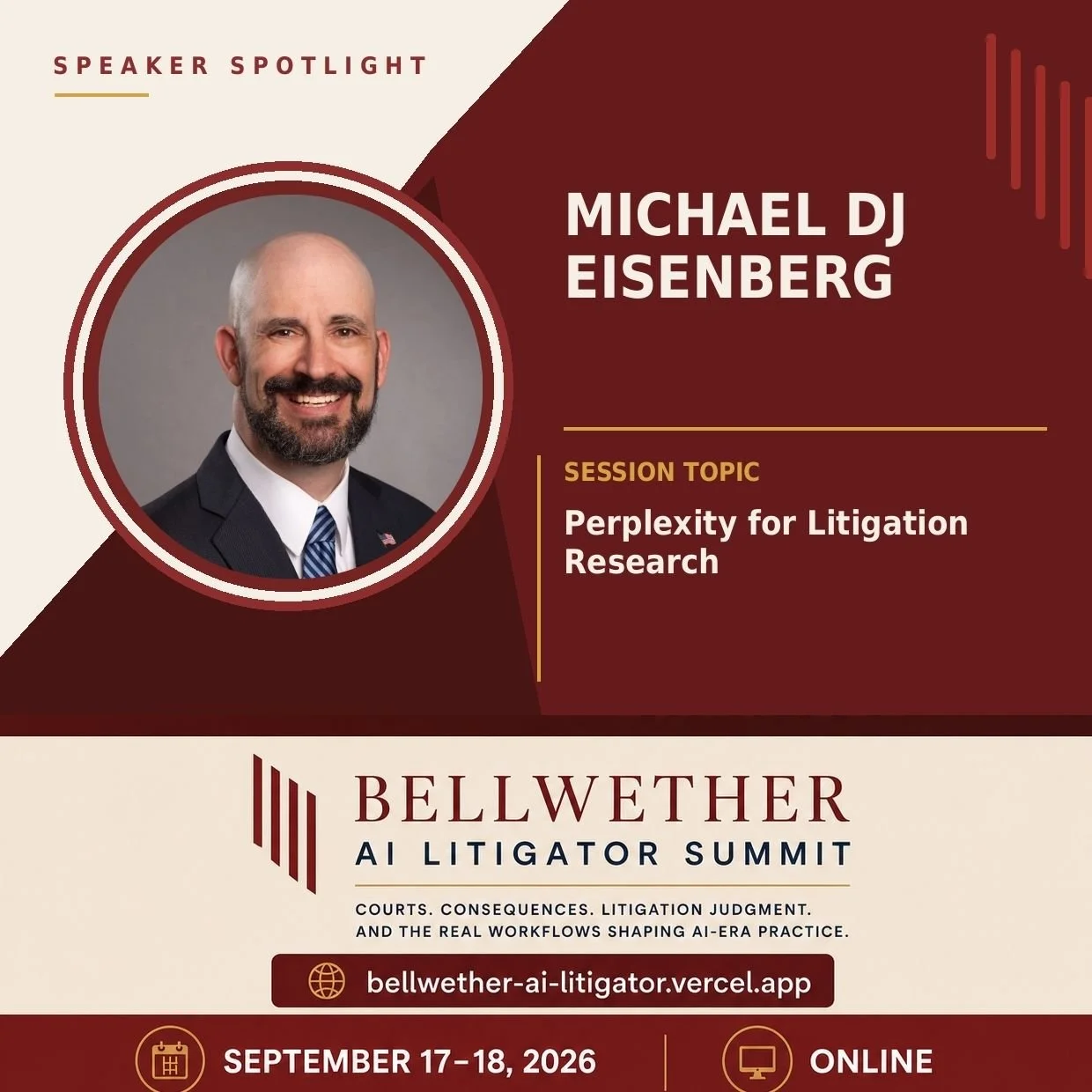
And me, at 11:00 a.m. on September 18, demonstrating Perplexity for litigation research. Ten minutes of live screen share, five minutes of Q&A. 🔍
What I Will Actually Show You 💻
Not a product pitch. A workflow.
How I build a research query. How I evaluate what comes back. And — this is the part that matters — the verification loop that follows every single output. Reading the underlying authority is not negotiable. Regular listeners of The Tech-Savvy Lawyer.Page Podcast know my rule: AI drafts are hypotheses, never answers. 🧪
Every Day Two demonstration answers four questions. What problem was the lawyer solving? What did AI actually do? Where did it fail? What did the lawyer have to verify?
That third question is the one no vendor will answer honestly. It is the reason this program is worth your afternoon.
Register Today 🎟️
Every participant receives the Bellwether Litigator Resource Kit — court AI-order tracking, pre-filing verification, citation and quotation checking, confidentiality and privilege guidance, protective orders, expert AI use, vendor due diligence, workflow design, and human-review protocols.
That kit alone justifies the $249. The judges and the screen shares are the bonus.
Register at the Bellwether AI Litigator summit page or through Eventbrite.bellwether-ai-litigator.vercel
See you tomorrow. Say hello during my Q&A. 👋