🗣️ SHOUT OUT: ⏰ Last Call: The Bellwether AI Litigator Summit Starts Tomorrow — And I'm Demonstrating Perplexity for Litigation Research on September 18 ⚖️🤖

The program runs from september 17 through the 18th - hope to see you there!!!

Two weeks ago, I told you about Carolyn Elefant's Be the Bellwether AI Litigator Summit. Now I am telling you it starts tomorrow. 🗓️

If you meant to register and life intervened, this is your reminder. Registration remains open, and the program runs online September 17–18, 2026. My full write-up is here: 🗣️ Shout Out! Carolyn Elefant's "Be the Bellwether AI Litigator" Summit — And Why I'm Demonstrating Perplexity for Litigation Research on September 17-18.

Three Numbers Worth Your Attention 📊

Carolyn's program page now publishes figures that should stop any litigator mid-scroll.

1,800+ judicial decisions since 2023 involving alleged or established AI-generated hallucinations in court filings. 800+ court orders, local rules, and judicial decisions addressing AI use. 20+ decisions addressing AI, privilege, and confidentiality.

Read those again. This is no longer an emerging issue. It is a developed body of law that most of us have not read. 😬

Why the Ethics Framing Matters ⚖️

I keep returning to the Model Rules because they are the through-line.

Model Rule 1.1, Comment 8 makes technology competence an ethical duty. Forty-one jurisdictions have adopted it. Eighteen hundred hallucination decisions are, at bottom, eighteen hundred competence failures.

Model Rule 3.3 requires candor toward the tribunal. The duty to correct a false statement continues until the proceeding concludes. That is why those 1,800 decisions exist — not because AI made errors, but because lawyers filed them unverified. I unpacked the remedial protocol in 🪙🪙 MTC: When Reputable Databases Fail: What Lawyers Must Do After AI Hallucinations Reach the Court. Stanford's research put Lexis+ AI at a 17% hallucination rate and Westlaw's AI-Assisted Research near 34%. A subscription is not a safe harbor. 🚨

Model Rule 1.6 and ABA Formal Opinion 512 govern what you feed a chatbot. Those 20+ privilege decisions are courts deciding whether AI-assisted work stays protected. Nathan Gaffney's Day One session addresses exactly that, and Hilary Gerzhoy and Professor Jonah Perlin follow with platform selection, vendor terms, and retention.

Model Rules 5.1 and 5.3 put supervision on you. Your associate's hallucination is your hallucination.

Model Rule 8.4(c) reaches dishonesty and misrepresentation — squarely implicated as altered and generated evidence arrives in court. I walked through that terrain with Professor Jennifer Wondracek's students in 🎙️ TSL.P EP# 132: AI, Deepfakes, and Metadata, including the terminating sanctions in Mendones v. Cushman & Wakefield.

What Happens Thursday 👨‍⚖️

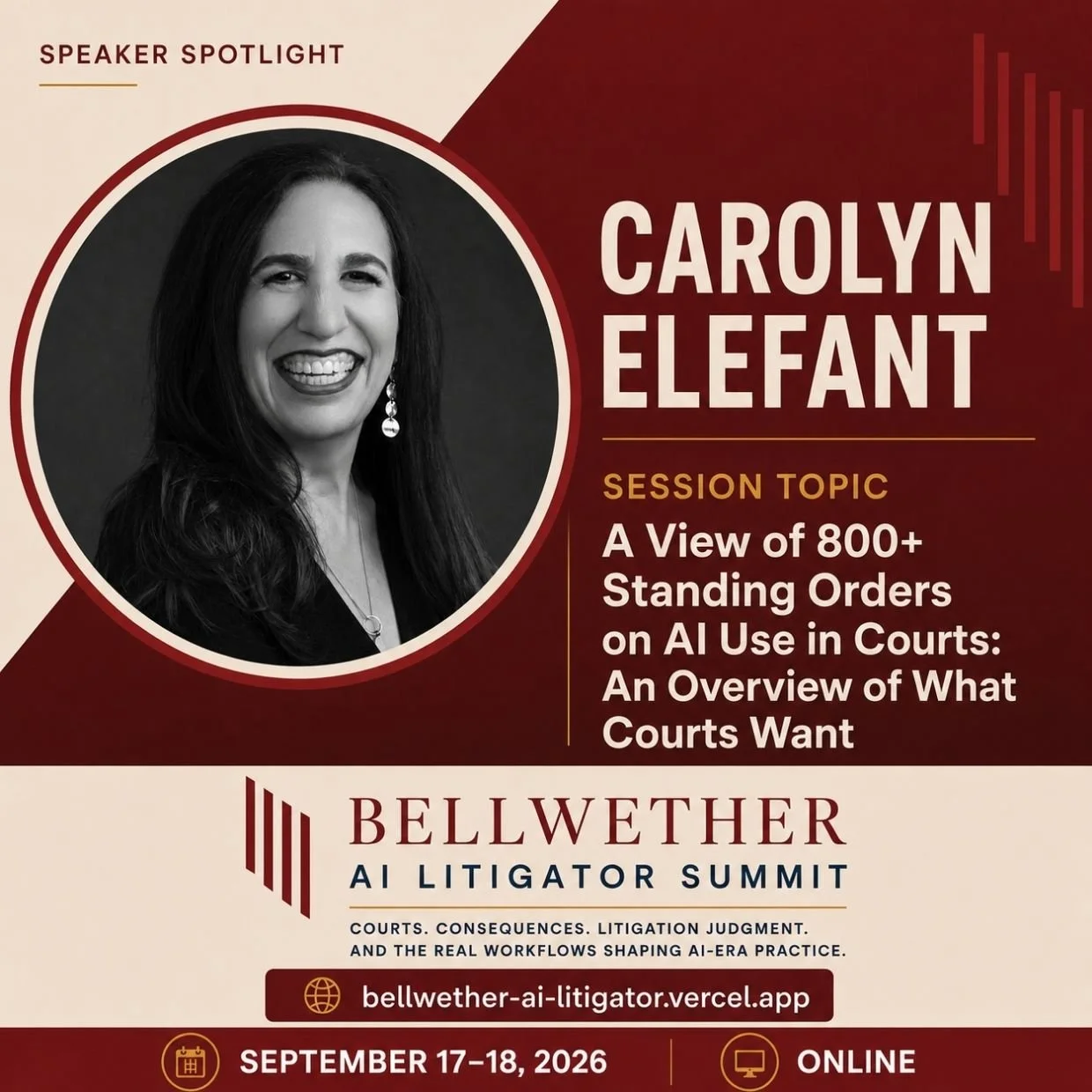
Day One carries the theme "Courts, Consequences, and Litigation Judgment." Carolyn opens at 10:00 a.m. with her survey of the 800+ standing orders. Adam Feldman follows on the hallucination cases. Shlomo Klapper and the Hon. Brian D. Palmucci bring the view from the bench at 1:00 p.m. Will Moye tells an expert's ChatGPT war story. Nick Rishwain covers expert prompts and disqualification risk. Christopher Kercher closes on the AI-native litigation firm.

Day Two is ten practicing litigators sharing screens on real matters. Porter Heath Morgan on in-house litigation management. Sarah Bashir on family law. John Stobart using Claude at trial. Regina Edwards on discovery. E. Aaron Cartright III generating thirteen litigation documents from one structured input. Arthur Rothrock running a case start to finish. Jim White on Obsidian. C. Todd Smith on Copilot. Descrybe.ai on emerging research tools.
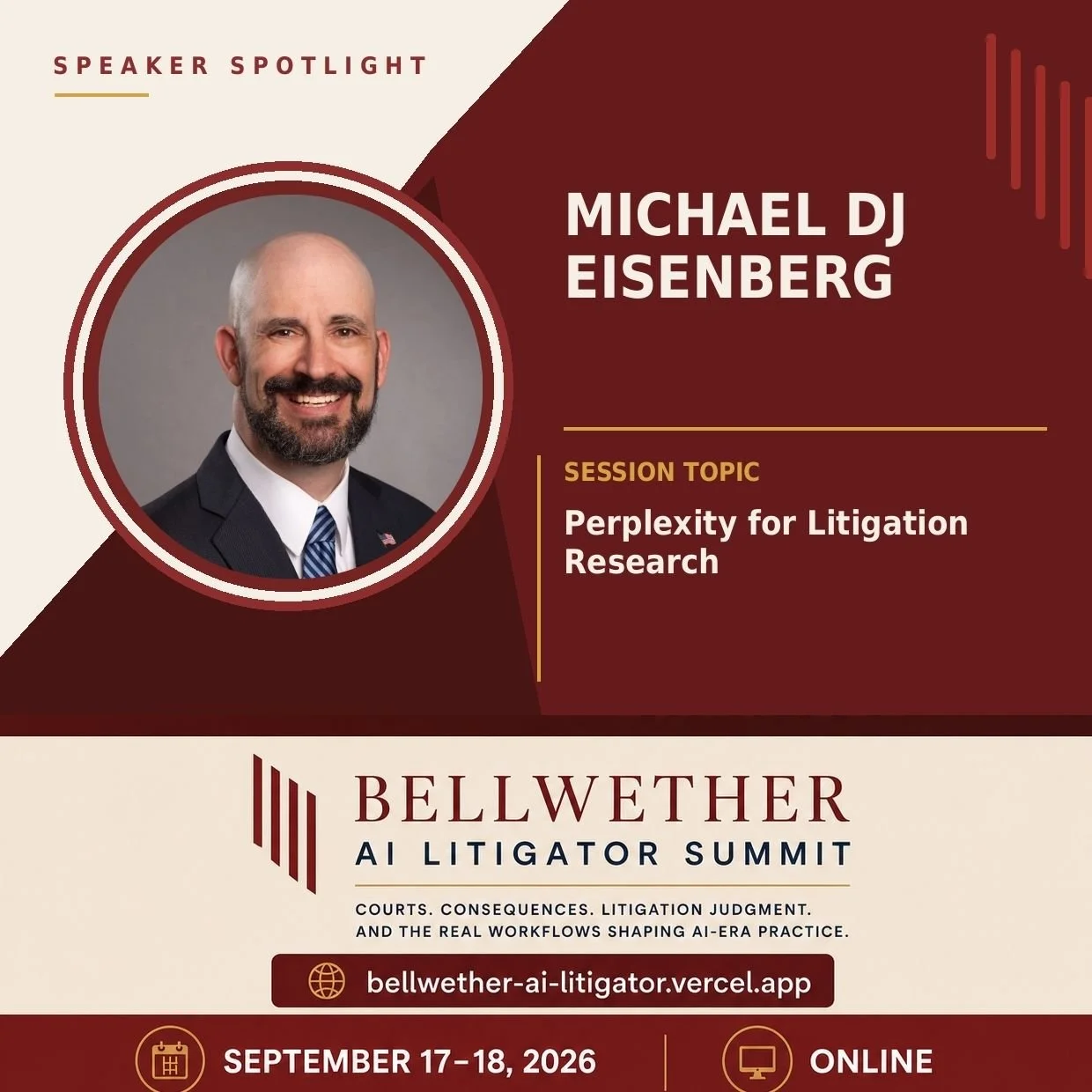
And me, at 11:00 a.m. on September 18, demonstrating Perplexity for litigation research. Ten minutes of live screen share, five minutes of Q&A. 🔍

What I Will Actually Show You 💻

Not a product pitch. A workflow.

How I build a research query. How I evaluate what comes back. And — this is the part that matters — the verification loop that follows every single output. Reading the underlying authority is not negotiable. Regular listeners of The Tech-Savvy Lawyer.Page Podcast know my rule: AI drafts are hypotheses, never answers. 🧪

Every Day Two demonstration answers four questions. What problem was the lawyer solving? What did AI actually do? Where did it fail? What did the lawyer have to verify?

That third question is the one no vendor will answer honestly. It is the reason this program is worth your afternoon.

Register Today 🎟️

Every participant receives the Bellwether Litigator Resource Kit — court AI-order tracking, pre-filing verification, citation and quotation checking, confidentiality and privilege guidance, protective orders, expert AI use, vendor due diligence, workflow design, and human-review protocols.

That kit alone justifies the $249. The judges and the screen shares are the bonus.

Register at the Bellwether AI Litigator summit page or through Eventbrite.bellwether-ai-litigator.vercel

See you tomorrow. Say hello during my Q&A. 👋

🗣️ Shout Out! Carolyn Elefant’s "Be the Bellwether AI Litigator" Summit — And Why I’m Demonstrating Perplexity for Litigation Research on September 17-18 ⚖️🤖

Every so often a program comes along that treats artificial intelligence the way practicing litigators actually experience it — as an evidence problem, a privilege problem, a candor problem, and only then as a productivity tool. 🎯 Carolyn Elefant’s Be the Bellwether AI Litigator summit is that program. It runs online September 17–18, 2026, and I am delighted to give it a full-throated Shout Out!

I have an interest to disclose. I am one of the presenters. On Day Two, September 18, at 11:00 a.m., I am demonstrating "Perplexity for Litigation Research" — a ten-minute, screen-shared walkthrough followed by five minutes of Q&A. No slides about the future of law. Just the tool, a real research problem, and the verification work that has to follow. You can see the full lineup in the Bellwether AI Litigator Summit agenda and register through the summit program page.

Why Carolyn Elefant Earned This Shout Out 👏

Carolyn has been the standard-bearer for solo and small-firm lawyers for more than two decades at MyShingle.com. She is a Cornell Law graduate, an ABA Legal Rebel, an inaugural Fastcase 50 honoree, and a recipient of the American Legal Technology Lifetime Achievement award. She has trained roughly 2,500 lawyers on AI ethics and policy since ChatGPT arrived. Critically, she still litigates. She fights energy cases at FERC, state PUCs, and in court. That matters. Her programs never drift into vendor theater.

The summit reflects that discipline. It is a day-and-a-half intensive built for solos, boutiques, larger firms, government lawyers, and public-interest litigators — the whole bench, not just BigLaw innovation officers.

Day One: Courts, Consequences, and Judgment ⚖️

Day One is themed "Courts, Consequences, and Litigation Judgment," and the faculty list is genuinely strong.

Carolyn opens at 10:00 a.m. with a survey of 800+ standing orders on AI use in courts. Let that number sit for a moment. Eight hundred. Adam Feldman follows with "What We Learned From the Hallucination Cases." Nathan Gaffney addresses privilege rulings. Hilary Gerzhoy and Professor Jonah Perlin pair scholarship with hands-on confidentiality guidance. Shlomo Klapper and the Hon. Brian D. Palmucci offer the judicial view at 1:00 p.m. Will Moye brings an expert’s ChatGPT war story, Nick Rishwain covers expert prompts and disqualification risk, and Christopher Kercher closes the day with the AI-native litigation firm.

That sequencing is not accidental. It tracks the ethical architecture most of us are still assembling.

The Model Rules Are Not Optional Here 📋

Regular readers know this drum. I keep beating it.

Model Rule 1.1, Comment 8 makes technology competence an ethical duty, not a hobby. Forty-one jurisdictions have adopted it. You cannot supervise what you do not understand.

Model Rule 1.6 governs confidentiality, and ABA Formal Opinion 512 sharpened the point: think hard before client-identifying information enters a public large language model. Gerzhoy and Perlin’s session goes directly at vendor terms, retention, and enterprise-versus-consumer platforms.

Model Rule 3.3 demands candor toward the tribunal. Fabricated citations are the most public failure mode of the past three years, and the duty to correct continues until the proceeding ends. I walked through the remedial protocol in 🪙🪙 MTC: When Reputable Databases Fail: What Lawyers Must Do After AI Hallucinations Reach the Court, where Stanford’s research showed Lexis+ AI hallucinating at 17% and Westlaw’s AI-Assisted Research at roughly 34%. Paid platforms are not a safe harbor. 🚨

Model Rules 5.1 and 5.3 put supervision of lawyers and nonlawyer assistance squarely on you. If your paralegal breaches confidentiality through a chatbot, that is your breach.

Model Rule 8.4(c) covers dishonesty and misrepresentation — increasingly relevant as altered and generated evidence reaches the courtroom. I covered that ground with Professor Jennifer Wondracek’s students in 🎙️ TSL.P EP# 132: AI, Deepfakes, and Metadata, including Mendones v. Cushman & Wakefield and the terminating sanctions that followed.

Day Two: Ten Lawyers, Ten Screens 💻

Day Two is the part I find most valuable, and not because I am on it.

Ten practicing litigators share their screens and run real workflows end to end. Porter Heath Morgan on in-house litigation management. Sarah Bashir on family law. John Stobart using Claude at trial. Regina Edwards on discovery. E. Aaron Cartright III generating thirteen litigation documents from one structured input. Arthur Rothrock running a case start to finish. Jim White on Obsidian. C. Todd Smith on Copilot. Descrybe.ai on emerging research tools.

Each demonstration answers four questions: What problem was the lawyer solving? What did AI actually do? Where did it fail? What did the lawyer have to verify?

That third question is the one vendors never answer. It is the reason this summit is worth your time.

My own segment will show how I use Perplexity to help with litigation research — building queries, evaluating sources, and, most importantly, the verification loop that follows every single output. Reading the underlying authority is not negotiable. If you have followed The Tech-Savvy Lawyer.Page Podcast, you know I treat AI drafts as hypotheses, never as answers. 🧪

Practical Details 📅

Registration is open, early-bird pricing is $249, and every participant receives the Bellwether Litigator Resource Kit — covering court AI-order tracking, pre-filing verification, citation and quotation checking, protective orders, vendor due diligence, and human-review protocols. Tickets are also available via Eventbrite.

Come for the judges. Stay for the screen shares. And please say hello during my Q&A. 👋

Congratulations, Carolyn. This one is going to matter. 🎉

🎙️ Ep. #131, Supercharging Litigation With AI: How StrongSuit Helps Lawyers Transform Research, Doc Review, and Drafting 💼⚖️

My next guest is Justin McCallan, founder of StrongSuit, an AI-powered litigation platform built to transform how litigators handle legal research, document review, and drafting while keeping lawyers firmly in control. In this episode, Justin and I dig into practical, real-world workflows that solos, small firms, and big-firm litigators can use today and over the next few years to change the economics, pace, and strategy of litigation—without sacrificing accuracy, ethics, or the quality of advocacy.

Join Justin and me as we discuss the following three questions and more!

  1. What are the top three ways litigators should be using AI tools like StrongSuit right now to change the economics and pace of litigation without sacrificing accuracy, ethics, or quality of advocacy?

  2. What are the top three mistakes lawyers make when adopting AI for litigation, and what practical workflows help lawyers stay in the loop and use AI as a force multiplier instead of a risk? 

  3. Looking ahead to 2026 and beyond, what are the top three AI-driven workflows every litigator should master to stay competitive, and how can platforms like StrongSuit help build those capabilities into day-to-day practice? 

In our conversation, we cover the following

  • 00:00 – Welcome and guest introduction

    • Justin joins the show and shares his current tech setup at his desk. 

  • 00:00–01:00 – Justin’s current tech stack

    • Lenovo laptop, ultra-wide monitor, and regular use of StrongSuit, ChatGPT, and Gemini for different AI tasks.

    • Everyday tools: Microsoft Word and Power BI for analytics and fast decision-making.

  • 01:00–02:00 – Android vs. iPhone for AI use

    • Why Justin has been on Android for 17 years and how UI/UX familiarity often drives device choice more than AI capability.

  • 02:00–05:30 – Q1: Top three ways litigators should be using AI right now

    • Using AI for end-to-end legal research across 11 million precedential U.S. cases to build litigation outlines and identify key authorities.

    • Scaling document review so AI surfaces relevant documents and synthesizes insights while lawyers focus on strategy and judgment.

    • Leveraging AI for drafting and editing—improving style, clarity, and consistency beyond traditional spelling and grammar checks.

  • 05:30–07:30 – StrongSuit vs. basic tools like Word grammar check

    • How StrongSuit aims to “up-level” a lawyer’s writing, not just catch typos.

    • Stylistic improvements, clarity enhancements, and catching subtle inconsistencies in legal documents.

  • 06:00–08:00 – AI context limits and scaling doc review

    • Constraints of large models’ context windows (around ~1M tokens ≈ ~750 pages).

    • How StrongSuit runs multiple AI agents in parallel, each handling small page sets with heuristics to maintain cohesion and share insights.

  • 08:00–09:00 – Handling tens of thousands of documents

    • How StrongSuit can handle between roughly 10,000–50,000 pages at a time, with the ability to scale further for enterprise matters.

  • 09:00–11:30 – Origin story of StrongSuit

    • Why Justin saw a once-in-a-generation opportunity when large language models emerged and how law, with its precedent and text-heavy nature, is especially suited to AI.

    • StrongSuit’s focus on litigators: supporting lawyers from intake through trial while keeping them in the loop at every step.

  • 11:30–13:30 – From intake to brief drafting in minutes

    • Generating full litigation outlines, research, and analysis in about ten minutes, then moving directly into drafting memos, briefs, complaints, and motions.

    • StrongSuit’s long-term goal: automating 50–99% of major litigation workflows by the end of 2026 while preserving lawyer control and judgment.

  • 12:00–14:30 – How StrongSuit tackles hallucinations

    • Building a full database of all precedential U.S. cases enriched with metadata: parties, summaries, holdings, and more.

    • Validating citations by checking whether the Bluebook citation actually exists in StrongSuit’s case database before surfacing it to the user.

    • Why lawyers should still review cases on-platform before filing, even when AI has filtered out hallucinations.

  • 14:30–16:30 – Coverage and jurisdictions

    • Coverage of all U.S. jurisdictions, federal and state, focused on precedential cases.

    • Handling most regulations from administrative agencies, and limits around local ordinances.

    • Uploading your own case files and using complaints and prior research as inputs into StrongSuit workflows.

  • 15:00–17:00 – Security and confidentiality for litigators

    • SOC 2 compliance and industry-standard encryption at rest and in transit.

    • No model training on user data.

    • Optional end-to-end encryption that can even prevent developers from accessing case content, using local encryption keys.

  • 16:30–20:30 – Q2: Top mistakes lawyers make when adopting AI for litigation

    • Mistake #1: Talking about AI instead of diving in with structured experiments and sanitized documents.

    • Using a framework to identify high-impact tasks: high volume, repetitive work, and heavy data/analysis (e.g., doc review, research, contract drafting).

    • How to shortlist tools: look for SOC 2, real product depth, awards, and a focus on your specific workflows.

    • Mistake #2: Expecting immediate mastery instead of moving through predictable adoption stages—from learning the tool, to daily use, to stringing workflows together.

  • 20:30–22:30 – Building firm-wide AI workflows over time

    • Moving from isolated experiments to integrated, low-friction workflows, such as automatic intake-to-research pipelines.

    • Using client intake audio or transcripts to automatically extract facts, issues, and research paths.

  • 22:30–24:30 – Time constraints and “no-time” lawyers

    • Why lawyers don’t need to be “technical” to use StrongSuit.

    • Reframing AI as text-based tools where lawyers’ writing skills and analytical thinking are assets, not obstacles. 

  • 24:00–26:00 – Practical workflows beyond intake

    • Using AI to prepare for expert depositions, including reviewing valuation analyses, flagging departures from market consensus, and generating targeted questions.

    • Reinforcing the value of AI-enhanced legal research and drafting as core litigation workflows.

  • 26:00–29:30 – Q3: 2026 and beyond – AI-driven workflows every litigator should master

    • Rapid improvement of baseline models (e.g., jumping from single-digit to high double-digit performance on difficult benchmarks year over year). 

    • The idea of “tipping points,” where small performance gains turn AI from marginally useful to essential in specific tasks.

    • Why legal research is a great training ground for understanding where AI excels, where it falls short, and how to divide labor between human and machine.

    • The value of learning basic prompting skills to get more from AI systems, even when platforms offer visual workflows.

  • 29:30–32:30 – Will workflows actually change—or just get better?

    • Why Justin expects familiar litigation workflows (doc review, research, drafting) to remain structurally similar, but become far faster and more sophisticated.

    • AI agents handling the grind work while lawyers focus on synthesis, judgment, and strategy.

    • A future where “AI + lawyer vs. AI + lawyer” resembles high-level chess: same rules, but much deeper thinking on both sides.

  • 32:30–End – Where to find Justin and StrongSuit

    • How to connect with Justin and learn more about StrongSuit’s litigation tools.

Resources

Connect with Justin

Hardware mentioned in the conversation

Software & Cloud Services mentioned in the conversation

MTC: Deepfakes, Deception, and Professional Duty - What the North Bethesda AI Incident Teaches Lawyers About Ethics in the Digital Age 🧠⚖️

Lawyers need to be aware of the potential Professional and ethical consequences if they allow deepfakes to enter the courtroom.

In October 2025, a seemingly lighthearted prank spiraled into a serious legal matter that carries profound implications for every practicing attorney. A 27 year-old, North Bethesda woman sent her husband an AI-generated photograph depicting a man lounging on their living room couch. Alarmed by the apparent intrusion, he called 911. The subsequent police response was swift and overwhelming: eight marked cruisers raced through daytime traffic with lights and sirens activated. When officers arrived, they found no burglar—the woman was alone at home, a cellphone mounted on a tripod aimed at the front door, and the admission that it was all a prank.

The story might have ended as a cautionary tale about viral social media trends gone awry. But for the legal profession, it offers urgent and multifaceted lessons about technological competence, professional responsibility, and the ethical obligations that now define modern legal practice.

The woman was charged with making a false statement concerning an emergency or crime and providing a false statement to a state official. Though the charges are criminal in nature, they illuminate a landscape that the legal profession must navigate with far greater care than many currently do. The intersection of generative AI, digital deception, and legal ethics represents uncharted territory—one where professional liability and disciplinary action await those who fail to understand the technology reshaping evidence, testimony, and truth-seeking in the courtroom.

The Technology Competence Imperative

In 2012, the American Bar Association amended Comment 8 to Model Rule 1.1 (Competence) to include an explicit requirement that lawyers remain competent in "the benefits and risks associated with relevant technology." This was not a suggestion; it was a mandate. Today, 31 states have adopted or adapted this language into their own professional conduct rules. The ABA's accompanying committee report emphasized that the amendment serves as "a reminder to lawyers that they should remain aware of technology." Yet the word "reminder" should not be mistaken for optional guidance. As the digital landscape grows more sophisticated—and more legally consequential—ignorance of technology is increasingly indefensible as a basis for professional incompetence.

This case exemplifies why: An attorney representing clients in disputes involving digital media—whether custody cases, employment disputes, criminal defense, or civil litigation—cannot afford to lack foundational knowledge of how AI-generated images are created, detected, and authenticated. A lawyer who fails to distinguish authentic video evidence from a deepfake, or who presents such evidence without proper verification, may be engaging in conduct that violates not only Rule 1.1 but also Rules 3.3 and 8.4 of the ABA Model Rules of Professional Conduct.

Rule 1.1 creates a floor, not a ceiling. While most attorneys are not expected to become machine learning engineers, they must possess working knowledge of AI detection tools, image metadata analysis, forensic software, and the limitations of each. Many free and low-cost resources now exist for such training. Bar associations, CLE providers, and technology vendors offer courses specifically designed for attorneys with moderate tech proficiency. The obligation is not to achieve expertise but to make a deliberate, documented effort to stay reasonably informed.

Lawyers may argue that they "reasonably believed" the photograph was authentic and thus did not knowingly violate Rule 3.3. But this defense grows weaker as technology becomes more accessible and detection methods more readily available.

🚨

Lawyers may argue that they "reasonably believed" the photograph was authentic and thus did not knowingly violate Rule 3.3. But this defense grows weaker as technology becomes more accessible and detection methods more readily available. 🚨

Candor, Evidence, and the Truth-Seeking Function

The Maryland incident also implicates ABA Model Rule 3.3 (Candor Toward the Tribunal). Rule 3.3(a)(3) prohibits lawyers from offering evidence that they know to be false. But what does a lawyer know when AI makes authenticity ambiguous?

Consider a hypothetical: A client provides a lawyer with a photograph purporting to show the opposing party engaged in misconduct. The lawyer accepts it at face value and presents it to the court. Later, it is discovered that the image was AI-generated. The lawyer may argue that they "reasonably believed" the photograph was authentic and thus did not knowingly violate Rule 3.3. But this defense grows weaker as technology becomes more accessible and detection methods more readily available. A lawyer's failure to employ basic verification protocols—such as checking metadata, using AI detection software, or consulting a forensic expert—may render their "belief" in authenticity unreasonable, transforming what appears to be good-faith conduct into a breach of the duty of candor.

The deeper concern is what scholars call the "Liar's Dividend": the phenomenon by which the mere existence of convincing deepfakes causes observers to distrust even genuine evidence. Lawyers can inadvertently exploit this dynamic by introducing AI-generated content without disclosure, or by sowing doubt in jurors' minds about the authenticity of real evidence. When a lawyer does so knowingly—or worse, with willful indifference—they corrupt the judicial process itself.

Rule 3.3 does not merely prevent lawyers from lying; it affirms their role as officers of the court whose duty to truth transcends client advocacy. This duty becomes more, not less, demanding in an age of manipulated media.

Dishonesty, Fraud, and the Outer Boundaries of Professional Conduct

North Bethesda deepfake prank highlights ethical gaps for attorneys.

ABA Model Rule 8.4(c) prohibits conduct involving dishonesty, fraud, deceit, or misrepresentation. On its face, Rule 8.4 seems straightforward. But its application to AI-generated evidence raises subtle questions. If a lawyer negligently fails to detect a deepfake and introduces it as genuine, are they guilty of "deceit"? Does their ignorance of the technology constitute a defense, or does it constitute a separate violation of Rule 1.1?

The answer likely depends on context. A lawyer who presents AI-generated evidence without having undertaken any effort to verify it—in a jurisdiction where technological competence is mandated, and where basic detection tools are publicly available—may struggle to argue that they acted with mere negligence rather than reckless indifference to truth. The line between incompetence and dishonesty can be perilously thin.

Consider, too, the scenario in which a lawyer becomes aware that a client has manufactured evidence using AI. Rule 8.4(c) does not explicitly prevent a lawyer from advising a client about the legal risks of doing so, nor does it require immediate disclosure to opposing counsel or the court in all circumstances. However, if the lawyer then remains silent while the falsified evidence is introduced into litigation, they may be viewed as having effectively participated in fraud. The duty to maintain client confidentiality (Rule 1.6) can conflict with the duty of candor, but Rule 3.3 clarifies that candor prevails: "The duties stated in paragraph (a) … continue to the conclusion of the proceeding, and apply even if compliance requires disclosure of information otherwise protected by Rule 1.6.

Practical Safeguards and Professional Resilience

So what can lawyers do—immediately and pragmatically—to protect themselves and their clients?

First, invest in education. Most state bar associations now offer CLE courses on AI, deepfakes, and digital evidence. Many require only two to three hours. Florida has mandated three hours of technology CLE every three years; others will likely follow. Attending such courses is not an extravagance; it is the baseline floor of professional duty.

Second, establish verification protocols. When digital evidence is introduced in a case—particularly photographs, videos, or audio recordings—require documentation of provenance. Demand metadata. Consider retained expert assistance to authenticate digital files. Many law firms now partner with forensic technology consultants for exactly this purpose. The cost is modest compared to the risk of professional discipline or malpractice liability.

Third, disclose limitations transparently. If you lack expertise in evaluating a particular form of digital evidence, say so. Rule 1.1 permits lawyers to partner with others possessing requisite skills. Transparency about technological limitations is not weakness; it is professionalism.

Fourth, update client engagement letters and retention agreements. Explicitly discuss how your firm will handle digital evidence, what verification steps will be taken, and what the client can reasonably expect. Document these conversations. In disputes with clients later, such records can be invaluable.

Fifth, stay alert to emerging guidance. Bar associations continue to issue formal opinions on technology and ethics. Journals, conference presentations, and industry publications track the intersection of AI and law. Subscribing to alerts from your state bar's ethics committee or joining legal technology practice groups ensures you remain informed as standards evolve. *You may find following The Tech-Savvy Lawyer.Page a great source for alerts and guidance! 🤗

Final Thoughts: The Deeper Question

Lawyers have the professional and ethical responsibility of knowing how deepfakes work!

The Maryland case is ultimately not about one woman's ill-advised prank. It is about the profession's obligation to remain trustworthy stewards of justice in an age when truth itself can be fabricated with a few keystrokes. The legal system depends on evidence, testimony, and the adversarial process to uncover truth. Lawyers are its guardians.

Technology competence is not an optional specialization or a nice-to-have skill. Under the ABA Model Rules and the rules adopted by 31 states, it is a foundational professional duty. Failure to acquire it exposes practitioners to disciplinary action, malpractice claims, and—most importantly—the real possibility of leading their clients, courts, and the public toward injustice.

The invitation to lawyers is clear: engage with the technology that is reshaping litigation, evidence, and professional practice. Understand its capabilities and risks. Invest in verification, transparency, and ongoing education. In doing so, you honor not just your professional obligations but the deeper mission of the law itself: the pursuit of truth.