

MTC: Why 2026’s PC Price Hikes Put Law Firms at Risk 💻⚖️ (and Why Many Lawyers Are Quietly Switching to Macs)
/
2026 PC price hikes threaten law firm budgets, performance, ethical compliance!
Lawyers and Legal Professionals, the warning signs have been flashing for more than a year: 2026 was never going to be a normal hardware refresh cycle for law firms. 💸 Economists tracking the global memory crunch and AI‑driven demand have been clear that PCs and laptops would see double‑digit price hikes as Dynamic Random-Access Memory (DRAM) and other components were redirected to lucrative data‑center workloads. For lawyers who depend on reliable, reasonably priced computers to run practice‑critical applications, this is not an abstract macroeconomic story; it is a direct hit to margins, access to justice, and even ethical compliance.
Recent moves by Microsoft have made the problem impossible to ignore. In mid‑April, Microsoft sharply raised prices across its Surface lineup, including the Surface Pro and Surface Laptop families that many lawyers and law firms rely on for their Windows‑based workflows. Entry‑level machines that once started under $1,000 now begin well above that mark, with some configurations jumping several hundred dollars over their launch prices. In some cases, high‑end Surface laptops now cost more than roughly comparable MacBook Pro configurations, erasing the longstanding assumption that Windows hardware is always the cheaper option.
Here, at the Tech‑Savvy Lawyer blog, I have been chronicling these developments for months, noting that major PC manufacturers signaled 15–20 percent price increases thanks to the AI‑driven memory squeeze and ongoing geopolitical tariff pressures. Those predictions are now a reality. For solo practitioners, small firms, and even midsize practices with thin IT budgets, the message is simple: if you are buying new Windows hardware in 2026, expect to pay more for the same level of performance, or accept underpowered machines that will age badly under AI‑enhanced workflows. 🧾
Apple, by contrast, has maneuvered itself into a relatively stronger position, even though it is not completely immune to component inflation. By tightly integrating Apple Silicon, storage, and other components under its own supply chain, Apple has been able to hold the line on some key configurations in a way that many PC Original Equipment Manufacturers (OEM) cannot. Commentators focusing on the legal market have already highlighted products like the MacBook Neo as examples of Apple using its vertical control to keep pricing relatively stable while competitors raise prices or quietly cut specifications. At the same time, Apple’s M‑series and M5‑generation chips continue to deliver strong performance per watt, especially for on‑device AI tasks and productivity applications, which matters when you are running multiple research tools, document management systems, videoconferencing platforms, and AI assistants on a single machine.
This does not mean Apple has avoided all price movement. Newer MacBook Air and MacBook Pro models with M5 chips have seen list price increases of around $ 100–$ 400, depending on configuration. However, when Microsoft’s updated Surface pricing pushes many midrange Windows machines into the same or higher price tiers than comparable Macs, the calculus for lawyers becomes more nuanced. A Windows laptop that used to be the “budget” choice can now be as expensive as, or more expensive than, a MacBook that delivers similar or better performance and longer support life.
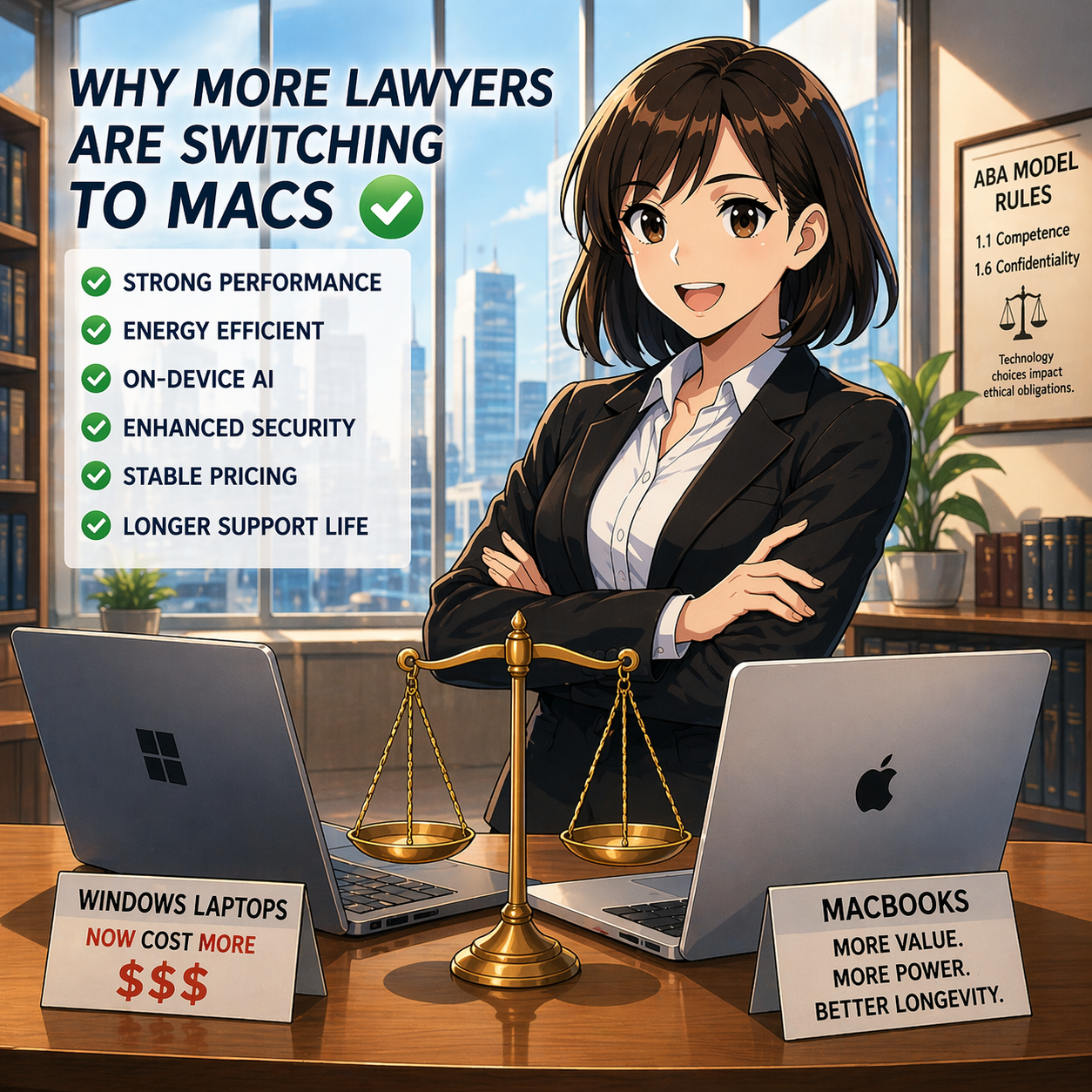
MacBooks outperform rising-cost Windows laptops for lawyers seeking value, security!
For the legal sector, this convergence of price and performance has three important implications.
First, hardware purchasing is no longer a purely IT or “back office” concern. It is an integral part of risk management and client‑service strategy. The ABA Model Rules, particularly Model Rule 1.1 on competence and Comment 8 to that rule, make clear that lawyers have a duty to maintain competence in relevant technology. Using outdated, underpowered hardware can impair your ability to use secure videoconferencing, e‑discovery tools, AI‑driven research platforms, and document automation systems. That, in turn, can compromise both efficiency and the quality of representation. ⚖️ When price hikes push firms toward “cheap but weak” machines, they risk falling behind on this duty of technological competence.
Second, Model Rule 1.6 on confidentiality and related ethics opinions underscore the importance of protecting client information in digital environments. In an era when AI tools increasingly run on‑device, machines that can perform more work locally reduce reliance on cloud processing and third‑party data transfers. Apple’s integrated hardware and on‑device AI capabilities, combined with its strong security posture, can make Macs appealing from a confidentiality standpoint, especially for sensitive practices such as criminal defense, family law, and complex commercial litigation. That does not mean Windows machines are inherently less secure, but when high‑end, well‑secured Windows hardware costs significantly more than it used to, some firms may find that Apple’s offerings now deliver a stronger security‑to‑cost ratio.
Third, long‑term budgeting must adapt to the new reality that technology lifecycles will cost more. Economists and industry groups have projected that tariffs and component shortages could add hundreds of dollars to the average laptop by the time those costs are fully passed through. For law firms, this means that hardware refresh cycles should be planned more deliberately, with strategic staggering of purchases, careful evaluation of total cost of ownership, and perhaps a willingness to stretch the lifecycle of existing machines that still meet performance and security requirements. 🗓️
So where does this leave the practicing lawyer or small firm managing technology with limited internal IT support? 🤔
One practical approach is to stop treating the Windows versus Mac decision as a matter of habit and start treating it as a structured, documented evaluation. Build a simple matrix that compares specific models—such as a midrange Surface Laptop and a MacBook Air or MacBook Neo—on price, performance, storage, memory, security features, support life, and compatibility with your core practice software. Involving firm leadership in these decisions and tying them explicitly to ABA Model Rule 1.1 and 1.6 considerations will help demonstrate that you are exercising reasonable diligence in technology selection.
At the same time, lawyers should not assume that Apple is the default winner. Many legal‑industry tools, case management systems, and document workflows remain optimized for Windows, especially in litigation and specialized practice areas. If your practice depends heavily on Windows‑only software, the cost of moving to Macs (including virtualization or remote desktop solutions) may outweigh hardware price advantages. However, even in a Windows‑centric environment, the new pricing landscape may push firms to consider non‑Surface OEMs or to buy fewer, higher‑quality machines and share them across teams rather than treating laptops as disposable commodities.

Strategic legal tech planning improves performance, security, and long-term cost control for lawyers!
Ultimately, the predicted—and now visible—price hikes on PCs are not just a story about higher invoices from vendors. They are a stress test of how seriously law firms take technological competence, security, and long‑term planning. The firms that respond by proactively reassessing their hardware standards, considering platforms like Apple that have weathered the pricing storm more gracefully, and explicitly aligning purchasing decisions with ABA Model Rules will not only control costs; they will position themselves as trustworthy, efficient, and forward‑looking in a market where clients increasingly notice the difference. 🚀
MTC