MTC: Staying Ahead of the Curve: Why ABA Techshow Is Not Optional for Today's Practicing Lawyer

the aba techshow is the perfect place for lawyers to learn the skills they need to know to meet aba requirements to stay abreast of the benefits and risks associated with relevant technOlogy used in the practice of law!

Let me be direct: technology is no longer a "nice-to-have" in legal practice. It is an ethical obligation. 🎯

The American Bar Association made that clear in 2012 when it amended Comment 8 to Model Rule 1.1 — the foundational rule governing competence. That comment explicitly states that a lawyer must "keep abreast of changes in the law and its practice, including the benefits and risks associated with relevant technology." Not someday. Not when it's convenient. Now — and continuously. If you are a practicing attorney and you are not actively engaging in legal technology education, you are not just leaving efficiency on the table. You may be skating dangerously close to an ethical violation.

That is precisely why I keep coming back to ABA TECHSHOW — and precisely why I encourage every lawyer I speak with, regardless of their comfort level with technology, to attend.

🔑 ABA TECHSHOW Is Built for You — Yes, You

I want to address something head-on: the assumption that Techshow is a conference for tech enthusiasts and IT professionals. It is not. The 2026 conference, running March 25–28 at McCormick Place in Chicago, features over 100 technology vendors and programming explicitly designed for lawyers at every skill level — including those who still break into a cold sweat opening a new software interface. The sessions span everything from AI fundamentals to cybersecurity to practice management to video communication. There is a deliberate on-ramp built into the conference structure because the organizers understand that the legal profession is diverse in its relationship with technology.

I have been privileged to serve as a speaker and faculty member at TECHSHOW, and this year is no exception. At TECHSHOW 2026, I am co-presenting two sessions that I believe speak directly to where the legal profession is right now.

The first, Podcasting for Lawyers: The Truth Behind the Mic, pulls back the curtain on how lawyers can leverage podcasting as a powerful tool for building authority, deepening client relationships, and positioning themselves as thought leaders in their practice areas. In a media landscape saturated with blogs and social media posts, a podcast gives you something rare: an intimate, sustained connection with your audience. As you know, I run my own podcast — The Tech-Savvy Lawyer.Page Podcast — and in that session, alongside colleagues and previous podcast guest Ruby Powers and hopefully future podcast guests Gyi Tsakalakis, and Stephanie Everett, we share the real, actionable steps behind building compelling legal content. 🎙️ 

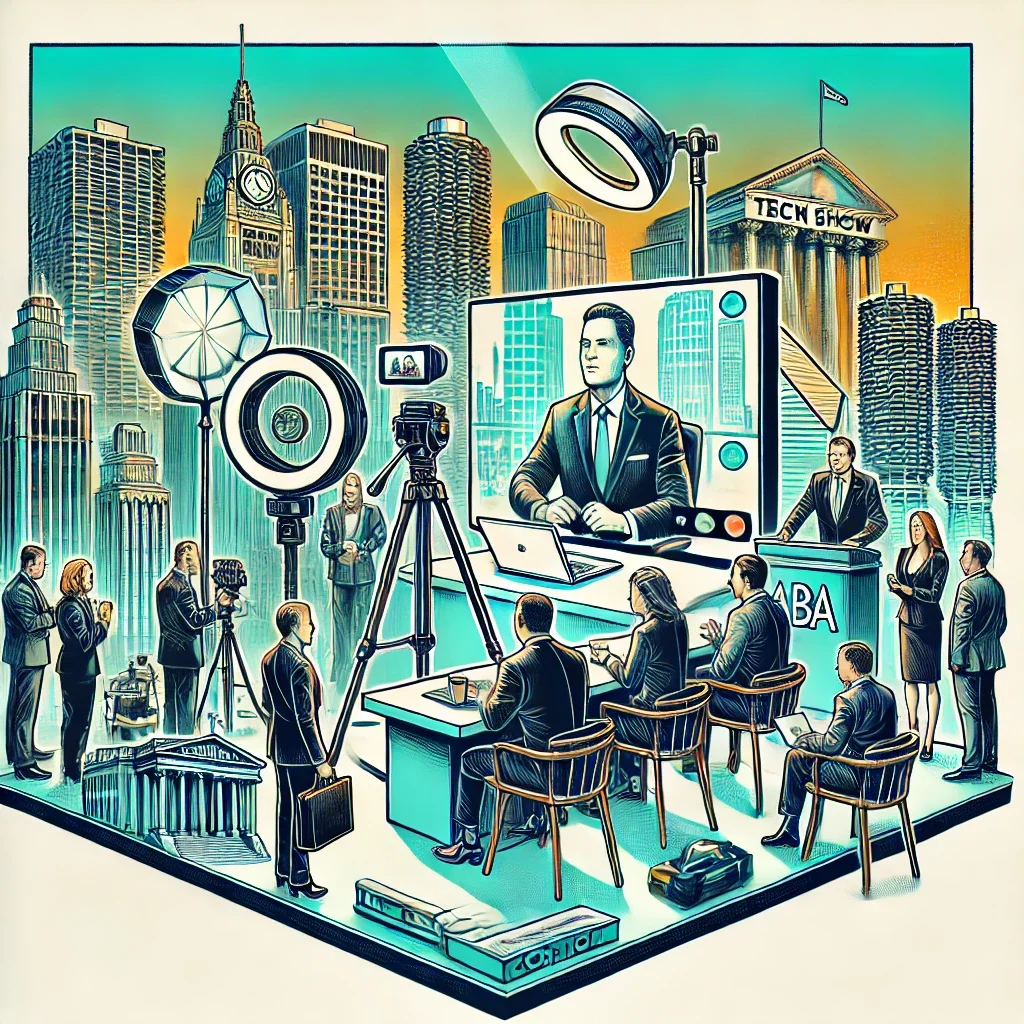
learn how setting up a podcast studio carries over to help with other legal events!

My second session, Camera Ready Anywhere: Mastering Video Meetings with Clients, Courts, and Colleagues, my co-presenter, Temi Siyanbade, and I explore the practical, professional, and ethical dimensions of virtual communication. As virtual meetings have become a permanent fixture of legal practice — whether you are conducting client consultations on Zoom, appearing remotely before a tribunal, or negotiating with opposing counsel on TECHSHOW — looking and sounding competent on camera is no longer optional. This session covers audio and video setup, lighting, platform best practices, and how to project professionalism in a digital environment. The irony is that many lawyers who are meticulous about their appearance in a courtroom give almost no thought to how they present themselves on a video call. That gap matters. It matters to clients. It matters to judges. And yes, it can matter to your reputation.

⚖️ The ABA Model Rules Are Not Suggestions

Let us return to the ethics piece, because I think it deserves more than a passing mention. ABA Model Rule 1.1 sets the standard for competent representation. Most lawyers understand this in terms of legal knowledge — knowing the law, understanding procedure, being prepared. Fewer appreciate that the ABA's 2012 amendment has extended that standard to technology.

As of today, 40-plus states have adopted some version of the technology competence obligation articulated in Comment 8. The District of Columbia most recently joined that group in 2025. This is not a fringe interpretation. It is a growing national consensus about what it means to be a competent lawyer in the modern era.

Rule 1.6 — governing confidentiality — also carries technology implications. A lawyer who fails to understand how their email system works, who stores client data on unsecured devices, or who falls victim to a phishing attack that exposes client files has potentially breached their duty of confidentiality. Rule 5.3 requires that supervisors ensure non-lawyer staff are also compliant with the Rules — and that includes how they use firm technology. The tentacles of technology competence reach throughout the Model Rules.

Conferences like TECHSHOW exist, in part, to help you satisfy these obligations in a practical, hands-on way. The ABA Law Practice Division has consistently described Techshow as an opportunity to understand the "benefits and risks" of technology — the exact language of Comment 8. This is not accidental. It is intentional alignment between the programming and your professional duties.

🚀 The Future Is Already Here — Are You Ready?

The 2026 theme — Innovation That Protects the Rule of Law — reflects something I have believed for years: technology, when adopted thoughtfully, does not undermine the legal profession. It strengthens it. AI tools are transforming how lawyers research, draft, and communicate. Wearable technology and augmented reality are beginning to reshape how we work and collaborate. Deposition technology is being revolutionized by AI-powered transcript tools and remote video platforms. None of this is science fiction. It is happening right now, in law firms across the country.

The question is not whether you will engage with these tools. The question is whether you will engage with them proactively — understanding their benefits and their risks — or reactively, scrambling to catch up after a client complaint or a disciplinary inquiry.

I am not here to alarm you. I am here to invite you. 🤝

your podcast studio set up iMpacts on you are perceived in the virtual legal landscape!

Whether you are a solo practitioner trying to figure out which AI tool is worth your subscription fee, or a partner at a mid-size firm wondering how to lead your team through a technology transition, Techshow offers you a safe, supportive, and genuinely energizing environment to learn. Most of the sessions are CLE-eligible. The vendors are accessible and eager to demonstrate — not sell. The community is collaborative.

More than four decades of working with technology and nearly 30 years of those in the legal arena have taught me one thing above all else: the lawyers who thrive are not necessarily the most tech-savvy. They are the most tech-willing — the ones who stay curious, stay engaged, and never stop learning. 💡

TECHSHOW is where that learning happens. I will see you there.

REGISTER HERE!

MTC

MTC: The 2026 Hardware Hike: Why Law Firms Must Budget for the "AI Squeeze" Now!

Lawyers need to be ready for $prices$ in tech to go up next year due to increased AI use!

A perfect storm is brewing in the hardware market. It will hit law firm budgets harder than expected in 2026. Reports from December 2025 confirm that major manufacturers like Dell, Lenovo, and HP are preparing to raise PC and laptop prices by 15% to 20% early next year. The catalyst is a global shortage of DRAM (Dynamic Random Access Memory). This shortage is driven by the insatiable appetite of AI servers.

While recent headlines note that giants like Apple and Samsung have the supply chain power to weather this surge, the average law firm does not. This creates a critical strategic challenge for managing partners and legal administrators.

The timing is unfortunate. Legal professionals are adopting AI tools at a record pace. Tools for eDiscovery, contract analysis, and generative drafting require significant computing power to run smoothly. In 2024, a laptop with 16GB of RAM was standard. Today, running local privacy-focused AI models or heavy eDiscovery platforms makes 32GB the new baseline. 64GB is becoming the standard for power users.

Don’t just meet today’s AI demands—exceed them. Upgrade to 32GB or 64GB of RAM now, not later. AI adoption in legal practice is accelerating exponentially. The memory you think is “enough” today will be the bottleneck tomorrow. Firms that overspec their hardware now will avoid costly mid-cycle replacements and gain a competitive edge in speed and efficiency.
— 💡 PRO TIP: Future-Proof Your Firm's Hardware Now

We face a paradox. We need more memory to remain competitive, but that memory is becoming scarce and expensive. The "AI Squeeze" is real. Chipmakers are prioritizing high-profit memory for data center AI over the standard memory used in law firm laptops. This supply shift drives up the bill of materials for every new workstation (low end when you compare them “high-profit memory data centers) you plan to buy.

Update your firm’s tech budget for 2026 by prioritizing ram for your next technology upgrade.

Law firms should act immediately. First, audit your hardware refresh cycles. If you planned to upgrade machines in Q1 or Q2 of 2026, accelerate those purchases to the current quarter. You could save 20% per unit by buying before the price hikes take full effect.

Second, adjust your 2026 technology budget. A flat budget will buy you less power next year. You cannot afford to downgrade specifications. Buying underpowered laptops will frustrate fee earners and throttle the efficiency gains you expect from your AI investments.

Finally, prioritize RAM over storage. Cloud storage is cheap and abundant. Memory is not. When configuring new machines, allocate your budget to 32GB or 64GB (or more) of RAM rather than a larger hard drive.

The hardware market is shifting. The cost of innovation is rising. Smart firms will plan for this reality today rather than paying the premium tomorrow.

Award-Winning Blogger Michael D.J. Eisenberg to Kick Off Tech-Savvy Saturdays for Lawyers on April 19th, 2025!

📣 Attention Legal Professionals! Join us for the inaugural Tech-Savvy Saturdays on April 19, 2025, at 12 PM EST, featuring your favorite blogger and podcaster Michael D.J. Eisenberg, the award-winning blogger and podcaster behind The Tech-Savvy Lawyer.Page. This free monthly webinar is tailored for attorneys eager to enhance their practice with technology. Each session includes a guest speaker, a live Q&A, a community tech triage, and a showcase of innovative tools for lawyers.

This month’s topic will be on TextExpander and how creating “snippets” can save you time and money and provide consistency in your legal work!

💻 Whether you're tech-curious or tech-savvy, this series is designed to empower you in your legal work. Please share this exciting announcement with your network! A link to register will be available soon—stay tuned!