MTC: When Your Phone's "Self-Destruct" Button Becomes a Federal Crime: Duress Passwords, Spoliation & the Duty to Preserve ⚖️📱

lawyers should know the interplay among Duress Passcodes, Border Searches, and Smartphone Evidence Destruction

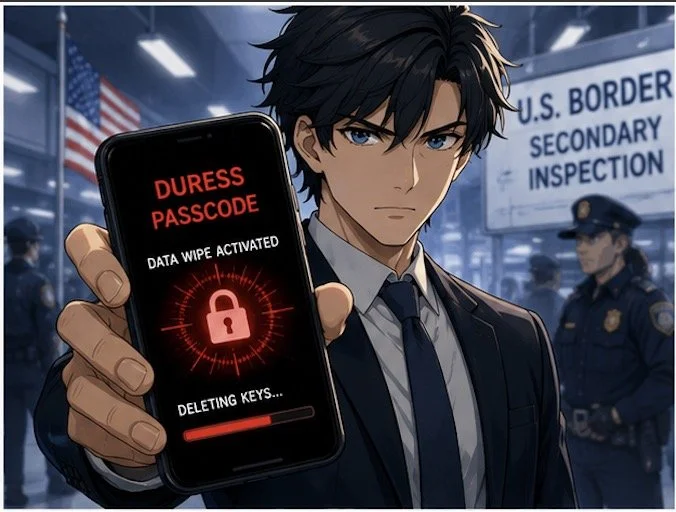
The Justice Department just indicted an Atlanta man for handing border agents a "duress passcode" that wiped his phone during a secondary inspection. It's believed to be the first prosecution of its kind — and it should put every lawyer (and every client with a smartphone) on notice. 🔔

"Duress passwords" — sometimes called "panic codes" or "coercion PINs" — are a real feature in iOS, Android, and third-party privacy apps. Enter one code and the device unlocks normally. Enter the duress code and the phone quietly obliterates its encryption keys, rendering the data unrecoverable. For journalists, activists, and anyone crossing borders with sensitive material, they're a shield. For prosecutors, they look like a loaded gun pointed at the evidence locker. 🔫💾

Here's where the professional-responsibility rubber meets the road. ABA Model Rule 3.4(a) makes it professional misconduct to "unlawfully obstruct another party's access to evidence or unlawfully alter, destroy or conceal a document or other material having potential evidentiary value." Comment 2 to Rule 3.4 clarifies that the duty attaches when a lawyer knows or reasonably should know that litigation is pending or reasonably foreseeable. A border inspection of a device you know contains responsive data? That's reasonably foreseeable. 📋
lawyers need to know the ABA Ethics Rules for Lawyers Protecting Digital Client Data!

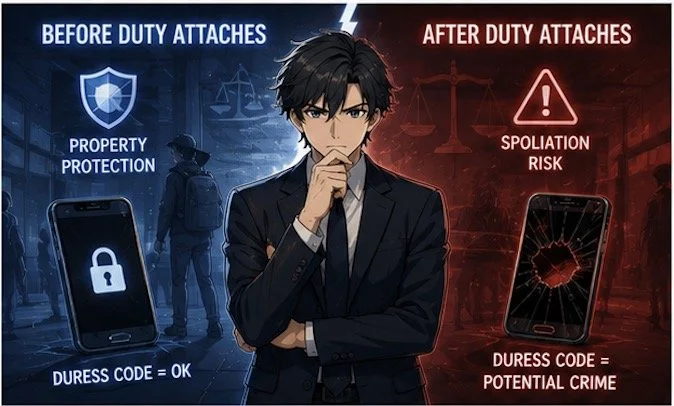
But Rule 1.15 (Safekeeping Property) and Rule 1.6 (Confidentiality) also impose affirmative duties to protect client data. A lawyer who carries privileged communications across a border has a genuine tension: the duty to preserve vs. the duty to safeguard. The duress password sits exactly on that fault line. If you trigger it before a preservation obligation attaches — say, because your phone is stolen — it's property protection. If you trigger it after a subpoena, a litigation hold, or a border detention you knew was coming, it's spoliation. 🧨

The line isn't always bright. Good-faith accident — dropping your phone in coffee, a toddler factory-resetting your iPad — is not a crime. But intent is inferred from circumstances: Did you enable the duress feature after learning of the investigation? Did you select the code specifically for the border crossing? Did you fail to issue a litigation hold to yourself? Courts draw adverse inferences from all three. 📉

Practical takeaways for your practice:

1.      Audit your own devices now. If you use a duress feature, document why and when you enabled it — before any matter makes it suspect. 📝

2.     Issue written preservation notices to yourself the moment litigation is reasonably foreseeable.

3.     Advise clients in writing about duress features before they travel. A client who wipes a phone at the border because you never mentioned the risk creates a Rule 1.1 (Competence) and Rule 1.4 (Communication) problem for you. ✉️

4.     Use encrypted cloud backups with immutable retention (“WORM” [Write Once, Read Many] storage) so a local wipe doesn't equal total loss. That's preservation and property protection. ☁️🔒
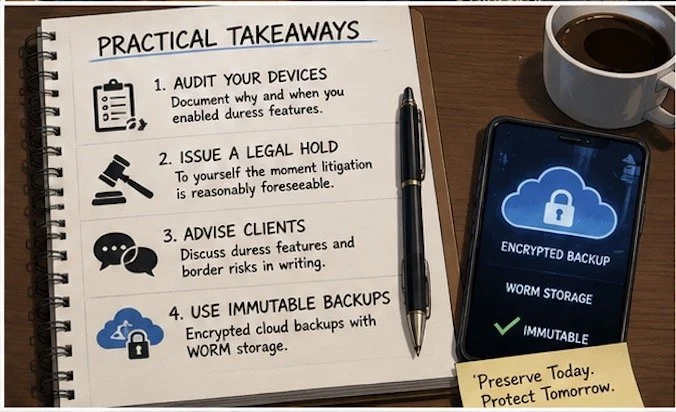
what are the four takeaways lawyers should know when it comes to protecting client data at the boarder!

The Atlanta case will test whether providing a duress code to law enforcement is "destruction" under 18 U.S.C. § 1519 or the Federal Rules' spoliation doctrine. But you don't need the verdict to know your ethical north star: preservation obligations attach when you know — or should know — the data matters. The duress code doesn't suspend that duty; it just makes the violation faster and harder to detect. ⚡

Stay tech-savvy. Stay ethical. And maybe keep a spare phone in the carry-on or use a different phone specifically for travel. 🧳📱

MTC*

* Please remember this is an editorial not legal advice nor create an attorney-client relationship. You should contact an attorney for legal advice about your situation should the need arise.

TSL.P Labs Bonus: Google AI Discussion: Everyday Tech, Extraordinary Evidence: Smartphones, Dash Cams, and Wearables as Silent Witnesses in Your Cases ⚖️📱

Join us for an AI-powered deep dive into the ethical challenges facing legal professionals in the age of generative AI. 🤖 In this Tech-Savvy Lawyer.Page Labs episode, our Google AI hosts unpack our January 26, 2026, editorial and discuss how everyday devices—smartphones, dash cams, wearables, and connected cars—are becoming “silent witnesses” that can make or break your next case, while walking carefully through ABA Model Rules on competence, candor, privacy, and preservation of digital evidence.

In our conversation, we cover the following:

  • 00:00 – Welcome to The Tech-Savvy Lawyer.Page Labs Initiative and this week’s “Everyday Tech, Extraordinary Evidence” AI roundtable 🧪

  • 00:30 – Why classic “surprise witness” courtroom drama is giving way to always-on digital witnesses 🎭

  • 01:15 – Introducing the concept of smartphones, dash cams, and wearables as objective “silent witnesses” in litigation 📱

  • 02:00 – Overview of Michael D.J. Eisenberg’s editorial “Everyday Tech, Extraordinary Evidence” and his mission to bridge tech and courtroom practice 📰[

  • 03:00 – Case study setup: the Alex Preddy shooting in Minneapolis and the clash between official reports and digital evidence ⚖️

  • 04:00 – How bystander smartphone video reframed the legal narrative in the Preddy matter and dismantled “brandished a weapon” claims 🎥

  • 05:00 – From “pressing play” to full video synchronization: building a unified timeline from multiple cameras to audit police reports 🧩06:00 – Using frame-by-frame analysis to test loaded terms like “lunging,” “aggressive resistance,” and “brandishing” against what the pixels actually show 🔍

  • 07:00 – Moving beyond what we see: introducing “quiet evidence” such as GPS logs, telemetry, and sensor data as litigation tools 📡

  • 08:00 – GPS data for location, duration, and speed: turning “he was charging” into a measurable movement profile in protest and road-rage cases 🚶‍♂️🚗

  • 09:00 – Layering GPS from phones with vehicle telematics to create a multi-source reconstruction that is hard to impeach in court 📊

  • 10:00 – Dash cams as 360-degree witnesses: solving blind spots of human perception and single-angle video 🛞

  • 11:00 – Why exterior audio from dash cams—shouts, commands, crowd noise—can be crucial to proving state of mind and mens rea 🔊

  • 12:00 – Wearables as a body-wide sensor network: heart rate, sleep, and step count as quantitative proof of pain, fear, and trauma ⌚

  • 13:00 – Using longitudinal wearable data to support claims of emotional distress or sleep disruption in personal injury and civil-rights litigation 😴

  • 14:00 – Heart-rate spikes and movement logs at the moment of an encounter as corroboration of fear or immobility in use-of-force matters

  • 15:00 – Why none of this evidence exists in your case file unless you know to ask for it at intake 🗂️

  • 16:00 – Updating intake: adding questions about smartwatches, location services, doorbell cameras, dash cams, and connected cars to your client questionnaires 📝

  • 17:00 – Data preservation as an emergency task: deletion cycles, cloud overwrites, and using TROs to stop digital spoliation 🚨

  • 18:00 – Turning raw logs into compelling visuals: maps, synced clips, and timelines that juries can understand without sacrificing accuracy 🗺️

  • 19:00 – Ethics spotlight: ABA Model Rule 1.1 competence and Comment 8—why “I’m not a tech person” is now an ethical problem, not an excuse 📚

  • 20:00 – Candor to the tribunal and the line between strong advocacy and fraud when editing or excerpting digital evidence ⚠️

  • 21:00 – Respecting third-party privacy under Rule 4.4: when you must blur faces, redact audio, or limit collateral exposure of bystanders 🧩

  • 22:00 – Advising clients not to delete texts, videos, or logs and explaining spoliation risks under Rule 3.4 ⚖️

  • 23:00 – The uranium analogy: digital tools as powerful but dangerous if used without adequate ethical “containment” ☢️

  • 24:00 – Philosophical closing: will juries someday trust heart-rate logs more than tears on the witness stand, and what does that mean for human testimony? 🤔

  • 25:00 – Closing remarks and invitation to explore the full editorial, show notes, and resources on The Tech-Savvy Lawyer.Page 🌐

If you enjoyed this episode, please like, comment, subscribe, and share!