
📣 Shout Out! Private AI for Lawyers at Texas’s December 4 CLE
/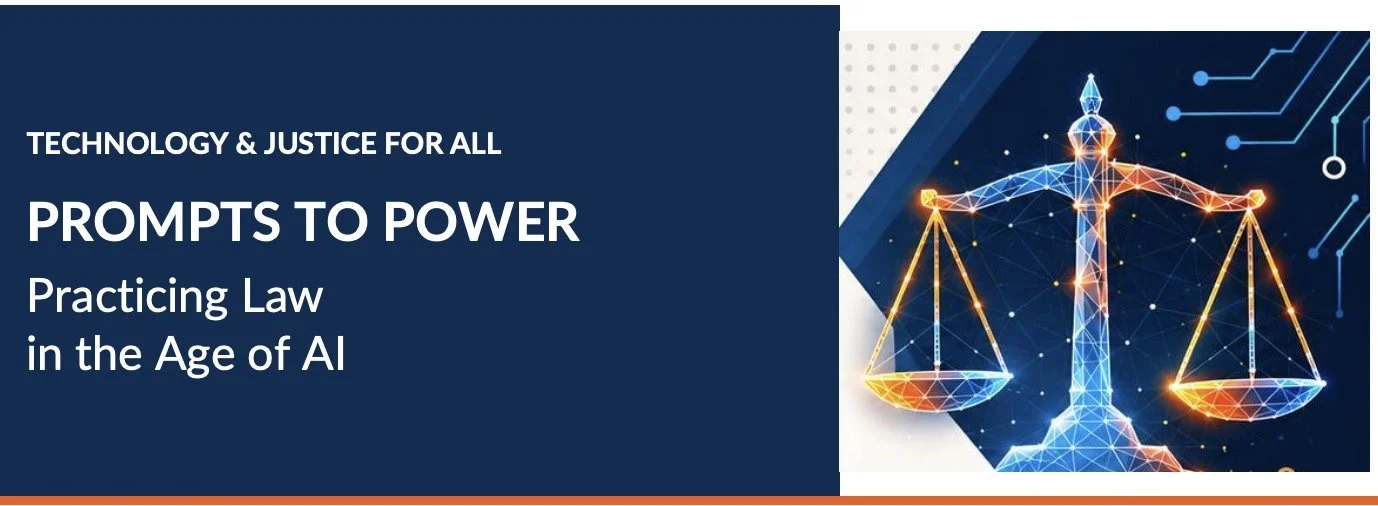
See You dec 4, 2026 at the State Bar of Texas Computer & Technology Section’s 10th Annual Technology & Justice for All CLE!
I’m heading to Austin to talk about private AI for lawyers at the State Bar of Texas Computer & Technology Section’s 10th Annual Technology & Justice for All CLE on December 4, 2026. I would love to see you there. My focus is practical: how lawyers can build, host, and run their own AI systems while addressing the ethical duties that come with them.
A conference built around actual practice 📅
This year’s theme is “Prompts to Power: Practicing Law in the Age of AI,” with attendance available in person or virtually. That is exactly the conversation I want our profession to have. Not another prediction about whether AI will change legal work. Let’s discuss which tools belong in our practices, what they require, and where we should draw boundaries.
The program covers AI licensing agreements, demonstrations of AI tools, privacy regulation, cybersecurity, practical adoption, and data-driven due diligence. It also includes a judicial panel with U.S. District Judge Xavier Rodriguez and Harris County Probate Court Judge Jerry Simoneaux, according to the agenda. I appreciate that combination. Technology decisions need perspective from the people drafting documents, managing information, and evaluating what reaches the courtroom.
My session, “Build it, Host it, Own it - Private AI for Texas Lawyers,” is scheduled for 1:30–2:00 p.m. under “Step 4: Applicable Legal Ethics.” Think of it as a practical conversation about taking greater control, not a computer science exam. Bring your questions about what a realistic setup would look like in your office.
Private AI for lawyers: control, not a compliance shortcut 🔒
By “build,” I mean assembling a usable system around an existing model, not training a new model from scratch. My goal is to connect the setup decisions to the professional decisions. What should the system access? Who should use it? What must someone check before an output becomes client work?
As I discuss in “MTC: Should Lawyers Host Their Own AI (or Hybrid AI)?”, self-hosting is not the right answer for every firm. A small practice should not take on infrastructure it cannot maintain responsibly. I want lawyers to leave with a way to compare local, cloud, and hybrid options, not a shopping list disguised as ethics advice.
We will consider a modest starting point: one approved task, a public or synthetic document,
The ethics belong in the setup ⚖️
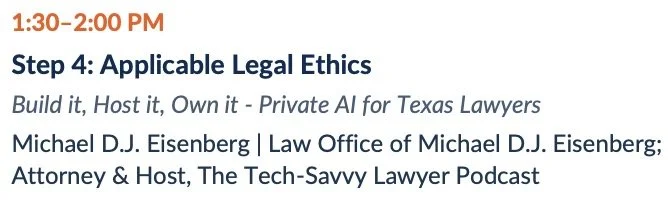
I’ll be speaking at 1:30 PM CDT at the 10th Annual Technology & Justice for All CLE
ABA Formal Opinion 512 connects generative AI use to existing professional duties, including competence, confidentiality, communication, supervision, candor, and reasonable fees. Texas Opinion 705 addresses corresponding obligations under Texas’s disciplinary rules. The ABA framework is useful guidance, not a substitute for the rules governing your practice.
Under Model Rule 1.1 and its technology comment, competence requires attention to relevant technology’s benefits and risks. For this session, I want to translate that into concrete questions: What does the model do well? Where does it fail? Can you recognize an answer that sounds convincing but is wrong?
Model Rule 1.6 requires reasonable efforts to prevent unauthorized disclosure or access to client information. My “HOW TO: How Lawyers Can Run a Private Local LLM on a Smartphone: A Practical, Ethical Guide” explores why local processing does not settle every privacy question. We will ask about backups, connected services, permissions, and retained information. The word “private” should begin your investigation, not end it.
Model Rules 5.1 and 5.3 make supervision part of the discussion, while Rule 3.3 addresses candor toward the tribunal. My recommendation: define who approves tools, who reviews results, and who handles problems. Opinion 512 also addresses client communication under Rule 1.4 and reasonable fees under Rule 1.5, including the prohibition on billing hourly clients for time not actually worked.
Join me in Austin or online 🤝

The program covers AI licensing agreements, demonstrations of AI tools, privacy regulation, cybersecurity, practical adoption, and data-driven due diligence.
The brochure lists UFCU Plaza Event Center, 8303 N MoPac Expy., Building C, first floor, Austin, as the in-person venue. It lists 6.75 MCLE hours, including 1.25 ethics hours, for the full program, not my session alone (program accreditation). That makes this an opportunity to connect practical learning with professional responsibility.
Registration is $160 for section members or $190 for nonmembers, including section membership, with the same rates for in-person and virtual attendance. Eligible legal aid providers, justice incubators, and current CTS Council members attend without charge, according to the brochure. Review the program and registration information to choose your attendance option.
Come with a workflow you want to improve and a question you have not resolved. Let’s make AI useful without treating our professional responsibilities as somebody else’s problem.