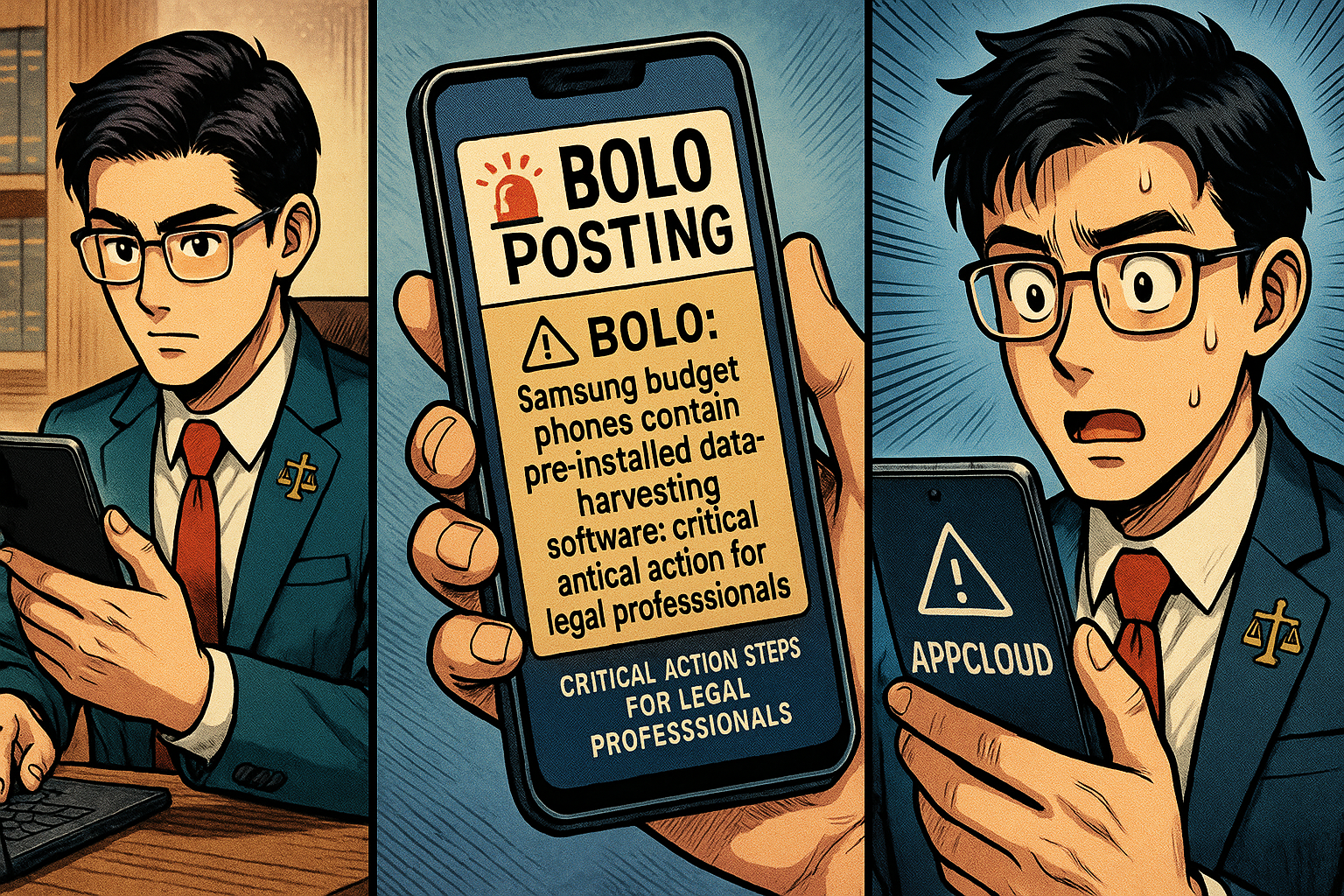
🚨 BOLO: Samsung Budget Phones Contain Pre-Installed Data-Harvesting Software: Critical Action Steps for Legal Professionals

‼️ ALERT: Hidden Spyware in Samsung Phones!

Samsung Galaxy A, M, and F series smartphones contain pre-installed software called AppCloud, developed by ironSource (now owned by Unity Technologies), that harvests user data, including location information, app usage patterns, IP addresses, and potentially biometric data. This software cannot be fully uninstalled without voiding your device warranty, and it operates without accessible privacy policies or explicit consent mechanisms. Legal professionals using these devices face significant risks to attorney-client privilege and confidential client information.

The Threat Landscape

AppCloud runs quietly in the background with permissions to access network connections, download files without notification, and prevent phones from sleeping. The application is deeply integrated into Samsung's One UI operating system, making it impossible to fully remove through standard methods. Users across West Asia, North Africa, Europe, and South Asia report that even after disabling the application, it reappears following system updates.

The digital rights organization SMEX documented that AppCloud's privacy policy is not accessible online, and the application does not present users with consent screens or terms of service disclosures. This lack of transparency raises serious ethical and legal compliance concerns, particularly for attorneys bound by professional responsibility rules regarding client confidentiality.

Legal and Ethical Implications for Attorneys

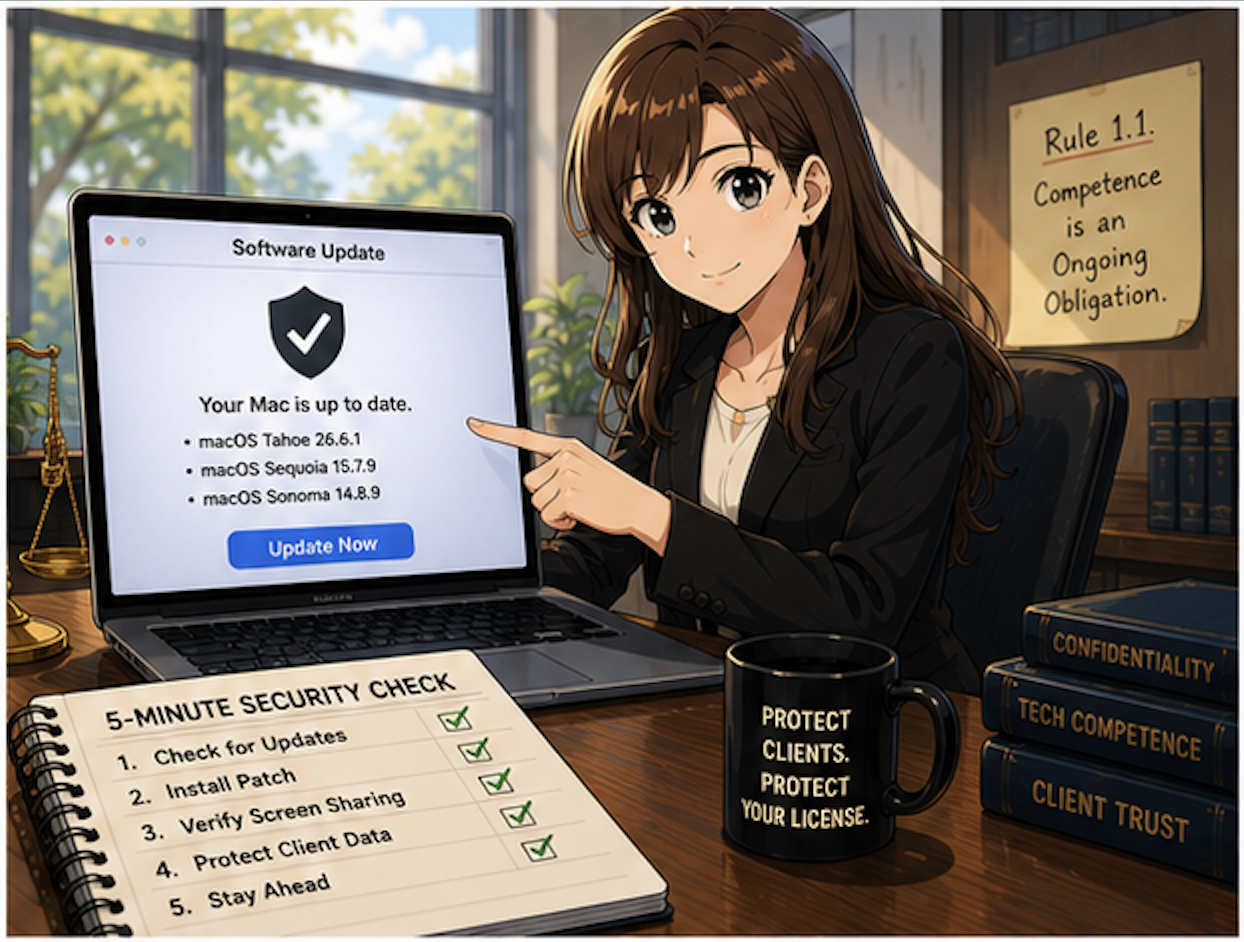
Under ABA Model Rule 1.6, attorneys must make "reasonable efforts to prevent the inadvertent or unauthorized disclosure of, or unauthorized access to, information relating to the representation of a client". The duty of technological competence under Rule 1.1, Comment 8, requires attorneys to "keep abreast of changes in the law and its practice, including the benefits and risks associated with relevant technology".

The New York Bar's 2022 ethics opinion specifically addresses smartphone security, prohibiting attorneys from sharing contact information with smartphone applications unless they can confirm that no person will view confidential client information and that data will not be transferred to third parties without client consent. AppCloud's data harvesting practices appear to violate both conditions.

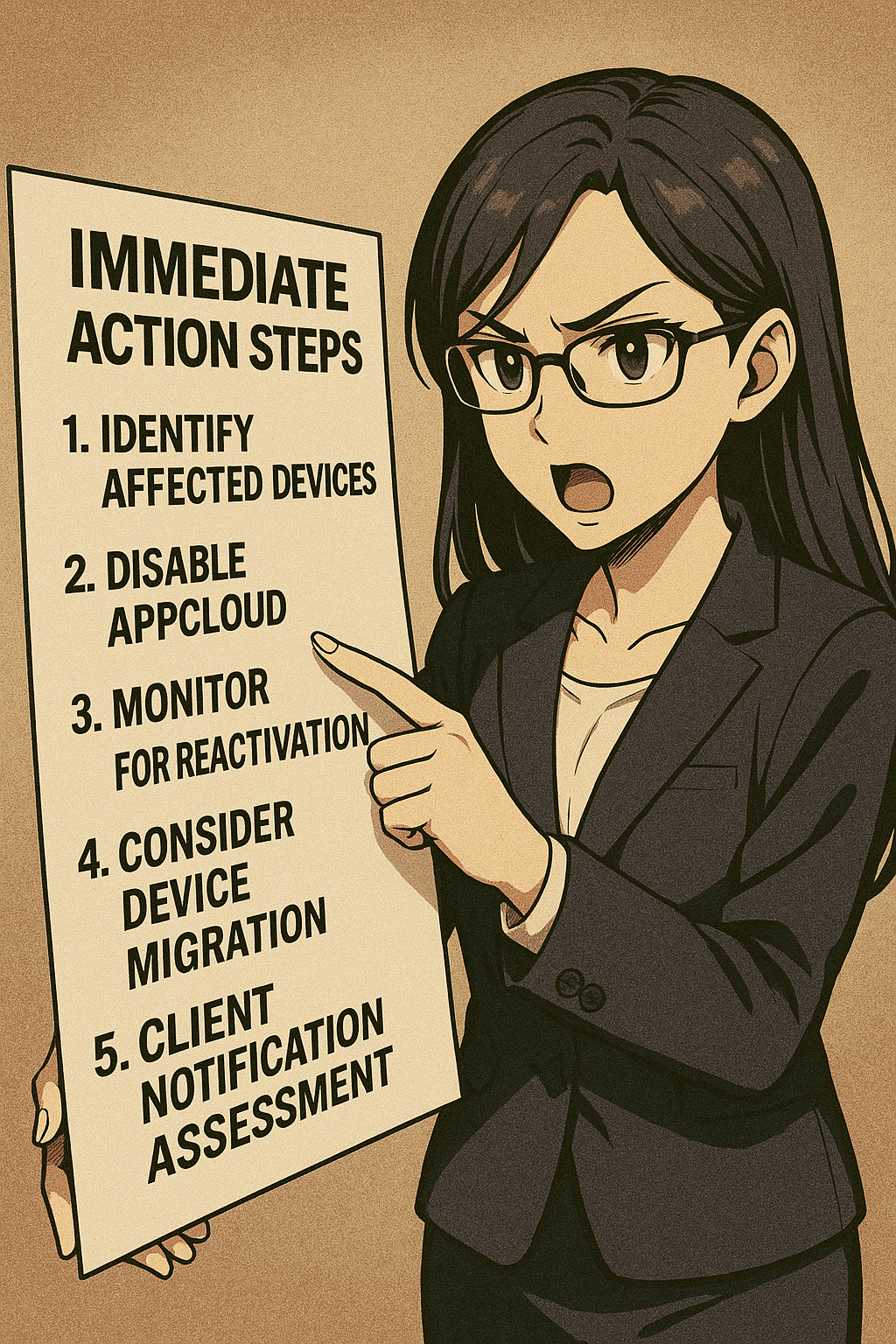
Immediate Action Steps

‼️ Act now if you’ve purchased certain samsung phones - your bar license could be in jeopardy!

Step 1: Identify Affected Devices
Check whether you use a Samsung Galaxy A series (A05 through A56), M series (M01 through M56), or F series device. These budget and mid-range models are primary targets for AppCloud installation.

Step 2: Disable AppCloud
Navigate to Settings > Apps > Show System Apps > AppCloud > Disable. Additionally, revoke notification permissions, restrict background data usage, and disable the "Install unknown apps" permission.

Step 3: Monitor for Reactivation
After system updates, return to AppCloud settings and re-disable the application.

Step 4: Consider Device Migration
For attorneys handling highly sensitive matters, consider transitioning to devices without pre-installed data collection software. Document your decision-making process as evidence of reasonable security measures.

Step 5: Client Notification Assessment
Evaluate whether client notification is required under your jurisdiction's professional responsibility rules. California's Formal Opinion 2020-203 addresses obligations following an electronic data compromise.

The Bottom Line

Budget smartphone economics should not compromise attorney-client privilege. Samsung's partnership with ironSource places aggressive advertising technology on devices used by legal professionals worldwide. Until Samsung provides transparent opt-out mechanisms or removes AppCloud entirely, attorneys using affected devices should implement immediate mitigation measures and document their security protocols.

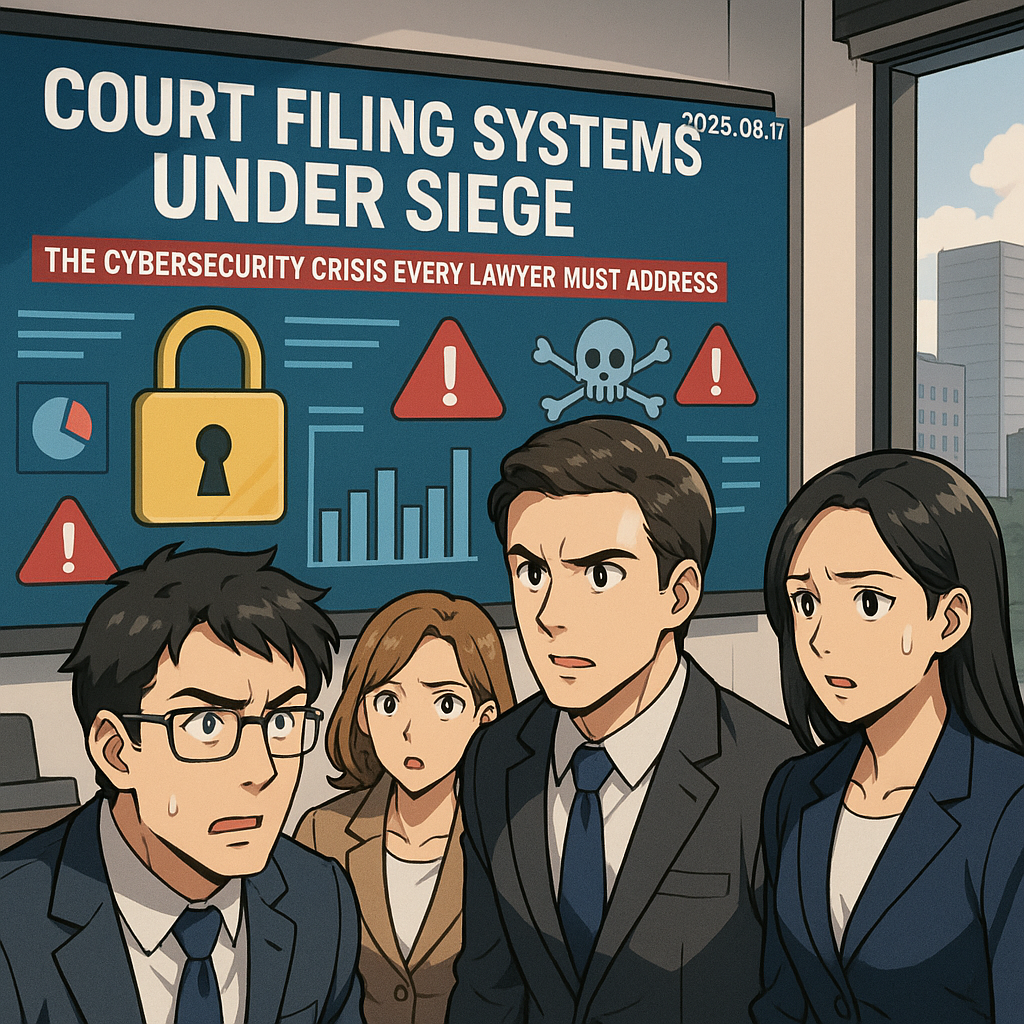
🧐 MTC/🚨 BOLO - Court Filing Systems Under Siege: The Cybersecurity Crisis Every Lawyer Must Address!

🔐 The Uncomfortable Truth About Court Filing Security 📊

Federal court filing systems are under attack! Are your client’s information protected?!

The federal judiciary's electronic case management system (CM/ECF) and PACER have been described as "unsustainable due to cyber risks". This isn't hyperbole – it's the official assessment from federal court officials who acknowledge that these systems, which legal professionals use daily for document uploads and case management, face "unrelenting security threats of extraordinary gravity".

Recent breaches have exposed sealed court documents, including confidential informant identities, arrest warrants, and national security information. Russian state-linked actors are suspected in these intrusions, which exploited security flaws that have been known since 2020. The attacks were described by one federal judiciary insider as being like "taking candy from a baby".

Human Error: The Persistent Vulnerability 🎯

Programs like #ILTACON2025’s "Anatomy of a Cyberattack" demonstrations that draw packed conference rooms highlight a critical truth: 50% of law firms now identify phishing as their top security threat, surpassing ransomware for the first time. This shift signals that cybercriminals have evolved from automated malware to sophisticated human-operated attacks that exploit our psychological weaknesses rather than just technical ones.

Consider these sobering statistics: 29% of law firms experienced security breaches in 2023, with 49% of data breaches involving stolen credentials. Most concerning is that only 58% of law firms provide regular cybersecurity training to employees, leaving the majority vulnerable to the very human errors that sophisticated attackers are designed to exploit.

What Lawyers Must Do Immediately 🛡️

Model rules require lawyers be aware of electronic court filing “insecurities”!

First, acknowledge that your court filings are not secure by default. The federal court system has implemented emergency procedures that require highly sensitive documents to be filed on paper or on secure devices, rather than through electronic systems. This should serve as a wake-up call about the vulnerabilities inherent in digital filing processes.

Second, implement multi-factor authentication everywhere. Despite its critical importance, 77% of law firms still don't use two-factor authentication. The federal courts only began requiring this basic security measure in May 2025 – decades after the technology became standard elsewhere.

Third, encrypt everything. Only half of law firms use file encryption, and just 40% employ email encryption. Given that legal professionals handle some of society's most sensitive information, these numbers represent a profound failure of professional responsibility.

Beyond Basic Defenses 🔍

Credential stuffing attacks exploit password reuse across platforms. When professionals use the same password for their court filing accounts and personal services, a breach anywhere becomes a breach everywhere. Implement unique, complex passwords for all systems, supported by password managers.

Cloud misconfiguration presents another critical vulnerability. Many law firms assume their technology providers have enabled security features by default, but the reality is that two-factor authentication and other protections often require explicit activation. Don't assume – verify and enable every available security feature.

Third-party vendor risks cannot be ignored. Only 35% of law firms have formal policies for managing vendor cybersecurity risks, yet these partnerships often provide attackers with indirect access to sensitive systems.

The Compliance Imperative 📋

The regulatory landscape is tightening rapidly. SEC rules now require public companies to disclose material cybersecurity incidents within four business days. While this doesn't directly apply to all law firms, it signals the direction of regulatory expectations. Client trust and professional liability exposure make cybersecurity failures increasingly expensive propositions.

Recent class-action lawsuits against law firms for inadequate data protection demonstrate that clients are no longer accepting security failures as inevitable business risks. The average cost of a legal industry data breach reached $7.13 million in 2020, making prevention significantly more cost-effective than remediation.

Final Thoughts: A Call to Professional Action ⚖️

Lawyers are a first-line defender of their client’s protected information.

The cybersecurity sessions are standing room only because lawyers are finally recognizing what cybersecurity professionals have known for years: the threat landscape has fundamentally changed. Nation-state actors, organized crime groups, and sophisticated cybercriminals view law firms as high-value targets containing treasure troves of confidential information.

The federal court system's acknowledgment that its filing systems require complete overhaul should prompt every legal professional to audit their own digital security practices. If the federal judiciary, with its vast resources and expertise, struggles with these challenges, individual practitioners and firms face even greater risks.

The legal profession's ethical obligations to protect client confidentiality extend into the digital realm. See ABA Model Rules 1.1, 1.1(8), and 1.6. This isn't about becoming cybersecurity experts – it's about implementing reasonable safeguards commensurate with the risks we face. When human error remains the biggest vulnerability, the solution lies in better training, stronger systems, and a cultural shift that treats cybersecurity as a core professional competency rather than an optional technical consideration.

The standing-room-only cybersecurity sessions reflect a profession in transition. The question isn't whether lawyers need to take cybersecurity seriously – recent breaches have answered that definitively. The question is whether we'll act before the next breach makes the decision for us. 🚨