MTC: Perplexity for Legal vs. Lexis, Westlaw, and vLex Fastcase: What Today's Lawyers Need to Know About Reliability, Cost, and Ethics

Tech-savvy lawyers need to HARNESs AI legal research tools!

If you practice law in 2026 and you're even mildly AI‑curious, you've probably seen the recent announcement of Perplexity for Legal, Perplexity's enterprise offering designed specifically for law firms and legal teams. 🧠 Now the field is more crowded than ever: Lexis+ AI/Protege, Westlaw Edge/Precision, and vLex Fastcase with Vincent AI are all vying for a place in your workflow—and Perplexity is asking a provocative new question: do you even need the legacy companies anymore? For solo and small‑to‑medium firm practitioners, the real question is simple. How does each of these platforms serve you in daily practice, and how do you choose responsibly?

What Perplexity for Legal Actually Offers

Perplexity's legal-focused enterprise product is built around its core strengths: fast, cited answers, deep multi‑source research, and the ability to connect to your firm's internal knowledge bases. You ask a question, see sources inline, and move from a synthesized answer directly into primary authority—or into firm work product—without hopping across multiple systems.

Highlighted use cases include:

  • Staying current on legal developments across jurisdictions in real time.

  • Generating client‑ready research memos faster.

  • Drafting pitch materials and Request for Proposal responses by pulling context from internal documents.

Firms like Gunderson Dettmer report using Perplexity Enterprise to scale legal research on rapidly evolving topics such as emerging company financings and technology transactions. 🚀 Latham & Watkins uses it for market intelligence and tactical research. For solos and small firms, the benefit is more pragmatic: less time wrestling with search syntax, more time actually thinking like a lawyer.

If you're a regular reader and listener of The Tech-Savvy Lawyer.Page blog and podcast, we discuss this type of workflow can enhance your firm's productivity effectively and safely.

Meet the Field: Lexis, Westlaw, and vLex Fastcase

Before we stack Perplexity against the competition, it helps to understand what each incumbent actually is today—because the landscape has shifted considerably.

Lexis+ AI layers generative AI on top of LexisNexis's curated legal content and the powerful Shepard's citator. Its AI features are bundled into subscriptions that can run from the low hundreds to several hundred dollars per user per month, depending on coverage tier. Pricing is often opaque and driven by long-term contract negotiation rather than transparent published rates—a persistent frustration for small firms.

Westlaw Edge/Precision integrates Thomson Reuters' generative AI capabilities directly into the Westlaw research ecosystem, pairing them with KeyCite and deep editorial enhancements. Like Lexis, its pricing sits at the premium end of the market, and it is best suited for firms that already rely heavily on Westlaw's proprietary citator and editorial content.

vLex Fastcase is the most democratically accessible of the three. After Fastcase merged with vLex in 2023 and vLex was subsequently acquired by Clio, the combined platform now serves over one million lawyers nationwide through partnerships with 80+ state, county, and specialty bar associations—often as a free member benefit. At the heart of its AI offering is Vincent, vLex's AI legal assistant, which handles research, drafting, document analysis, and customizable workflows through a feature called Vincent Studio for enterprise teams. The platform's Cert citator flags negative treatment and authority, replacing the older Bad Law Bot, while AI Case Analysis generates automated headnotes and summaries. For many solos and small-firm practitioners, vLex Fastcase is effectively free through their bar membership—making it arguably the highest-value entry point in the market.

If you are a member of the Florida Bar, California Lawyers Association, Illinois State Bar, or any of the dozens of other partnered associations, you likely already have access to vLex Fastcase Premium (a $995/year value) at no additional charge.

Reliability: Can You Trust These Platforms for Legal Research?

today’s lawyers need to evaluate AI legal platforms, pricing, and ethics.

Reliability is the first concern I hear from lawyers when AI enters the conversation—something we cover on The Tech-Savvy Lawyer.Page. No AI platform is infallible, but they fail in different ways.

Lexis+ AI and Westlaw AI answer from within their proprietary, editorially curated databases. Their hallucination risk is constrained by the quality of their content backbones, but they can still misinterpret authority, overgeneralize from a line of cases, or overlook nuances between jurisdictions.

vLex Fastcase/Vincent answers from vLex's global legal database—over one billion searchable documents across 100+ countries—supplemented by its AI‑powered analysis layer. Vincent has performed strongly in independent AI benchmarking, including the Vals Legal AI Report and a comparative AI evaluation by law librarians. Its Cert citator provides direct verification, making it more trustworthy for authority checking than pure generative systems.

Perplexity for Legal draws from a broad web‑scale index plus any internal data you connect through the enterprise deployment. Its core reliability strength is the inline citation on virtually every statement—you can trace each claim back to a source immediately. Its Deep Research feature structures multi‑step investigations into organized reports with full sourcing. The honest limitation: Perplexity does not have a built-in citator or a curated legal content backbone like KeyCite or Cert. For final authority verification, you still need to confirm via Westlaw, Lexis, vLex Fastcase's Cert, or a reliable citator—no exceptions.

For all four platforms, the universal rule applies: AI answers are drafts, not final work product. Read the cases. Check the citations. Verify the authority. 📋

Ethics: ABA Model Rules and AI Research

Using any AI tool in legal practice implicates several ABA Model Rules, and the analysis is the same whether you use Perplexity, Lexis+ AI, Westlaw, or vLex Fastcase:

Rule 1.1 (Competence). Comment 8 requires lawyers to understand the benefits and risks of relevant technology. This means knowing how each tool generates its answers, where it can fail, and how to verify its output. You cannot delegate judgment to any AI—Perplexity, Vincent, or otherwise.

Rule 1.6 (Confidentiality). Enterprise deployments of Perplexity are designed to isolate firm data and not train public models on your inputs. vLex Fastcase, operating within the Clio ecosystem, also maintains firm-level data controls. Regardless of which platform you use, you must confirm the contractual and technical safeguards before loading confidential client information. Never use a consumer-grade tool without verified protections.

Rule 5.3 (Responsibilities Regarding Non-Lawyer Assistance). AI is, functionally, a non-lawyer assistant. You must supervise its use, review its output, and ensure that the work product it generates meets your professional obligations. Vincent Studio's custom workflows are an interesting development in this regard—they allow firms to embed review and compliance steps directly into AI workflows, which supports Rule 5.3 compliance by design.

Rule 1.4 (Communication). If AI tools materially change how you handle matters—especially in flat-fee engagements—consider whether to disclose that to clients. Doing so can build trust and align expectations.

These obligations are vendor‑agnostic. The ABA Model Rules care about your conduct, not your software logo. ⚖️

💰 Cost and Access: The Solo and Small‑Firm Reality

For solos and small‑to‑medium firms, cost is where decisions often get made. A realistic comparison in 2026 looks like this:

  • Lexis+ AI: Bundled AI features run roughly $125–$275 per user per month at the low to mid-tier; enterprise tiers go significantly higher. Opaque pricing and long-term contracts are common complaints.

  • Westlaw Edge/Precision: Premium pricing in the hundreds of dollars per month per user, with AI features integrated at the top tiers. Best suited for firms already embedded in the Westlaw ecosystem.

  • vLex Fastcase: Free to bar association members for the core plan, with a retail value around $995 per year. Vincent AI premium features (50-state surveys, drafting tools) require a paid upgrade, but bar members often get discounted access. For many solos, this is already sitting in their inbox—they just haven't activated it.

  • Perplexity for Legal (Enterprise): Enterprise pricing is generally more transparent and leaner than full Lexis/Westlaw stacks. Exact per-seat pricing varies by deployment, but it is positioned as an accessible AI layer rather than an all-in-one legal publisher.

    💡 Tip: Solos and Small Firms, check out if the Enterprise Pro plan meets you needs - Perplexity Enterprise Pro runs a fraction of the cost of Lexis+ AI or Westlaw Precision—platforms that can run $125–$275 per user per month or more—making it one of the most cost-competitive AI research tools available to solo and small-firm practitioners today.

The practical calculus for solos and small firms:

  • If you already have Lexis or Westlaw, Perplexity can complement them for early-stage research, cross-domain intelligence, and drafting.

  • If you have vLex Fastcase through your bar, you already have a solid free primary law backbone with built-in AI. Pairing that with Perplexity Enterprise gives you AI synthesis capabilities across web-scale sources at a potentially lower total cost than upgrading to premium Lexis or Westlaw AI tiers.

  • If you are starting from scratch, the vLex Fastcase bar benefit plus a Perplexity Enterprise subscription may deliver more value per dollar than any single legacy vendor stack. 💸

That is not a recommendation to ditch Lexis or Westlaw wholesale—their curated content and citator infrastructure remain industry benchmarks. It is a recommendation to audit what you actually use and design a deliberate stack around it.

A Practical Framework for Choosing and Using These Tools

tech-savvy lawyers need to compare modern ai- vs legacy- legal research tools.

  • Keep Lexis/Westlaw if you heavily use KeyCite/Shepard's, proprietary treatises, or sophisticated editorial enhancements.

  • Activate vLex Fastcase through your bar if you haven't already—it's free for most practitioners and now includes genuine AI capabilities via Vincent.

  • Use Perplexity for Legal for early-stage issue spotting, multi-jurisdiction surveys, cross-domain research, and AI-assisted first drafts of memos and correspondence.

  • Anchor everything in the ABA Model Rules:

    • Competence: know how each tool works and where it fails.

    • Confidentiality: enterprise deployments only, with verified data protections.

    • Supervision: treat all AI output as a first draft to be reviewed and verified.

  • Write an internal AI use policy specifying which tools are authorized, for which tasks, and how outputs are verified and documented.

The question is never "Which one wins?" It's "How do I build a balanced, ethical, cost-conscious research stack that serves my clients well?" That's what it means to be a truly tech-savvy lawyer. 💼


ILTACON 2025: Legal AI Revolution Accelerates as Major Providers Unveil Next-Generation Platforms

Lexis, vlex, westlaw highlight their newest ai functions!

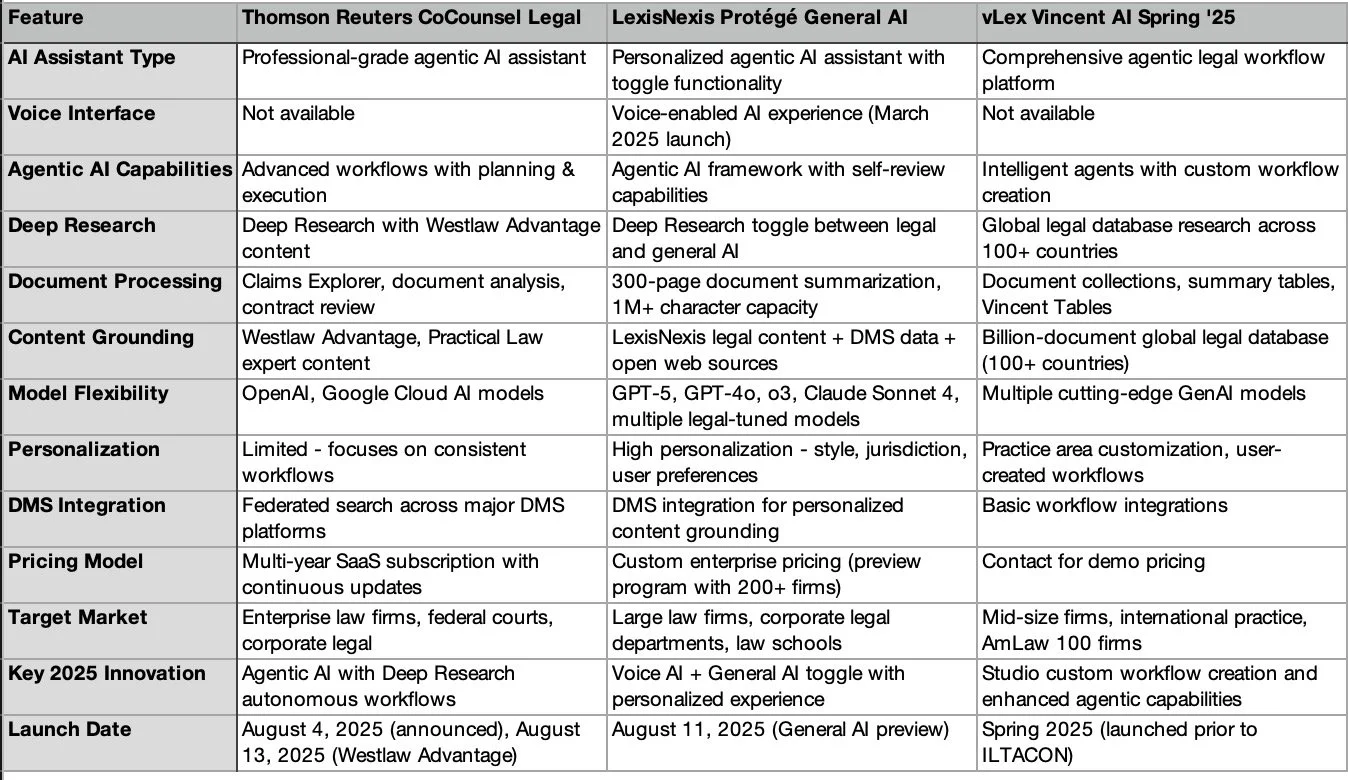
The International Legal Technology Association’s 2025 annual conference (#ILTACON2025) in the National Harbor just outside of Washington, DC, became the epicenter of legal AI innovation as Thomson Reuters, LexisNexis, and vLex/Fastcase showcased their most advanced artificial intelligence platforms. Each provider demonstrated distinct approaches to solving the legal profession's technology challenges, with announcements that signal a fundamental shift from experimental AI tools to enterprise-ready systems capable of autonomous legal workflows.

Thomson Reuters Launches CoCounsel Legal with Groundbreaking Deep Research

Thomson Reuters made headlines with the launch of CoCounsel Legal, featuring what the company positions as industry-leading Agentic AI capabilities. This launch represents a fundamental evolution from AI assistants that respond to prompts toward intelligent systems that can plan, reason, and execute complex multi-step workflows autonomously.

The platform's flagship innovation is Deep Research, an AI feature that conducts comprehensive legal research by leveraging Westlaw Advantage’s proprietary research tools and expert legal content. According to Thomson Reuters, CoCounsel Legal combines advanced generative models with the exclusive resources of Westlaw and Practical Law, aiming to deliver trusted, up-to-date, and relevant legal analysis for practitioners. The company emphasizes that its Agentic AI operates directly within Westlaw, making use of the platform’s curated research toolset and authoritative content to enhance accuracy and reliability in legal workflows.

Thomson Reuters Launches CoCounsel Legal with Groundbreaking Deep Research

Key capabilities include guided workflows for drafting privacy policies, employee policies, complaints, and discovery requests, with Thomson Reuters planning incremental releases of new workflows. The platform addresses the critical challenge of document management system integration through federated search technology, which leverages existing Document Management System (DMS) search systems while applying AI for re-ranking and summarization.

The company also introduced Westlaw Advantage on August 13, 2025, positioned as the final versioned release of Westlaw, with future improvements delivered through continuous updates rather than new license agreements. This shift to a traditional Software-as-a-Service (aka SaaS) delivery model includes multi-year subscriptions with automatic upgrades at no additional cost.

Thomson Reuters has invested $10 billion in transforming legal technology foundations, with over $200 million annually dedicated specifically to integrating AI into flagship products. The platform already serves over 20,000 law firms and corporate legal departments, including the majority of AmLaw 100 firms.

LexisNexis Introduces Protégé General AI with Industry-First Voice Capabilities

LexisNexis announced on August 11, 2025, the preview launch of Protégé General AI, expanding its personalized AI assistant to include secure access to general-purpose AI models alongside legal-specific tools. This development builds on the company's March 2025 launch of the legal industry's first voice-enabled AI assistant for complex legal work. This voice feature allows users to interact naturally with the platform, guiding legal research and drafting by issuing spoken requests. The tool is designed to help legal practitioners streamline routine workflows, surface key insights, and perform drafting and search tasks hands-free, all within a secure and integrated environment.

LexisNexis Introduces Protégé General AI with Industry-First Voice Capabilities

Protégé's key differentiator lies in its toggle functionality, allowing users to switch between authoritative legal AI (grounded in LexisNexis content) and general-purpose AI models including GPT-5*, GPT-4o, GPT-o3, and Claude Sonnet 4. This eliminates the need to switch between different AI tools while maintaining enterprise-grade security.

The platform processes documents up to 300 pages long (a 250% increase over previous limits) and offers unprecedented personalization capabilities. It learns individual user workflows, preferences, writing styles, and jurisdictions to deliver customized responses. The system integrates with document management systems to ground responses in firm-specific knowledge while maintaining strict security controls.

Approximately 200 law firms, corporate legal departments, and law schools are participating in the customer preview program, with general availability expected later in 2025.

vLex Showcases Vincent AI Spring '25 with Studio Workflow Creation

vLex presented its Vincent AI Spring '25 Release at ILTACON 2025, highlighting enhanced agentic capabilities and the introduction of Studio, a platform allowing users to create custom workflows without coding. The company emphasized its data-centric approach, leveraging its billion-document global legal database spanning over 100 countries.

vLex Showcases Vincent AI Spring '25 with Studio Workflow Creation

vLex’s Spring ’25 release also emphasizes its Vincent Tables feature, which allows users to extract and compare key data points across large sets of documents and generate structured outputs like memos. Their General Assist capability supports drafting tasks—such as composing emails and summarizing meeting notes—within Vincent’s secure, enterprise-grade environment. Overall, vLex positions Vincent AI as a comprehensive workflow platform that delivers consistent, authoritative legal insights powered by a global database of over one billion documents from more than 100 jurisdictions.

During ILTACON, vLex also announced the 2025 Fastcase 50 awards, recognizing legal innovation leaders who are "engineering the future of legal practice". The company positioned itself as serving the "engineering minds and visionary leaders driving the legal profession's transformation".

🔎 Feature Comparison: How the Big Three Actually Stack Up

Market Positioning and Strategic Differentiation

The three providers have established distinct market positions based on their 2025 announcements. Thomson Reuters targets enterprise-level implementations, evidenced by multi-year contracts with the U.S. Federal Courts system, including the U.S. Supreme Court, and a focus on consistent, reliable workflows for large-scale legal operations.

LexisNexis emphasizes user experience and personalization, with Protégé designed to understand individual lawyer preferences and adapt to different work styles. The voice interface represents a significant advancement in accessibility and usability, particularly valuable for lawyers with physical accessibility needs or those who prefer natural language interaction.

vLex positions itself as serving both mid-size firms and AmLaw 100 practices, emphasizing comprehensive workflow solutions and global legal coverage. The Studio platform addresses the growing demand for customizable AI workflows tailored to specific practice requirements.

Final Thoughts: Industry Impact and Measurable Results

ILTACON was a great experience - I learned and hope to share a lot!

These ILTACON 2025 announcements demonstrate the maturation of legal AI from experimental tools to platforms delivering measurable business value. Case studies reveal significant cost savings, with startups like OMNIUX reporting monthly savings of $15,000 to $20,000 in legal fees using CoCounsel.

Independent analysis shows that contract review tasks, which previously required two to two and a half hours, can now be completed in 10 minutes, representing productivity improvements of over 90%. Legal professionals report that document analysis tasks requiring days of manual work can now be completed in under an hour.

The competitive landscape now features three mature approaches: Thomson Reuters' enterprise-focused agentic workflows with deep legal research integration, LexisNexis's personalized voice-enabled AI with comprehensive model flexibility, and vLex's comprehensive workflow platform with global legal intelligence.

As legal professionals evaluate these platforms, selection criteria should include firm size, practice areas, existing technology infrastructure, required customization levels, and specific workflow requirements. The legal profession's digital transformation has clearly accelerated beyond the experimental phase, with AI becoming essential infrastructure for competitive legal practice.

But what does this mean for the solo, small-, and medium-size law forms? Stay Tuned as my analysis on that will be posted soon!

Happy Lawyering!

* (Note, the original launch was supposed to include GPT-5 but it has been pulled pending resolution of issues in its program - see MTC: Why "Newer" AI Models Aren't Always Better: The ChatGPT-5 and Apple Intelligence Reality Check for Legal Professionals! for reference).

MTC: AI and Legal Research: The Existential Threat to Lexis, Westlaw, and Fastcase.

How does this ruling for anthropic change the business models legal information providers operate under?

MTC: The legal profession faces unprecedented disruption as artificial intelligence reshapes how attorneys access and analyze legal information. A landmark federal ruling combined with mounting evidence of AI's devastating impact on content providers signals an existential crisis for traditional legal databases.

The Anthropic Breakthrough

Judge William Alsup's June 25, 2025 ruling in Bartz v. Anthropic fundamentally changed the AI landscape. The court found that training large language models on legally acquired copyrighted books constitutes "exceedingly transformative" fair use under copyright law. This decision provides crucial legal clarity for AI companies, effectively creating a roadmap for developing sophisticated legal AI tools using legitimately purchased content.

The ruling draws a clear distinction: while training on legally acquired materials is permissible, downloading pirated content remains copyright infringement. This clarity removes a significant barrier that had constrained AI development in the legal sector.

Google's AI Devastates Publishers: A Warning for Legal Databases

The news industry's experience with Google's AI features provides a sobering preview of what awaits legal databases. Traffic to the world's 500 most visited publishers has plummeted 27% year-over-year since February 2024, losing an average of 64 million visits per month. Google's AI Overviews and AI Mode have created what industry experts call "zero-click searches," where users receive information without visiting original sources.

The New York Times saw its share of organic search traffic fall from 44% in 2022 to just 36.5% in April 2025. Business Insider experienced devastating 55% traffic declines and subsequently laid off 21% of its workforce. Major outlets like HuffPost and The Washington Post have lost more than half their search traffic.

This pattern directly threatens legal databases operating on similar information-access models. If AI tools can synthesize legal information from multiple sources without requiring expensive database subscriptions, the fundamental value proposition of Lexis, WestLaw, and Fastcase erodes dramatically.

The Rise of Vincent AI and Legal Database Alternatives

The threat is no longer theoretical. Vincent AI, integrated into vLex Fastcase, represents the emergence of sophisticated legal AI that challenges traditional database dominance. The platform offers comprehensive legal research across 50 states and 17 countries, with capabilities including contract analysis, argument building, and multi-jurisdictional comparisons—all often available free through bar association memberships.

Vincent AI recently won the 2024 New Product Award from the American Association of Law Libraries. The platform leverages vLex's database of over one billion legal documents, providing multimodal capabilities that can analyze audio and video files while generating transcripts of court proceedings. Unlike traditional databases that added AI as supplementary features, Vincent AI integrates artificial intelligence throughout its core functionality.

Stanford University studies reveal the current performance gaps: Lexis+ AI achieved 65% accuracy with 17% hallucination rates, while Westlaw's AI-Assisted Research managed only 42% accuracy with 33% hallucination rates. However, AI systems improve rapidly, and these quality gaps are narrowing.

Economic Pressures Intensify

Can traditional legal resources protect their proprietary information from AI?

Goldman Sachs research indicates 44% of legal work could be automated by emerging AI tools, targeting exactly the functions that justify expensive database subscriptions. The legal research market, worth $68 billion globally, faces dramatic cost disruption as AI platforms provide similar capabilities at fractions of traditional pricing.

The democratization effect is already visible. Vincent AI's availability through over 80 bar associations provides enterprise-level capabilities to solo practitioners and small firms previously unable to afford comprehensive legal research tools. This accessibility threatens the pricing power that has sustained traditional legal database business models.

The Information Ecosystem Transformation

The parallel between news publishers and legal databases extends beyond surface similarities. Both industries built their success on controlling access to information and charging premium prices for that access. AI fundamentally challenges this model by providing synthesized information that reduces the need to visit original sources.

AI chatbots have provided only 5.5 million additional referrals per month to publishers, a fraction of the 64 million monthly visits lost to AI-powered search features. This stark imbalance demonstrates that AI tools are net destroyers of traffic to content providers—a dynamic that threatens any business model dependent on information access.

Publishers describe feeling "betrayed" by Google's shift toward AI-powered search results that keep users within Google's ecosystem rather than sending them to external sites. Legal databases face identical risks as AI tools become more capable of providing comprehensive legal analysis without requiring expensive subscriptions.

Quality and Professional Responsibility Challenges

Despite AI's advancing capabilities, significant concerns remain around accuracy and professional responsibility. Legal practice demands extremely high reliability standards, and current AI tools still produce errors that could have serious professional consequences. Several high-profile cases involving lawyers submitting AI-generated briefs with fabricated case citations have heightened awareness of these risks.

However, platforms like Vincent AI address many concerns through transparent citation practices and hybrid AI pipelines that combine generative and rules-based AI to increase reliability. The platform provides direct links to primary legal sources and employs expert legal editors to track judicial treatment and citations.

Adaptation Strategies and Market Response

Is AI the beginning for the end of Traditional legal resources?

Traditional legal database providers have begun integrating AI capabilities, but this strategy faces inherent limitations. By incorporating AI into existing platforms, these companies risk commoditizing their own products. If AI can provide similar insights using publicly available information, proprietary databases lose their exclusivity advantage regardless of AI integration.

The more fundamental challenge is that AI's disruptive potential extends beyond individual products to entire business models. The emergence of comprehensive AI platforms like Vincent AI demonstrates this disruption is already underway and accelerating.

Looking Forward: Scenarios and Implications

Several scenarios could emerge from this convergence of technological and economic pressures. Traditional databases might successfully maintain market position through superior curation and reliability, though the news industry's experience suggests this is challenging without fundamental business model changes.

Alternatively, AI-powered platforms could continue gaining market share by providing comparable functionality at significantly lower costs, forcing traditional providers to dramatically reduce prices or lose market share. The rapid adoption of vLex Fastcase by bar associations suggests this disruption is already underway.

A hybrid market might develop where different tools serve different needs, though economic pressures favor comprehensive, cost-effective solutions over specialized, expensive ones.

Preparing for Transformation

The confluence of the Anthropic ruling, advancing AI capabilities, evidence from news industry disruption, and sophisticated legal AI platforms creates a perfect storm for the legal information industry. Legal professionals must develop AI literacy while implementing robust quality control processes and maintaining ethical obligations.

For legal database providers, the challenge is existential. The news industry's experience shows traffic declines of 50% or more would be catastrophic for subscription-dependent businesses. The rapid development of comprehensive AI legal research platforms suggests this disruption may occur faster than traditional providers anticipate.

The legal profession's relationship with information is fundamentally changing. The Anthropic ruling removed barriers to AI development, news industry data shows the potential scale of disruption, and platforms like Vincent AI demonstrate achievable sophistication. The race is now on to determine who will control the future of legal information access.

MTC