
MTC: Perplexity for Legal vs. Lexis, Westlaw, and vLex Fastcase: What Today's Lawyers Need to Know About Reliability, Cost, and Ethics
/
Tech-savvy lawyers need to HARNESs AI legal research tools!
If you practice law in 2026 and you're even mildly AI‑curious, you've probably seen the recent announcement of Perplexity for Legal, Perplexity's enterprise offering designed specifically for law firms and legal teams. 🧠 Now the field is more crowded than ever: Lexis+ AI/Protege, Westlaw Edge/Precision, and vLex Fastcase with Vincent AI are all vying for a place in your workflow—and Perplexity is asking a provocative new question: do you even need the legacy companies anymore? For solo and small‑to‑medium firm practitioners, the real question is simple. How does each of these platforms serve you in daily practice, and how do you choose responsibly?
What Perplexity for Legal Actually Offers
Perplexity's legal-focused enterprise product is built around its core strengths: fast, cited answers, deep multi‑source research, and the ability to connect to your firm's internal knowledge bases. You ask a question, see sources inline, and move from a synthesized answer directly into primary authority—or into firm work product—without hopping across multiple systems.
Highlighted use cases include:
Staying current on legal developments across jurisdictions in real time.
Generating client‑ready research memos faster.
Drafting pitch materials and Request for Proposal responses by pulling context from internal documents.
Firms like Gunderson Dettmer report using Perplexity Enterprise to scale legal research on rapidly evolving topics such as emerging company financings and technology transactions. 🚀 Latham & Watkins uses it for market intelligence and tactical research. For solos and small firms, the benefit is more pragmatic: less time wrestling with search syntax, more time actually thinking like a lawyer.
If you're a regular reader and listener of The Tech-Savvy Lawyer.Page blog and podcast, we discuss this type of workflow can enhance your firm's productivity effectively and safely.
Meet the Field: Lexis, Westlaw, and vLex Fastcase
Before we stack Perplexity against the competition, it helps to understand what each incumbent actually is today—because the landscape has shifted considerably.
Lexis+ AI layers generative AI on top of LexisNexis's curated legal content and the powerful Shepard's citator. Its AI features are bundled into subscriptions that can run from the low hundreds to several hundred dollars per user per month, depending on coverage tier. Pricing is often opaque and driven by long-term contract negotiation rather than transparent published rates—a persistent frustration for small firms.
Westlaw Edge/Precision integrates Thomson Reuters' generative AI capabilities directly into the Westlaw research ecosystem, pairing them with KeyCite and deep editorial enhancements. Like Lexis, its pricing sits at the premium end of the market, and it is best suited for firms that already rely heavily on Westlaw's proprietary citator and editorial content.
vLex Fastcase is the most democratically accessible of the three. After Fastcase merged with vLex in 2023 and vLex was subsequently acquired by Clio, the combined platform now serves over one million lawyers nationwide through partnerships with 80+ state, county, and specialty bar associations—often as a free member benefit. At the heart of its AI offering is Vincent, vLex's AI legal assistant, which handles research, drafting, document analysis, and customizable workflows through a feature called Vincent Studio for enterprise teams. The platform's Cert citator flags negative treatment and authority, replacing the older Bad Law Bot, while AI Case Analysis generates automated headnotes and summaries. For many solos and small-firm practitioners, vLex Fastcase is effectively free through their bar membership—making it arguably the highest-value entry point in the market.
If you are a member of the Florida Bar, California Lawyers Association, Illinois State Bar, or any of the dozens of other partnered associations, you likely already have access to vLex Fastcase Premium (a $995/year value) at no additional charge.
Reliability: Can You Trust These Platforms for Legal Research?

today’s lawyers need to evaluate AI legal platforms, pricing, and ethics.
Reliability is the first concern I hear from lawyers when AI enters the conversation—something we cover on The Tech-Savvy Lawyer.Page. No AI platform is infallible, but they fail in different ways.
Lexis+ AI and Westlaw AI answer from within their proprietary, editorially curated databases. Their hallucination risk is constrained by the quality of their content backbones, but they can still misinterpret authority, overgeneralize from a line of cases, or overlook nuances between jurisdictions.
vLex Fastcase/Vincent answers from vLex's global legal database—over one billion searchable documents across 100+ countries—supplemented by its AI‑powered analysis layer. Vincent has performed strongly in independent AI benchmarking, including the Vals Legal AI Report and a comparative AI evaluation by law librarians. Its Cert citator provides direct verification, making it more trustworthy for authority checking than pure generative systems.
Perplexity for Legal draws from a broad web‑scale index plus any internal data you connect through the enterprise deployment. Its core reliability strength is the inline citation on virtually every statement—you can trace each claim back to a source immediately. Its Deep Research feature structures multi‑step investigations into organized reports with full sourcing. The honest limitation: Perplexity does not have a built-in citator or a curated legal content backbone like KeyCite or Cert. For final authority verification, you still need to confirm via Westlaw, Lexis, vLex Fastcase's Cert, or a reliable citator—no exceptions.
For all four platforms, the universal rule applies: AI answers are drafts, not final work product. Read the cases. Check the citations. Verify the authority. 📋
Ethics: ABA Model Rules and AI Research
Using any AI tool in legal practice implicates several ABA Model Rules, and the analysis is the same whether you use Perplexity, Lexis+ AI, Westlaw, or vLex Fastcase:
Rule 1.1 (Competence). Comment 8 requires lawyers to understand the benefits and risks of relevant technology. This means knowing how each tool generates its answers, where it can fail, and how to verify its output. You cannot delegate judgment to any AI—Perplexity, Vincent, or otherwise.
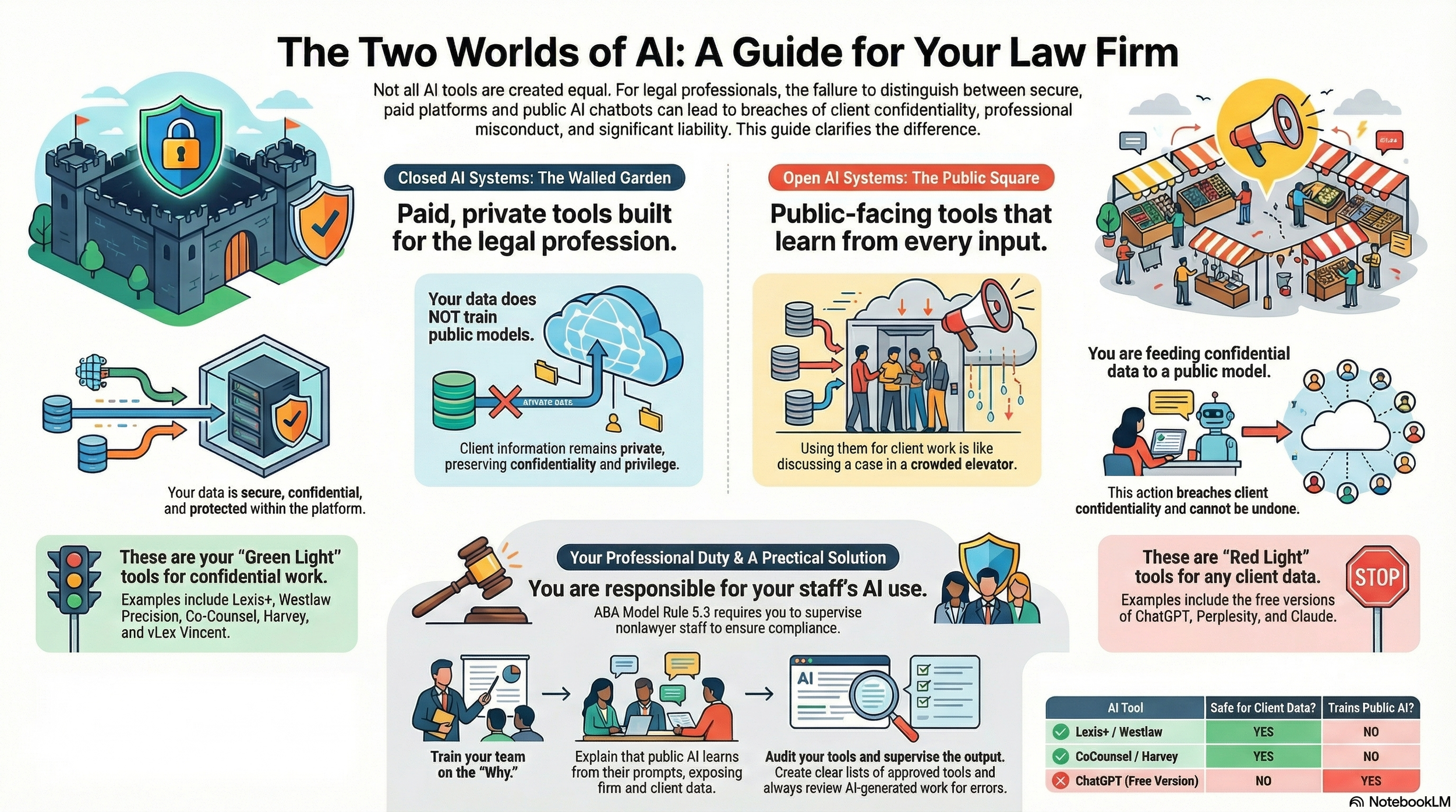
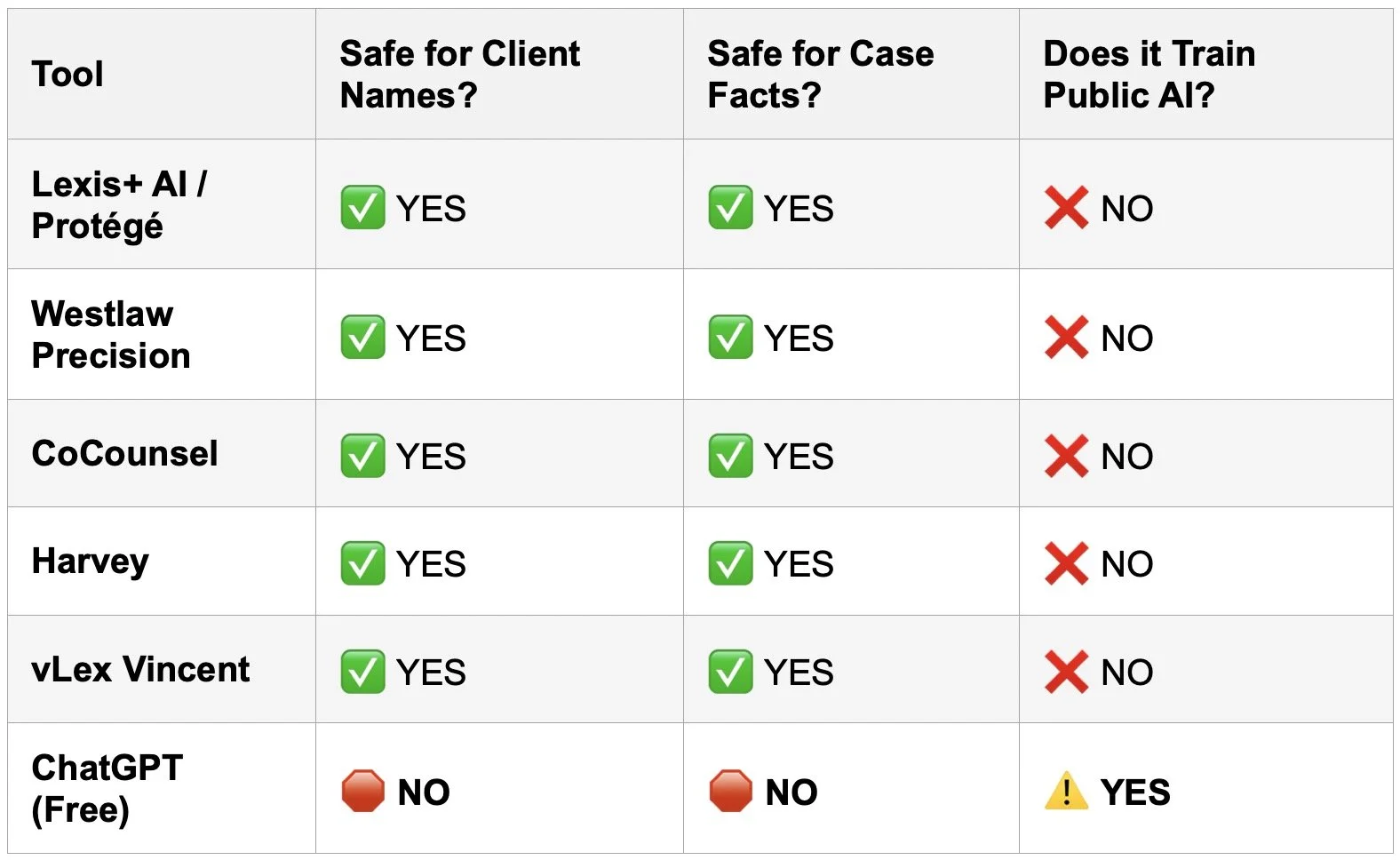
Rule 1.6 (Confidentiality). Enterprise deployments of Perplexity are designed to isolate firm data and not train public models on your inputs. vLex Fastcase, operating within the Clio ecosystem, also maintains firm-level data controls. Regardless of which platform you use, you must confirm the contractual and technical safeguards before loading confidential client information. Never use a consumer-grade tool without verified protections.
Rule 5.3 (Responsibilities Regarding Non-Lawyer Assistance). AI is, functionally, a non-lawyer assistant. You must supervise its use, review its output, and ensure that the work product it generates meets your professional obligations. Vincent Studio's custom workflows are an interesting development in this regard—they allow firms to embed review and compliance steps directly into AI workflows, which supports Rule 5.3 compliance by design.
Rule 1.4 (Communication). If AI tools materially change how you handle matters—especially in flat-fee engagements—consider whether to disclose that to clients. Doing so can build trust and align expectations.
These obligations are vendor‑agnostic. The ABA Model Rules care about your conduct, not your software logo. ⚖️
💰 Cost and Access: The Solo and Small‑Firm Reality
For solos and small‑to‑medium firms, cost is where decisions often get made. A realistic comparison in 2026 looks like this:
Lexis+ AI: Bundled AI features run roughly $125–$275 per user per month at the low to mid-tier; enterprise tiers go significantly higher. Opaque pricing and long-term contracts are common complaints.
Westlaw Edge/Precision: Premium pricing in the hundreds of dollars per month per user, with AI features integrated at the top tiers. Best suited for firms already embedded in the Westlaw ecosystem.
vLex Fastcase: Free to bar association members for the core plan, with a retail value around $995 per year. Vincent AI premium features (50-state surveys, drafting tools) require a paid upgrade, but bar members often get discounted access. For many solos, this is already sitting in their inbox—they just haven't activated it.
Perplexity for Legal (Enterprise): Enterprise pricing is generally more transparent and leaner than full Lexis/Westlaw stacks. Exact per-seat pricing varies by deployment, but it is positioned as an accessible AI layer rather than an all-in-one legal publisher.
💡 Tip: Solos and Small Firms, check out if the Enterprise Pro plan meets you needs - Perplexity Enterprise Pro runs a fraction of the cost of Lexis+ AI or Westlaw Precision—platforms that can run $125–$275 per user per month or more—making it one of the most cost-competitive AI research tools available to solo and small-firm practitioners today.
The practical calculus for solos and small firms:
If you already have Lexis or Westlaw, Perplexity can complement them for early-stage research, cross-domain intelligence, and drafting.
If you have vLex Fastcase through your bar, you already have a solid free primary law backbone with built-in AI. Pairing that with Perplexity Enterprise gives you AI synthesis capabilities across web-scale sources at a potentially lower total cost than upgrading to premium Lexis or Westlaw AI tiers.
If you are starting from scratch, the vLex Fastcase bar benefit plus a Perplexity Enterprise subscription may deliver more value per dollar than any single legacy vendor stack. 💸
That is not a recommendation to ditch Lexis or Westlaw wholesale—their curated content and citator infrastructure remain industry benchmarks. It is a recommendation to audit what you actually use and design a deliberate stack around it.
A Practical Framework for Choosing and Using These Tools

tech-savvy lawyers need to compare modern ai- vs legacy- legal research tools.
Keep Lexis/Westlaw if you heavily use KeyCite/Shepard's, proprietary treatises, or sophisticated editorial enhancements.
Activate vLex Fastcase through your bar if you haven't already—it's free for most practitioners and now includes genuine AI capabilities via Vincent.
Use Perplexity for Legal for early-stage issue spotting, multi-jurisdiction surveys, cross-domain research, and AI-assisted first drafts of memos and correspondence.
Anchor everything in the ABA Model Rules:
Competence: know how each tool works and where it fails.
Confidentiality: enterprise deployments only, with verified data protections.
Supervision: treat all AI output as a first draft to be reviewed and verified.
Write an internal AI use policy specifying which tools are authorized, for which tasks, and how outputs are verified and documented.
The question is never "Which one wins?" It's "How do I build a balanced, ethical, cost-conscious research stack that serves my clients well?" That's what it means to be a truly tech-savvy lawyer. 💼