MTC: 2025 Year in Review: The "AI Squeeze," Redaction Disasters, and the Return of Hardware!

As we close the book on 2025, the legal profession finds itself in a dramatically different landscape than the one we predicted back in January. If 2023 was the year of "AI Hype" and 2024 was the year of "AI Experimentation," 2025 has undeniably been the year of the "AI Reality Check."

Here at The Tech-Savvy Lawyer.Page, we have spent the last twelve months documenting the friction between rapid innovation and the stubborn realities of legal practice. From our podcast conversations with industry leaders like Seth Price and Chris Dralla to our deep dives into the ethics of digital practice, one theme has remained constant: Competence is no longer optional; it is survival.

Looking back at our coverage from this past year, three specific highlights stand out as defining moments for legal technology in 2025. These aren't just news items; they are signals of where our profession is heading.

Highlight #1: The "Black Box" Redaction Wake-Up Call

Just days ago, on December 23, 2025, the legal world learned of a catastrophic failure of basic technological competence. As we covered in our recent post, How To: Redact PDF Documents Properly and Recover Data from Failed Redactions: A Guide for Lawyers After the DOJ Epstein Files Release “Leak”, the Department of Justice’s release of the Jeffrey Epstein files became a case study in what not to do.

The failure was simple but devastating: relying on visual "masks" rather than true data sanitization. Tech-savvy readers—and let’s be honest, anyone with a basic knowledge of copy-paste—were able to lift the "redacted" names of associates and victims directly from the PDF.

Why this matters for you: This event shattered the illusion that "good enough" tech skills are acceptable in high-stakes litigation. In 2025, we learned that the duty of confidentiality (Model Rule 1.6) is inextricably linked to the duty of technical competence (Model Rule 1.1 and its Comment 8). As we move into 2026, firms must move beyond basic PDF tools and invest in purpose-built redaction software that "burns in" changes and scrubs metadata. If the DOJ can fail this publicly, your firm is not immune.

Highlight #2: The "AI Squeeze" on Hardware

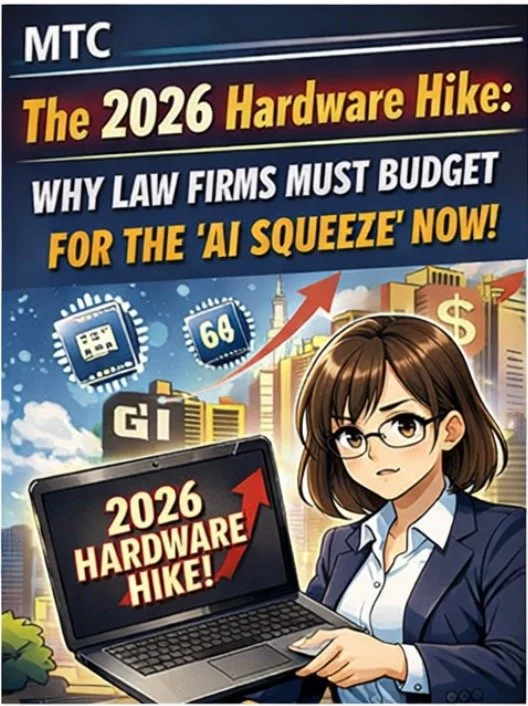
Throughout the year, we’ve heard complaints about sluggish laptops and crashing applications. In our December 22nd post, The 2026 Hardware Hike: Why Law Firms Must Budget for the 'AI Squeeze' Now, we identified the culprit. It isn’t just your imagination—it’s the supply chain.

We are currently facing a global shortage of DRAM (Dynamic Random Access Memory), driven by the insatiable appetite of data centers powering the very AI models we use daily. Manufacturers like Dell and Lenovo are pivoting their supply to these high-profit enterprise clients, leaving consumer and business laptops with a supply deficit.

Why this matters for you: The era of the 16GB RAM laptop for lawyers is dead. Running local, privacy-focused AI models (a major trend in 2025) and heavy eDiscovery platforms now requires 32GB or even 64GB of RAM as a baseline (which means you may want more than the “baseline”). The "AI Squeeze" means that in 2026, hardware will be 15-20% more expensive and harder to find. The lesson? Buy now. If your firm has a hardware refresh cycle planned for Q2 2026, accelerate it to Q1. Budgeting for technology is no longer just about software subscriptions; it’s about securing the physical silicon needed to do your job.

Highlight #3: From "Chat" to "Doing" (The Rise of Agentic AI)

Earlier this year, on the Tech-Savvy Lawyer Podcast, we spoke with Chris Dralla of TypeLaw and discussed the evolution of AI tools. 2025 marked the shift from "Chatbot AI" (asking a bot a question) to "Agentic AI" (telling a bot to do a job).

Tools like TypeLaw didn't just "summarize" cases this year; they actively formatted briefs, checked citations against local court rules, and built tables of authorities with minimal human intervention. This is the "boring" automation we have always advocated for—technology that doesn't try to be a robot lawyer, but acts as a tireless paralegal.

Why this matters for you: The novelty of chatting with an LLM has worn off. The firms winning in 2025 were the ones adopting tools that integrated directly into Microsoft Word and Outlook to automate specific, repetitive workflows. The "Generalist AI" is being replaced by the "Specialist Agent."

Moving Forward: What We Can Learn Today for 2026

As we look toward the new year, the profession must internalize a critical lesson: Technology is a supply chain risk.

Whether it is the supply of affordable memory chips or the supply of secure software that properly handles redactions, you are dependent on your tools. The "Tech-Savvy" lawyer of 2026 is not just a user of technology but a manager of technology risk.

What to Expect in 2026:

Is your firm budgeted for the anticipated 2026 hardware price hike?

  1. The Rise of the "Hybrid Builder": I predict that mid-sized firms will stop waiting for vendors to build the perfect tool and start building their own "micro-apps" on top of secure, private AI models.

  2. Mandatory Tech Competence CLEs: rigorous enforcement of tech competence rules will likely follow the high-profile data breaches and redaction failures of 2025.

  3. The Death of the Billable Hour (Again?): With "Agentic AI" handling the grunt work of drafting and formatting, clients will aggressively push back on bills for "document review" or "formatting." 2026 will force firms to bill for judgment, not just time.

As we sign off for the last time in 2025, remember our motto: Technology should make us better lawyers, not lazier ones. Check your redactions, upgrade your RAM, and we’ll see you in 2026.

Happy Lawyering and Happy New Year!

🧪🎧 TSL Labs Bonus Podcast: Open vs. Closed AI — The Hidden Liability Trap in Your Firm ⚖️🤖

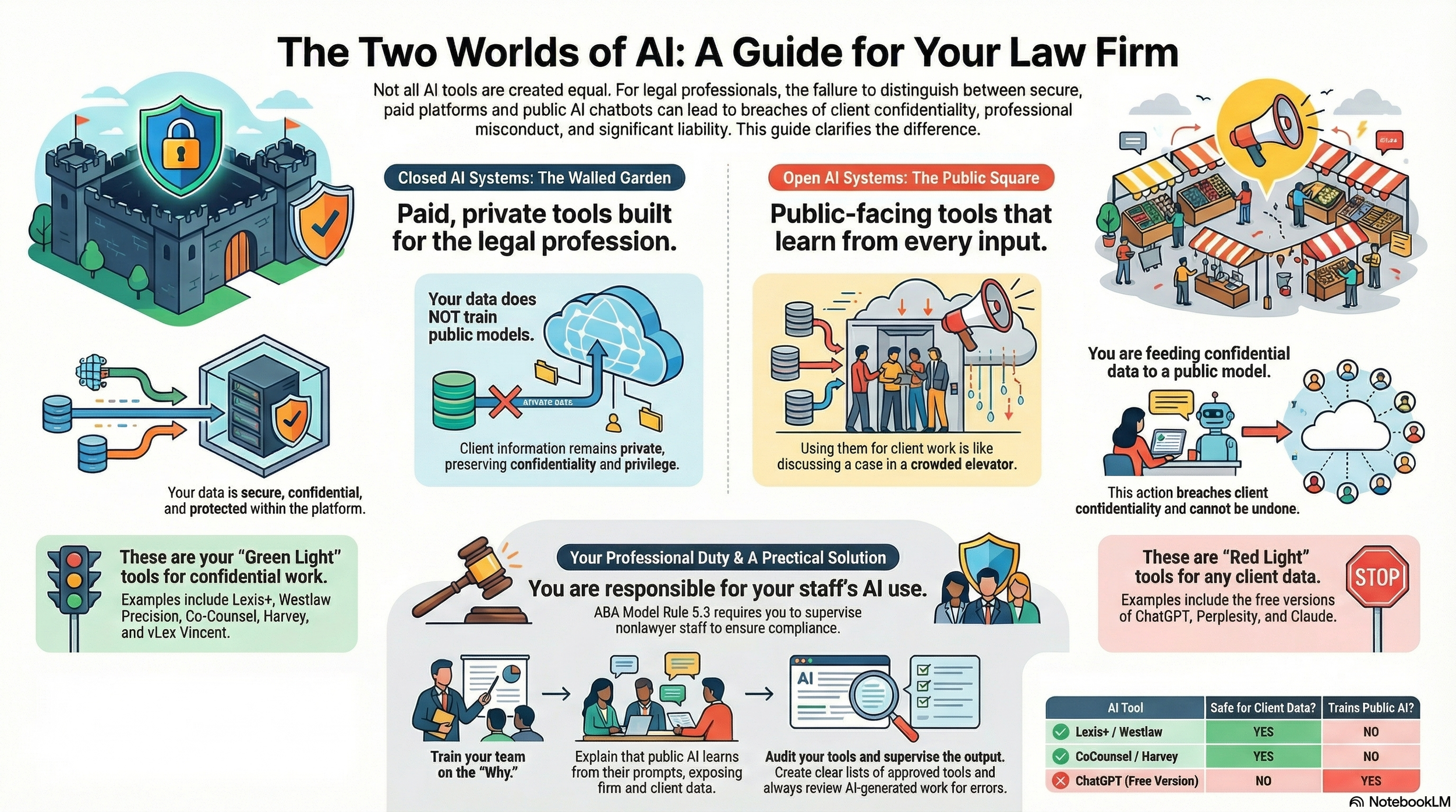
Welcome to TSL Labs Podcast Experiment. 🧪🎧 In this special "Deep Dive" bonus episode, we strip away the hype surrounding Generative AI to expose a critical operational risk hiding in plain sight: the dangerous confusion between "Open" and "Closed" AI systems.

Featuring an engaging discussion between our Google Notebook AI hosts, this episode unpacks the "Swiss Army Knife vs. Scalpel" analogy that every managing partner needs to understand. We explore why the "Green Light" tools you pay for are fundamentally different from the "Red Light" public models your staff might be using—and why treating them the same could trigger an immediate breach of ABA Model Rule 5.3. From the "hidden crisis" of AI embedded in Microsoft 365 to the non-negotiable duty to supervise, this is the essential briefing for protecting client confidentiality in the age of algorithms.

In our conversation, we cover the following:

  • [00:00] – Introduction: The hidden danger of AI in law firms.

  • [01:00] – The "AI Gap": Why staff confuse efficiency with confidentiality.

  • [02:00] – The Green Light Zone: Defining secure, "Closed" AI systems (The Scalpel).

  • [03:45] – The Red Light Zone: Understanding "Open" Public LLMs (The Swiss Army Knife).

  • [04:45] – "Feeding the Beast": How public queries actively train the model for everyone else.

  • [05:45]The Duty to Supervise: ABA Model Rules 5.3 and 1.1[8] implications.

  • [07:00] – The Hidden Crisis: AI embedded in ubiquitous tools (Microsoft 365, Adobe, Zoom).

  • [09:00] – The Training Gap: Why digital natives assume all prompt boxes are safe.

  • [10:00] – Actionable Solutions: Auditing tools and the "Elevator vs. Private Room" analogy.

  • [12:00] – Hallucinations: Vendor liability vs. Professional negligence.

  • [14:00] – Conclusion: The final provocative thought on accidental breaches.

RESOURCES

Mentioned in the episode

Software & Cloud Services mentioned in the conversation

TSL.P Lab's Initiative: 🤖 Hidden AI in Legal Practice: A Tech-Savvy Lawyer Labs Initiative Analysis

In this Tech-Savvy Lawyer Labs Initiative analysis, we use Google NotebookLM to break down the "Hidden AI" crisis affecting every legal professional. Microsoft 365, Zoom, and your practice management software may be processing client data without your knowledge—and without your explicit consent. We explain what ABA Formal Opinion 512 actually requires from you. We also provide a practical 5-step playbook to audit your tech stack and protect your license.

What you'll discover:
✅ Why "I didn't know" is no longer a valid defense
✅ Hallucination rates in legal research tools (17-33% error rates)
✅ How the Mata v. Avianca sanctions case proves verification is mandatory
✅ Tactical steps to identify and disable dangerous default settings
✅ Ethical guidelines for billing AI-assisted work

‼️ Don't let an "invisible assistant" trigger an ethics violation or put your professional license at risk.

Enjoy!

*Remember the presentation, like all postings on The Tech-Savvy Lawyer.Page, is for informational purposes only, does not offer legal advice or create attorney-client relationship.

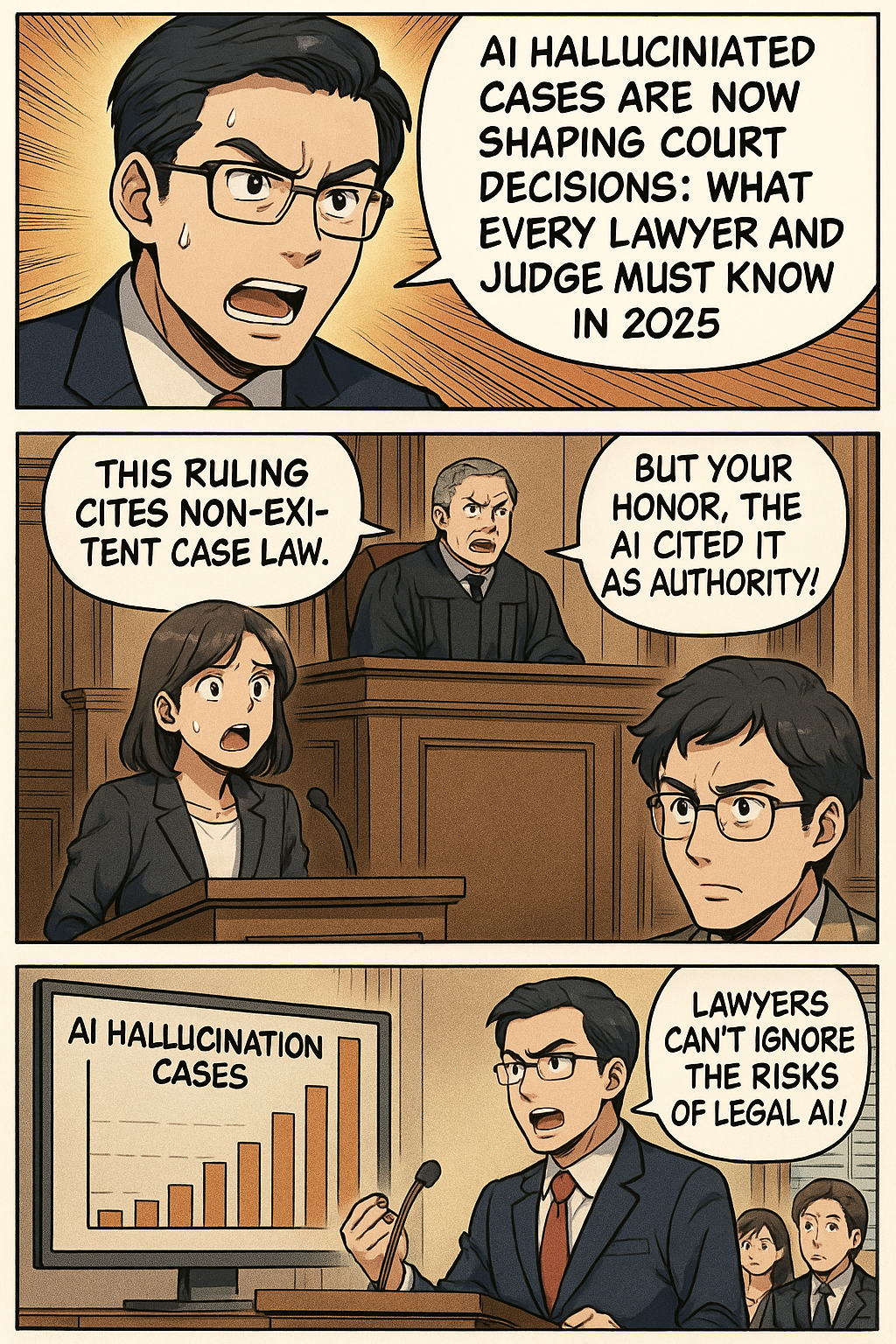
MTC: AI Hallucinated Cases Are Now Shaping Court Decisions - What Every Lawyer, Legal Professional and Judge Must Know in 2025!

AL Hallucinated cases are now shaping court decisions - what every lawyer and judge needs to know in 2025.

Artificial intelligence has transformed legal research, but a threat is emerging from chambers: hallucinated case law. On June 30, 2025, the Georgia Court of Appeals delivered a landmark ruling in Shahid v. Esaam that should serve as a wake-up call to every member of the legal profession: AI hallucinations are no longer just embarrassing mistakes—they are actively influencing court decisions and undermining the integrity of our judicial system.

The Georgia Court of Appeals Ruling: A Watershed Moment

The Shahid v. Esaam decision represents the first documented case where a trial court's order was based entirely on non-existent case law, likely generated by AI tools. The Georgia Court of Appeals found that the trial court's order denying a motion to reopen a divorce case relied upon two fictitious cases, and the appellee's brief contained an astounding 11 bogus citations out of 15 total citations. The court imposed a $2,500 penalty on attorney Diana Lynch—the maximum allowed under GA Court of Appeals Rule 7(e)(2)—and vacated the trial court's order entirely.

What makes this case particularly alarming is not just the volume of fabricated citations, but the fact that these AI-generated hallucinations were adopted wholesale without verification by the trial court. The court specifically referenced Chief Justice John Roberts' 2023 warning that "any use of AI requires caution and humility".

The Explosive Growth of AI Hallucination Cases

The Shahid case is far from isolated. Legal researcher Damien Charlotin has compiled a comprehensive database tracking over 120 cases worldwide where courts have identified AI-generated hallucinations in legal filings. The data reveals an alarming acceleration: while there were only 10 cases documented in 2023, that number jumped to 37 in 2024, and an astounding 73 cases have already been reported in just the first five months of 2025.

Perhaps most concerning is the shift in responsibility. In 2023, seven out of ten cases involving hallucinations were made by pro se litigants, with only three attributed to lawyers. However, by May 2025, legal professionals were found to be at fault in at least 13 of 23 cases where AI errors were discovered. This trend indicates that trained attorneys—who should know better—are increasingly falling victim to AI's deceptive capabilities.

High-Profile Cases and Escalating Sanctions

Always check your research - you don’t want to get in trouble with your client, the judge or the bar!

The crisis has intensified with high-profile sanctions. In May 2025, a special master in California imposed a staggering $31,100 sanction against law firms K&L Gates and Ellis George for what was termed a "collective debacle" involving AI-generated research4. The case involved attorneys who used multiple AI tools including CoCounsel, Westlaw Precision, and Google Gemini to generate a brief, with approximately nine of the 27 legal citations proving to be incorrect.

Even more concerning was the February 2025 case involving Morgan & Morgan—the largest personal injury firm in the United States—where attorneys were sanctioned for a motion citing eight nonexistent cases. The firm subsequently issued an urgent warning to its more than 1,000 lawyers that using fabricated AI information could result in termination.

The Tech-Savvy Lawyer.Page: Years of Warnings

The risks of AI hallucinations in legal practice have been extensively documented by experts in legal technology. I’ve been sounding the alarm at The Tech-Savvy Lawyer.Page Blog and Podcast about these issues for years. In a blog post titled "Why Are Lawyers Still Failing at AI Legal Research? The Alarming Rise of AI Hallucinations in Courtrooms," the editorial detailed how even advanced legal AI platforms can generate plausible but fake authorities.

My comprehensive coverage has included reviews of specific platforms, such as the November 2024 analysis "Lexis+ AI™️ Falls Short for Legal Research," which documented how even purpose-built legal AI tools can cite non-existent legislation. The platform's consistent message has been clear: AI is a collaborator, not an infallible expert.

International Recognition of the Crisis

The problem has gained international attention, with the London High Court issuing a stark warning in June 2025 that attorneys who use AI to cite non-existent cases could face contempt of court charges or even criminal prosecution. Justice Victoria Sharp warned that "in the most severe instances, intentionally submitting false information to the court with the aim of obstructing the course of justice constitutes the common law criminal offense of perverting the course of justice".

The Path Forward: Critical Safeguards

Based on extensive research and mounting evidence, several key recommendations emerge for legal professionals:

For Individual Lawyers:

Lawyers need to be diligent and make sure their case citations are not only accurate but real!

  • Never use general-purpose AI tools like ChatGPT for legal research without extensive verification

  • Implement mandatory verification protocols for all AI-generated content

  • Obtain specialized training on AI limitations and best practices

  • Consider using only specialized legal AI platforms with built-in verification mechanisms

For Courts:

  • Implement consistent disclosure requirements for AI use in court filings

  • Develop verification procedures for detecting potential AI hallucinations

  • Provide training for judges and court staff on AI technology recognition

FINAL THOUGHTS

The legal profession is at a crossroads. AI can enhance efficiency, but unchecked use can undermine the integrity of the justice system. The solution is not to abandon AI, but to use it wisely with appropriate oversight and verification. The warnings from The Tech-Savvy Lawyer.Page and other experts have proven prescient—the question now is whether the profession will heed these warnings before the crisis deepens further.

MTC

Happy Lawyering!