There Is an App for That: How the Transit App Helps Lawyers Meet ABA Tech Competence and Protect Client Service šŸš†āš–ļø

Smart Transit Planning Helps Lawyers Stay Punctual, Professional, and ABA-Compliant!

For many lawyers, the most stressful part of the day is not the hearing itself but getting to the courthouse, client site, or arbitration on time. šŸš‡ In transit‑dependent cities, delays can threaten punctuality, strain client relationships, and create avoidable risk, yet the tools to manage this are already in your pocket.

The Transit app is built on a mix of official agency feeds, crowdsourced rider reports, and its own ETA prediction engine, which gives it unusually accurate real‑time arrival data across many cities worldwide. It is designed to be a ā€œone‑stopā€ view of buses, subways, trains, ferries, bikeshare, scooters, and even some rideshare options, so you are not juggling multiple agency apps or websites to understand how to get from your office to court.🚌 For a practitioner trying to manage hearings in different venues, this unified view reduces friction and the risk of missing a critical transfer.

Key features go well beyond static schedules. You can plan the fastest route from A to B, compare options that mix modes (for example, bus + rail or scooter + metro), save frequent destinations such as courthouses or jails, and receive disruption alerts when there are delays, detours, or service changes. The GO navigation feature adds departure alarms, ā€œtime to get offā€ alerts, and real‑time progress so you are less likely to overshoot your stop while reviewing notes or answering emails. For lawyers new to a region, live crowding reports and rider tips can also help you choose safer, more predictable paths, which ties back to your duty to reasonably safeguard your own security and your clients’ matters under the ABA Model Rules.āš–ļø

Reliability is strengthened by the app’s business model and data philosophy. Transit is free to use, supported by a paid option called Royale and by partnerships with transit agencies, rather than by selling riders’ personal data. The developer states that it does not link your location history to identifiable personal data and does not sell your data, which reduces some privacy concerns lawyers may have about location tracking. From an ABA Model Rule 1.6 perspective, this kind of transparent, limited‑use data practice is easier to justify than tools that depend heavily on advertising and profiling.šŸ”

BE the hero! use Transit Apps to help Manage Delays, Deadlines, and Ethical Duties!

From a practical standpoint, Transit runs on iPhone, Apple Watch, and Android, making it accessible for most modern devices in a law office. The core app is free, which means solo and small‑firm lawyers can test it with no up‑front cost; optional Royale subscriptions are available on a monthly or annual basis, adding cosmetic perks and advanced features while leaving the essential planning tools available to everyone. This combination of broad city coverage, accurate multi‑modal data, and a privacy‑conscious, low‑cost model makes Transit a defensible choice when you explain how you are using accessible technology to manage foreseeable transit risks in line with ABA Model Rules 1.1, 1.3, and 1.6.

For solo and small‑firm lawyers, where every hour is critical, this kind of lightweight technology can be as impactful as more expensive practice‑management platforms. It improves reliability, supports ABA Model Rule compliance, and signals professionalism to clients and courts alike. In an era where judges, clients, and opposing counsel expect you to manage foreseeable risks, there truly is an app for that—and it may keep your practice on track in more ways than one. šŸš

šŸ§ŖšŸŽ§ TSL Labs Bonus Podcast: Open vs. Closed AI — The Hidden Liability Trap in Your Firm āš–ļøšŸ¤–

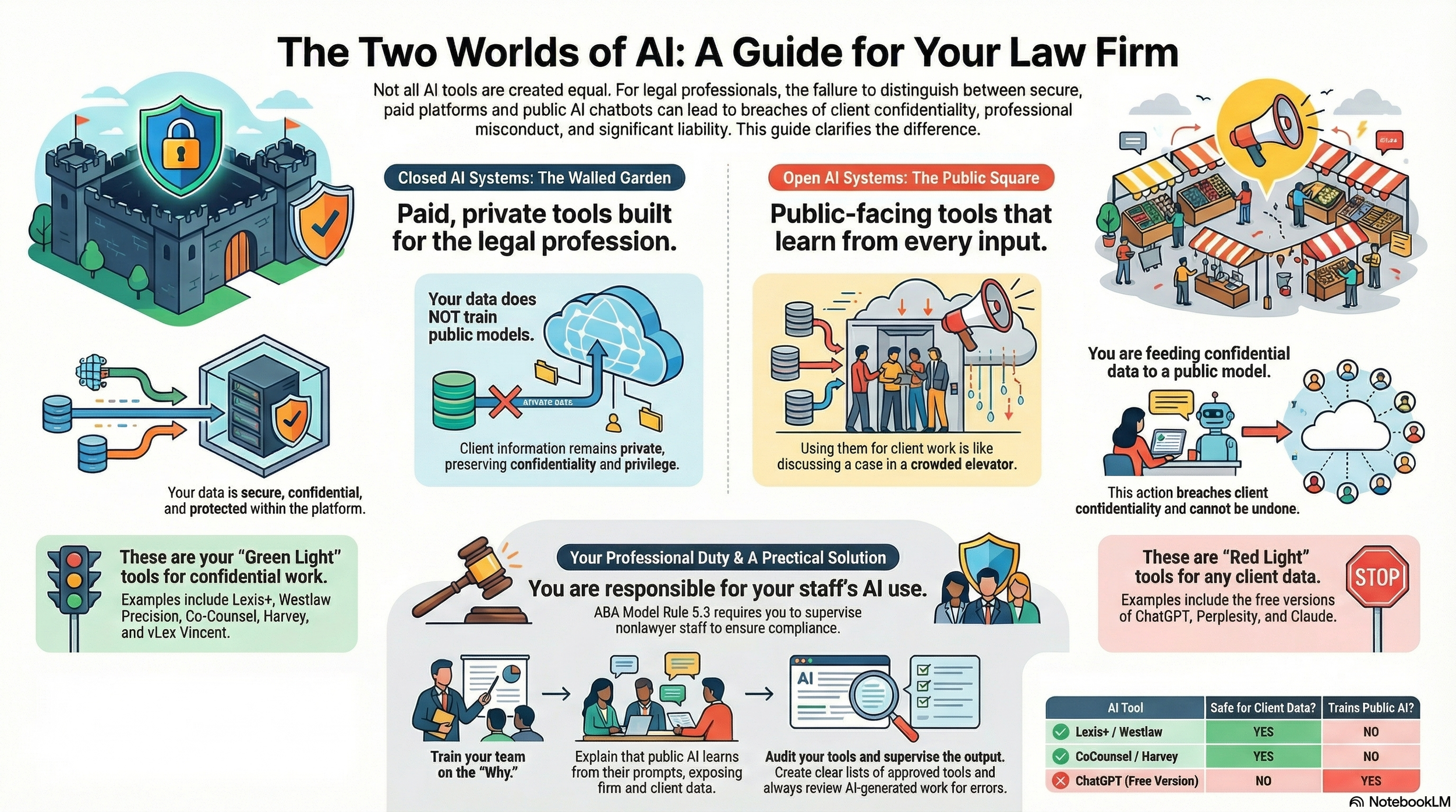
Welcome to TSL Labs Podcast Experiment. šŸ§ŖšŸŽ§ In this special "Deep Dive" bonus episode, we strip away the hype surrounding Generative AI to expose a critical operational risk hiding in plain sight: the dangerous confusion between "Open" and "Closed" AI systems.

Featuring an engaging discussion between our Google Notebook AI hosts, this episode unpacks the "Swiss Army Knife vs. Scalpel" analogy that every managing partner needs to understand. We explore why the "Green Light" tools you pay for are fundamentally different from the "Red Light" public models your staff might be using—and why treating them the same could trigger an immediate breach of ABA Model Rule 5.3. From the "hidden crisis" of AI embedded in Microsoft 365 to the non-negotiable duty to supervise, this is the essential briefing for protecting client confidentiality in the age of algorithms.

In our conversation, we cover the following:

  • [00:00] ā€“ Introduction: The hidden danger of AI in law firms.

  • [01:00] ā€“ The "AI Gap": Why staff confuse efficiency with confidentiality.

  • [02:00] ā€“ The Green Light Zone: Defining secure, "Closed" AI systems (The Scalpel).

  • [03:45] ā€“ The Red Light Zone: Understanding "Open" Public LLMs (The Swiss Army Knife).

  • [04:45] ā€“ "Feeding the Beast": How public queries actively train the model for everyone else.

  • [05:45] – The Duty to Supervise: ABA Model Rules 5.3 and 1.1[8] implications.

  • [07:00] ā€“ The Hidden Crisis: AI embedded in ubiquitous tools (Microsoft 365, Adobe, Zoom).

  • [09:00] ā€“ The Training Gap: Why digital natives assume all prompt boxes are safe.

  • [10:00] ā€“ Actionable Solutions: Auditing tools and the "Elevator vs. Private Room" analogy.

  • [12:00] ā€“ Hallucinations: Vendor liability vs. Professional negligence.

  • [14:00] ā€“ Conclusion: The final provocative thought on accidental breaches.

RESOURCES

Mentioned in the episode

Software & Cloud Services mentioned in the conversation

TSL.P Lab's Initiative: šŸ¤– Hidden AI in Legal Practice: A Tech-Savvy Lawyer Labs Initiative Analysis

In this Tech-Savvy Lawyer Labs Initiative analysis, we use Google NotebookLM to break down the "Hidden AI" crisis affecting every legal professional. Microsoft 365, Zoom, and your practice management software may be processing client data without your knowledge—and without your explicit consent. We explain what ABA Formal Opinion 512 actually requires from you. We also provide a practical 5-step playbook to audit your tech stack and protect your license.

What you'll discover:
āœ… Why "I didn't know" is no longer a valid defense
āœ… Hallucination rates in legal research tools (17-33% error rates)
āœ… How the Mata v. Avianca sanctions case proves verification is mandatory
āœ… Tactical steps to identify and disable dangerous default settings
āœ… Ethical guidelines for billing AI-assisted work

ā€¼ļø Don't let an "invisible assistant" trigger an ethics violation or put your professional license at risk.

Enjoy!

*Remember the presentation, like all postings on The Tech-Savvy Lawyer.Page, is for informational purposes only, does not offer legal advice or create attorney-client relationship.

Why Are Lawyers Still Failing at AI Legal Research? The Alarming Rise of AI Hallucinations in Courtrooms šŸšØāš–ļø

lawyers avoid sanctions - check your work!

The legal profession stands at a crossroads: Artificial intelligence (AI) offers unprecedented speed and efficiency in legal research, yet lawyers across the country (and even around the world, like our neighbor to the north) continue to make costly mistakes by over-relying on these tools. Despite years of warnings and mounting evidence, courts are now sanctioning attorneys for submitting briefs filled with fake citations and non-existent case law. Let’s examine where we are today:

The Latest AI Legal Research Failures: A Pattern, Not a Fluke

Within the last month, the legal world has witnessed a series of embarrassing AI-driven blunders:

  • $31,000 Sanction in California: Two major law firms, Ellis George LLP and K&L Gates LLP, were hit with a $31,000 penalty after submitting a brief with at least nine incorrect citations, including two to cases that do not exist. The attorneys used Google Gemini and Westlaw’s AI features but failed to verify the output-a mistake that Judge Michael Wilner called ā€œinexcusableā€ for any competent attorney.

  • Morgan & Morgan’s AI Crackdown: After a Wyoming federal judge threatened sanctions over AI-generated, fictitious case law, the nation’s largest personal injury firm issued a warning: use AI without verification, and you risk termination.

  • Nationwide Trend: From Minnesota to Texas, courts are tossing filings and sanctioning lawyers for AI-induced ā€œhallucinationsā€-the confident generation of plausible but fake legal authorities.

These are not isolated incidents. As covered in our recent blog post, ā€œGenerative AI vs. Traditional Legal Research Platforms: What Modern Lawyers Need to Know in 2025,ā€ the risks of AI hallucinations are well-documented, and the consequences for ignoring them are severe.

The Tech-Savvy Lawyer.Page: Prior Warnings and Deep Dives

lawyers need to confirm all of their citations generative ai or not!

I’ve been sounding the alarm on these issues for some time. In our November 2024 review, ā€œLexis+ AIā„¢ļø Falls Short for Legal Research,ā€ I detailed how even the most advanced legal AI platforms can cite non-existent legislation, misinterpret legal concepts, and confidently provide incorrect information. The post emphasized the need for human oversight and verification-a theme echoed in every major AI research failure since.

Our ā€œWord of the Weekā€ feature explained the phenomenon of AI ā€œHallucinationsā€ in plain language: ā€œThe AI is making stuff up.ā€ We warned attorneys that AI tools are not ready to write briefs without review and that those who fail to learn how to use AI properly will be replaced by those who do.

For a more in-depth discussion, listen to our podcast episode "From Chatbots to Generative AI – Tom Martin explores LawDroid's legal tech advancements with AI", where we explore how leading legal tech companies are addressing the reliability and security concerns of AI-driven research. Tom’s advice? Treat AI as a collaborator, not an infallible expert, and always manage your expectations about its capabilities.

Why Do These Mistakes Keep Happening? šŸ¤”

  1. Overtrust in AI Tools
    Despite repeated warnings, lawyers continue to treat AI outputs as authoritative. As detailed in our November 2024 editorial, MTC/🚨BOLO🚨: Lexis+ AIā„¢ļø Falls Short for Legal Research!, and January 2025 roundup of AI legal research platforms, Shout Out to Robert Ambrogi: AI Legal Research Platforms - A Double-Edged Sword for Tech-Savvy Lawyers šŸ”āš–ļø, even the best tools, e.g., Lexis+AI, Westlaw Precision AI, vLex's Vincent AI, produce inconsistent results and are prone to hallucinations. The myth of AI infallibility persists, leading to dangerous shortcuts.

  2. Lack of AI Literacy and Verification
    Many attorneys lack the technical skills to critically assess AI-generated research (yet have the legal research tools to check their work, i.e., legal citations). Our blog’s ongoing coverage stresses that AI tools are supplements, not replacements, for professional judgment. As we discussed in ā€œGenerative AI vs. Traditional Legal Research Platforms,ā€ traditional platforms still offer higher reliability, especially for complex or high-stakes matters.

  3. Inadequate Disclosure and Collaboration
    Lawyers often share AI-generated drafts without disclosing their origin, allowing errors to propagate. This lack of transparency was a key factor in several recent sanctions and is a recurring theme in our blog postings and podcast interviews with legal tech innovators.

  4. AI’s Inability to Grasp Legal Nuance
    AI can mimic legal language but cannot truly understand doctrine or context. Our review of Lexis+ AI, see ā€œMTC/🚨BOLO🚨: Lexis+ AIā„¢ļø Falls Short for Legal Research!," highlighted how the platform confused criminal and tort law concepts and cited non-existent statutes-clear evidence that human expertise remains essential.

The Real-World Consequences

lawyers don’t find yourself sanctioned or worse because you used unverified generative ai research!

  • Judicial Sanctions and Fines: Increasingly severe penalties, including the $31,000 sanction in California, are becoming the norm.

  • Professional Embarrassment: Lawyers risk public censure and reputational harm-outcomes we’ve chronicled repeatedly on The Tech-Savvy Lawyer.Page.

  • Client Harm: Submitting briefs with fake law can jeopardize client interests and lead to malpractice claims.

  • Loss of Trust: Repeated failures erode public confidence in the legal system.

What Needs to Change-Now

  1. Mandatory AI Verification Protocols
    Every AI-generated citation must be independently checked using trusted, primary sources. Our blog and podcast guests have consistently advocated for checklists and certifications to ensure research integrity.

  2. AI Literacy Training
    Ongoing education is essential. As we’ve reported, understanding AI’s strengths and weaknesses is now a core competency for all legal professionals.

  3. Transparent Disclosure
    Attorneys should disclose when AI tools are used in research or drafting. This simple step can prevent many of the cascading errors seen in recent cases.

  4. Responsible Adoption
    Firms must demand transparency from AI vendors and insist on evidence of reliability before integrating new tools. Our coverage of the ā€œAI smackdownā€ comparison made clear that no platform is perfect-critical thinking is irreplaceable.

Final Thoughts 🧐: AI Is a Tool, Not a Substitute for Judgment

lawyers balance your legal research using generative ai with known, reliable legal resouirces!

Artificial intelligence can enhance legal research, but it cannot replace diligence, competence, or ethical responsibility. The recent wave of AI-induced legal blunders is a wake-up call: Technology is only as good as the professional who wields it. As we’ve said before on The Tech-Savvy Lawyer.Page, lawyers must lead with skepticism, verify every fact, and never outsource their judgment to a machine. The future of the profession-and the trust of the public-depends on it.