🎙️ Ep. # 124: AI Governance Expert Nikki Mehrpoo Shares the Triple E Protocol for Implementing Responsible AI and Legal Practice While Maintaining Ethical Compliance and Protecting Client Data.

My next guest is Nikki Mehrpoo. She is a nationally recognized leader in AI governance for law practices, known for her practical, ethical, and innovation-focused strategies. Today, she details her Triple-E Protocol and shares key steps for safely leveraging AI in legal work.

Join Nikki Mehrpoo and me as we discuss the following three questions and more!

  1. Based on your pioneering work with “Govern Before You Automate,” what are the top three foundational steps every lawyer should take to implement AI responsibly, and what are the top three mistakes lawyers make with AI?

  2. What are your top three tips or tricks when using AI in your work?

  3. When assessing the next AI platform from a service provider, what are the top three questions lawyers should be asking?

In our conversation, we cover the following:

  • 00:00:00 – Welcome and guest’s background 🌟

  • 00:01:00 – Current tech setup and cloud-based workflows ☁️

  • 00:02:00 – Privacy and IP management, not client confidentiality 🔐

  • 00:03:00 – Document deduplication with Effingo 📄

  • 00:04:00 – Hardware: HP Omni Book 7 Laptop, HP monitors, iPhone 💻📱

  • 00:05:00 – Efficiency tools: Text Expander, personal workflow shortcuts ⌨️

  • 00:06:00 – Balancing technology innovation and risk management ⚖️

  • 00:07:00 – Adapting to change, ongoing legal tech education 🧑‍💻

  • 00:08:00 – Triple-E Framework: Educate, Empower, Elevate 🚀

  • 00:09:00 – Governance, supervision duties, policy setting 🛡️

  • 00:10:00 – Human verification as a standard for all legal AI output 🧑‍⚖️

  • 00:12:00 – Real-world examples: AI hallucinations, bias, and due diligence ⚠️

  • 00:13:00 – IT vs. AI expertise, communicating across teams 🛠️

  • 00:14:00 – Chief AI Governance Officer, governance in legal innovation 🏛️

  • 00:15:00 – Global compliance, EU AI Act, international standards 🌐

  • 00:16:00 – Hidden AI in legacy software, policy gaps 🔎

  • 00:17:00 – Education as continuous legal responsibility 📚

  • 00:18:00 – Better results through prompt engineering 🔤

  • 00:19:00 – Verify, verify, verify: never trust without review ✔️

  • 00:20:00 – ABA Formal Opinion 512: standards for responsible legal AI 📜

  • 00:21:00 – Nikki’s Triple-E Protocol, governance best practices 📊

  • 00:22:00 – Data origin, bias, and auditability in legal AI systems 🧩

  • 00:23:00 – Frameworks for “govern before you automate” in legal workflows 🔒

  • 00:24:00 – Importance of internal hosting and zero retention policies 🏢

  • 00:25:00 – Maintaining confidentiality with third-party AI and HIPAA compliance 🤫

  • 00:26:00 – Where to find Nikki and connect 🌐

Resources

Connect with Nikki Mehrpoo

Mentioned in the episode

Hardware mentioned in the conversation

Software & Cloud Services mentioned in the conversation

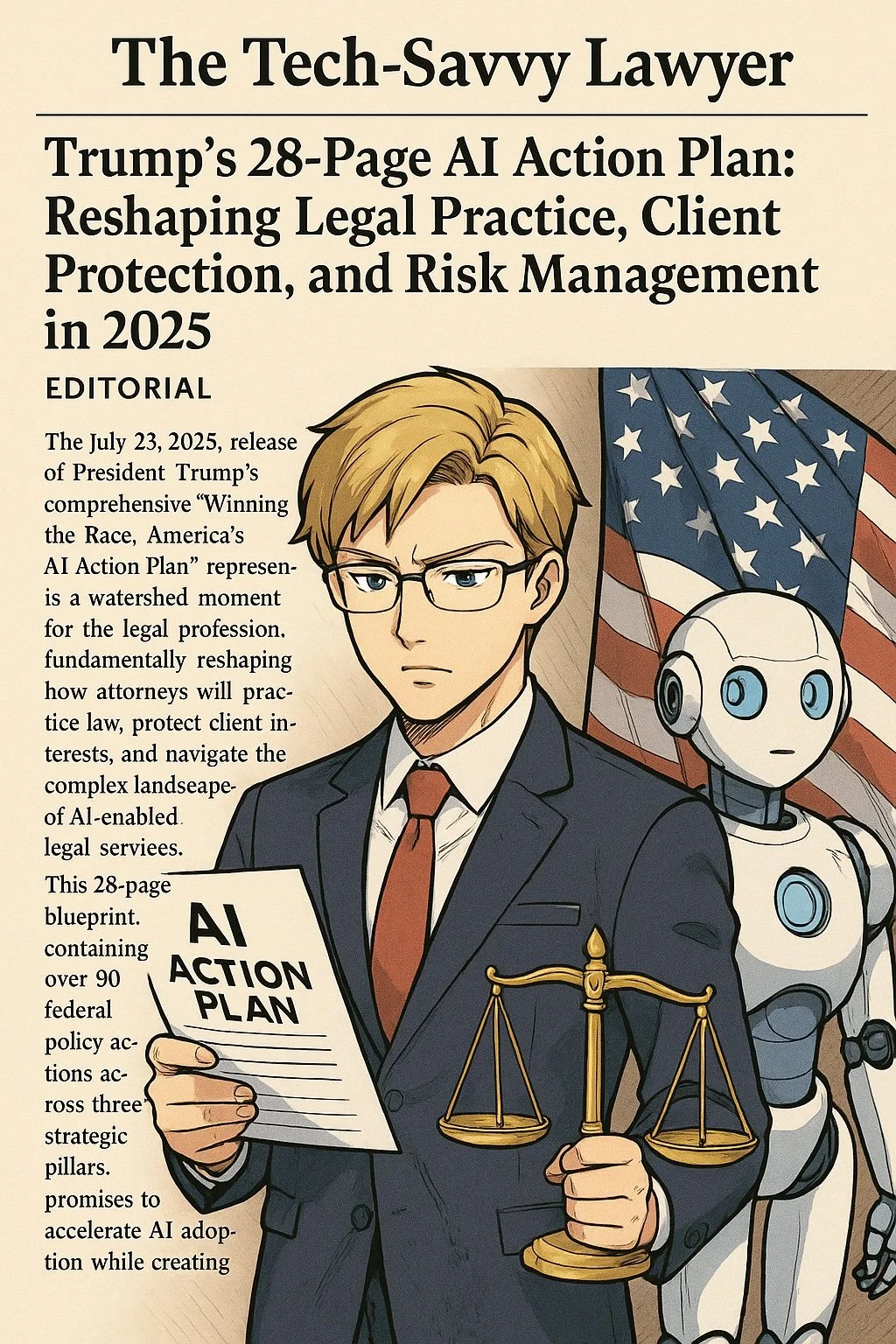
MTC: Trump's 28-Page AI Action Plan - Reshaping Legal Practice, Client Protection, and Risk Management in 2025 ⚖️🤖

The July 23, 2025, release of President Trump's comprehensive "Winning the Race: America's AI Action Plan" represents a watershed moment for the legal profession, fundamentally reshaping how attorneys will practice law, protect client interests, and navigate the complex landscape of AI-enabled legal services. This 28-page blueprint, containing over 90 federal policy actions across three strategic pillars, promises to accelerate AI adoption while creating new challenges for legal professionals who must balance innovation with ethical responsibility.

What does Trump’s ai action plan mean for the practice of law?

Accelerated AI Integration and Deregulatory Impact

The Action Plan's aggressive deregulatory stance will dramatically accelerate AI adoption across law firms by removing federal barriers that previously constrained AI development and deployment. The Administration's directive to "identify, revise, or repeal regulations, rules, memoranda, administrative orders, guidance documents, policy statements, and interagency agreements that unnecessarily hinder AI development" will create a more permissive environment for legal technology innovation. This deregulatory approach extends to federal funding decisions, with the plan calling for limiting AI-related federal deemed "burdensome" to AI development.

For legal practitioners, this means faster access to sophisticated AI tools for document review, legal research, contract analysis, and predictive litigation analytics. The plan's endorsement of open-source and open-weight AI models will particularly benefit smaller firms that previously lacked access to expensive proprietary systems. However, this rapid deployment environment places greater responsibility on individual attorneys to implement proper oversight and verification protocols.

Enhanced Client Protection Obligations

The Action Plan's emphasis on "truth-seeking" AI models that are "free from top-down ideological bias" creates new client protection imperatives for attorneys. Under the plan's framework, (at least federal) lawyers must now ensure that AI tools used in client representation meet federal standards for objectivity and accuracy. This requirement aligns with existing ABA Formal Opinion 512, which mandates that attorneys maintain competence in understanding AI capabilities and limitations.

Legal professionals face (continued yet) heightened obligations to protect client confidentiality when using AI systems, particularly as the plan encourages broader AI adoption without corresponding privacy safeguards. Attorneys must implement robust data security protocols and carefully evaluate third-party AI providers' confidentiality protections before integrating these tools into client representations.

Critical Error Prevention and Professional Liability

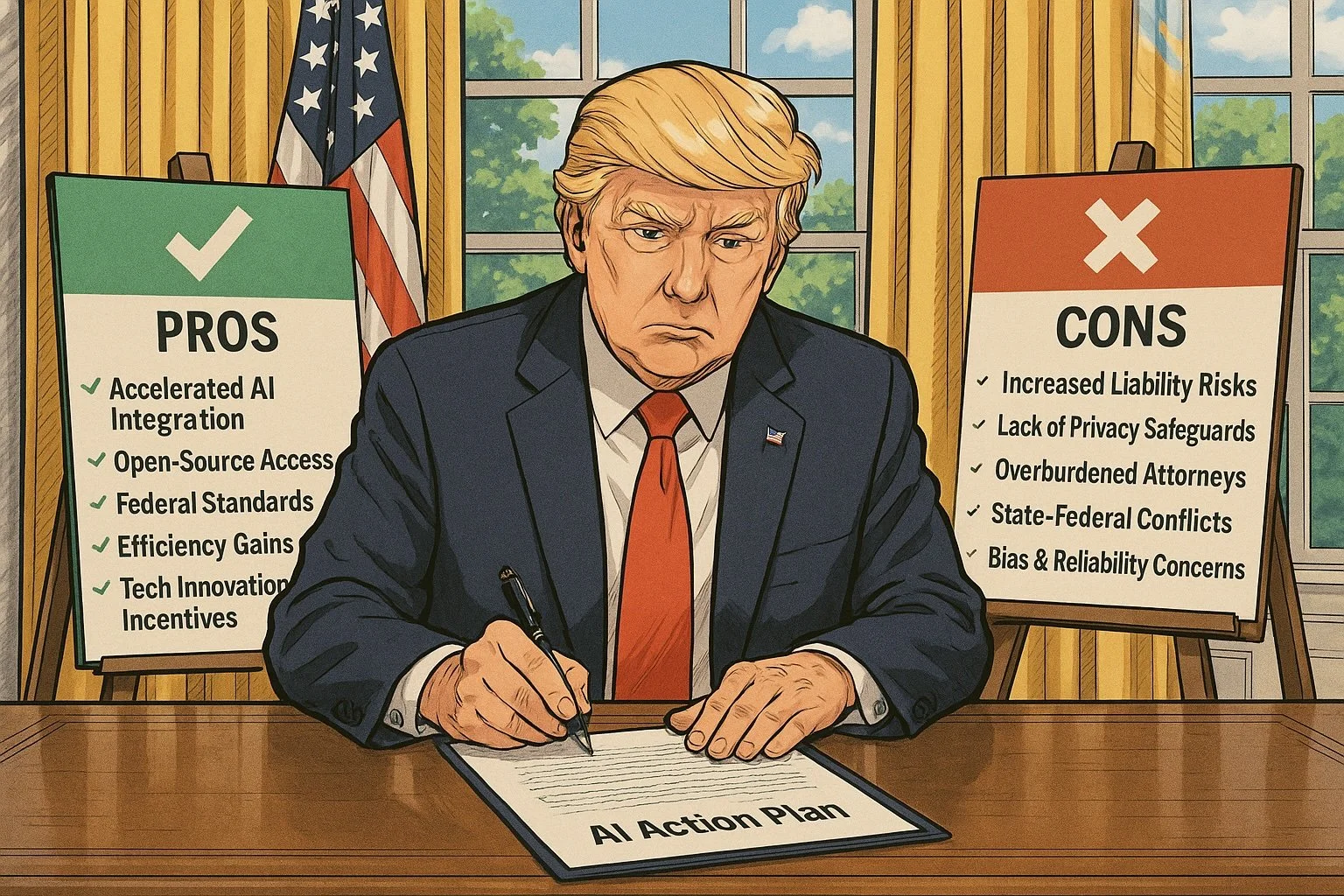
What are the pros and cons to trump’s new ai plan?

The Action Plan's deregulatory approach paradoxically increases attorneys' responsibility for preventing AI-driven errors and hallucinations. Recent Stanford research reveals that even specialized legal AI tools produce incorrect information 17-34% of the time, with some systems generating fabricated case citations that appear authoritative but are entirely fictitious. The plan's call to adapt the Federal Rules of Evidence for AI-generated material means courts will increasingly encounter authenticity and reliability challenges.

Legal professionals must establish comprehensive verification protocols to prevent the submission of AI-generated false citations or legal authorities, which have already resulted in sanctions and malpractice claims across multiple jurisdictions. The Action Plan's emphasis on rapid AI deployment without corresponding safety frameworks makes attorney oversight more critical than ever for preventing professional misconduct and protecting client interests.

Federal Preemption and Compliance Complexity

Perhaps most significantly, the Action Plan's aggressive stance against state AI regulation creates unprecedented compliance challenges for legal practitioners operating across multiple jurisdictions. President Trump's declaration that "we need one common-sense federal standard that supersedes all states" signals potential federal legislation to preempt state authority over AI governance. This federal-state tension could lead to prolonged legal battles that create uncertainty for attorneys serving clients nationwide.

The plan's directive for agencies to factor state-level AI regulatory climates into federal funding decisions adds another layer of complexity, potentially creating a fractured regulatory landscape until federal preemption is resolved. Attorneys must navigate between conflicting federal deregulatory objectives and existing state AI protection laws, particularly in areas affecting employment, healthcare, and criminal justice, where AI bias concerns remain paramount. (All the while following their start bar ethics rules).

Strategic Implications for Legal Practice

Lawyers must remain vigilAnt when using AI in their work!

The Action Plan fundamentally transforms the legal profession's relationship with AI technology, moving from cautious adoption to aggressive implementation. While this creates opportunities for enhanced efficiency and client service, it also demands that attorneys develop new competencies in AI oversight, bias detection, and error prevention. Legal professionals who successfully adapt to this new environment will gain competitive advantages, while those who fail to implement proper safeguards face increased malpractice exposure and professional liability risks.

The plan's vision of AI-powered legal services requires attorneys to become sophisticated technology managers while maintaining their fundamental duty to provide competent, ethical representation. Success in this new landscape will depend on lawyers' ability to harness AI's capabilities while implementing robust human oversight and quality control measures to protect both client interests and professional integrity.

MTC