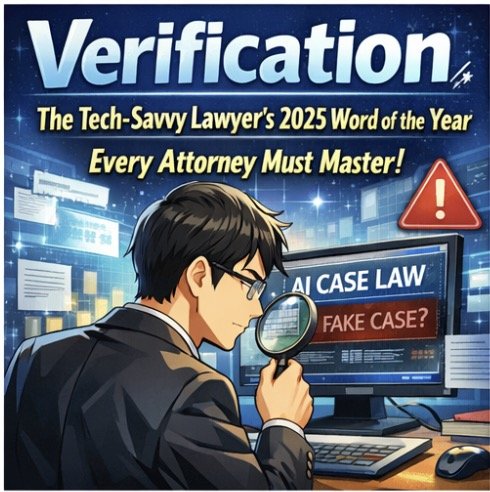
📖 WORD OF THE WEEK YEAR🥳:  Verification: The 2025 Word of the Year for Legal Technology ⚖️💻

all lawyers need to remember to check ai-generated legal citations

After reviewing a year's worth of content from The Tech-Savvy Lawyer.Page blog and podcast, one word emerged to me as the defining concept for 2025: Verification. This term captures the essential duty that separates competent legal practice from dangerous shortcuts in the age of artificial intelligence.

Throughout 2025, The Tech-Savvy Lawyer consistently emphasized verification across multiple contexts. The blog covered proper redaction techniques following the Jeffrey Epstein files disaster. The podcast explored hidden AI in everyday legal tools. Every discussion returned to one central theme: lawyers must verify everything. 🔍

Verification means more than just checking your work. The concept encompasses multiple layers of professional responsibility. Attorneys must verify AI-generated legal research to prevent hallucinations. Courts have sanctioned lawyers who submitted fictitious case citations created by generative AI tools. One study found error rates of 33% in Westlaw AI and 17% in Lexis+ AI. Note the study's foundation is from May 2024, but a 2025 update confirms these findings remain current—the risk of not checking has not gone away. "Verification" cannot be ignored.

The duty extends beyond research. Lawyers must verify that redactions actually remove confidential information rather than simply hiding it under black boxes. The DOJ's failed redaction of the Epstein files demonstrated what happens when attorneys skip proper verification steps. Tech-savvy readers simply copied text from beneath the visual overlays. ⚠️

use of ai-generated legal work requires “verification”, “Verification”, “Verification”!

ABA Model Rule 1.1 requires technological competence. Comment 8 specifically mandates that lawyers understand "the benefits and risks associated with relevant technology." Verification sits at the heart of this competence requirement. Attorneys cannot claim ignorance about AI features embedded in Microsoft 365, Zoom, Adobe, or legal research platforms. Each tool processes client data differently. Each requires verification of settings, outputs, and data handling practices. 🛡️

The verification duty also applies to cybersecurity. Zero Trust Architecture operates on the principle "never trust, always verify." This security model requires continuous verification of user identity, device health, and access context. Law firms can no longer trust that users inside their network perimeter are authorized. Remote work and cloud-based systems demand constant verification.

Hidden AI poses another verification challenge. Software updates automatically activate AI features in familiar tools. These invisible assistants process confidential client data by default. Lawyers must verify which AI systems operate in their technology stack. They must verify data retention policies. They must verify that AI processing does not waive attorney-client privilege. 🤖

ABA Formal Opinion 512 eliminates the "I didn't know" defense. Lawyers bear responsibility for understanding how their tools use AI. Rule 5.3 requires attorneys to supervise software with the same care they supervise human staff members. Verification transforms from a good practice into an ethical mandate.

verify your ai-generated work like your bar license depends on it!

The year 2025 taught legal professionals that technology competence means verification competence. Attorneys must verify redactions work properly. They must verify AI outputs for accuracy. They must verify security settings protect confidential information. They must verify that hidden AI complies with ethical obligations. ✅

Verification protects clients, preserves attorney licenses, and maintains the integrity of legal practice. As The Tech-Savvy Lawyer demonstrated throughout 2025, every technological advancement creates new verification responsibilities. Attorneys who master verification will thrive in the AI era. Those who skip verification steps risk sanctions, malpractice claims, and disciplinary action.

The legal profession's 2025 Word of the Year is verification. Master it or risk everything. 💼⚖️

🎙️ Ep. # 124: AI Governance Expert Nikki Mehrpoo Shares the Triple E Protocol for Implementing Responsible AI and Legal Practice While Maintaining Ethical Compliance and Protecting Client Data.

My next guest is Nikki Mehrpoo. She is a nationally recognized leader in AI governance for law practices, known for her practical, ethical, and innovation-focused strategies. Today, she details her Triple-E Protocol and shares key steps for safely leveraging AI in legal work.

Join Nikki Mehrpoo and me as we discuss the following three questions and more!

  1. Based on your pioneering work with “Govern Before You Automate,” what are the top three foundational steps every lawyer should take to implement AI responsibly, and what are the top three mistakes lawyers make with AI?

  2. What are your top three tips or tricks when using AI in your work?

  3. When assessing the next AI platform from a service provider, what are the top three questions lawyers should be asking?

In our conversation, we cover the following:

  • 00:00:00 – Welcome and guest’s background 🌟

  • 00:01:00 – Current tech setup and cloud-based workflows ☁️

  • 00:02:00 – Privacy and IP management, not client confidentiality 🔐

  • 00:03:00 – Document deduplication with Effingo 📄

  • 00:04:00 – Hardware: HP Omni Book 7 Laptop, HP monitors, iPhone 💻📱

  • 00:05:00 – Efficiency tools: Text Expander, personal workflow shortcuts ⌨️

  • 00:06:00 – Balancing technology innovation and risk management ⚖️

  • 00:07:00 – Adapting to change, ongoing legal tech education 🧑‍💻

  • 00:08:00 – Triple-E Framework: Educate, Empower, Elevate 🚀

  • 00:09:00 – Governance, supervision duties, policy setting 🛡️

  • 00:10:00 – Human verification as a standard for all legal AI output 🧑‍⚖️

  • 00:12:00 – Real-world examples: AI hallucinations, bias, and due diligence ⚠️

  • 00:13:00 – IT vs. AI expertise, communicating across teams 🛠️

  • 00:14:00 – Chief AI Governance Officer, governance in legal innovation 🏛️

  • 00:15:00 – Global compliance, EU AI Act, international standards 🌐

  • 00:16:00 – Hidden AI in legacy software, policy gaps 🔎

  • 00:17:00 – Education as continuous legal responsibility 📚

  • 00:18:00 – Better results through prompt engineering 🔤

  • 00:19:00 – Verify, verify, verify: never trust without review ✔️

  • 00:20:00 – ABA Formal Opinion 512: standards for responsible legal AI 📜

  • 00:21:00 – Nikki’s Triple-E Protocol, governance best practices 📊

  • 00:22:00 – Data origin, bias, and auditability in legal AI systems 🧩

  • 00:23:00 – Frameworks for “govern before you automate” in legal workflows 🔒

  • 00:24:00 – Importance of internal hosting and zero retention policies 🏢

  • 00:25:00 – Maintaining confidentiality with third-party AI and HIPAA compliance 🤫

  • 00:26:00 – Where to find Nikki and connect 🌐

Resources

Connect with Nikki Mehrpoo

Mentioned in the episode

Hardware mentioned in the conversation

Software & Cloud Services mentioned in the conversation

📢 ANNOUNCEMENT: Tech-Savvy Saturdays Takes a Brief Hiatus - Continuing to Empower Lawyers with Legal Tech Insights Through Blogs and Podcasts.

Hey everyone!

My goal with Tech-Savvy Saturdays (TSS) is to consistently serve as a cornerstone resource for legal professionals seeking to navigate the evolving landscape of legal technology. Due to other obligations, I need to take a pause on TSS.  But fear not, TSS will return in several months. Meanwhile, you can still stay updated on all things legal tech through the Tech-Savvy Lawyer Blog and Podcast.

Stay safe and Tech-Savvy!

Your Friend,
Michael D.J.