📖 WORD OF THE WEEK YEAR🥳:  Verification: The 2025 Word of the Year for Legal Technology ⚖️💻

all lawyers need to remember to check ai-generated legal citations

After reviewing a year's worth of content from The Tech-Savvy Lawyer.Page blog and podcast, one word emerged to me as the defining concept for 2025: Verification. This term captures the essential duty that separates competent legal practice from dangerous shortcuts in the age of artificial intelligence.

Throughout 2025, The Tech-Savvy Lawyer consistently emphasized verification across multiple contexts. The blog covered proper redaction techniques following the Jeffrey Epstein files disaster. The podcast explored hidden AI in everyday legal tools. Every discussion returned to one central theme: lawyers must verify everything. 🔍

Verification means more than just checking your work. The concept encompasses multiple layers of professional responsibility. Attorneys must verify AI-generated legal research to prevent hallucinations. Courts have sanctioned lawyers who submitted fictitious case citations created by generative AI tools. One study found error rates of 33% in Westlaw AI and 17% in Lexis+ AI. Note the study's foundation is from May 2024, but a 2025 update confirms these findings remain current—the risk of not checking has not gone away. "Verification" cannot be ignored.

The duty extends beyond research. Lawyers must verify that redactions actually remove confidential information rather than simply hiding it under black boxes. The DOJ's failed redaction of the Epstein files demonstrated what happens when attorneys skip proper verification steps. Tech-savvy readers simply copied text from beneath the visual overlays. ⚠️
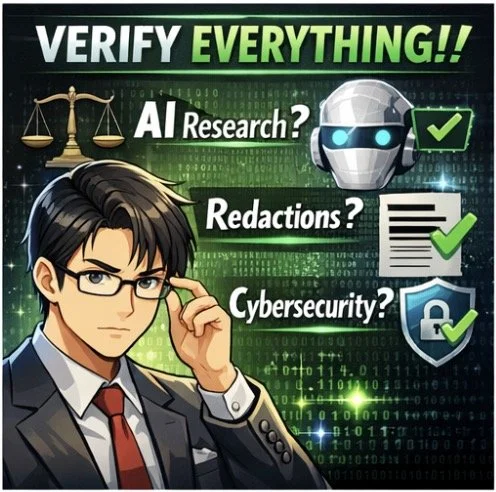
use of ai-generated legal work requires “verification”, “Verification”, “Verification”!

ABA Model Rule 1.1 requires technological competence. Comment 8 specifically mandates that lawyers understand "the benefits and risks associated with relevant technology." Verification sits at the heart of this competence requirement. Attorneys cannot claim ignorance about AI features embedded in Microsoft 365, Zoom, Adobe, or legal research platforms. Each tool processes client data differently. Each requires verification of settings, outputs, and data handling practices. 🛡️

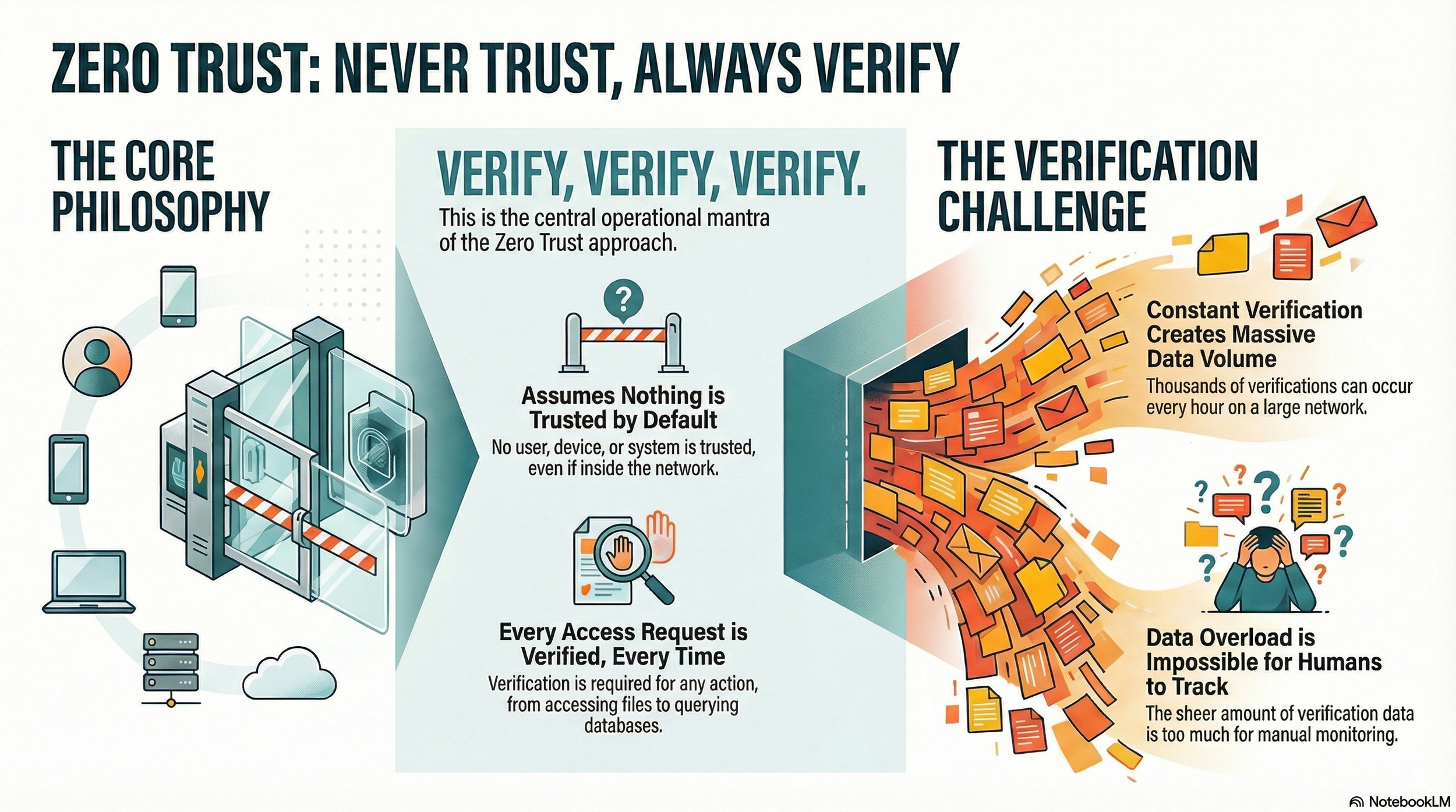
The verification duty also applies to cybersecurity. Zero Trust Architecture operates on the principle "never trust, always verify." This security model requires continuous verification of user identity, device health, and access context. Law firms can no longer trust that users inside their network perimeter are authorized. Remote work and cloud-based systems demand constant verification.

Hidden AI poses another verification challenge. Software updates automatically activate AI features in familiar tools. These invisible assistants process confidential client data by default. Lawyers must verify which AI systems operate in their technology stack. They must verify data retention policies. They must verify that AI processing does not waive attorney-client privilege. 🤖

ABA Formal Opinion 512 eliminates the "I didn't know" defense. Lawyers bear responsibility for understanding how their tools use AI. Rule 5.3 requires attorneys to supervise software with the same care they supervise human staff members. Verification transforms from a good practice into an ethical mandate.

verify your ai-generated work like your bar license depends on it!

The year 2025 taught legal professionals that technology competence means verification competence. Attorneys must verify redactions work properly. They must verify AI outputs for accuracy. They must verify security settings protect confidential information. They must verify that hidden AI complies with ethical obligations. ✅

Verification protects clients, preserves attorney licenses, and maintains the integrity of legal practice. As The Tech-Savvy Lawyer demonstrated throughout 2025, every technological advancement creates new verification responsibilities. Attorneys who master verification will thrive in the AI era. Those who skip verification steps risk sanctions, malpractice claims, and disciplinary action.

The legal profession's 2025 Word of the Year is verification. Master it or risk everything. 💼⚖️
📖 WORD OF THE WEEK (WoW): Zero Trust Architecture ⚖️🔐

Zero Trust Architecture and ABA Model Rules Compliance 🛡️

Lawyers need to "never trust, always verify" their network activity!

Zero Trust Architecture represents a fundamental shift in how law firms approach cybersecurity and fulfill ethical obligations. Rather than assuming that users and devices within a firm's network are trustworthy by default, this security model operates on the principle of "never trust, always verify." For legal professionals managing sensitive client information, implementing this framework has become essential to protecting confidentiality while maintaining compliance with ABA Model Rules.

The traditional security approach created a protective perimeter around a firm's network, trusting anyone inside that boundary. This model no longer reflects modern legal practice. Remote work, cloud-based case management systems, and mobile device usage mean that your firm's data exists across multiple locations and devices. Zero Trust abandons the perimeter-based approach entirely.

ABA Model Rule 1.6(c) requires lawyers to "make reasonable efforts to prevent the inadvertent or unauthorized disclosure of, or unauthorized access to, information relating to the representation of a client." Zero Trust Architecture directly fulfills this mandate by requiring continuous verification of every user and device accessing firm resources, regardless of location. This approach ensures compliance with the confidentiality duty that forms the foundation of legal practice.

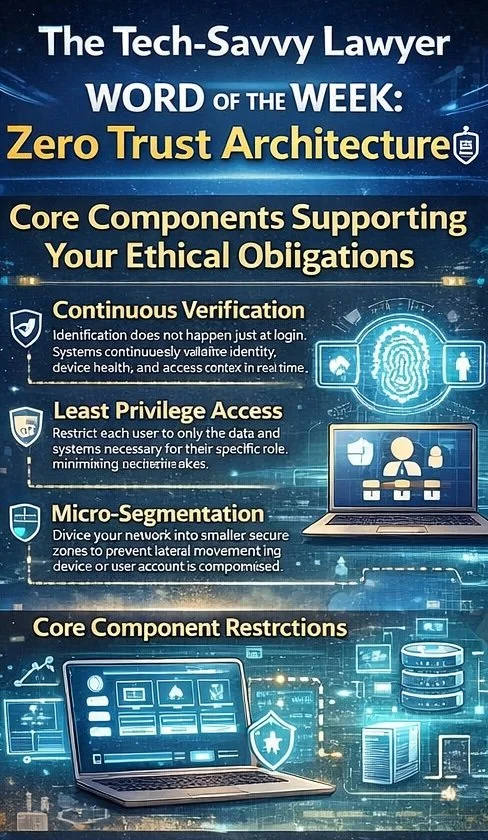
Core Components Supporting Your Ethical Obligations

Zero Trust Architecture operates through three interconnected principles aligned with ABA requirements.

legal professionals do you know the core components of modern cyber security?

  • Continuous verification means that authentication does not happen once at login. Instead, systems continuously validate user identity, device health, and access context in real time.

  • Least privilege access restricts each user to only the data and systems necessary for their specific role. An associate working on discovery does not need access to billing systems, and a paralegal in real estate does not need access to litigation files.

  • Micro-segmentation divides your network into smaller, secure zones. This prevents lateral movement, which means that if a bad actor compromises one device or user account, they cannot automatically access all firm systems.

ABA Model Rule 1.1, Comment 8 requires that lawyers maintain competence, including competence in "the benefits and risks associated with relevant technology." Understanding Zero Trust Architecture demonstrates that your firm maintains technological competence in cybersecurity matters. Additional critical components include multi-factor authentication, which requires users to verify their identity through multiple methods before accessing systems. Device authentication ensures that only approved and properly configured devices can connect to firm resources. End-to-end encryption protects data both at rest and in transit.

ABA Model Rule 1.4 requires lawyers to keep clients "reasonably informed about significant developments relating to the representation." Zero Trust Architecture supports this duty by protecting client information and enabling prompt client notification if security incidents occur.

ABA Model Rules 5.1 and 5.3 require supervisory lawyers and managers to ensure that subordinate lawyers and non-lawyer staff comply with professional obligations. Implementing Zero Trust creates the framework for effective supervision of cybersecurity practices across your entire firm.

Addressing Safekeeping Obligations

ABA Model Rule 1.15 requires lawyers to "appropriately safeguard" property of clients, including electronic information. Zero Trust Architecture provides the security infrastructure necessary to meet this safekeeping obligation. This rule mandates maintaining complete records of client property and preserving those records. Zero Trust's encryption and access controls ensure that stored records remain protected from unauthorized access.

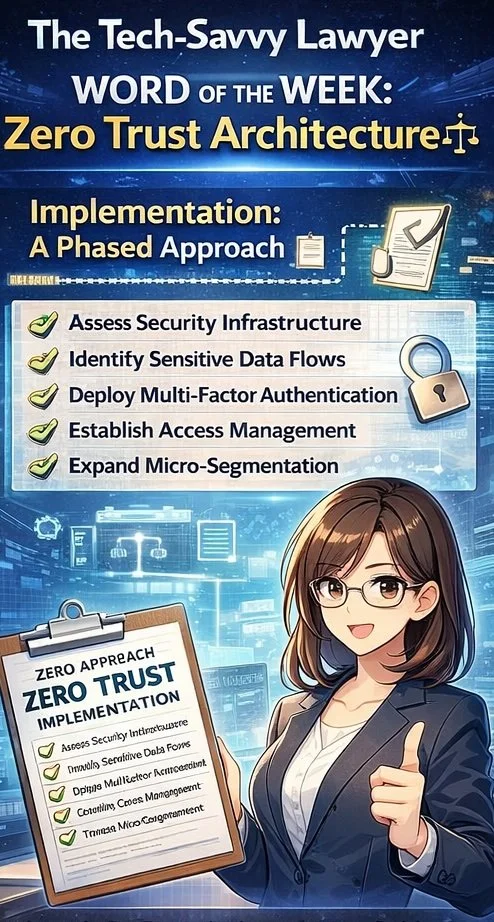
Implementation: A Phased Approach 📋

Implementing Zero Trust need not happen all at once. Begin by assessing your current security infrastructure and identifying sensitive data flows. Establish identity and access management systems to control who accesses what. Deploy multi-factor authentication across all applications. Then gradually expand micro-segmentation and monitoring capabilities as your systems mature. Document your efforts to demonstrate compliance with ABA Model Rule 1.6(c)'s requirement for "reasonable efforts."

Final Thoughts

Zero Trust Architecture transforms your firm's security posture from reactive protection to proactive verification while ensuring compliance with essential ABA Model Rules. For legal practices handling confidential client information, this security framework is not optional. It protects your clients, your firm's reputation, and your ability to practice law with integrity.

TSL Labs 🧪Bonus: 🎙️ From Cyber Compliance to Cyber Dominance: What VA's AI Revolution Means for Government Cybersecurity, Legal Ethics, and ABA Model Rule Compliance!

In this TSL Labs bonus episode, we examine this week’s editorial on how the Department of Veterans Affairs is leading a historic transformation from traditional compliance frameworks to a dynamic, AI-driven approach called "cyber dominance." This conversation unpacks what this seismic shift means for legal professionals across all practice areas—from procurement and contract law to privacy, FOIA, and litigation. Whether you're advising government agencies, representing contractors, or handling cases where data security matters, this discussion provides essential insights into how continuous monitoring, zero trust architecture, and AI-driven threat detection are redefining professional competence under ABA Model Rule 1.1. 💻⚖️🤖

Join our AI hosts and me as we discuss the following three questions and more!

  1. How has federal cybersecurity evolved from the compliance era to the cyber dominance paradigm? 🔒

  2. What are the three technical pillars—continuous monitoring, zero trust architecture, and AI-driven detection—and how do they interconnect? 🛡️

  3. What professional liability and ethical obligations do lawyers now face under ABA Model Rule 1.1 regarding technology competence? ⚖️

In our conversation, we cover the following:

  • [00:00:00] - Introduction: TSL Labs Bonus Podcast on VA's AI Revolution 🎯

  • [00:01:00] - Introduction to Federal Cybersecurity: The End of the Compliance Era 📋

  • [00:02:00] - Legal Implications and Professional Liability Under ABA Model Rules ⚖️

  • [00:03:00] - From Compliance to Continuous Monitoring: Understanding the Static Security Model 🔄

  • [00:04:00] - The False Comfort of Compliance-Only Approaches 🚨

  • [00:05:00] - The Shift to Cyber Dominance: Three Integrated Technical Pillars 💪

  • [00:06:00] - Zero Trust Architecture (ZTA) Explained: Verify Everything, Trust Nothing 🔐

  • [00:07:00] - AI-Driven Detection and Legal Challenges: Professional Competence Under Model Rule 1.1 🤖

  • [00:08:00] - The New Legal Questions: Real-Time Risk vs. Static Compliance 📊

  • [00:09:00] - Evolving Compliance: From Paper Checks to Dynamic Evidence 📈

  • [00:10:00] - Cybersecurity as Operational Discipline: DevSecOps and Security by Design 🔧

  • [00:11:00] - Litigation Risks: Discovery, Red Teaming, and Continuous Monitoring Data ⚠️

  • [00:12:00] - Cyber Governance with AI: Algorithmic Bias and Explainability 🧠

  • [00:13:00] - Synthesis and Future Outlook: Law Must Lead, Not Chase Technology 🚀

  • [00:14:00] - The Ultimate Question: Is Your Advice Ready for Real-Time Risk Management? 💡

  • [00:15:00] - Conclusion and Resources 📚

Resources

Mentioned in the Episode

Software & Cloud Services Mentioned in the Conversation

  • AI-Driven Detection Systems - Automated threat detection and response platforms

  • Automated Compliance Platforms - Dynamic evidence generation systems

  • Continuous Monitoring Systems - Real-time security assessment platforms

  • DevSecOps Tools - Automated security testing in software development pipelines

  • Firewalls - Network security hardware devices

  • Google Notebook AI - https://notebooklm.google.com/

  • Penetration Testing Software - Security vulnerability assessment tools

  • Zero Trust Architecture (ZTA) Solutions - Identity and access verification systems