TSL Labs 🧪Bonus: 🎙️ From Cyber Compliance to Cyber Dominance: What VA's AI Revolution Means for Government Cybersecurity, Legal Ethics, and ABA Model Rule Compliance!

In this TSL Labs bonus episode, we examine this week’s editorial on how the Department of Veterans Affairs is leading a historic transformation from traditional compliance frameworks to a dynamic, AI-driven approach called "cyber dominance." This conversation unpacks what this seismic shift means for legal professionals across all practice areas—from procurement and contract law to privacy, FOIA, and litigation. Whether you're advising government agencies, representing contractors, or handling cases where data security matters, this discussion provides essential insights into how continuous monitoring, zero trust architecture, and AI-driven threat detection are redefining professional competence under ABA Model Rule 1.1. 💻⚖️🤖

Join our AI hosts and me as we discuss the following three questions and more!

  1. How has federal cybersecurity evolved from the compliance era to the cyber dominance paradigm? 🔒

  2. What are the three technical pillars—continuous monitoring, zero trust architecture, and AI-driven detection—and how do they interconnect? 🛡️

  3. What professional liability and ethical obligations do lawyers now face under ABA Model Rule 1.1 regarding technology competence? ⚖️

In our conversation, we cover the following:

  • [00:00:00] - Introduction: TSL Labs Bonus Podcast on VA's AI Revolution 🎯

  • [00:01:00] - Introduction to Federal Cybersecurity: The End of the Compliance Era 📋

  • [00:02:00] - Legal Implications and Professional Liability Under ABA Model Rules ⚖️

  • [00:03:00] - From Compliance to Continuous Monitoring: Understanding the Static Security Model 🔄

  • [00:04:00] - The False Comfort of Compliance-Only Approaches 🚨

  • [00:05:00] - The Shift to Cyber Dominance: Three Integrated Technical Pillars 💪

  • [00:06:00] - Zero Trust Architecture (ZTA) Explained: Verify Everything, Trust Nothing 🔐

  • [00:07:00] - AI-Driven Detection and Legal Challenges: Professional Competence Under Model Rule 1.1 🤖

  • [00:08:00] - The New Legal Questions: Real-Time Risk vs. Static Compliance 📊

  • [00:09:00] - Evolving Compliance: From Paper Checks to Dynamic Evidence 📈

  • [00:10:00] - Cybersecurity as Operational Discipline: DevSecOps and Security by Design 🔧

  • [00:11:00] - Litigation Risks: Discovery, Red Teaming, and Continuous Monitoring Data ⚠️

  • [00:12:00] - Cyber Governance with AI: Algorithmic Bias and Explainability 🧠

  • [00:13:00] - Synthesis and Future Outlook: Law Must Lead, Not Chase Technology 🚀

  • [00:14:00] - The Ultimate Question: Is Your Advice Ready for Real-Time Risk Management? 💡

  • [00:15:00] - Conclusion and Resources 📚

Resources

Mentioned in the Episode

Software & Cloud Services Mentioned in the Conversation

  • AI-Driven Detection Systems - Automated threat detection and response platforms

  • Automated Compliance Platforms - Dynamic evidence generation systems

  • Continuous Monitoring Systems - Real-time security assessment platforms

  • DevSecOps Tools - Automated security testing in software development pipelines

  • Firewalls - Network security hardware devices

  • Google Notebook AI - https://notebooklm.google.com/

  • Penetration Testing Software - Security vulnerability assessment tools

  • Zero Trust Architecture (ZTA) Solutions - Identity and access verification systems
TSL Labs Bonus Podcast: Google’s Notebook LLM “Deep Dive” on December 1st, 2025, editorial on the the Lawyer’s Defense Against Holiday Scams and ‘Bargain’ Tech Traps!

Listen in as Google's Notebook LLM provides an AI-powered conversation unpacks our December 1st, 2025 editorial examining how the holiday digital marketplace transforms into a lucrative hunting ground for device compromise and credential theft. We explore why attorneys and paralegals—trained to spot hidden clauses and anticipate risk—often abandon professional skepticism when faced with shiny gadgets bearing 70% off stickers. Our discussion arms you with actionable strategies to protect your practice, safeguard client confidentiality, and prevent the kind of security breaches that trigger bar complaints and operational shutdowns. Whether you're a solo practitioner or part of a large firm, this episode delivers the technical insights you need without the jargon.

Join Google's Notebook LLM as we discuss the following three questions and more!

  1. How do bargain tech deals create hidden professional liabilities that extend far beyond wasted money, and what specific technical deficits should lawyers avoid in discount hardware?

  2. What free forensic tools can legal professionals use to distinguish genuine discounts from manipulated pricing schemes, and how do these tools apply procurement-level rigor to personal shopping decisions?

  3. Which three active scam vectors target high-value professionals during the holiday season, and what mandatory four-point protocol ensures comprehensive protection against credential theft and device compromise?

In our conversation, we cover the following:

  • [00:00:00] Welcome to TSL Labs Bonus Episode: AI-powered deep dive on holiday shopping risks

  • [00:01:00] Why legal professionals abandon professional skepticism during holiday sales

  • [00:02:00] The high stakes: credential theft, device compromise, and operational lockdown

  • [00:03:00] The bargain trap: understanding technical debt in cheap vs. inexpensive hardware

  • [00:04:00] Processor bottleneck red flags: older generation chips that consume billable time

  • [00:05:00] Screen resolution hazards: how 1366x768 displays create genuine error risks

  • [00:06:00] RAM deficits and security longevity: when devices become e-waste and compliance gaps

  • [00:07:00] Introduction to forensic price tracking tools for procurement-level shopping

  • [00:08:00] CamelCamelCamel, Keepa, and Honey: free tools that reveal true pricing history

  • [00:09:00] Malwarebytes 2025 holiday scam report: three attack vectors targeting professionals

  • [00:10:00] Scam #1: urgent delivery smishing attacks exploiting package expectations

  • [00:11:00] Scam #2: malvertising minefield—when legitimate ads redirect to cloned fraud sites

  • [00:12:00] Scam #3: gift card emergency scams posing as court clerks and government officials

  • [00:13:00] Bonus threat: social media marketplace fraud and payment protection gaps

  • [00:14:00] The mandatory four-point protocol for holiday shopping protection

  • [00:15:00] Final thoughts: applying contract-reading diligence to every link you click

Resources

Hardware Mentioned in the Conversation

Software & Cloud Services Mentioned in the Conversation

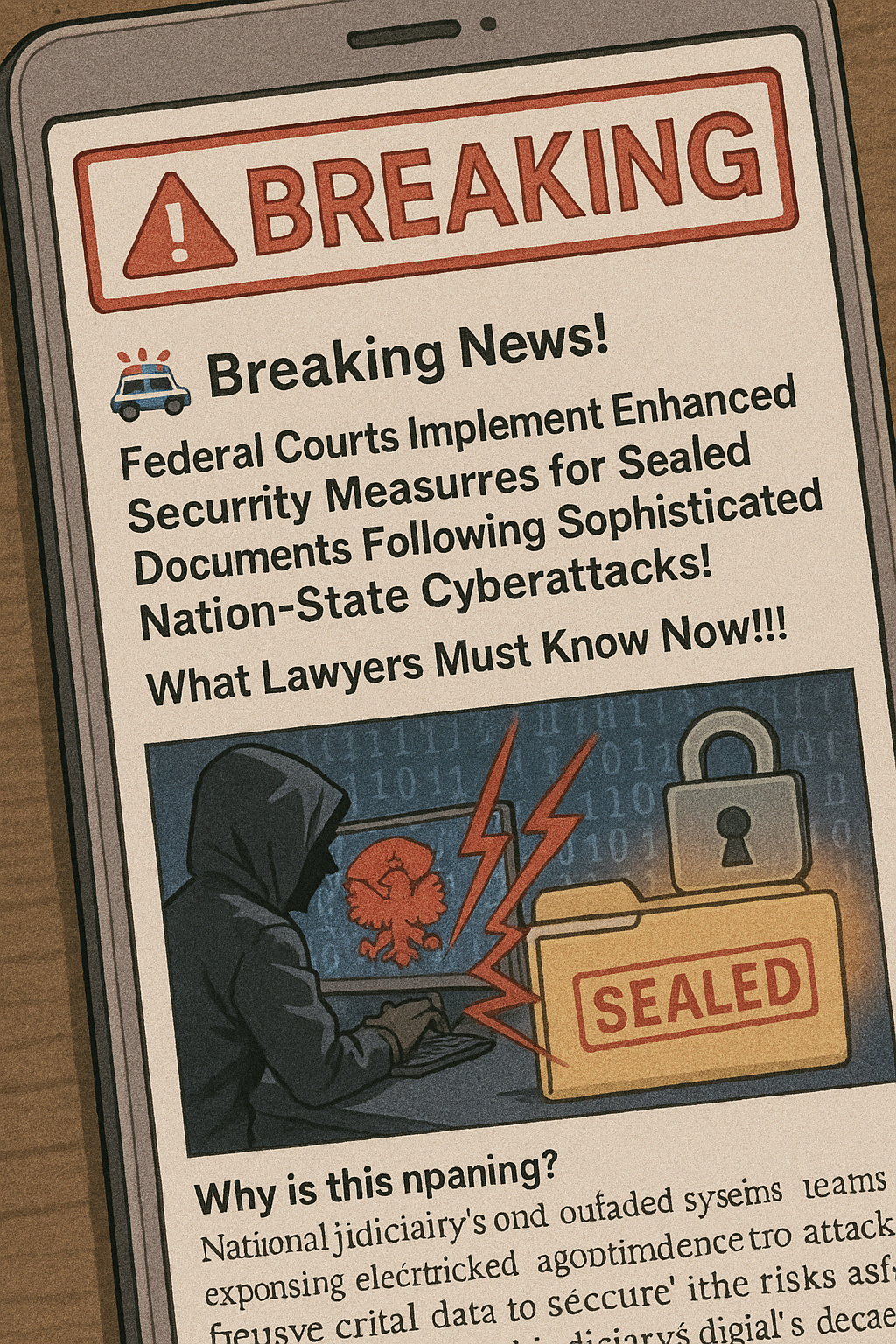
🚨 Breaking News! Federal Courts Implement Enhanced Security Measures for Sealed Documents Following Sophisticated Nation-State Cyberattacks! What Lawyers Must Know Now!!!

Federal courts have launched sweeping new protocols restricting electronic access to sealed documents after a widespread cyberattack linked to Russian actors exposed critical vulnerabilities in the federal judiciary’s decades-old digital infrastructure. As previously reported here, the breach compromised highly confidential information—such as sealed indictments and informant data—across numerous districts, prompting courts to eliminate electronic viewing of sealed filings and require paper-only procedures for sensitive court documents.

what do lawyers need to do as Federal courts respond to cyber attacks?

Why is this happening?
Nation-state cyber threats and outdated systems left federal courts open to attack, as repeatedly warned by The Tech-Savvy Lawyer.Page. The blog has consistently flagged the risks associated with aging technology, weak authentication, and the need for law firms to adopt advanced cybersecurity practices. The recent breach brings these warnings to life, forcing immediate changes for all legal professionals.

What lawyers must do:
Attorneys must now file sealed documents according to new court protocols—usually paper filings—and cannot access them electronically. This transformation demands lawyers take proactive steps to secure confidential information at all times, in line with ABA Model Rule 1.6. Practitioners should review The Tech-Savvy Lawyer.Page for practical tips on ethical compliance and digital preparedness, such as those featured in its “go bag” guide for legal professionals.

Most importantly, consult your local federal court’s website or clerk for the latest procedures, as requirements may vary by district. Safeguarding client confidentiality remains central to legal ethics—stay vigilant, stay informed, and stay tech-savvy.

MTC: Is Puerto Rico’s Professional Responsibility Rule 1.19 Really Necessary? A Technology Competence Perspective.

Is PR’s Rule 1.19 necessary?

The legal profession stands at a crossroads regarding technological competence requirements. With forty states already adopting Comment 8 to Model Rule 1.1, which mandates lawyers "keep abreast of changes in the law and its practice, including the benefits and risks associated with relevant technology," the question emerges: do we need additional rules like PR Rule 1.19?

Comment 8 to Rule 1.1 establishes clear parameters for technological competence. This amendment, adopted by the ABA in 2012, expanded the traditional duty of competence beyond legal knowledge to encompass technological proficiency. The Rule requires lawyers to understand the "benefits and risks associated with relevant technology" in their practice areas.

The existing framework appears comprehensive. Comment 8 already addresses core technological competencies, including e-discovery, cybersecurity, and client communication systems. Under Rule 1.1 (Comment 5), legal professionals must evaluate whether their technological skills meet "the standards of competent practitioners" without requiring additional regulatory layers.

However, implementation challenges persist. Many attorneys struggle with the vague standard of "relevant technology". The rule's elasticity means that competence requirements continuously evolve in response to technological advancements. Some jurisdictions, like Puerto Rico (see PR’s Supreme Court’s Order ER-2025-02 approving adoption of its full set of Rules of Professional Conduct, have created dedicated technology competence rules (Rule 1.19) to provide clearer guidance.

The verdict: redundancy without added value. Rather than creating overlapping rules, the legal profession should focus on robust implementation of existing Comment 8 requirements. Enhanced continuing legal education mandates, clearer interpretive guidance, and practical competency frameworks would better serve practitioners than additional regulatory complexity.

Technology competence is essential, but regulatory efficiency should guide our approach. 🚀

Word of the Week: “Phishing” 🎣 in the Legal Profession - What Every Lawyer Needs to Know in 2025 🛡️

Lawyers Battle phishing on a daily basis.

Phishing is one of the most persistent and dangerous cyber threats facing law firms today. Phishing is a form of computer and internet fraud in which criminals use fake emails, websites, or messages to trick recipients into revealing sensitive information such as passwords, bank details, or client data. For lawyers and legal professionals, the stakes are especially high: law firms hold vast amounts of confidential client information, making them prime targets for cybercriminals. The American Bar Association (ABA) Model Rules for Professional Conduct, particularly Rule 1.6 (Confidentiality of Information) and Rule 1.1 (Competence), require lawyers to protect client data and maintain competence in technology relevant to their practice.

How Phishing Targets Law Firms

Phishing attacks against law firms have become more sophisticated in 2025. Criminals now use generative AI to craft emails that closely mimic real communications from clients, colleagues, or even senior partners. These messages often create a sense of urgency, pressuring recipients to act quickly—such as transferring funds, sharing login credentials, or downloading malicious attachments. Business Email Compromise (BEC) scams are particularly damaging, as attackers impersonate managing partners or clients to divert wire transfers or request sensitive documents.

Impersonation: The Hidden Dangers in Your Inbox

Attackers often use email spoofing to manipulate the display name and email address, making a message appear to come from someone you trust. The display name (the name that appears in your inbox) can be set to any familiar contact, but the actual email address may be subtly altered or completely fake. For example, a scammer might use “john.smith@lawfirm.com”or “John Smith of ….” as the display name, but the underlying address could be “jjohn.smith@lawf1rm.com” or “john..john.smith@lawfirm.co@lawfirm.co.” These changes are often just a single character off, designed to trick you into replying or clicking a malicious link.

Lawyers should always examine the full email address, not just the display name, before responding or acting on any request. On many smartphones and email clients, only the display name is shown by default, so you may need to click or tap to reveal the actual sender’s email address. If the message requests sensitive information, money transfers, or urgent action, verify the request through a separate communication channel, such as a phone call using a known number—not one provided in the suspicious email. This vigilance aligns with ABA Model Rule 1.1, which requires lawyers to maintain competence, including understanding risks associated with technology.

Recent Phishing Incidents Involving Lawyers

Phishing Email Threatens Law Firm Cybersecurity Defense

What Lawyers Should Watch For

  • Impersonation: Always check the sender’s full email address, not just the display name. Watch for addresses that are off by one or more characters.

  • Urgency and Pressure: Be cautious of emails that demand immediate action, especially those involving money or confidential data.

  • Suspicious Links or Attachments: Hover over links to check their true destination, and never open unexpected attachments.

  • Unusual Requests: Be wary of requests outside normal procedures, such as buying gift cards or changing payment instructions.

Prevention and Best Practices

  • Employee Training: Regular cybersecurity awareness training is crucial. Staff should be able to recognize phishing attempts and know how to report them. This supports ABA Model Rule 5.3 (Responsibilities Regarding Nonlawyer Assistance).

  • Multi-Factor Authentication (MFA): MFA adds an extra layer of security, making it harder for attackers to access accounts even if credentials are compromised.

  • Incident Response Plan: Every law firm should have a clear plan for responding to phishing incidents, including communication protocols and legal obligations for breach notification.

  • Client Education: Educate clients about phishing risks and encourage them to verify any unusual requests that appear to come from your firm.

Professional Responsibility and Phishing

lawyers need to be proactive Against Cybersecurity Threats in 2025!

The ABA Model Rules make clear that lawyers must take reasonable steps to prevent unauthorized access to client information (Rule 1.6(c)). Lawyers must also keep abreast of changes in technology and its associated risks (Rule 1.1, Comment 8). Failing to implement basic cybersecurity measures, such as phishing awareness and email verification, may expose lawyers to disciplinary action and civil liability.

Final Thoughts

Phishing is not just an IT problem—it’s a business risk that can compromise client trust, cause financial loss, and result in legal liability. By staying vigilant, investing in training, and adopting robust security measures, lawyers can protect themselves, their clients, and their reputations in an increasingly digital world. Compliance with the ABA Model Rules is not optional—it's essential for ethical and effective law practice.

BOLO: LexisNexis Data Breach: What Legal Professionals Need to Know Now—and Why All Lexis Products Deserve Scrutiny!

LAWYERS NEED TO BE BOTH TECH-SAVVY AND Cyber-SavvY!

On December 25, 2024, LexisNexis Risk Solutions (LNRS)—a major data broker and subsidiary of LexisNexissuffered a significant data breach that exposed the personal information of over 364,000 individuals. This incident, which went undetected until April 2025, highlights urgent concerns for legal professionals who rely on LexisNexis and its related products for research, analytics, and client management.

What Happened in the LexisNexis Breach?

Attackers accessed sensitive data through a third-party software development platform (GitHub), not LexisNexis’s internal systems. The compromised information includes names, contact details, Social Security numbers, driver’s license numbers, and dates of birth. Although LexisNexis asserts that no financial or credit card data was involved and that its main systems remain secure, the breach raises red flags about the security of data handled across all Lexis-branded platforms.

Why Should You Worry About Other Lexis Products?

LexisNexis Risk Solutions is just one division under the LexisNexis and RELX umbrella, which offers a suite of legal, analytics, and data products widely used by law firms, courts, and corporate legal departments. The breach demonstrates that vulnerabilities may not be limited to one product or platform; third-party integrations, development tools, and shared infrastructure can all present risks. If you use LexisNexis for legal research, client intake, or case management, your clients’ confidential data could be at risk—even if the breach did not directly affect your specific product.

Ethical Implications: ABA Model Rules of Professional Conduct

ALL LawyerS NEED TO BE PREPARED TO FighT Data LeakS!

The American Bar Association’s Model Rules of Professional Conduct require lawyers to safeguard client information and maintain competence in technology. Rule 1.6(c) mandates that attorneys “make reasonable efforts to prevent the inadvertent or unauthorized disclosure of, or unauthorized access to, information relating to the representation of a client.” Rule 1.1 further obligates lawyers to keep abreast of changes in law and its practice, including the benefits and risks associated with relevant technology.

In light of the LexisNexis breach, lawyers must:

  • Assess the security of all third-party vendors, including legal research and data analytics providers.

  • Promptly notify clients if their data may have been compromised, as required by ethical and sometimes statutory obligations.

  • Implement additional safeguards, such as multi-factor authentication and regular vendor risk assessments.

  • Stay informed about ongoing investigations and legal actions stemming from the breach.

What Should Legal Professionals Do Next?

  • Review your firm’s use of LexisNexis and related products.

  • Ask vendors for updated security protocols and breach response plans.

  • Consider offering affected clients identity protection services.

  • Update internal policies to reflect heightened risks associated with third-party platforms.

The Bottom Line

The LexisNexis breach is a wake-up call for the legal profession. Even if your primary Lexis product was not directly affected, the interconnected nature of modern legal technology means your clients’ data could still be at risk. Proactive risk management and ethical vigilance are now more critical than ever.