MTC: Why Is AI Slop Still Front-Page News in Law? 🚨 A Florida Bar Referral, the ABA Model Rules, and What Every Lawyer Must Do Now!

🚨 why are lawyers still using ai slop?!

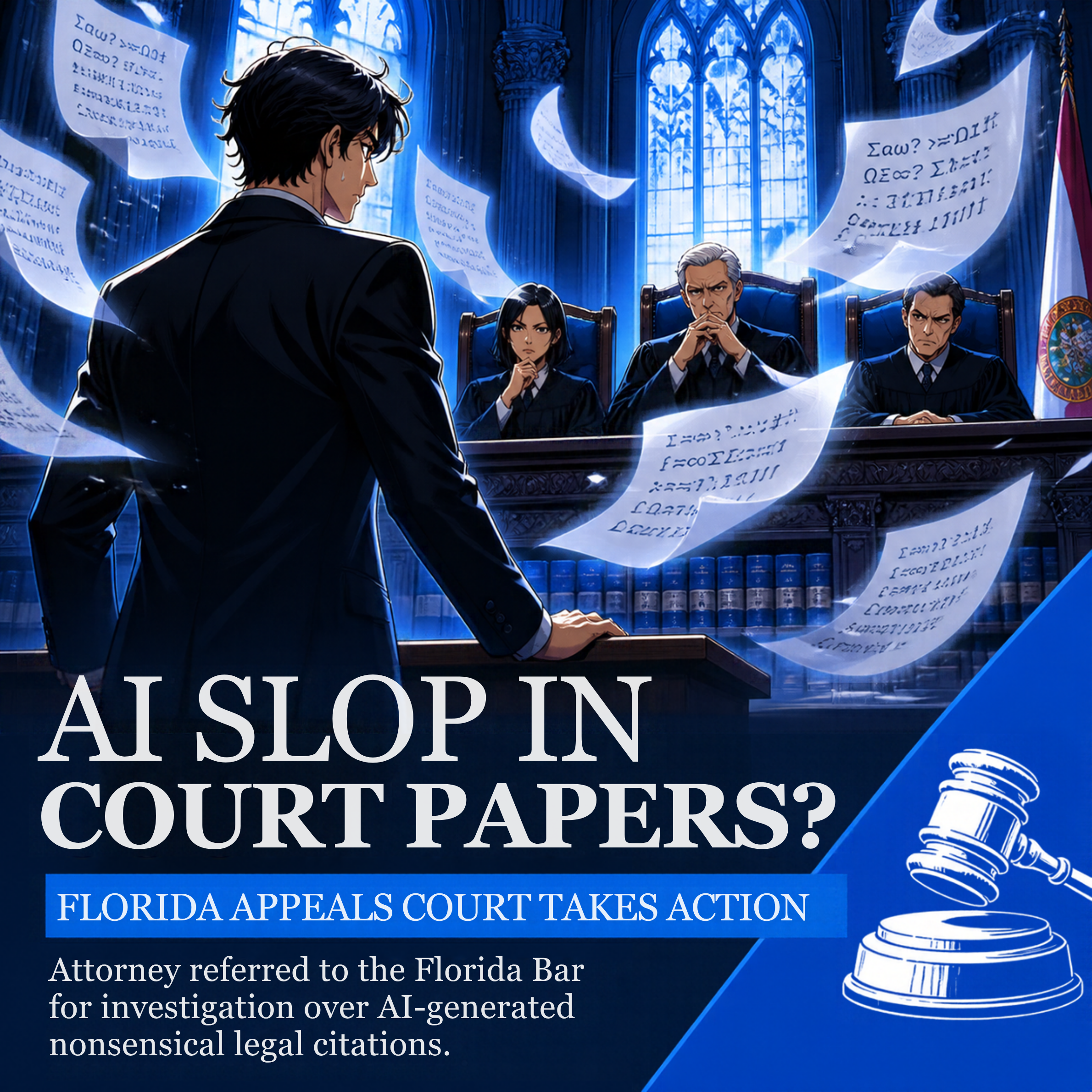
I keep hoping the AI-hallucination story has run its course. 📰 Then another court opinion lands, and the headline writes itself again. The newest example comes from Joseph A. Corsmeier, whose Lawyer Ethics Alert post, "Florida Appeals court refers lawyer to The Florida Bar for investigation related to AI generated "slop" in court documents," should stop every practitioner mid-scroll. 🛑

So why is AI slop in the practice of law still front-page news in late 2026? After years of warnings, sanctions, and CLEs, it is a fair question.

What Happened in Florida ⚖️

According to Joseph, Florida's Fourth District Court of Appeal issued an opinion on October 21, 2026, referring a lawyer to the Florida Bar for investigation and potential discipline. The case arose from a marriage dissolution involving parenting, visitation, and a guardian ad litem.

The court's September 16 order had already denied the lawyer's petition for a writ of prohibition. It also ordered her to show cause why she should not be sanctioned. The court described her filings as lengthy, unfocused, confusing, and at times inconsistent with the record. The volume was striking. 📚 There was a 41-page request for multiple forms of relief. There was an 11-page emergency motion and three motions in limine. There was a 33-page motion to disqualify the trial judge. The petition itself ran 61 pages. Her response to the show-cause order ran 82 pages.

Here is the detail I cannot get past. The court noted that the cited cases existed. This was not a classic fake-citation case. Yet the motion to disqualify contained a lengthy false quotation attributed to a decision of that very court. The lawyer called it "human error" from drafting under "time pressure." The court responded: "Until AI, and until this case, we never encountered lawyers 'hallucinating' non-existent quotations." 😳

The line that should concern all of us came at the end: "That counsel believes her practice in this case is acceptable raises many issues that the Florida Bar should consider."

Why Is This Still Happening? 🤔

Lawyers who use AI have the Duty to Verify Every Court Filing 🔎

I have written about this problem repeatedly, from "Why Are Lawyers Still Failing at AI Legal Research? The Alarming Rise of AI Hallucinations in Courtrooms" to "MTC: AI Hallucinated Cases Are Now Shaping Court Decisions." Lawyers know the risk. I see five reasons it persists.

  1. Fluency feels like accuracy. 🧠 Generative AI writes with confidence. Polished prose triggers what researchers call automation bias. We trust output that sounds right. A quotation that reads like appellate language feels authentic, even when no judge ever wrote it.

  2. Time pressure is the reason, not the excuse. ⏰ Solo and small-firm lawyers juggle emergency motions, clients in crisis, and thin margins. AI promises relief. But "time pressure" is exactly when verification gets skipped. That is when errors reach the court.

  3. Length looks like effort. 📄 AI makes pages cheap. A judge's time is not. Some lawyers seem to believe more pages signal more advocacy. Courts disagree. Volume without judgment is the very definition of slop.

  4. "The case exists" is not verification. 🔍 Many lawyers now check that a cited case is real. Fewer confirm that the case says what the brief claims, word for word. The Florida opinion shows this gap clearly. Real cases, wrong quotation, same professional failure. I addressed a related blind spot in "MTC: When Reputable Databases Fail: What Lawyers Must Do After AI Hallucinations Reach the Court."

  5. Some lawyers do not know what they do not know. 🎓 Many practitioners learned AI from marketing, not training. They see a tool, not a duty. That is why the court's closing line matters. The most dangerous lawyer is not the one who makes a mistake. It is the one who believes the practice is acceptable.

The ABA Model Rules Already Answer This 📜

lawyers should scruitinize their use of ai like their license depends on it.

The Florida referral will be judged under the Rules Regulating The Florida Bar. Still, the ABA Model Rules frame the same duties every lawyer carries.

ABA Formal Opinion 512 (July 2024) puts it plainly. Lawyers using generative AI must understand its capabilities and limits. They must also independently review its output. As I said in "MTC: Even Though AI Hallucinations Are Down: Lawyers Still Must Verify AI, Guard PII, and Follow ABA Ethics Rules," fewer errors do not mean zero errors.

A Practical Checklist for Monday Morning ✅

lawyers need to balance Innovation With Professional Responsibility

  • Read every authority you cite. Pull it from a trusted database or official reporter yourself.

  • Copy quotations from the source, never from the AI draft. Then compare them word for word.

  • Cite the record precisely. Unofficial or rough transcripts deserve a clear caveat.

  • Edit for length. Ask what the judge actually needs to rule. Then cut the rest. ✂️

  • Build a verification buffer into deadlines. Emergency filings need more review, not less.

  • Adopt a written firm AI policy. It should cover approved tools, review steps, and supervision.

  • Check your court's standing orders. Many judges now require AI-use disclosures, as I discussed in "MTC: AI in Court Filings: What Now Are Judges Now Scrutinizing Lawyers and Pro Se Litigants About AI Use."

Final Thoughts 💡

AI slop stays on the front page because it keeps happening. Each new opinion erodes the bar's credibility. The fix is not to abandon AI. It is to treat AI output like a first-year associate's rough draft: useful, fast, and never filed without a careful lawyer's review. 🤝

The lesson remains the same:  “Review, Review, Review” your work before you file! 😯

Happy Lawyering! ⚖️

MTC

MTC: Is Puerto Rico’s Professional Responsibility Rule 1.19 Really Necessary? A Technology Competence Perspective.

Is PR’s Rule 1.19 necessary?

The legal profession stands at a crossroads regarding technological competence requirements. With forty states already adopting Comment 8 to Model Rule 1.1, which mandates lawyers "keep abreast of changes in the law and its practice, including the benefits and risks associated with relevant technology," the question emerges: do we need additional rules like PR Rule 1.19?

Comment 8 to Rule 1.1 establishes clear parameters for technological competence. This amendment, adopted by the ABA in 2012, expanded the traditional duty of competence beyond legal knowledge to encompass technological proficiency. The Rule requires lawyers to understand the "benefits and risks associated with relevant technology" in their practice areas.

The existing framework appears comprehensive. Comment 8 already addresses core technological competencies, including e-discovery, cybersecurity, and client communication systems. Under Rule 1.1 (Comment 5), legal professionals must evaluate whether their technological skills meet "the standards of competent practitioners" without requiring additional regulatory layers.

However, implementation challenges persist. Many attorneys struggle with the vague standard of "relevant technology". The rule's elasticity means that competence requirements continuously evolve in response to technological advancements. Some jurisdictions, like Puerto Rico (see PR’s Supreme Court’s Order ER-2025-02 approving adoption of its full set of Rules of Professional Conduct, have created dedicated technology competence rules (Rule 1.19) to provide clearer guidance.

The verdict: redundancy without added value. Rather than creating overlapping rules, the legal profession should focus on robust implementation of existing Comment 8 requirements. Enhanced continuing legal education mandates, clearer interpretive guidance, and practical competency frameworks would better serve practitioners than additional regulatory complexity.

Technology competence is essential, but regulatory efficiency should guide our approach. 🚀

MTC: Lawyers, Generative AI, and the Right to Privacy: Navigating Ethics, Client Confidentiality, and Public Data in the Digital Age

Modern attorneys need to tackle AI ethics and privacy risks.

The legal profession stands at a critical crossroads as generative AI tools like ChatGPT become increasingly integrated into daily practice. While these technologies offer unprecedented efficiency and insight, they also raise urgent questions about client privacy, data security, and professional ethics—questions that every lawyer, regardless of technical proficiency, must confront.

Recent developments have brought these issues into sharp focus. OpenAI, the company behind ChatGPT, was recently compelled to preserve all user chats for legal review, highlighting how data entered into generative AI systems can be stored, accessed, and potentially scrutinized by third parties. For lawyers, this is not a theoretical risk; it is a direct challenge to the core obligations of client confidentiality and the right to privacy.

The ABA Model Rules and Generative AI

The American Bar Association’s Model Rules of Professional Conduct are clear: Rule 1.6 requires lawyers to “act competently to safeguard information relating to the representation of a client against unauthorized access by third parties and against inadvertent or unauthorized disclosure”. This duty extends beyond existing clients to former and prospective clients under Rules 1.9 and 1.18. Crucially, the obligation applies even to information that is publicly accessible or contained in public records, unless disclosure is authorized or consented to by the client.

Attorneys need to explain generative AI privacy concerns to client.

The ABA’s recent Formal Opinion 512 underscores these concerns in the context of generative AI. Lawyers must fully consider their ethical obligations, including competence, confidentiality, informed consent, and reasonable fees when using AI tools. Notably, the opinion warns that boilerplate consent in engagement letters is not sufficient; clients must be properly informed about how their data may be used and stored by AI systems.

Risks of Generative AI: PII, Case Details, and Public Data

Generative AI tools, especially those that are self-learning, can retain and reuse input data, including Personally Identifiable Information (PII) and case-specific details. This creates a risk that confidential information could be inadvertently disclosed or cross-used in other cases, even within a closed firm system. In March 2023, a ChatGPT data leak allowed users to view chat histories of others, illustrating the real-world dangers of data exposure.

Moreover, lawyers may be tempted to use client public data—such as court filings or news reports—in AI-powered research or drafting. However, ABA guidance and multiple ethics opinions make it clear: confidentiality obligations apply even to information that is “generally known” or publicly accessible, unless the client has given informed consent or an exception applies. The act of further publicizing such data, especially through AI tools that may store and process it, can itself breach confidentiality.

Practical Guidance for the Tech-Savvy (and Not-So-Savvy) Lawyer

Lawyers can face disciplinary hearing over unethical use of generative AI.

The Tech-Savvy Lawyer.Page Podcast Episode 99, “Navigating the Intersection of Law Ethics and Technology with Jayne Reardon and other The Tech-Savvy Lawyer.Page postings offer practical insights for lawyers with limited to moderate tech skills. The message is clear: lawyers must be strategic, not just enthusiastic, about legal tech adoption. This means:

  • Vetting AI Tools: Choose AI platforms with robust privacy protections, clear data handling policies, and transparent security measures.

  • Obtaining Informed Consent: Clearly explain to clients how their information may be used, stored, or processed by AI systems—especially if public data or PII is involved.

  • Limiting Data Input: Avoid entering sensitive client details, PII, or case specifics into generative AI tools unless absolutely necessary and with explicit client consent.

  • Monitoring for Updates: Stay informed about evolving ABA guidance, state bar opinions, and the technical capabilities of AI tools.

  • Training and Policies: Invest in ongoing education and firm-wide policies to ensure all staff understand the risks and responsibilities associated with AI use.

Conclusion

The promise of generative AI in law is real, but so are the risks. As OpenAI’s recent legal challenges and the ABA’s evolving guidance make clear, lawyers must prioritize privacy, confidentiality, and ethics at every step. By embracing technology with caution, transparency, and respect for client rights, legal professionals can harness AI’s benefits without compromising the foundational trust at the heart of the attorney-client relationship.

MTC

MTC: Florida Bar's Proposed Listserv Rule: A Digital Wake-Up Call for Legal Professionals.

not just Florida Lawyers should be reacting to New Listserv Ethics Rules!

The Florida Bar's proposed Advisory Opinion 25-1 regarding lawyers' use of listservs represents a crucial moment for legal professionals navigating the digital landscape. This proposed guidance should serve as a comprehensive reminder about the critical importance of maintaining client confidentiality in our increasingly connected professional world.

The Heart of the Matter: Confidentiality in Digital Spaces 💻

The Florida Bar's Professional Ethics Committee has recognized that online legal discussion groups and peer-to-peer listservs provide invaluable resources for practitioners. These platforms facilitate contact with experienced professionals and offer quick feedback on legal developments. However, the proposed opinion emphasizes that lawyers participating in listservs must comply with Rule 4-1.6 of the Rules Regulating The Florida Bar.

The proposed guidance builds upon the American Bar Association's Formal Opinion 511, issued in 2024, which prohibits lawyers from posting questions or comments relating to client representations without informed consent if there's a reasonable likelihood that client identity could be inferred. This nationwide trend reflects growing awareness of digital confidentiality challenges facing modern legal practitioners.

National Landscape of Ethics Opinions 📋

🚨 BOLO: florida is not the only state that has rules related to lawyers discussing cases online!

The Florida Bar's approach aligns with a broader national movement addressing lawyer ethics in digital communications. Multiple jurisdictions have issued similar guidance over the past two decades. Maryland's Ethics Opinion 2015-03 established that hypotheticals are permissible only when there's no likelihood of client identification. Illinois Ethics Opinion 12-15 permits listserv guidance without client consent only when inquiries won't reveal client identity.

Technology Competence and Professional Responsibility 🎯

I regularly addresses these evolving challenges for legal professionals. As noted in many of The Tech-Savvy Lawyer.Page Podcast's discussions, lawyers must now understand both the benefits and risks of relevant technology under ABA Model Rule 1.1 Comment 8. Twenty-seven states have adopted revised versions of this comment, making technological competence an ethical obligation.

The proposed Florida rule reflects this broader trend toward requiring lawyers to understand their digital tools. Comment 8 to Rule 1.1 advises lawyers to "keep abreast of changes in the law and its practice," including technological developments. This requirement extends beyond simple familiarity to encompass understanding how technology impacts client confidentiality.

Practical Implications for Legal Practice 🔧

The proposed advisory opinion provides practical guidance for lawyers who regularly participate in professional listservs. Prior informed consent is recommended when there's reasonable possibility that clients could be identified through posted content or the posting lawyer's identit1. Without such consent, posts should remain general and abstract to avoid exposing unnecessary information.

The guidance particularly affects in-house counsel and government lawyers who represent single clients, as their client identities would be obvious in any posted questions. These practitioners face heightened scrutiny when participating in online professional discussions.

Final Thoughts: Best Practices for Digital Ethics ✅

Florida lawyers need to know their state rules before discussing cases online!

Legal professionals should view the Florida Bar's proposed guidance as an opportunity to enhance their digital practice management. The rule encourages lawyers to obtain informed consent at representation's outset when they anticipate using listservs for client benefit. This proactive approach can be memorialized in engagement agreements.

The proposed opinion also reinforces the fundamental principle that uncertainty should be resolved in favor of nondisclosure. This conservative approach protects both client interests and lawyer professional standing in our digitally connected legal ecosystem.

The Florida Bar's proposed Advisory Opinion 25-1 represents more than regulatory housekeeping. It provides essential guidance for legal professionals navigating increasingly complex digital communication landscapes while maintaining the highest ethical standards our profession demands.

MTC