🎙Bonus Episode: TSL Labs's 🧪 Deep Dive into our July 13, 2026, Editorial, Law School, Laptops, and AI: Why Banning Computers Misses the Point!

Join us for an AI-powered deep dive into the ethical challenges facing legal professionals in the age of generative AI. 🤖 In this episode, we unpack our editorial “Law School, Laptops and AI: Why Banning Computers Misses the Point,” and explore why laptop bans in law schools are less about ethics and more about administrative convenience — and how that choice could leave future lawyers unprepared for a fully digital profession.

In our conversation, we cover the following

00:00:00 — From “no calculators” to “no laptops”: how old tech panics mirror today’s AI fears in legal education 📚🧮

00:01:00 — AI panic hits law schools: blanket bans on generative AI and even laptops in the classroom 🎓⚠️

00:02:00 — Why Michael supports limiting AI in 1L while still opposing laptop bans: building foundational legal judgment 💪⚖️

00:03:00 — ABA Model Rule 1.1 and competence: why early overreliance on AI short-circuits “intellectual muscle” 🧠

00:05:00 — Why banning laptops “misses the point”: the scalpel vs leeches analogy and modern legal training 🩺🖥️

00:06:00 — Accessibility and fairness: Michael’s 2002 law school story and laptops as essential accessibility tools ✍️💻

00:07:00 — Digital-native students and analog exams: how bans unfairly shift the playing field instead of leveling it 🎯

00:08:00 — Law practice is 100% digital: e‑discovery, e‑filing, and why stripping laptops undermines tech competence 🌐📑

00:08:30 — ABA Model Rule 1.1, Comment 8: the ethical duty to understand the benefits and risks of relevant technology 📘

00:09:30 — Lazy enforcement: why laptop bans are about visual policing, not thoughtful AI policy 🧍‍♂️👀

00:10:00 — ABA Model Rule 5.3: supervising AI as a “digital clerk” and why hiding the tech creates ethical gaps 🤖📎

00:11:30 — Guardrails, not prohibitions: network geofencing, offline laptops, and locked‑down software environments 🧱📶

00:12:30 — Clear AI policies in assignments: when AI is permitted, when it is prohibited, and how disclosure builds discipline 📝

00:13:00 — Teaching prompt engineering as a core legal skill: delegation, context, and structured AI use 🧩

00:13:30 — ABA Model Rule 1.6 and confidentiality: the risks of pasting client secrets into public AI tools 🔐

00:14:30 — Cognitive offloading vs cognitive atrophy: why tech can strengthen legal reasoning when used wisely 🧠⚙️

00:16:00 — Verifying AI outputs: hallucinations, fake cases, and training students to check everything against primary law 📚

00:17:00 — Temptation vs discipline: why bans don’t teach judgment, but supervised AI use can 🎯

00:18:00 — The false dichotomy: foundational human judgment vs tech competence and why future lawyers must have both ⚖️💡

00:19:00 — The future horizon: when AI becomes the “senior partner” and the lawyer becomes the supervisor‑in‑chief 🧑‍⚖️🤖

00:20:00 — Final challenge: law schools can’t ban their way out of the future — they have to teach students to wield the tools safely 🔍🚀

RESOURCES

Mentioned in the episode

Software & Cloud Services mentioned in the conversation

If you care about the future of legal education, client protection, and real‑world tech competence, hit play now and then share this episode with a colleague who still thinks “just ban the laptops” is a solution. 🎧💬

📢 Your Tech-Savvy Lawyer Blogger and Podcaster, Michael D.J. Eisenberg, Announces His Upcoming Talk on Ethical AI Use in Legal Practice at the 2026 AI Legal Practice Summit!

Saturday, April 18, 2026 | Capital University Law School

As technology continues to transform legal practice, I’m honored to announce that I’ll be speaking at the 2026 AI Legal Practice Summit, hosted by my alma mater, Capital University Law School, in Columbus, Ohio. This event brings together attorneys, educators, and technologists to explore how artificial intelligence is reshaping the legal field — not just operationally, but ethically and professionally as well.

My presentation, “Smart Practice, Smarter Ethics: Navigating AI Tools Under the ABA Model Rules,” focuses on a topic that’s both timely and critically important: how lawyers can use emerging AI technologies responsibly while meeting their professional obligations under the ABA Model Rules of Professional Conduct.

👉 Learn more and view the full schedule at law-capital.libguides.com/2026_AI_Legal_Practice_Summit.
🎟️ Register today through Eventbrite: eventbrite.com/e/ai-legal-practice-summit-tickets-1986544900273.

Through my work on The Tech-Savvy Lawyer.Page blog and podcast, I’ve had countless conversations with practitioners who want to use AI to streamline tasks such as research, document drafting, and client management — yet remain uncertain about compliance, bias, and confidentiality. Law practice is evolving rapidly, but our ethical foundations must remain strong.

In my session, I’ll walk through key aspects of how the ABA Model Rules, including Rules 1.1 (Competence), 1.6 (Confidentiality of Information), and 5.3 (Responsibilities Regarding Nonlawyer Assistance), apply in an age of intelligent automation. These rules guide us in assessing not just what technology can do, but how and when it should be used.

Your faculty!

We’ll discuss:

  • Reviewing the tech stack you already own;

  • How to vet and implement AI-powered tools while maintaining confidentiality.

  • Questions to ask vendors about data handling and bias;

  • How to document best practices for firm-wide ethical compliance;

  • Ways to blend human legal judgment with algorithmic assistance; and

  • Managing client expectations about AI-enabled legal work.

My goal is to help attorneys approach technology with confidence — to experiment, adopt, and adapt responsibly. Being a “tech‑savvy lawyer” isn’t about mastering every gadget or platform; it’s about understanding how technology fits within the ethical framework of our profession.

The conversation around technological competence has matured since Comment 8 to Rule 1.1 was introduced. It’s no longer optional. Attorneys must understand the benefits, risks, and limitations of relevant technology to provide competent representation. Artificial intelligence highlights that reality better than any emerging tool before it.

Whether you’re a solo practitioner looking to automate administrative tasks, working for a government agency, or part of a large firm implementing AI-assisted legal research or document review, I’ll share specific practices you can adopt immediately.

If you’re attending and seeking Ohio CLE credit, please contact Jenny Wondracek at jwondracek@law.capital.edu for details.

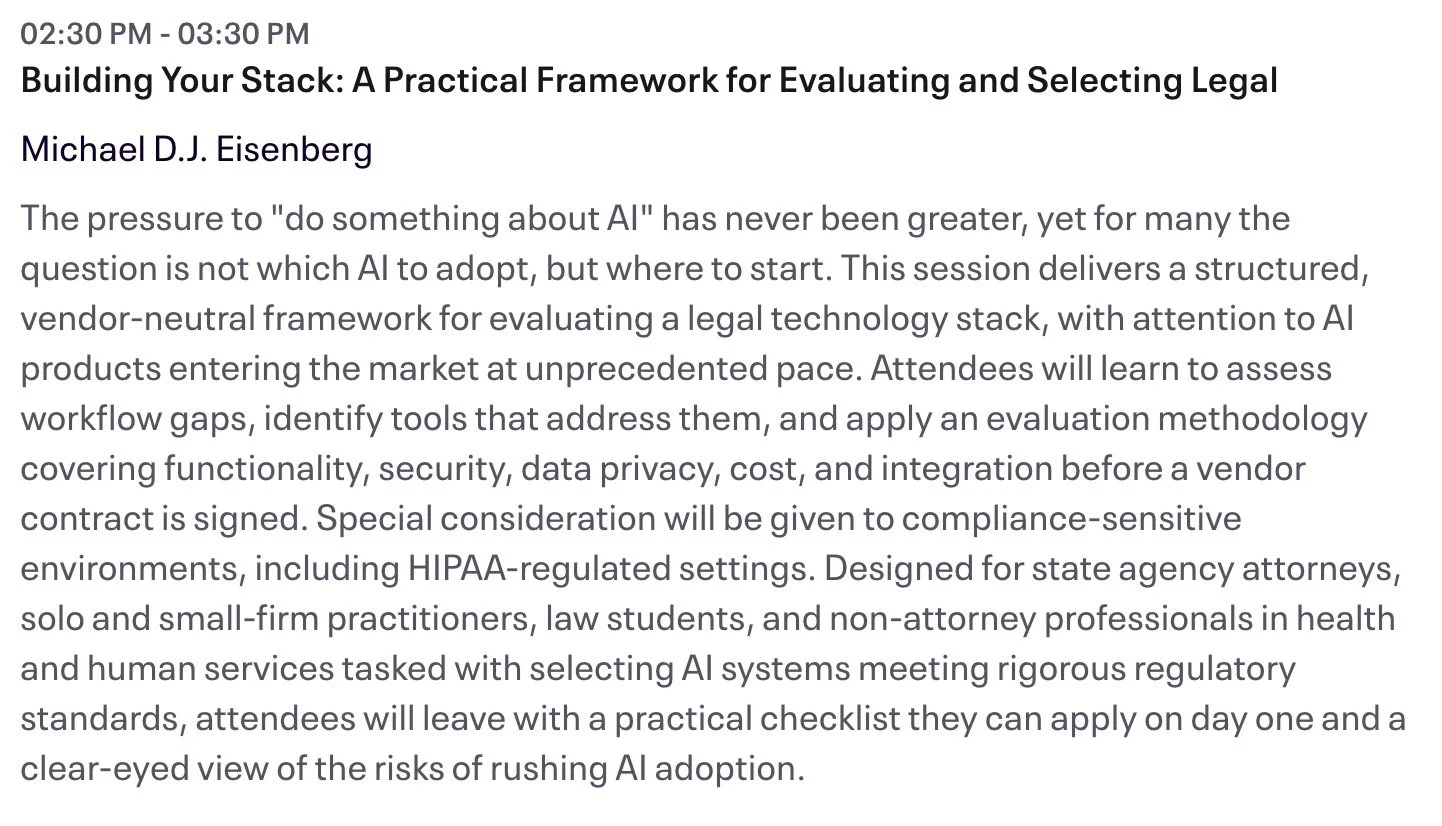
PRogram description of my presentation.

The 2026 AI Legal Practice Summit will feature leading scholars, ethics experts, and seasoned practitioners. I’m looking forward to exchanging ideas, testing assumptions, and continuing a dialogue that helps ensure AI becomes a responsible partner—never a replacement—in the practice of law.

Let’s move forward together, with competence, curiosity, and care.

Learn more about the Summit at law-capital.libguides.com/2026_AI_Legal_Practice_Summit.
Register today: eventbrite.com/e/ai-legal-practice-summit-tickets-1986544900273.

I look forward to seeing you there! ⚖️

MTC: Is Puerto Rico’s Professional Responsibility Rule 1.19 Really Necessary? A Technology Competence Perspective.

Is PR’s Rule 1.19 necessary?

The legal profession stands at a crossroads regarding technological competence requirements. With forty states already adopting Comment 8 to Model Rule 1.1, which mandates lawyers "keep abreast of changes in the law and its practice, including the benefits and risks associated with relevant technology," the question emerges: do we need additional rules like PR Rule 1.19?

Comment 8 to Rule 1.1 establishes clear parameters for technological competence. This amendment, adopted by the ABA in 2012, expanded the traditional duty of competence beyond legal knowledge to encompass technological proficiency. The Rule requires lawyers to understand the "benefits and risks associated with relevant technology" in their practice areas.

The existing framework appears comprehensive. Comment 8 already addresses core technological competencies, including e-discovery, cybersecurity, and client communication systems. Under Rule 1.1 (Comment 5), legal professionals must evaluate whether their technological skills meet "the standards of competent practitioners" without requiring additional regulatory layers.

However, implementation challenges persist. Many attorneys struggle with the vague standard of "relevant technology". The rule's elasticity means that competence requirements continuously evolve in response to technological advancements. Some jurisdictions, like Puerto Rico (see PR’s Supreme Court’s Order ER-2025-02 approving adoption of its full set of Rules of Professional Conduct, have created dedicated technology competence rules (Rule 1.19) to provide clearer guidance.

The verdict: redundancy without added value. Rather than creating overlapping rules, the legal profession should focus on robust implementation of existing Comment 8 requirements. Enhanced continuing legal education mandates, clearer interpretive guidance, and practical competency frameworks would better serve practitioners than additional regulatory complexity.

Technology competence is essential, but regulatory efficiency should guide our approach. 🚀