
📖 Word of the Week: “Cross‑Tenant” Learning in Legal Practice
/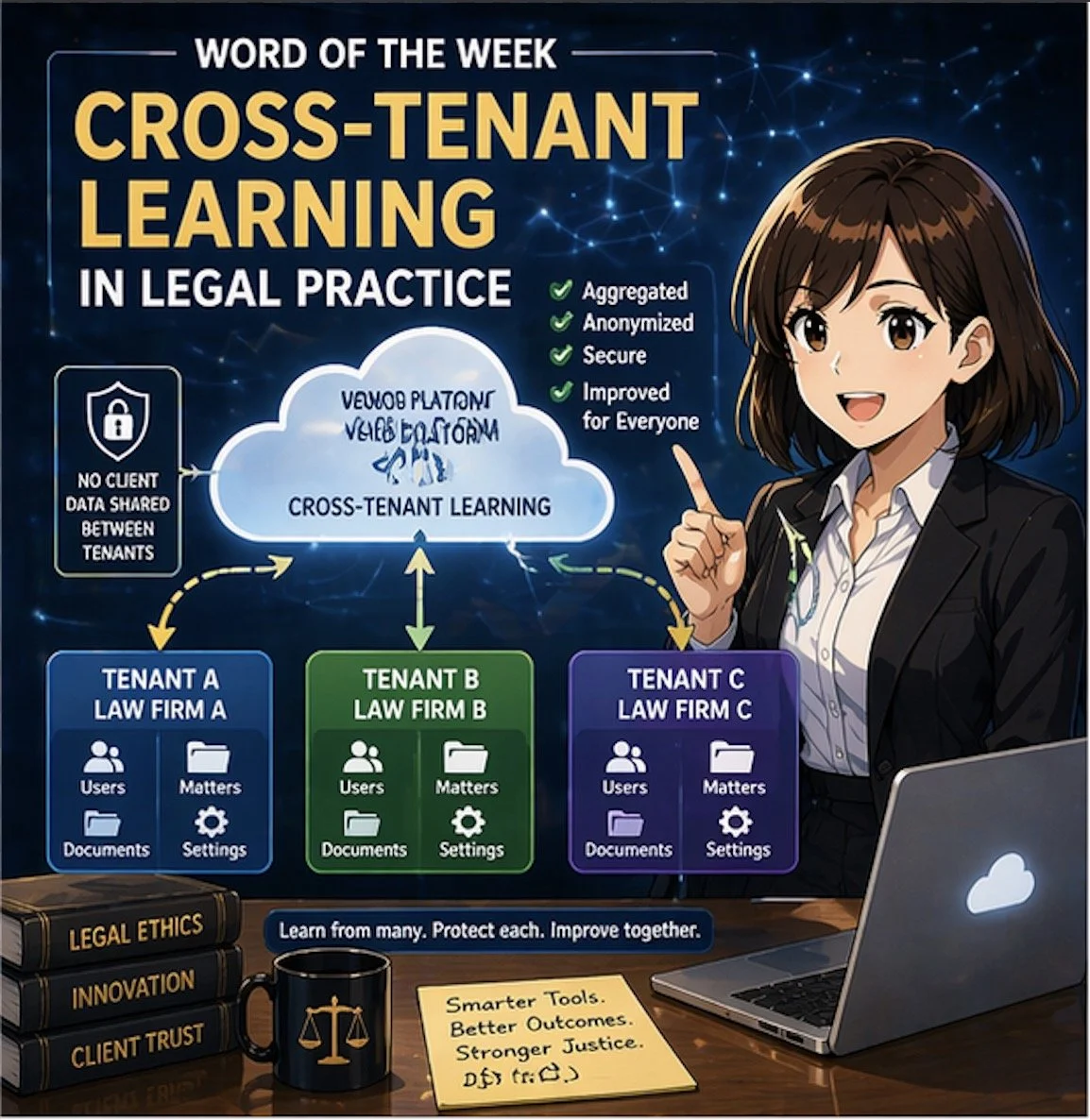
Cross-tenant learning helps law firms improve AI tools without exposing data
If your firm uses cloud‑based tools, you are already living in a multi‑tenant world. In that world, cross‑tenant learning is quickly becoming a key concept that every lawyer and legal operations professional should understand. 🧠⚖️
In simple terms, a “tenant” is your firm’s logically separate space inside a cloud platform: your own users, matters, documents, and settings, isolated from everyone else’s. Cross‑tenant learning refers to techniques in which a vendor’s system learns from patterns across multiple tenants (for example, many law firms) to improve its features—such as search, drafting suggestions, or document classification—without exposing any other firm’s confidential data to you or yours to them.
Why cross‑tenant learning matters for law firms
Cross‑tenant learning is especially relevant as generative AI and machine‑learning tools become embedded in e‑discovery platforms, contract review tools, legal research systems, and practice‑management software. Vendors may use aggregated and anonymized usage data to:
Improve relevance of search results and recommendations.
Enhance clause and issue spotting in contracts and briefs.
Reduce false positives in e‑discovery or compliance alerts.
Optimize workflows based on how similar firms use the product.
For lawyers, the value proposition is straightforward: your tools can become “smarter” faster, based on lessons learned across many organizations, not just your own firm’s experience. Done properly, cross‑tenant learning can raise the baseline quality and efficiency of technology available to your practice. ⚙️📈
ABA Model Rules: Confidentiality and Competence
Any discussion of cross‑tenant learning for law firms must start with confidentiality and competence.
Model Rule 1.6 (Confidentiality of Information) requires lawyers to safeguard information relating to the representation of a client. That obligation extends to how your vendors collect, store, and use your data. You must understand whether and how client data may be used for cross‑tenant learning and ensure that any such use preserves confidentiality through anonymization, aggregation, and strong technical and contractual controls. 🔐
Model Rule 1.1 (Competence), including Comment 8, emphasizes that lawyers should keep abreast of the benefits and risks associated with relevant technology. Understanding cross‑tenant learning is now part of that duty. You do not need to become a data scientist, but you should be comfortable asking vendors precise questions and recognizing red flags.
Model Rule 5.3 (Responsibilities Regarding Nonlawyer Assistance) applies when you rely on vendors as nonlawyer assistants. You must make reasonable efforts to ensure that their conduct is compatible with your professional obligations, including how they use your data for cross‑tenant learning. 🧾
Key questions to ask your vendors

ABA Model Rules guide ethical use of cross-tenant learning technologies
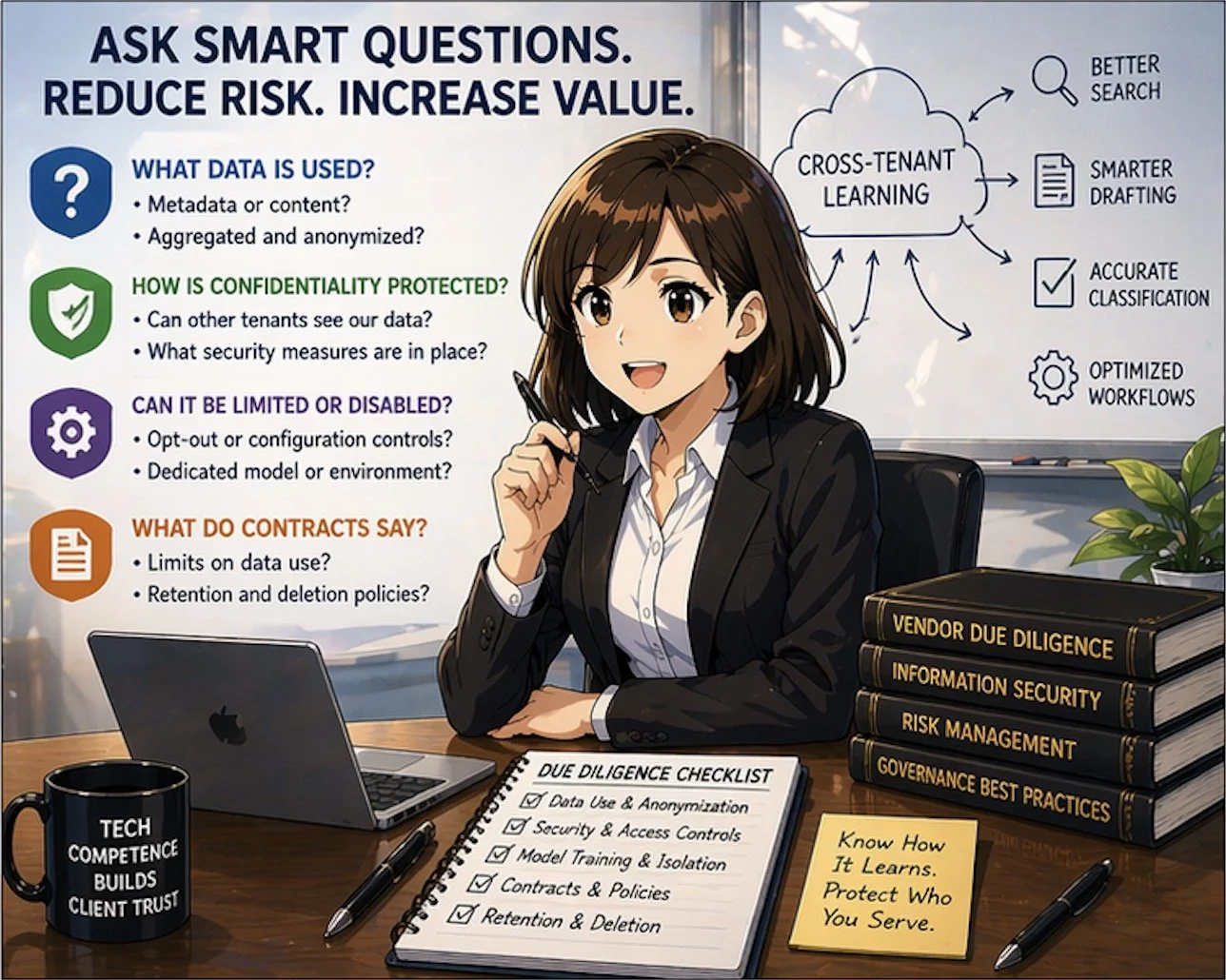
When evaluating a product that relies on cross‑tenant learning, consider asking:
What data is used?
Is it only metadata or usage logs, or are actual document contents included?
Is the data aggregated and anonymized before it is used to train shared models?
How is confidentiality protected?
Can other tenants ever see prompts, documents, or client‑identifying information from our firm?
What technical measures (encryption, access controls, tenant isolation) are in place?
Can cross‑tenant learning be limited or disabled?
Do we have opt‑out or configuration controls?
Is there a dedicated model or environment for our firm if needed?
What do the contract and policies say?
Does the MSA or DPA clearly limit use of client data to defined purposes?
How long is data retained, and how is it deleted if we leave?
These questions are not merely IT concerns; they go directly to your obligations under the ABA Model Rules and your firm’s risk profile.
Practical examples in law practice
Consider a cloud‑based contract‑analysis platform used by hundreds of firms. Over time, the provider can see which clauses lawyers routinely flag as risky, which edits are typically made, and what becomes the “preferred” language for certain issues. Through cross‑tenant learning, the system can use that aggregated knowledge to highlight problematic clauses and suggest alternatives more accurately for everyone.
Another example is an e‑discovery platform that uses cross‑tenant learning to distinguish between truly relevant documents and common “noise” such as automatically generated emails. The more matters the system processes across different tenants, the better it gets at ranking documents and reducing review burdens. This can be a material efficiency gain for litigation teams. ⚖️💼
In both scenarios, your ethical comfort depends on whether underlying data is appropriately anonymized, compartmentalized, and contractually protected.
Governance steps for your firm
To align cross‑tenant learning with professional obligations, firms can:
Update vendor‑due‑diligence checklists to include explicit questions about cross‑tenant learning, training data use, and model isolation.
Involve a cross‑functional team—lawyers, IT, information security, and risk management—in vendor selection and review.
Document your analysis of vendor practices and how they satisfy confidentiality, competence, and supervision obligations under the ABA Model Rules.
Educate lawyers and staff about how AI‑enabled tools work, what kinds of data they send into the system, and how to avoid unnecessary exposure of client‑identifying details.
Takeaway for busy practitioners
Smart vendor questions reduce risk in cross-tenant legal technology adoption
You do not need to reject cross‑tenant learning to protect your clients. Instead, you should approach it as a powerful capability that demands informed oversight. When well‑implemented, cross‑tenant learning can help your firm deliver faster, more consistent, and more cost‑effective legal services, while still honoring confidentiality and ethical duties. When poorly explained or loosely governed, it becomes an unnecessary and avoidable risk.
Understanding how your tools learn—and from whom—is now part of competent, modern legal practice. ⚖️💡