TSL.P Labs 🧪 Initiative: Why 96% AI Accuracy Still Fails Lawyers: Ethics, Hallucinations, and the Future of the Billable Hour ⚖️🤖

📌 To Busy to Read This Week’s Editorial?

Welcome to the TSL Lab’s Initiative. 🤖 This weeks episode builds on my March 3rd, 2026, editorial “Even Though AI Hallucinations Are Down: Lawyers STILL MUST Verify AI, Guard PII, and Follow ABA Ethics Rules ⚖️🤖” is a misleading comfort blanket for lawyers, and how ABA Model Rules on confidentiality, competence, diligence, candor, supervision, and client communication must govern every AI prompt you run. Our Google LLM Notebook hosts translate the theory into practical workflows you can implement today—from document grounding and tokenization to vendor due diligence and line‑by‑line verification—so you can leverage AI confidently without sacrificing ethics, privilege, or your professional license.

You will hear how document grounding changes what LLMs actually do, why uploading active case files to cloud AI tools can quietly trigger Rule 1.6 problems, and how cross‑border data flows, vendor training rights, and retention policies can erode privilege if you do not negotiate them carefully. 🔐 We also unpack practical safeguards like tokenization, internal sandbox testing, and bright‑line “danger zones” where AI must never operate unsupervised—especially on open‑ended research, choice of law, and any task that turns statistical text into real‑world legal risk.

Finally, we confront the economic paradox: when AI can compress 100 hours of document review into seconds, but partners must still verify every line to protect their licenses, what exactly are clients paying for—and how does the billable hour survive? 💼

In our conversation, we cover the following

  • 00:00 – Why “96% fewer hallucinations” is still not good enough in law ⚖️

  • 01:00 – How the remaining 4% error rate can trigger malpractice, sanctions, and ethics violations

  • 02:00 – From IT issue to ethics issue: ABA Model Rules as the real constraint on AI adoption

  • 03:00 – Document grounding 101: turning a free‑floating LLM into a reading‑comprehension engine

  • 04:00 – The hidden danger of “just upload the file”: how Rule 1.6 confidentiality is instantly implicated

  • 05:00 – Cloud AI architecture, cross‑border data transfers, GDPR, and privilege risk 🌐

  • 06:00 – Model training nightmares: when your client’s trade secrets leak back out through someone else’s prompt

  • 07:00 – Negotiating no‑training clauses and ring‑fencing vendor data use (before you upload anything)

  • 08:00 – Tokenization explained: turning John Doe into “Plaintiff 01” without losing legal meaning 🔐

  • 09:00 – What AI does well today: grounded summarization, clause extraction, and playbook‑based redlines

  • 10:00 – The “danger zone” of tasks: open‑ended research, choice of law, and abstract legal reasoning

  • 11:00 – Phantom case law: how LLMs manufacture perfect‑looking but fake citations (and Rule 3.3 candor)

  • 12:00 – Sandboxing AI tools internally and measuring real‑world failure rates against known outcomes 🧪

  • 13:00 – Building bright‑line firm policies around forbidden AI use cases

  • 14:00 – Verification as a workflow, not a suggestion: what Model Rules 5.1 and 5.3 demand from supervisors

  • 15:00 – The efficiency paradox: when partner‑level verification erases associate‑level time savings ⏱️

  • 16:00 – Making AI verification as routine as a conflict check in your practice

  • 17:00 – Falling hallucination rates, rising risk: why better AI can still make lawyers more vulnerable

  • 18:00 – Client communication under Rule 1.4: when and why clients may be entitled to know you used AI

  • 19:00 – “You can delegate the task, not the liability”: Rule 1.2 and ultimate responsibility for AI‑assisted work

  • 20:00 – Treating every AI prompt and ToS as a potential ethics document

  • 📝21:00 – The existential question: if AI drafts in seconds, what exactly are clients paying lawyers for?

👉 Tune in now to learn how to stay tech‑forward without becoming the next ethics cautionary tale, and start designing AI policies that actually protect your clients, your firm, and your bar license.


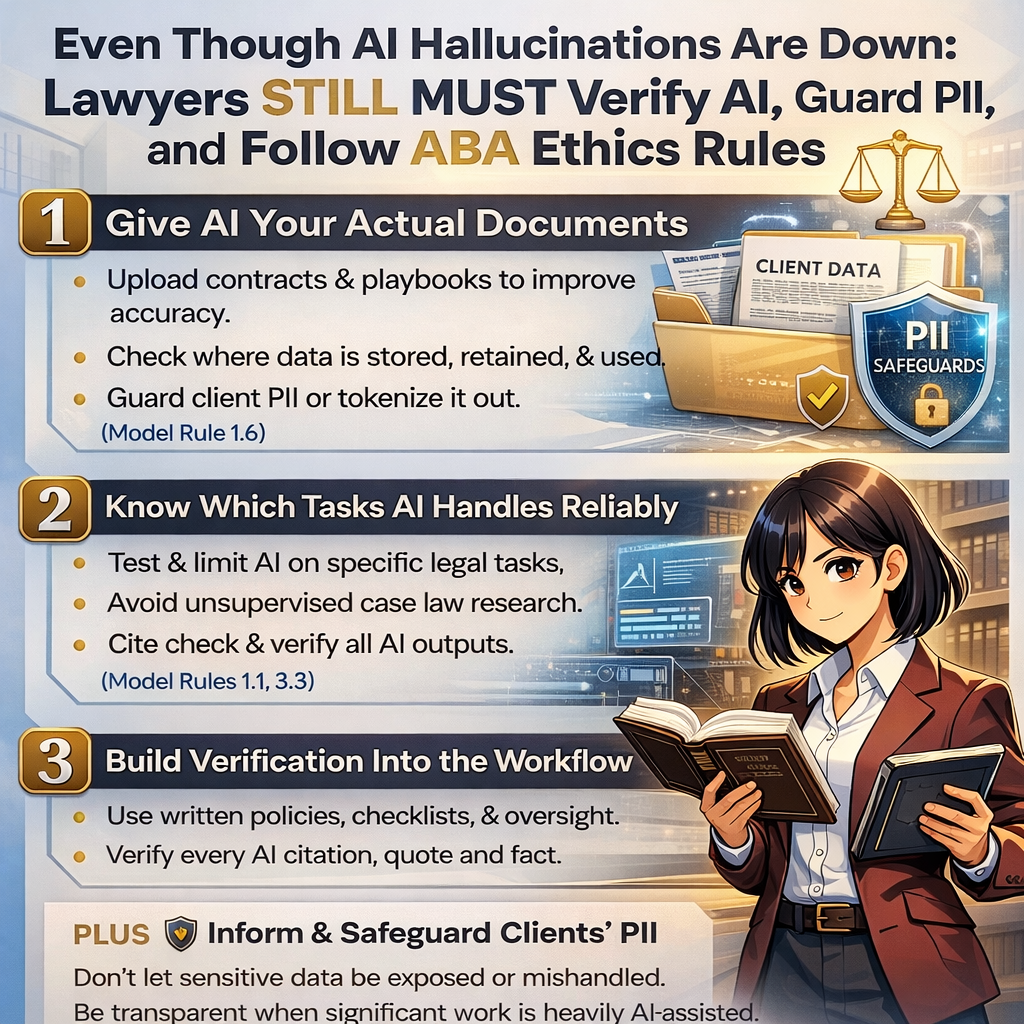
MTC: Even Though AI Hallucinations Are Down: Lawyers STILL MUST Verify AI, Guard PII, and Follow ABA Ethics Rules ⚖️🤖

A Tech-Savvy Lawyer MUST REVIEW AI-Generated Legal Documents

AI hallucinations are reportedly down across many domains. Still, previous podcast guest Dorna Moini is right to warn that legal remains the unnerving exception—and that is where our professional duties truly begin, not end. Her article, “AI hallucinations are down 96%. Legal is the exception,” helpfully shifts the conversation from “AI is bad at law” to “lawyers must change how they use AI,” yet from the perspective of ethics and risk management, we need to push her three recommendations much further. This is not only a product‑design problem; it is a competence, confidentiality, and candor problem under the ABA Model Rules. ⚖️🤖

Her first point—“give AI your actual documents”—is directionally sound. When we anchor AI in contracts, playbooks, and internal standards, we move from free‑floating prediction to something closer to reading comprehension, and hallucinations usually fall. That is a genuine improvement, and Moini is right to emphasize it. But as soon as we start uploading real matter files, we are squarely inside Model Rule 1.6 territory: confidential information, privileged communications, trade secrets, and dense pockets of personally identifiable information. The article treats document‑grounding primarily as an accuracy-and-reliability upgrade, but lawyers and the legal profession must insist that it is first and foremost a data‑governance decision.

Before a single contract is uploaded, a lawyer must know where that data is stored, who can access it, how long it is retained, whether it is used to train shared models, and whether any cross‑border transfers could complicate privilege or regulatory compliance. That analysis should involve not just IT, but also risk management and, in many cases, outside vendors. “Give AI your actual documents” is safe only if your chosen platform offers strict access controls, clear no‑training guarantees, encryption in transit and at rest, and, ideally, firm‑controlled or on‑premise storage. Otherwise, you may be trading a marginal reduction in hallucinations for a major confidentiality incident or regulatory investigation. In other words, feeding AI your documents can be a smart move, but only after you read the terms, negotiate the data protection, and strip or tokenize unnecessary PII. 🔐

LawyerS NEED TO MONITOR AI Data Security and PII Compliance POLICIES OF THE AI PLATFORMS THEY USE IN THEIR LEGAL WORK.

Moini’s second point—“know which tasks your tool handles reliably”—is also excellent as far as it goes. Document‑grounded summarization, clause extraction, and playbook‑based redlines are indeed safer than open‑ended legal research, and she correctly notes that open‑ended research still demands heavy human verification. Reliability, however, cannot be left to vendor assurances, product marketing, or a single eye‑opening demo. For purposes of Model Rule 1.1 (competence) and 1.3 (diligence), the relevant question is not “Does this tool look impressive?” but “Have we independently tested it, in our own environment, on tasks that reflect our real matters?”

A counterpoint is that reliability has to be measured, not assumed. Firms should sandbox these tools on closed matters, compare AI outputs with known correct answers, and have experienced lawyers systematically review where the system fails. Certain categories of work—final cites in court filings, complex choice‑of‑law questions, nuanced procedural traps—should remain categorically off‑limits to unsupervised AI, because a hallucinated case there is not just an internal mistake; it can rise to misrepresentation to the court under Model Rule 3.3. Knowing what your tool does well is only half of the equation; you must also draw bright, documented lines around what it may never do without human review. 🧪

Her third point—“build verification into the workflow”—is where the article most clearly aligns with emerging ethics guidance from courts and bars, and it deserves strong validation. Judges are already sanctioning lawyers who submit AI‑fabricated authorities, and bar regulators are openly signaling that “the AI did it” will not excuse a lack of diligence. Verification, though, cannot remain an informal suggestion reserved for conscientious partners. It has to become a systematic, auditable process that satisfies the supervisory expectations in Model Rules 5.1 and 5.3.

That means written policies, checklists, training sessions, and oversight. Associates and staff should receive simple, non‑negotiable rules:

✅ Every citation generated with AI must be independently confirmed in a trusted legal research system;

✅ Every quoted passage must be checked against the original source; 

✅ Every factual assertion must be tied back to the record.

Supervising attorneys must periodically spot‑check AI‑assisted work for compliance with those rules. Moini is right that verification matters; the editorial extension is that verification must be embedded into the culture and procedures of the firm. It should be as routine as a conflict check.

Stepping back from her three‑point framework, the broader thesis—that legal hallucinations can be tamed by better tooling and smarter usage—is persuasive, but incomplete. Even as hallucination rates fall, our exposure is rising because more lawyers are quietly experimenting with AI on live matters. Model Rule 1.4 on communication reminds us that, in some contexts, clients may be entitled to know when significant aspects of their work product are generated or heavily assisted by AI, especially when it impacts cost, speed, or risk. Model Rule 1.2 on scope of representation looms in the background as we redesign workflows: shifting routine drafting to machines does not narrow the lawyer’s ultimate responsibility for the outcome.

Attorney must verify ai-generated Case Law

For practitioners with limited to moderate technology skills, the practical takeaway should be both empowering and sobering. Moini’s article offers a pragmatic starting structure—ground AI in your documents, match tasks to tools, and verify diligently. But you must layer ABA‑informed safeguards on top: treat every AI term of service as a potential ethics document; never drop client names, medical histories, addresses, Social Security numbers, or other PII into systems whose data‑handling you do not fully understand; and assume that regulators may someday scrutinize how your firm uses AI. Every AI‑assisted output must be reviewed line by line.

Legal AI is no longer optional, yet ethics and PII protection are not. The right stance is both appreciative and skeptical: appreciative of Moini’s clear, practitioner‑friendly guidance, and skeptical enough to insist that we overlay her three points with robust, documented safeguards rooted in the ABA Model Rules. Use AI, ground it in your documents, and choose tasks wisely—but do so as a lawyer first and a technologist second. Above all, review your work, stay relentlessly wary of the terms that govern your tools, and treat PII and client confidences as if a bar investigator were reading over your shoulder. In this era, one might be. ⚖️🤖🔐

MTC

MTC: AI may not be your co‑counsel—and a recent SDNY decision just made that painfully clear. ⚖️🤖

SDNY Heppner Ruling: Public AI Use Breaks Attorney-Client PrivilegE!

In United States v. Heppner, Judge Jed Rakoff of the Southern District of New York ruled that documents a criminal defendant generated with a publicly accessible AI tool and later sent to his lawyers were not protected by either attorney‑client privilege or the work‑product doctrine. That decision should be a wake‑up call for every lawyer who has ever dropped client facts into a public chatbot.

The court’s analysis followed traditional privilege principles rather than futuristic AI theory. Privilege requires confidential communication between a client and a lawyer made for the purpose of obtaining legal advice. In Heppner, the AI tool was “obviously not an attorney,” and there was no “trusting human relationship” with a licensed professional who owed duties of loyalty and confidentiality. Moreover, the platform’s privacy policy disclosed that user inputs and outputs could be collected and shared with third parties, undermining any reasonable expectation of confidentiality. In short, the defendant’s AI‑generated drafts looked less like protected client notes and more like research entrusted to a third‑party service.

For sometime now, I’ve warned on The Tech‑Savvy Lawyer.Page has warned practitioners not to paste client PII or case‑specific facts into generative AI tools, particularly public models whose terms of use and training practices erode confidentiality. We have consistently framed AI as an extension of a lawyer’s existing ethical duties, not a shortcut around them. I have encouraged readers to treat these systems like any other non‑lawyer vendor that must be vetted, contractually constrained, and configured before use. That perspective aligns squarely with Heppner’s outcome: once you treat a public AI as a casual brainstorming partner, you risk treating your client’s confidences as discoverable data.

A Tech-Savvy Lawyer Avoids AI Privilege Waiver With Confidentiality Safeguards!

For lawyers, this has immediate implications under the ABA Model Rules. Model Rule 1.1 on competence now explicitly includes understanding the “benefits and risks associated” with relevant technology, and recent ABA guidance on generative AI emphasizes that uncritical reliance on these tools can breach the duty of competence. A lawyer who casually uses public AI tools with client facts—without reading the terms of use, configuring privacy, or warning the client—may fail the competence test in both technology and privilege preservation. The Tech‑Savvy Lawyer.Page repeatedly underscores this point, translating dense ethics opinions into practical checklists and workflows so that even lawyers with only moderate tech literacy can implement safer practices.

Model Rule 1.6 on confidentiality is equally implicated. If a lawyer discloses client confidential information to a public AI platform that uses data for training or reserves broad rights to disclose to third parties, that disclosure can be treated like sharing with any non‑necessary third party, risking waiver of privilege. Ethical guidance stresses that lawyers must understand whether an AI provider logs, trains on, or shares client data and must adopt reasonable safeguards before using such tools. That means reading privacy policies, toggling enterprise settings, and, in many cases, avoiding consumer tools altogether for client‑specific prompts.

Does a private, paid AI make a difference? Possibly, but only if it is structured like other trusted legal technology. Enterprise or legal‑industry tools that contractually commit not to train on user data and to maintain strict confidentiality can better support privilege claims, because confidentiality and reasonable expectations are preserved. Tools like Lexis‑style or Westlaw‑style AI offerings, deployed under robust business associate and security agreements, look more like traditional research platforms or litigation support vendors within Model Rules 5.1 and 5.3, which govern supervisory duties over non‑lawyer assistants. The Tech‑Savvy Lawyer.Page has emphasized this distinction, encouraging lawyers to favor vetted, enterprise‑grade solutions over consumer chatbots when client information is involved.

Enterprise AI Vetting Checklist for Lawyers: Contracts, NDA, No Training

The tech‑savvy lawyer in 2026 is not the one who uses the most AI; it is the one who knows when not to use it. Before entering client facts into any generative AI, lawyers should ask: Is this tool configured to protect client confidentiality? Have I satisfied my duties of competence and communication by explaining the risks to my client (Model Rules 1.1 and 1.4)? And if a court reads this platform’s privacy policy the way Judge Rakoff did, will I be able to defend my privilege claims with a straight face to a court or to a disciplinary bar?

AI may be a powerful drafting partner, but it is not your co‑counsel and not your client’s confidant. The tech‑savvy lawyer—of the sort championed by The Tech‑Savvy Lawyer.Page—treats it as a tool: carefully vetted, contractually constrained, and ethically supervised, or not used at all. 🔒🤖

MTC: Lawyers and AI Oversight: What the VA’s Patient Safety Warning Teaches About Ethical Law Firm Technology Use! ⚖️🤖

Human-in-the-loop is the point: Effective oversight happens where AI meets care—aligning clinical judgment, privacy, and compliance with real-world workflows.

The Department of Veterans Affairs’ experience with generative AI is not a distant government problem; it is a mirror held up to every law firm experimenting with AI tools for drafting, research, and client communication. I recently listened to an interview by Terry Gerton of the Federal News Network of Charyl Mason, Inspector General of the Department of Veterans Affairs, “VA rolled out new AI tools quickly, but without a system to catch mistakes, patient safety is on the line” and gained some insights on how lawyers can learn from this perhaps hastilly impliment AI program. VA clinicians are using AI chatbots to document visits and support clinical decisions, yet a federal watchdog has warned that there is no formal mechanism to identify, track, or resolve AI‑related risks—a “potential patient safety risk” created by speed without governance. In law, that same pattern translates into “potential client safety and justice risk,” because the core failure is identical: deploying powerful systems without a structured way to catch and correct their mistakes.

The oversight gap at the VA is striking. There is no standardized process for reporting AI‑related concerns, no feedback loop to detect patterns, and no clearly assigned responsibility for coordinating safety responses across the organization. Clinicians may have helpful tools, but the institution lacks the governance architecture that turns “helpful” into “reliably safe.” When law firms license AI research platforms, enable generative tools in email and document systems, or encourage staff to “try out” chatbots on live matters without written policies, risk registers, or escalation paths, they recreate that same governance vacuum. If no one measures hallucinations, data leakage, or embedded bias in outputs, risk management has given way to wishful thinking.

Existing ethics rules already tell us why that is unacceptable. Under ABA Model Rule 1.1, competence now includes understanding the capabilities and limitations of AI tools used in practice, or associating with someone who does. Model Rule 1.6 requires lawyers to critically evaluate what client information is fed into self‑learning systems and whether informed consent is required, particularly when providers reuse inputs for training. Model Rules 5.1, 5.2, and 5.3 extend these obligations across partners, supervising lawyers, and non‑lawyer staff: if a supervised lawyer or paraprofessional relies on AI in a way that undermines client protection, firm leadership cannot plausibly claim ignorance. And rules on candor to tribunals make clear that “the AI drafted it” is never a defense to filing inaccurate or fictitious authority.

Explaining the algorithm to decision-makers: Oversight means making AI risks understandable to judges, boards, and the public—clearly and credibly.

What the VA story adds is a vivid reminder that effective AI oversight is a system, not a slogan. The inspector general emphasized that AI can be “a helpful tool” only if it is paired with meaningful human engagement: defined review processes, clear routes for reporting concerns, and institutional learning from near misses. For law practice, that points directly toward structured workflows. AI‑assisted drafts should be treated as hypotheses, not answers. Reasonable human oversight includes verifying citations, checking quotations against original sources, stress‑testing legal conclusions, and documenting that review—especially in high‑stakes matters involving liberty, benefits, regulatory exposure, or professional discipline.

For lawyers with limited to moderate tech skills, this should not be discouraging; done correctly, AI governance actually makes technology more approachable. You do not need to understand model weights or training architectures to ask practical questions: What data does this tool see? When has it been wrong in the past? Who is responsible for catching those errors before they reach a client, a court, or an opposing party? Thoughtful prompts, standardized checklists for reviewing AI output, and clear sign‑off requirements are all well within reach of every practitioner.

The VA’s experience also highlights the importance of mapping AI uses and classifying their risk. In health care, certain AI use cases are obviously safety‑critical; in law, the parallel category includes anything that could affect a person’s freedom, immigration status, financial security, public benefits, or professional license. Those use cases merit heightened safeguards: tighter access control, narrower scoping of AI tasks, periodic sampling of outputs for quality, and specific training for the lawyers who use them. Importantly, this is not a “big‑law only” discipline. Solo and small‑firm lawyers can implement proportionate governance with simple written policies, matter‑level notes showing how AI was used, and explicit conversations with clients where appropriate.

Critically, AI does not dilute core professional responsibility. If a generative system inserts fictitious cases into a brief or subtly mischaracterizes a statute, the duty of candor and competence still rests squarely on the attorney who signs the work product. The VA continues to hold clinicians responsible for patient care decisions, even when AI is used as a support tool; the law should be no different. That reality should inform how lawyers describe AI use in engagement letters, how they supervise junior lawyers and staff, and how they respond when AI‑related concerns arise. In some situations, meeting ethical duties may require forthright client communication, corrective filings, and revisions to internal policies.

AI oversight starts at the desk: Lawyers must be able to interrogate model outputs, data quality, and risk signals—before technology impacts patient care.

The practical lesson from the VA’s AI warning is straightforward. The “human touch” in legal technology is not a nostalgic ideal; it is the safety mechanism that makes AI ethically usable at all. Lawyers who embrace AI while investing in governance—policies, training, and oversight calibrated to risk—will be best positioned to align with the ABA’s evolving guidance, satisfy courts and regulators, and preserve hard‑earned client trust. Those who treat AI as a magic upgrade and skip the hard work of oversight are, knowingly or not, accepting that their clients may become the test cases that reveal where the system fails. In a profession grounded in judgment, the real innovation is not adopting AI; it is designing a practice where human judgment still has the final word.

MTC