
MTC: When Your CEO Asks ChatGPT How to Take Over: Lessons for Lawyers on Public AI, Ethics, and Confidentiality 🧠⚖️
/
Lawyers need to evaluate public AI chatbot against ABA confidentiality and privilege rules
In March 2026, the Delaware Court of Chancery in Fortis Advisors, LLC v. Krafton, Inc. handed lawyers one of the clearest cautionary tales yet about public AI chatbots, corporate governance, and the limits of “move fast and break things.” A South Korean gaming conglomerate, Krafton Inc., used an artificial intelligence chatbot to help devise an internal “Project X” takeover plan against its own studio, Unknown Worlds Entertainment, and then tried to defend the fallout in court. The result: a detailed opinion reinstating the studio’s CEO, extending a $250 million earnout period, and spotlighting how AI misuse can become Exhibit A when things go wrong.
If you’re a solo, a small-firm lawyer, or an AI‑curious practitioner dabbling with ChatGPT or similar tools, this case is your wake‑up call. The message is not “don’t use AI.” The message is: treat public chatbots the same way you treat email, cloud storage, or texting — through the lens of ABA ethics, client confidentiality, and privilege. 😬
In this editorial, I’ll unpack what happened, how the court framed the misuse of a chatbot, and what you should do in your own practice to stay on the right side of the rules.
The Case in a Nutshell: AI as a Takeover Co‑Pilot
Krafton bought Unknown Worlds — the studio behind Subnautica — for $500 million upfront plus up to $250 million in contingent earnout payments, with a contractually guaranteed structure: the founders and CEO (the “Key Employees”) retained operational control and could only be fired for defined “Cause.” As Subnautica 2 approached early‑access launch, internal projections showed the game would easily trigger a massive earnout.
The CEO of Krafton grew concerned he looked like a “pushover” under the deal and turned to a public AI chatbot for advice on how to avoid paying the earnout and seize control of the studio. The chatbot’s “response strategy” included:
Locking down publishing rights and code access.
Crafting messaging to “secure public support” and undermine the “large corporation vs. indie” narrative.
Preparing a “takeover” path that blended hardball legal tactics with PR framing.
Krafton’s internal team implemented much of that plan — cutting off the studio’s access to its Steam publishing console, posting unilateral public statements, and ultimately terminating the founders and CEO on a pretext of “premature release” risk. When sued, Krafton tried to pivot to new justifications, including the executives’ role changes and their defensive downloads of company data.
The court was having none of it. Vice Chancellor Will held that:
The terminations were not “for Cause” under the negotiated contract.
The “Project X” takeover guided by the chatbot was a pretext to avoid the earnout.
The studio’s CEO, Ted Gill, must be reinstated with full operational control, and the earnout period equitably extended by the length of his ouster.
In other words, the AI‑assisted takeover strategy became part of the factual narrative of bad faith and breach — not a clever workaround.
Public Chatbots and ABA Model Rules: Three Pressure Points ⚖️

Attorneys must consider ethical AI chatbot use for confidential client case analysis
Even though this is a corporate earnout case, the opinion gives lawyers a concrete frame for thinking about public AI tools under the ABA Model Rules.
1. Confidentiality — Model Rule 1.6
Rule 1.6 requires lawyers to keep “information relating to the representation of a client” confidential, absent informed consent or a specific exception. Public chatbots are not your firm’s Document Management System (DMS) — they’re third‑party services that typically ingest prompts for training, quality, and logging. When Krafton’s CEO ran “Project X” through a chatbot, he was effectively outsourcing high‑stakes strategy to a non‑privileged third‑party system that could store and learn from those prompts.
For lawyers, the parallels are obvious:
Dropping fact patterns, names, or deal structures into a public chatbot can mean you’ve disclosed client information to a non‑controlled vendor.
Even “sanitized” prompts can be re‑identified when combined with other data.
Under 1.6, that’s a potential confidentiality breach unless you’ve vetted the tool, negotiated appropriate terms (including data handling and retention), and obtained informed client consent for that mode of assistance. Emojis and “it’s just drafting help” don’t change that. 😉
2. Privilege — Model Rules 1.1 and 1.4 (Competence and Communication)
Privilege isn’t framed in the Model Rules, but Rule 1.1 (competence) and 1.4 (communication) require you to understand how your technology choices affect the protection of client communications. When you route strategy discussions through a public chatbot:
You may jeopardize attorney–client privilege by involving a third‑party with no need‑to‑know and no formal role in the representation.
You may create discoverable records that live outside your control, just as Krafton’s CEO created chat logs he then tried to delete.
The court noted that relevant chatbot logs were deleted, which did not play well in evaluating Krafton’s narrative. Privilege analysis is already complex with cloud tools; adding public AI as a “secret co‑counsel” without protections only compounds that risk.
Competent use of technology now includes understanding whether your AI stack is preserving or eroding privilege and communicating those risks to clients when you propose AI‑assisted workflows.
3. Candor and Misrepresentation — Model Rule 4.1 and 8.4(c) 🚨
Although this case turns on contractual “Cause” and good faith, the court’s language about “pretextual” justifications and manufactured defenses should resonate with litigators. Model Rule 4.1 prohibits knowingly making false statements of material fact to third parties; Rule 8.4(c) bars conduct involving dishonesty, fraud, deceit, or misrepresentation.
When you:
Use a chatbot to generate strategic messaging designed to mislead stakeholders.
Craft public statements or demand letters that you know are pretextual, but you’ve optimized with AI for tone and impact.
… you’re still responsible for the truthfulness of that content. The court saw through Krafton’s attempt to re‑frame events after the fact, and its internal AI‑assisted playbooks did not help.
For lawyers, the lesson is simple: AI‑generated output is yours once you sign or speak it. If it’s misleading, you own the ethics problem — not “the algorithm.”
Practical Takeaways for Solo and Small‑Firm Lawyers 🧩
So what do you do if you’re a tech‑savvy lawyer who likes AI, but doesn’t want your prompts quoted in an opinion like this?
Here are grounded, practice‑ready steps.
1. Establish an AI Use Policy
Even if you’re a solo, write down what you will and won’t do with public chatbots.
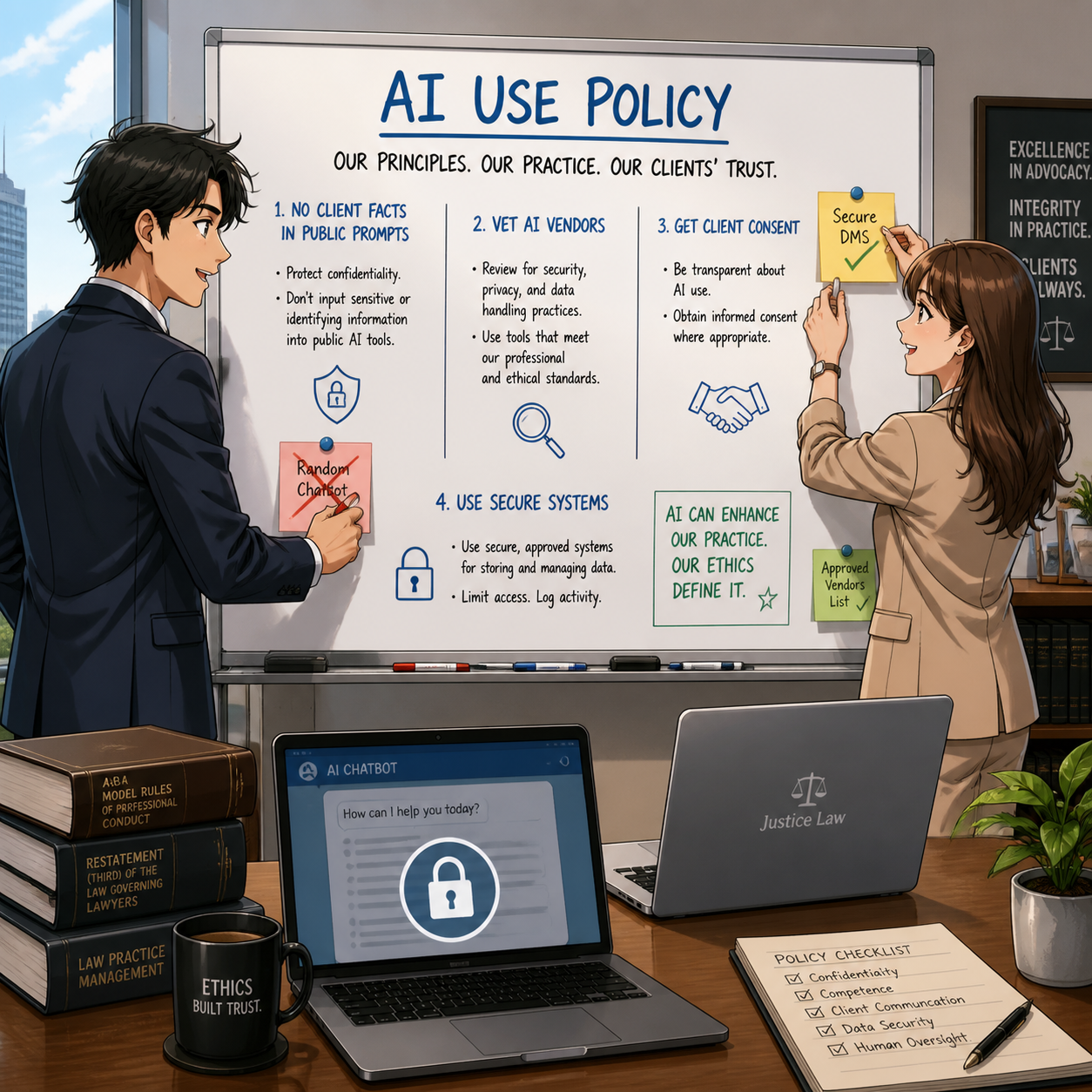
lawyers need to build practical, ethical AI policies for practice.
No client names, exact fact patterns, or identifiable deal terms in public tools.
Use AI for structure and language, not for strategy or confidential analysis.
Prefer client‑specific, non‑logging enterprise tools when handling sensitive material.
Treat this like you treat your cloud storage or remote‑work policy — it’s part of your competence under Model Rule 1.1 and your supervisory obligations under 5.1/5.3 if you have staff.
2. Separate “Public Prompting” from “Privileged Thinking” 🧠
Use public chatbots for:
Headline and meta description drafting.
Blog outlines, post ideas, or simple explainer language for non‑client scenarios.
Rough templates for standard documents that you will heavily edit.
Avoid using them for:
Fact‑specific case assessments.
Litigation strategy, negotiation plans, or internal “playbooks” like Krafton’s “Project X.”
Anything that feels like the kind of conversation you’d normally have only with a colleague behind closed doors.
This separation keeps your privileged work product inside tools and workflows you control.
3. Vet Vendors Like You Vet e‑Discovery Platforms
If you move beyond public chatbots to paid AI tools, evaluate them as you would any major legaltech vendor:
Where is data stored?
Is training on your material disabled by default?
Can you get a Business Associate Agreement or Data Processing Agreement / Data Protection Impact Assessment that aligns with your jurisdiction’s expectations?
The ABA’s Formal Opinion 477R on secure communications and cloud ethics opinions from state bars all provide analogies: reasonable steps, not perfection, are required — but “type client memo into random website” is not reasonable. 😄
4. Document Client Consent When AI Is Material to the Representation
If you expect to use AI in a way that materially affects how you deliver legal services, communicate that to clients under Rule 1.4:
Explain benefits (efficiency, faster drafting).
Explain risks (data handling, reliability, hallucinations).
Offer an AI‑free option.
Written engagement terms that address AI use can save hard conversations later if something goes sideways.
5. Revisit Your “Bad Facts” Mindset
Reading this Delaware opinion, you see how internal strategy — including AI‑assisted plotting — can become a litigation exhibit. For lawyers, that’s an invitation to ask:
“If this prompt or chatbot conversation showed up in an opinion, would I be comfortable defending it under the Model Rules?”
If the answer is no, don’t send it. That simple heuristic scales across tools and platforms.
What This Case Signals for the Next Wave of Legal Tech 🌊
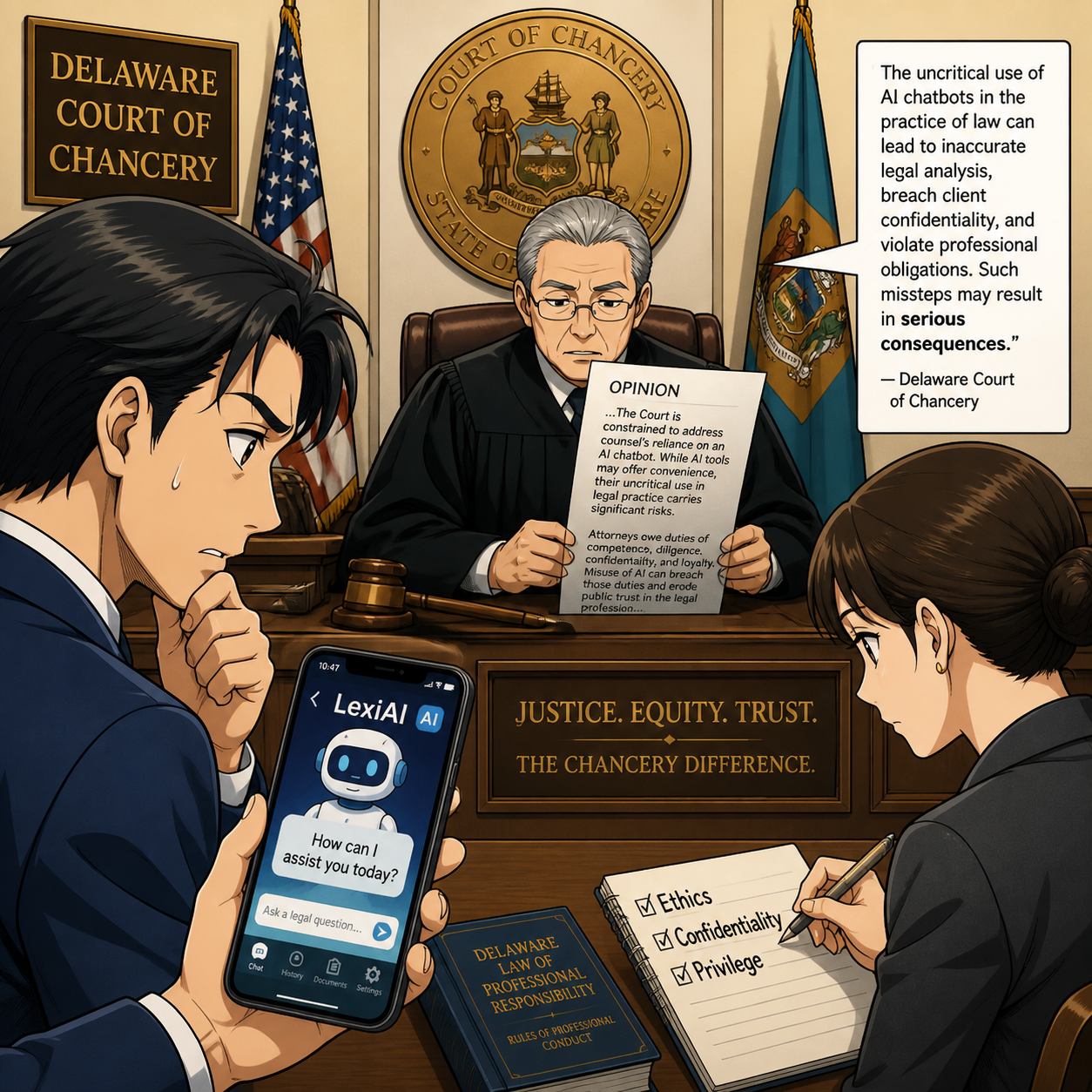
There can be significant legal consequences for AI chatbot misuse in legal disputes.
The opinion in Fortis Advisors v. Krafton is not an ethics decision aimed at lawyers, but it shows courts will:
Scrutinize AI‑assisted strategies as part of broader narratives about good faith, bad faith, and pretext.
Expect parties — and by extension, counsel — to maintain and produce AI‑related records where relevant.
Be unimpressed by attempts to retroactively justify decisions made for economic reasons with thin “quality” or “readiness” arguments.
As public models get more powerful and more embedded in practice, ABA Model Rules on competence, confidentiality, supervision, and candor apply just as they did when lawyers moved to email, smartphones, and the cloud. AI is just the next tool — but it’s a tool that makes it very easy to generate sophisticated bad ideas quickly.
Your job is to keep your ethical compass steady, even when the chatbot is very persuasive. 🧭
MTC