MTC (Bonus): National Court Technology Rules: Finding Balance Between Guidance and Flexibility ⚖️

Standardizing Tech Guidelines in the Legal System
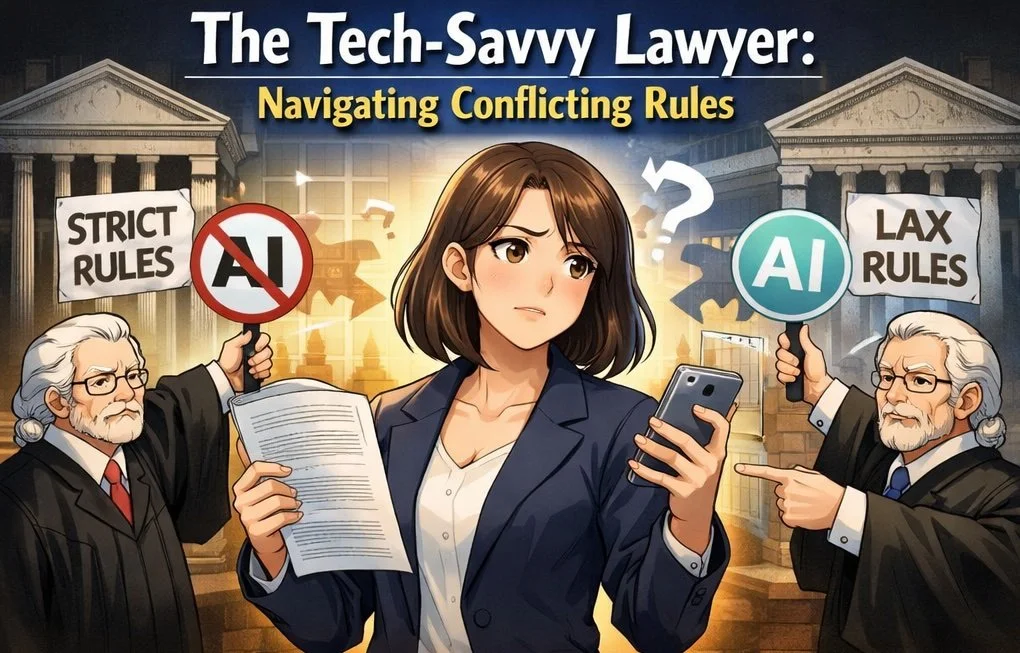
Lawyers and their staff needs to know the standard and local rules of AI USe in the courtroom - their license could depend on it.

The legal profession stands at a critical juncture where technological capability has far outpaced judicial guidance. Nicole Black's recent commentary on the fragmented approach to technology regulation in our courts identifies a genuine problem—one that demands serious consideration from both proponents of modernization and cautious skeptics alike.

The core tension is understandable. Courts face legitimate concerns about technology misuse. The LinkedIn juror research incident in Judge Orrick's courtroom illustrates real risks: a consultant unknowingly violated a standing order, resulting in a $10,000 sanction despite the attorney's good-faith disclosure and remedial efforts. These aren't theoretical concerns—they reflect actual ethical boundaries that protect litigants and preserve judicial integrity. Yet the response to these concerns has created its own problems.

The current patchwork system places practicing attorneys in an impossible position. A lawyer handling cases across multiple federal districts cannot reasonably track the varying restrictions on artificial intelligence disclosure, social media evidence protocols, and digital research methodologies. When the safe harbor is simply avoiding technology altogether, the profession loses genuine opportunities to enhance accuracy and efficiency. Generative AI's citation hallucinations justify judicial scrutiny, but the ad hoc response by individual judges—ranging from simple guidance to outright bans—creates unpredictability that chills responsible innovation.

SHould there be an international standard for ai use in the courtroom

There are legitimate reasons to resist uniform national rules. Local courts understand their communities and case management needs better than distant regulatory bodies. A one-size-fits-all approach might impose burdensome requirements on rural jurisdictions with fewer tech-savvy practitioners. Furthermore, rapid technological evolution could render national rules obsolete within months, whereas individual judges retain flexibility to respond quickly to emerging problems.

Conversely, the current decentralized approach creates serious friction. The 2006 amendments to Federal Rules of Civil Procedure for electronically stored information succeeded partly because they established predictability across jurisdictions. Lawyers knew what preservation obligations applied regardless of venue. That uniformity enabled the profession to invest in training, software, and processes. Today's lawyers lack that certainty. Practitioners must maintain contact lists tracking individual judge orders, and smaller firms simply cannot sustain this administrative burden.

The answer likely lies between extremes. Rather than comprehensive national legislation, the profession would benefit from model standards developed collaboratively by the Federal Judicial Conference, state supreme courts, and bar associations. These guidelines could allow reasonable judicial discretion while establishing baseline expectations—defining when AI disclosure is mandatory, clarifying which social media research constitutes impermissible contact, and specifying preservation protocols that protect evidence without paralyzing litigation.
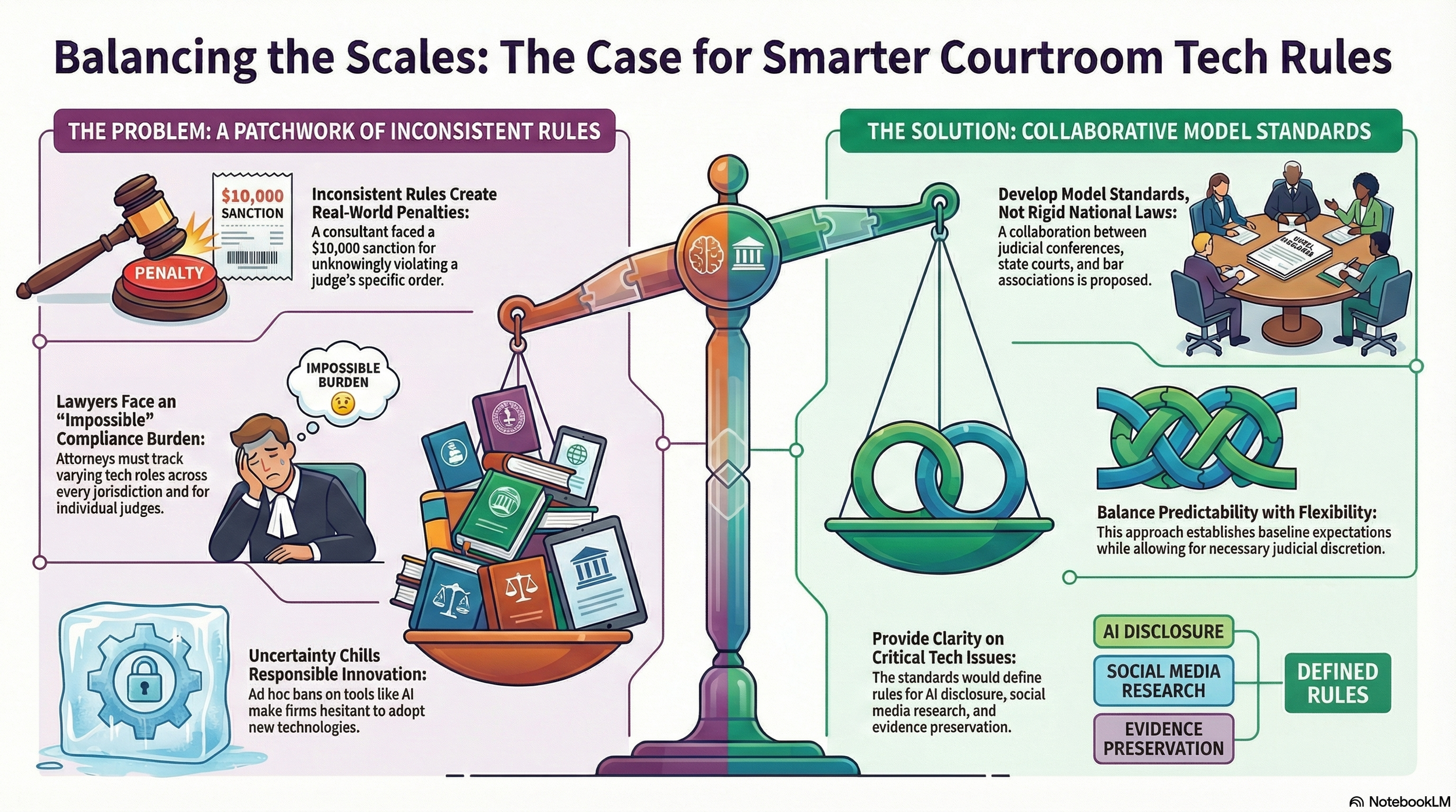
Such an approach acknowledges both legitimate judicial concerns and legitimate professional needs. It recognizes that judges require authority to protect courtroom procedures while recognizing that lawyers require predictability to serve clients effectively.

I basically agree with Nicole: The question is not whether courts should govern technology use. They must. The question is whether they govern wisely—with sufficient uniformity to enable compliance, sufficient flexibility to address local concerns, and sufficient clarity to encourage rather than discourage responsible innovation.
🎙️TSL Labs! MTC: The Hidden AI Crisis in Legal Practice: Why Lawyers Must Unmask Embedded Intelligence Before It's Too Late!

📌 Too Busy to Read This Week's Editorial?

Join us for a professional deep dive into essential tech strategies for AI compliance in your legal practice. 🎙️ This AI-powered discussion unpacks the November 17, 2025, editorial, MTC: The Hidden AI Crisis in Legal Practice: Why Lawyers Must Unmask Embedded Intelligence Before It's Too Late! with actionable intelligence on hidden AI detection, confidentiality protocols, ethics compliance frameworks, and risk mitigation strategies. Artificial intelligence has been silently operating inside your most trusted legal software for years, and under ABA Formal Opinion 512, you bear full responsibility for all AI use, whether you knowingly activated it or it came as a default software update. The conversation makes complex technical concepts accessible to lawyers with varying levels of tech expertise—from tech-hesitant solo practitioners to advanced users—so you'll walk away with immediate, actionable steps to protect your practice, your clients, and your professional reputation.

In Our Conversation, We Cover the Following

00:00:00 - Introduction: Overview of TSL Labs initiative and the AI-generated discussion format

00:01:00 - The Silent Compliance Crisis: How AI has been operating invisibly in your software for years

00:02:00 - Core Conflict: Understanding why helpful tools simultaneously create ethical threats to attorney-client privilege

00:03:00 - Document Creation Vulnerabilities: Microsoft Word Co-pilot and Grammarly's hidden data processing

00:04:00 - Communication Tools Risks: Zoom AI Companion and the cautionary Otter.ai incident

00:05:00 - Research Platform Dangers: Westlaw and Lexis+ AI hallucination rates between 17-33%

00:06:00 - ABA Formal Opinion 512: Full lawyer responsibility for AI use regardless of awareness

00:07:00 - Model Rule 1.6 Analysis: Confidentiality breaches through third-party AI systems

00:08:00 - Model Rule 5.3 Requirements: Supervising AI tools with the same diligence as human assistants

00:09:00 - Five-Step Compliance Framework: Technology audits and vendor agreement evaluation

00:10:00 - Firm Policies and Client Consent: Establishing protocols and securing informed consent

00:11:00 - The Verification Imperative: Lessons from the Mata v. Avianca sanctions case

00:12:00 - Billing Considerations: Navigating hourly versus value-based fee models with AI

00:13:00 - Professional Development: Why tool learning time is non-billable competence maintenance

00:14:00 - Ongoing Compliance: The necessity of quarterly reviews as platforms rapidly evolve

00:15:00 - Closing Remarks: Resources and call to action for tech-savvy innovation

Resources

Mentioned in the Episode

Software & Cloud Services Mentioned in the Conversation

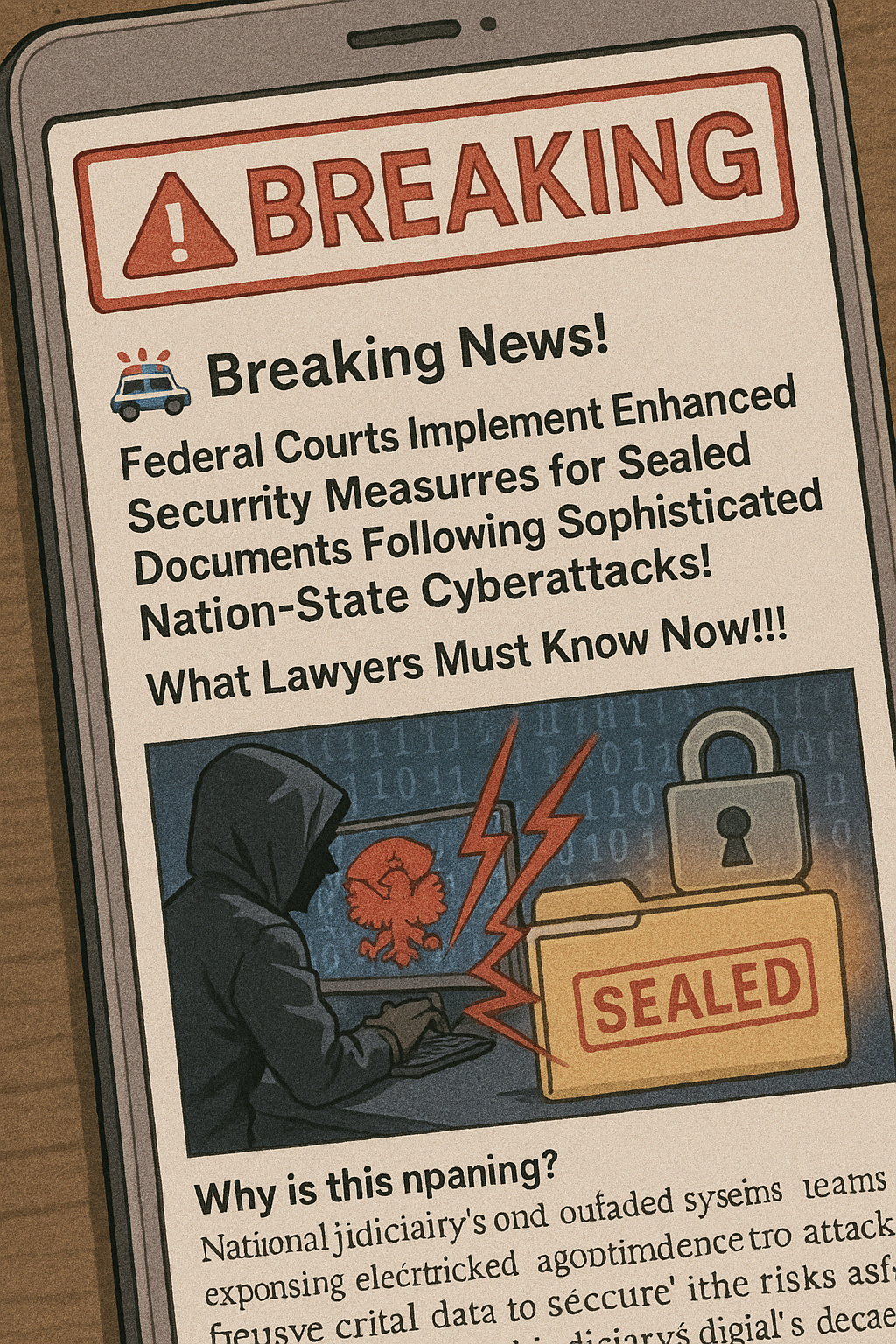
🚨 Breaking News! Federal Courts Implement Enhanced Security Measures for Sealed Documents Following Sophisticated Nation-State Cyberattacks! What Lawyers Must Know Now!!!

Federal courts have launched sweeping new protocols restricting electronic access to sealed documents after a widespread cyberattack linked to Russian actors exposed critical vulnerabilities in the federal judiciary’s decades-old digital infrastructure. As previously reported here, the breach compromised highly confidential information—such as sealed indictments and informant data—across numerous districts, prompting courts to eliminate electronic viewing of sealed filings and require paper-only procedures for sensitive court documents.

what do lawyers need to do as Federal courts respond to cyber attacks?

Why is this happening?
Nation-state cyber threats and outdated systems left federal courts open to attack, as repeatedly warned by The Tech-Savvy Lawyer.Page. The blog has consistently flagged the risks associated with aging technology, weak authentication, and the need for law firms to adopt advanced cybersecurity practices. The recent breach brings these warnings to life, forcing immediate changes for all legal professionals.

What lawyers must do:
Attorneys must now file sealed documents according to new court protocols—usually paper filings—and cannot access them electronically. This transformation demands lawyers take proactive steps to secure confidential information at all times, in line with ABA Model Rule 1.6. Practitioners should review The Tech-Savvy Lawyer.Page for practical tips on ethical compliance and digital preparedness, such as those featured in its “go bag” guide for legal professionals.

Most importantly, consult your local federal court’s website or clerk for the latest procedures, as requirements may vary by district. Safeguarding client confidentiality remains central to legal ethics—stay vigilant, stay informed, and stay tech-savvy.