🎙️Ep. 128, Building a Tech-Forward Law Firm: AI Intake, CRM Strategy & Client Experience with Colleen Joyce!

My next guest is Colleen Joyce, CEO of Lawyer.com, a leading legal marketplace that connects over one million consumers monthly with qualified attorneys nationwide. With nearly two decades of experience transforming how law firms leverage technology and marketing, Colleen has pioneered innovations including LawyerLine call intake services, AI-powered matching technology, and the Lawyer Growth Summit. She publishes the Fast Five newsletter every Tuesday, reaching over 20,000 legal professionals with insights on AI trends, business growth strategies, and practice management. In this episode, Colleen shares her expertise on the essential technologies modern law firms need to scale profitably, how AI is revolutionizing client intake processes, and the critical human touchpoints that should never be automated in legal practice.

💬 Join Colleen Joyce and me as we discuss the following three questions and more!

1.     Beyond the essential lead generation that Lawyer.com provides, you see thousands of firms succeed and fail based on their operational efficiency. If you are building a modern law firm from scratch today, what are the top three non-negotiable technologies? For example, specific CRM automations, financial analytics, or project management tools you would implement immediately to ensure the firm scales profitably rather than just chaotically.

2.     We know AI is reshaping the top of the funnel for legal consumers. Based on the data you're seeing from your new AI initiatives, what are the top three specific intake bottlenecks that AI can now solve better than a human receptionist? Allowing attorneys to focus primarily on high-value legal work rather than data entry or basic screening.

3.     Technology can handle logistics, but it can't handle the emotion of legal crisis. From your experience overseeing millions of consumer connections, what are the top three human touchpoints in the client lifecycle that a lawyer should never automate? Because they are crucial for building the trust and transparency that leads to long-term referrals.

In our conversation, we cover the following:

-      00:00:00 - Welcome and Introduction to Colleen Joyce

-      00:00:20 - Colleen's Current Tech Setup: MacBook Pro, iPhone 16, iPad, and Curved Monitor

-      00:01:00 - Discussion about iPhone Models and AppleCare Benefits

-      00:02:00 - Using Plaud AI for Recording Conversations

-      00:03:00 - MacBook Pro Specifications and Upgrade Recommendations

-      00:04:00 - Dell Curved Monitor Benefits for Focus and Productivity

-      00:05:00 - Question 1: Top Three Non-Negotiable Technologies for Modern Law Firms

-      00:06:00 - Intake Technology, CRM, and Practice Management Systems

-      00:07:00 - Balancing Cost and Technology for New Lawyers

-      00:08:00 - Leveraging Freemium Tools and AI for Budget-Conscious Firms

-      00:08:30 - Question 2: AI Solutions for Intake Bottlenecks

-      00:09:00 - Answering Phones with Empathetic AI Agents

-      00:10:00 - Importance of Legal-Specific AI Training

-      00:11:00 - Consumer Adoption and Resistance to AI vs. Human Agents

-      00:12:00 - Using Virtual Receptionists and Calendly for Scheduling

-      00:13:00 - Generational Differences in Technology Adoption

-      00:14:00 - The Evolution of Legal Technology Adoption Over 14 Years

-      00:15:00 - Question 3: Human Touchpoints That Should Never Be Automated

-      00:16:00 - Relationship Building and the Courting Period

-      00:17:00 - Screening Clients Through Your Tech Processes

-      00:18:00 - Where to Find Colleen: LinkedIn and the Fast Five Newsletter - 00:18:30 - Closing Remarks and Gratitude

---

📚 Resources

🤝 Connect with Colleen Joyce

•  LinkedIn: https://www.linkedin.com/in/colleenjoyce

•  Lawyer.com: https://www.lawyer.com

•  Lawyer.com Services: https://services.lawyer.com

•  Fast Five Newsletter (Published Tuesdays): https://www.linkedin.com/newsletters/ fast-five-fridays-7265815097552326656

•  Lawyer Growth Summit: https://lawyergrowthsummit.com

•  Lawyer.com Phone: 800-620-0900

•  Lawyer.com Address: 25 Mountainview Boulevard, Basking Ridge, NJ 07920

📖 Mentioned in the Episode

•  MacRumors Buyer's Guide: https://buyersguide.macrumors.com

•  LawyerLine (24-hour Intake Services) : https://www.lawyerline.ai/

🖥 Hardware Mentioned in the Conversation

•  MacBook Pro : https://www.apple.com/macbook-pro/

•  MacBook Pro with M4/M5 Chips (Upgrade recommendation): https://www.apple.com/macbook-pro/

•  iPhone 16: https://www.apple.com/iphone-16/

•  iPad: https://www.apple.com/ipad/

•  Dell Curved Monitor (22-24 inch, white): https://www.dell.com/monitors

•  HP Printer (with automatic duplex printing): https://www.hp.com/printers

☁ Software & Cloud Services Mentioned in the Conversation

•  Plaud AI (Call Recording & Transcription): https://www.plaud.ai

Slack (Team Communication Platform): https://slack.com

•  iMessage (Apple Messaging): https://support.apple.com/en-us/104969

•  Calendly (Scheduling Software): https://calendly.com

•  Monday.com (Project Management & Team Organization): https://monday.com

•  ChatGPT (AI Assistant): https://openai.com/chatgpt

•  AppleCare (Apple Device Protection): https://www.apple.com/support/applecare/

MTC (Bonus): National Court Technology Rules: Finding Balance Between Guidance and Flexibility ⚖️

Standardizing Tech Guidelines in the Legal System

Lawyers and their staff needs to know the standard and local rules of AI USe in the courtroom - their license could depend on it.

The legal profession stands at a critical juncture where technological capability has far outpaced judicial guidance. Nicole Black's recent commentary on the fragmented approach to technology regulation in our courts identifies a genuine problem—one that demands serious consideration from both proponents of modernization and cautious skeptics alike.

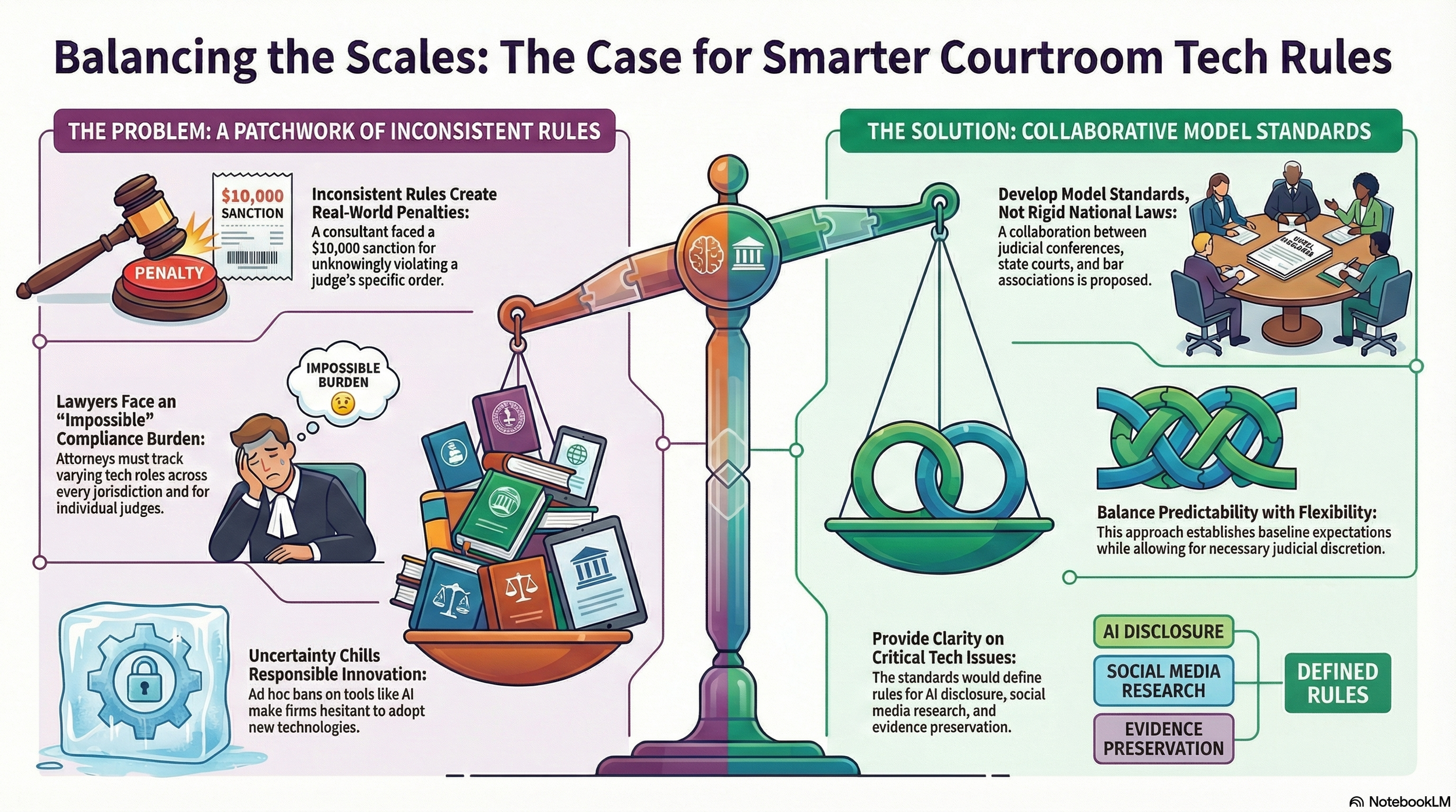
The core tension is understandable. Courts face legitimate concerns about technology misuse. The LinkedIn juror research incident in Judge Orrick's courtroom illustrates real risks: a consultant unknowingly violated a standing order, resulting in a $10,000 sanction despite the attorney's good-faith disclosure and remedial efforts. These aren't theoretical concerns—they reflect actual ethical boundaries that protect litigants and preserve judicial integrity. Yet the response to these concerns has created its own problems.

The current patchwork system places practicing attorneys in an impossible position. A lawyer handling cases across multiple federal districts cannot reasonably track the varying restrictions on artificial intelligence disclosure, social media evidence protocols, and digital research methodologies. When the safe harbor is simply avoiding technology altogether, the profession loses genuine opportunities to enhance accuracy and efficiency. Generative AI's citation hallucinations justify judicial scrutiny, but the ad hoc response by individual judges—ranging from simple guidance to outright bans—creates unpredictability that chills responsible innovation.

SHould there be an international standard for ai use in the courtroom

There are legitimate reasons to resist uniform national rules. Local courts understand their communities and case management needs better than distant regulatory bodies. A one-size-fits-all approach might impose burdensome requirements on rural jurisdictions with fewer tech-savvy practitioners. Furthermore, rapid technological evolution could render national rules obsolete within months, whereas individual judges retain flexibility to respond quickly to emerging problems.

Conversely, the current decentralized approach creates serious friction. The 2006 amendments to Federal Rules of Civil Procedure for electronically stored information succeeded partly because they established predictability across jurisdictions. Lawyers knew what preservation obligations applied regardless of venue. That uniformity enabled the profession to invest in training, software, and processes. Today's lawyers lack that certainty. Practitioners must maintain contact lists tracking individual judge orders, and smaller firms simply cannot sustain this administrative burden.

The answer likely lies between extremes. Rather than comprehensive national legislation, the profession would benefit from model standards developed collaboratively by the Federal Judicial Conference, state supreme courts, and bar associations. These guidelines could allow reasonable judicial discretion while establishing baseline expectations—defining when AI disclosure is mandatory, clarifying which social media research constitutes impermissible contact, and specifying preservation protocols that protect evidence without paralyzing litigation.

Such an approach acknowledges both legitimate judicial concerns and legitimate professional needs. It recognizes that judges require authority to protect courtroom procedures while recognizing that lawyers require predictability to serve clients effectively.

I basically agree with Nicole: The question is not whether courts should govern technology use. They must. The question is whether they govern wisely—with sufficient uniformity to enable compliance, sufficient flexibility to address local concerns, and sufficient clarity to encourage rather than discourage responsible innovation.

MTC: Law Firm Technology Procurement Strategy During Trade Court Tariff Chaos: Buy Now or Wait?

Tariff chaos continues with recent ruling by US Court of International trade creating confusion for lawyers on how to address their office tech needs!

The recent ruling by the US Court of International Trade has thrown technology procurement strategies for law firms into unprecedented uncertainty. Legal practitioners nationwide face a critical decision that could significantly impact their operational costs and technological capabilities for years to come.

On May 28, 2025, a three-judge panel at the US Court of International Trade delivered a landmark decision that struck down President Trump's sweeping tariff regime, ruling that the administration exceeded its constitutional authority by implementing global import duties under emergency powers legislation. The court determined that the International Emergency Economic Powers Act (IEEPA) does not grant the president unlimited authority to impose tariffs unilaterally, particularly the 30% tariffs on Chinese goods, 25% tariffs on certain imports from Mexico and Canada, and 10% universal tariffs on most other goods.

However, the victory for importers and businesses proved short-lived. The Trump administration immediately appealed the decision, and the Federal Circuit Court granted an emergency stay, allowing tariff collection to continue pending further legal proceedings. This legal ping-pong effect has created exactly the type of market uncertainty that makes technology procurement decisions particularly challenging for law firms.

The Technology Dilemma Facing Legal Practitioners

The smartphone and computer hardware that law firms depend on daily face significant price pressures under the current tariff regime. Industry analysts predict smartphone prices could increase by 4% in the US market due to tariff uncertainty. More dramatically, experts suggest that forcing iPhone production to move entirely to the United States could result in device prices reaching $3,500, several times the current prices. While such extreme scenarios may not materialize, the underlying message is clear: technology costs are likely to increase substantially if current trade policies persist.

For law firms, this creates a fundamental procurement dilemma. Should practices accelerate their hardware refresh cycles to avoid potential price increases? Or should they maintain their normal procurement schedules and hope that legal challenges will ultimately overturn the tariffs?

Understanding the Current Legal Landscape

lawyers struggle to balance timing of future tech purchases with the uncertainty the tariffs have created1

The Court of International Trade's ruling provides important guidance for understanding the likely trajectory of these trade policies. The judges specifically noted that tariffs designed to address drug trafficking and immigration issues fail to establish a clear connection between the emergency declared and the remedy implemented. The court emphasized that “…the collection of tariffs on lawful imports does not clearly relate to foreign efforts to arrest, seize, detain, or otherwise intercept wrongdoers within their jurisdictions".

This reasoning suggests that even if the Federal Circuit Court ultimately upholds some aspects of the administration's trade policy, the current broad-based tariff regime may face continued legal challenges. However, the court left intact Section 232 tariffs on steel, aluminum, and automobiles, indicating that more narrowly tailored trade measures may survive judicial scrutiny.

Practical Procurement Strategies for Law Firms

Given this uncertain environment, law firms should consider a hybrid approach to technology procurement that balances risk management with cost efficiency. Rather than making dramatic changes to established procurement cycles, firms should focus on strategic timing and vendor diversification.

  • Immediate Actions: Law firms with aging hardware that was already scheduled for replacement should consider accelerating those purchases slightly. Equipment approaching end-of-life status represents the highest risk category, as firms cannot afford to delay these replacements indefinitely. However, avoid panic purchasing of equipment that still has useful life remaining.

  • Vendor Diversification: The current trade tensions highlight the risks of over-reliance on any single country's manufacturing base. Samsung smartphones, for example, may face fewer tariff pressures than Apple devices because Samsung shifted most production away from China to Vietnam, India, and South Korea. Law firms should evaluate whether their technology vendors have diversified supply chains that reduce exposure to specific country-based tariffs.

  • Future-Proofing Without Overcommitment: Interestingly, recent surveys reveal that 73% of iPhone users and 87% of Samsung Galaxy users find little to no value in artificial intelligence features. This suggests that law firms should focus procurement decisions on proven functionality rather than cutting-edge features that may not provide practical value. Battery life, storage capacity, and build quality remain more important factors than AI capabilities for most legal professionals.

The Economics of Hardware as a Service

be the hero in your law office by having a solid understanding of where your tech comes from and how tariffs may impact your purchasing power!

The US Court of International Trade’s ruling and the ensuing tariff uncertainty underscore the need for law firms to reassess traditional hardware procurement models. Hardware as a Service (HaaS) offers a strategic alternative, shifting the financial and operational risks of ownership to specialized providers. Under HaaS, firms pay fixed monthly fees for enterprise-grade computers and devices, with vendors handling maintenance, upgrades, and supply chain disruptions—critical advantages amid fluctuating trade policies.

For small-to-midsize firms, HaaS mitigates two key risks: sudden tariff-driven price hikes and premature hardware obsolescence. By converting capital expenditures into predictable operational costs, firms avoid large upfront investments in equipment that may depreciate rapidly if tariffs escalate. Providers also absorb the burden of navigating geopolitical trade complexities, ensuring timely hardware replacements even if import restrictions tighten.

While many legal workflows rely on Software as a Service (SaaS), these cloud-based tools still require reliable hardware. Outdated computers struggle with modern SaaS platforms, leading to lagging performance, security vulnerabilities, and lost productivity. HaaS ensures firms maintain hardware capable of running current software efficiently, without the financial strain of cyclical refresh cycles.

Long-Term Strategic Considerations

Law firms must avoid knee-jerk reactions to tariff headlines. The legal challenges to presidential trade authority suggest broader import duties may face judicial limits, but appeals will prolong uncertainty. Instead, firms should build hardware procurement resilience through:

  1. Vendor Diversification: Partner with HaaS providers and suppliers across multiple regions to reduce dependency on tariff-affected geographies.

  2. Modular Budgeting: Allocate flexible funds for hardware upgrades, allowing adjustments as trade policies evolve.

  3. Performance Benchmarks: Prioritize devices with proven durability and processing power over speculative AI features, as 73% of legal professionals report minimal use of smartphone AI tools.

Final Thoughts

THERE ARE MORE FACTORS THAT JUST THE TARIFF’S THEMSELVES FOR LAWYER TO CONSIDER WHEN PURCHASING THEIR NEXT OFFICE TECH DEVICE!

The tariff chaos demands measured action, not paralysis. Firms should:

  • Replace aging hardware incapable of running current software and SaaS tools efficiently, as outdated devices increase security risks and hinder client service.

  • Adopt hybrid procurement models, blending HaaS for high-risk devices (e.g., laptops, servers) with outright purchases for stable, long-use equipment (e.g., monitors, keyboards, etc.).

  • Ignore speculative tech trends; focus on hardware that enhances core workflows, not flashy AI features with negligible practical value.

By anchoring decisions in operational needs rather than tariff panic, firms will balance cost efficiency with preparedness for any trade policy outcome.

MTC