📖 WORD OF THE WEEK (WoW): Zero Trust Architecture ⚖️🔐

Zero Trust Architecture and ABA Model Rules Compliance 🛡️

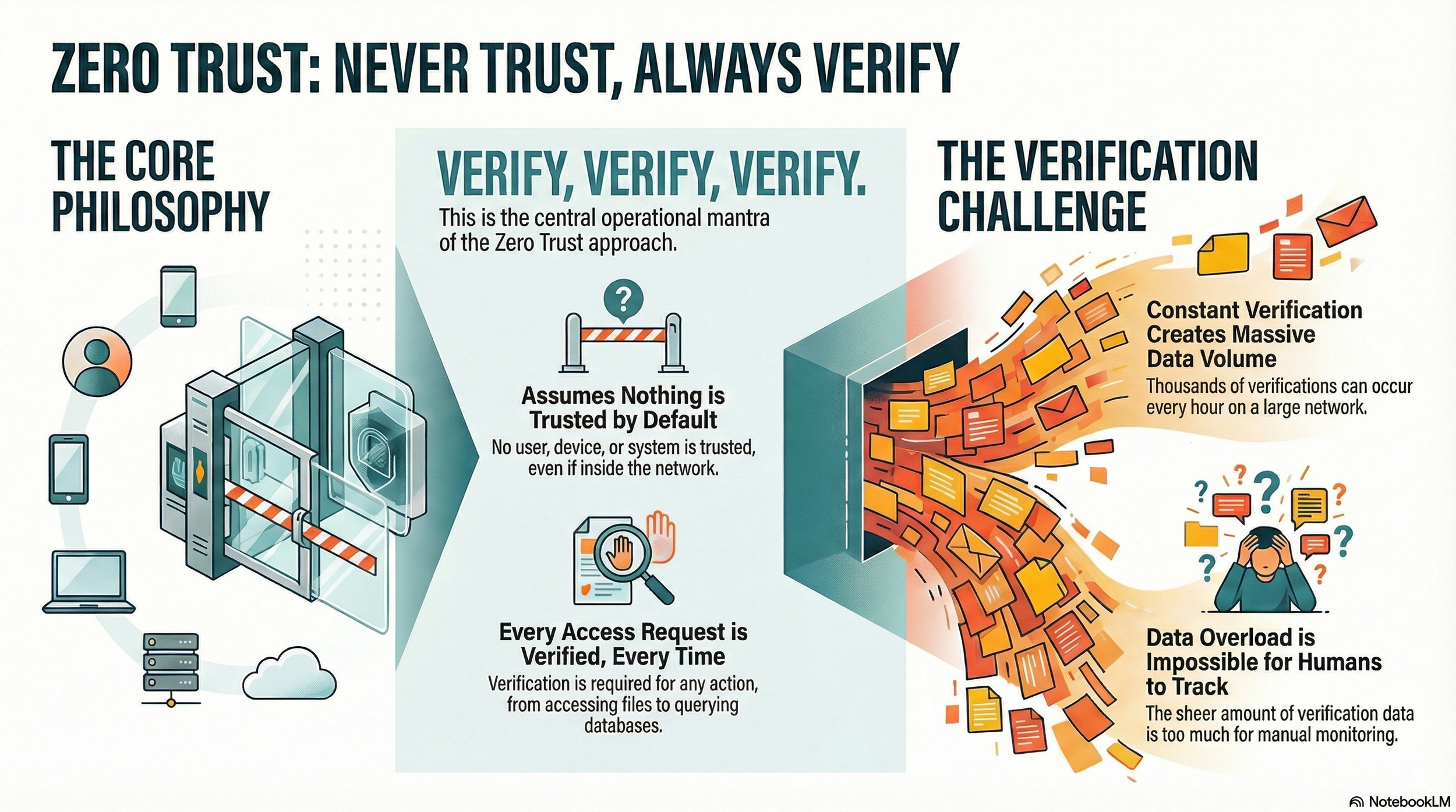
Lawyers need to "never trust, always verify" their network activity!

Zero Trust Architecture represents a fundamental shift in how law firms approach cybersecurity and fulfill ethical obligations. Rather than assuming that users and devices within a firm's network are trustworthy by default, this security model operates on the principle of "never trust, always verify." For legal professionals managing sensitive client information, implementing this framework has become essential to protecting confidentiality while maintaining compliance with ABA Model Rules.

The traditional security approach created a protective perimeter around a firm's network, trusting anyone inside that boundary. This model no longer reflects modern legal practice. Remote work, cloud-based case management systems, and mobile device usage mean that your firm's data exists across multiple locations and devices. Zero Trust abandons the perimeter-based approach entirely.

ABA Model Rule 1.6(c) requires lawyers to "make reasonable efforts to prevent the inadvertent or unauthorized disclosure of, or unauthorized access to, information relating to the representation of a client." Zero Trust Architecture directly fulfills this mandate by requiring continuous verification of every user and device accessing firm resources, regardless of location. This approach ensures compliance with the confidentiality duty that forms the foundation of legal practice.

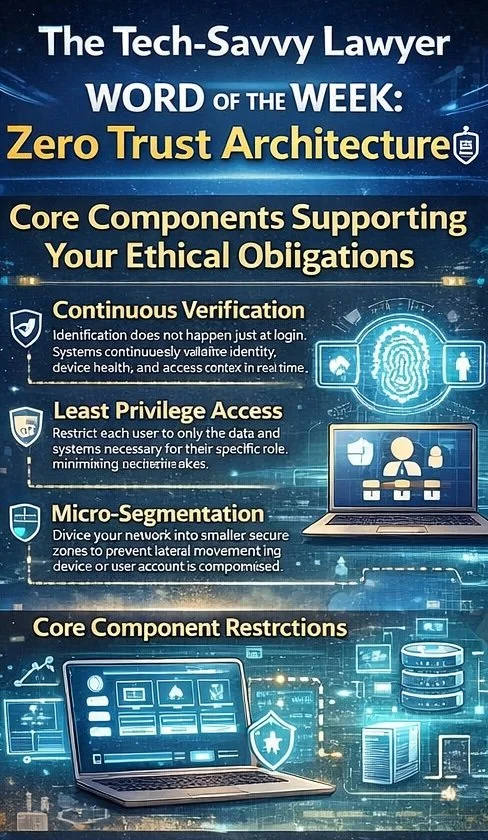
Core Components Supporting Your Ethical Obligations

Zero Trust Architecture operates through three interconnected principles aligned with ABA requirements.

legal professionals do you know the core components of modern cyber security?

  • Continuous verification means that authentication does not happen once at login. Instead, systems continuously validate user identity, device health, and access context in real time.

  • Least privilege access restricts each user to only the data and systems necessary for their specific role. An associate working on discovery does not need access to billing systems, and a paralegal in real estate does not need access to litigation files.

  • Micro-segmentation divides your network into smaller, secure zones. This prevents lateral movement, which means that if a bad actor compromises one device or user account, they cannot automatically access all firm systems.

ABA Model Rule 1.1, Comment 8 requires that lawyers maintain competence, including competence in "the benefits and risks associated with relevant technology." Understanding Zero Trust Architecture demonstrates that your firm maintains technological competence in cybersecurity matters. Additional critical components include multi-factor authentication, which requires users to verify their identity through multiple methods before accessing systems. Device authentication ensures that only approved and properly configured devices can connect to firm resources. End-to-end encryption protects data both at rest and in transit.

ABA Model Rule 1.4 requires lawyers to keep clients "reasonably informed about significant developments relating to the representation." Zero Trust Architecture supports this duty by protecting client information and enabling prompt client notification if security incidents occur.

ABA Model Rules 5.1 and 5.3 require supervisory lawyers and managers to ensure that subordinate lawyers and non-lawyer staff comply with professional obligations. Implementing Zero Trust creates the framework for effective supervision of cybersecurity practices across your entire firm.

Addressing Safekeeping Obligations

ABA Model Rule 1.15 requires lawyers to "appropriately safeguard" property of clients, including electronic information. Zero Trust Architecture provides the security infrastructure necessary to meet this safekeeping obligation. This rule mandates maintaining complete records of client property and preserving those records. Zero Trust's encryption and access controls ensure that stored records remain protected from unauthorized access.

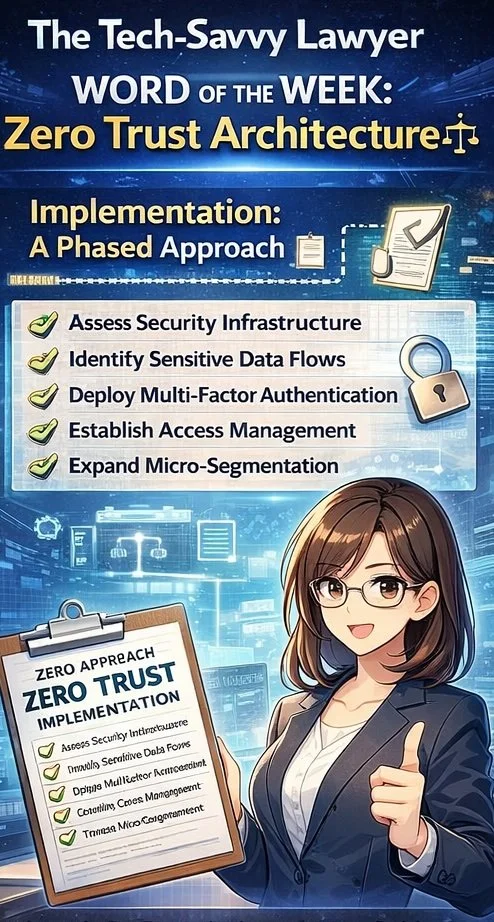
Implementation: A Phased Approach 📋

Implementing Zero Trust need not happen all at once. Begin by assessing your current security infrastructure and identifying sensitive data flows. Establish identity and access management systems to control who accesses what. Deploy multi-factor authentication across all applications. Then gradually expand micro-segmentation and monitoring capabilities as your systems mature. Document your efforts to demonstrate compliance with ABA Model Rule 1.6(c)'s requirement for "reasonable efforts."

Final Thoughts

Zero Trust Architecture transforms your firm's security posture from reactive protection to proactive verification while ensuring compliance with essential ABA Model Rules. For legal practices handling confidential client information, this security framework is not optional. It protects your clients, your firm's reputation, and your ability to practice law with integrity.

🔒 Word (Phrase) of the Week: “Zero Data Retention” Agreements: Why Every Lawyer Must Pay Attention Now!

Understanding Zero Data Retention in Legal Practice

🚨 Lawyers Must Know Zero Data Retention Now!

Zero Data Retention (ZDR) agreements represent a fundamental shift in how law firms protect client confidentiality when using third-party technology services. These agreements ensure that sensitive client information is processed but never stored by vendors after immediate use. For attorneys navigating an increasingly digital practice environment, understanding ZDR agreements has become essential to maintaining ethical compliance.

ZDR works through a simple but powerful principle: access, process, and discard. When lawyers use services with ZDR agreements, the vendor connects to data only when needed, performs the requested task, and immediately discards all information without creating persistent copies. This architectural approach dramatically reduces the risk of data breaches and unauthorized access.

The Legal Ethics Crisis Hidden in Your Vendor Contracts

Recent court orders have exposed a critical vulnerability in how lawyers use technology. A federal court ordered OpenAI to preserve all ChatGPT conversation logs indefinitely, including deleted content—even for paying subscribers. This ruling affects millions of users and demonstrates how quickly data retention policies can change through litigation.

The implications for legal practice are severe. Attorneys using consumer-grade AI tools, standard cloud storage, or free collaboration platforms may unknowingly expose client confidences to indefinite retention. This creates potential violations of fundamental ethical obligations, regardless of the lawyer's intent or the vendor's original promises.

ABA Model Rules Create Mandatory Obligations

Three interconnected ABA Model Rules establish clear ethical requirements for lawyers using technology vendors.

Rule 1.1 and its Comment [8] requires technological competence. Attorneys must understand "the benefits and risks associated with relevant technology". This means lawyers cannot simply trust vendor marketing claims about data security. They must conduct meaningful due diligence before entrusting client information to any third party.

Rule 1.6 mandates confidentiality protection. Lawyers must "make reasonable efforts to prevent the inadvertent or unauthorized disclosure of, or unauthorized access to, information relating to the representation of a client". This obligation extends to all digital communications and cloud-based storage. When vendors retain data beyond the immediate need, attorneys face heightened risks of unauthorized disclosure.

Rule 5.3 governs supervision of nonlawyer assistants. This rule applies equally to technology vendors who handle client information. Lawyers with managerial authority must ensure their firms implement measures that provide reasonable assurance that vendors comply with the attorney's professional obligations.

Practical Steps for Ethical Compliance

Attorneys must implement specific practices to satisfy their ethical obligations when selecting technology vendors.

1. Demand written confirmation of zero data retention policies from all vendors handling client information. Ask whether the vendor uses client data for training AI models. Determine how long any data remains accessible after processing. These questions must be answered clearly before using any service.

Lawyers Need Zero Data Retention Agreements!

Review vendor agreements carefully. Standard terms of service often fail to provide adequate confidentiality protections. Attorneys should negotiate explicit contractual provisions that prohibit data retention beyond immediate processing needs. These agreements must specify encryption standards, access controls, and breach notification procedures.

Obtain client consent when using third-party services that may access confidential information. While not always legally required, informed consent demonstrates respect for client autonomy and provides an additional layer of protection.

Conduct ongoing monitoring of vendor practices. Initial due diligence is insufficient. Technology changes rapidly, and vendors may alter their data handling practices. Regular reviews ensure continued compliance with ethical obligations.

Restrict employee use of unauthorized tools. Many data breaches stem from "shadow IT"—employees using personal accounts or unapproved services for work purposes. Clear policies and training can prevent inadvertent ethical violations.

The Distinction Between Consumer and Enterprise Services

Not all AI and cloud services create equal ethical risks. Consumer versions of popular tools often lack the security features required for legal practice. Enterprise subscriptions typically provide enhanced protections, including zero data retention options.

For example, OpenAI offers different service tiers with dramatically different data handling practices. ChatGPT Free, Plus, Pro, and Team subscriptions now face indefinite data retention due to court orders. However, ChatGPT Enterprise and API customers with ZDR agreements remain unaffected. This distinction matters enormously for attorney compliance.

Industry-Specific Legal AI Offers Additional Safeguards

Legal-specific AI platforms build confidentiality protections into their core architecture. These tools understand attorney-client privilege requirements and design their systems accordingly. They typically offer encryption, access controls, SOC 2 compliance, and explicit commitments not to use client data for training.

When evaluating legal technology vendors, attorneys should prioritize those offering private AI environments, end-to-end encryption, and contractual guarantees about data retention. These features align with the ethical obligations imposed by the Model Rules.

Zero Data Retention as Competitive Advantage

Beyond ethical compliance, ZDR agreements offer practical benefits. They reduce storage costs, simplify regulatory compliance, and minimize the attack surface for cybersecurity threats. In an era of increasing data breaches, the ability to tell clients that their information is never stored by third parties provides meaningful competitive differentiation.

Final Thoughts: Action Required Now

Lawyers must Protect Client Data with ZDR!

The landscape of legal technology changes constantly. Court orders can suddenly transform data retention policies. Vendors can modify their terms of service. New ethical opinions can shift compliance expectations.

Attorneys cannot afford passive approaches to vendor management. They must actively investigate, negotiate, and monitor the data handling practices of every technology provider accessing client information. Zero data retention agreements represent one powerful tool for maintaining ethical compliance in an increasingly complex technological environment.

The duty of confidentiality remains absolute, regardless of the tools lawyers choose. By demanding ZDR agreements and implementing comprehensive vendor management practices, attorneys can embrace technological innovation while protecting the fundamental trust that defines the attorney-client relationship.