Word of the Week: Deepfakes: How Lawyers Can Spot Fake Digital Evidence and Avoid ABA Model Rule Violations ⚖️

A Tech-Savvy Lawyer needs to be able to spot Deepfakes Before Courtroom Ethics Violations!

“Deepfakes” are AI‑generated or heavily manipulated audio, video, or images that convincingly depict people saying or doing things that never happened.🧠 They are moving from internet novelty to everyday litigation risk, especially as parties try to slip fabricated “evidence” into the record.📹

Recent cases and commentary show courts will not treat deepfakes as harmless tech problems. Judges have dismissed actions outright and imposed severe sanctions when parties submit AI‑generated or altered media, because such evidence attacks the integrity of the judicial process itself.⚖️ At the same time, courts are wary of lawyers who cry “deepfake” without real support, since baseless challenges can look like gamesmanship rather than genuine concern about authenticity.

For practicing lawyers, deepfakes are first and foremost a professional responsibility issue. ABA Model Rule 1.1 (Competence) now clearly includes a duty to understand the benefits and risks of relevant technology, which includes generative AI tools that create or detect deepfakes. You do not need to be an engineer, but you should recognize common red flags, know when to request native files or metadata, and understand when to bring in a qualified forensic expert.
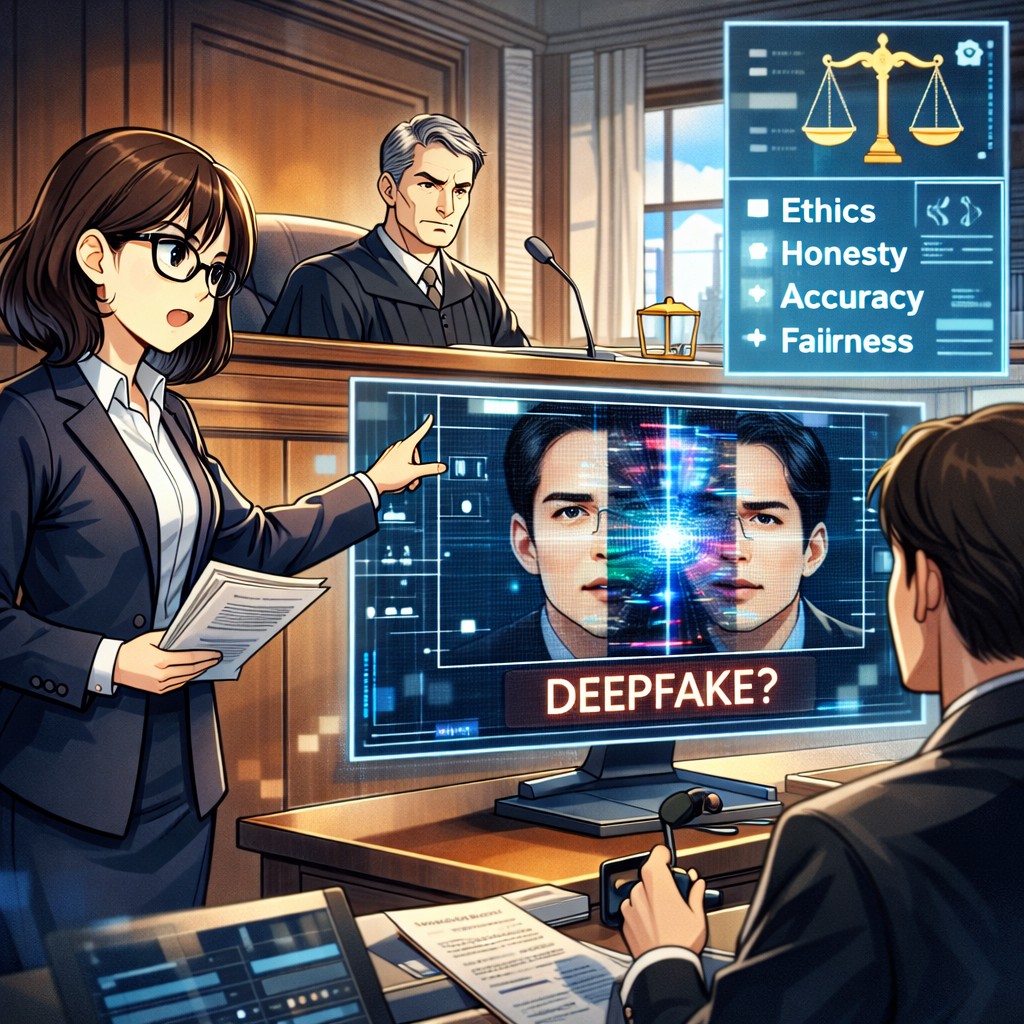
Deepfakes in Litigation: Detect Fake Evidence, Protect Your License!

Deepfakes also implicate Model Rule 3.3 (Candor to the tribunal) and Model Rule 3.4 (Fairness to opposing party and counsel). If you knowingly offer manipulated media, or ignore obvious signs of fabrication in your client’s “evidence,” you risk presenting false material to the court and obstructing access to truthful proof. Courts have made clear that submitting fake digital evidence can justify terminating sanctions, fee shifting, and referrals for disciplinary action.

Model Rule 8.4(c), which prohibits conduct involving dishonesty, fraud, deceit, or misrepresentation, sits in the background of every deepfake decision. A lawyer who helps create, weaponize, or strategically “look away” from deepfake evidence is not just making a discovery mistake; they may be engaging in professional misconduct. Likewise, a lawyer who recklessly accuses an opponent of using deepfakes without factual grounding risks violating duties of candor and professionalism.

Practically, you can start protecting your clients with a few repeatable steps. Ask early in the case what digital media exists, how it was created, and who controlled the devices or accounts.🔍 Build authentication into your discovery plan, including requests for original files, device logs, and platform records that can help confirm provenance. When the stakes justify it, consult a forensic expert rather than relying on “gut feel” about whether a recording “looks real.”
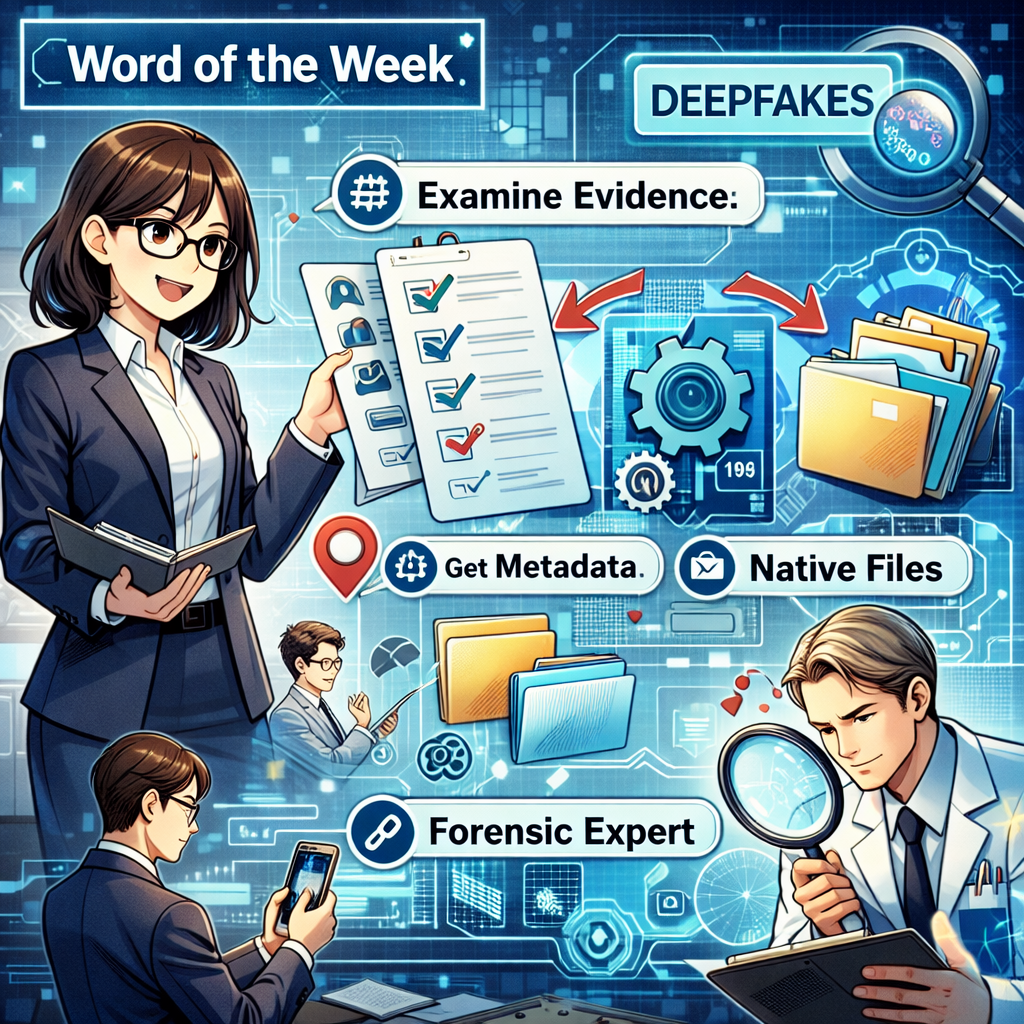
lawyers need to know Deepfakes, Metadata, and ABA Ethics Rules!

Finally, talk to clients about deepfakes before they become a problem. Explain that altering media or using AI to “clean up” evidence is dangerous, even if they believe they are only fixing quality.📲 Remind them that courts are increasingly sophisticated about AI and that discovery misconduct in this area can destroy otherwise strong cases. Treat deepfakes as another routine topic in your litigation checklist, alongside spoliation and privilege, and you will be better prepared for the next “too good to be true” video that lands in your inbox.


MTC: Everyday Tech, Extraordinary Evidence—Again: How Courts Are Punishing Fake Digital and AI Data ⚖️📱

Check your Ai work - AI fraud can meet courtroom consequences.

In last month’s editorial, “Everyday Tech, Extraordinary Evidence,” we walked through how smartphones, dash cams, and wearables turned the Minnesota ICE shooting into a case study in modern evidence practice, from rapid preservation orders to multi‑angle video timelines.📱⚖️ We focused on the positive side: how deliberate intake, early preservation, and basic synchronization tools can turn ordinary devices into case‑winning proof.📹 This follow‑up tackles the other half of the equation—what happens when “evidence” itself is fake, AI‑generated, or simply unverified slop, and how courts are starting to respond with serious sanctions.⚠️

From Everyday Tech to Everyday Scrutiny

The original article urged you to treat phones and wearables as critical evidentiary tools, not afterthoughts: ask about devices at intake, cross‑reference GPS trails, and treat cars as rolling 360‑degree cameras.🚗⌚ We also highlighted the Minnesota Pretti shooting as an example of how rapid, court‑ordered preservation of video and other digital artifacts can stop crucial evidence from “disappearing” before the facts are fully understood.📹 Those core recommendations still stand—if anything, they are more urgent now that generative AI makes it easier to fabricate convincing “evidence” that never happened.🤖

The same tools that helped you build robust, data‑driven reconstructions—synchronized bystander clips, GPS logs, wearables showing movement or inactivity—are now under heightened scrutiny for authenticity.📊 Judges and opposing counsel are no longer satisfied with “the video speaks for itself”; they want to know who created it, how it was stored, whether metadata shows AI editing, and what steps counsel took to verify that the file is what it purports to be.📁

When “Evidence” Is Fake: Sanctions Arrive

We have moved past the hypothetical stage. Courts are now issuing sanctions—sometimes terminating sanctions—when parties present fake or AI‑generated “evidence” or unverified AI research.💥

These are not “techie” footnotes; they are vivid warnings that falsified or unverified digital and AI data can end careers and destroy cases.🚨

ABA Model Rules: The Safety Rails You Ignore at Your Peril

Train to verify—defend truth in the age of AI.

Your original everyday‑tech playbook already fits neatly within ABA Model Rule 1.1 and Comment 8’s duty of technological competence; the new sanctions landscape simply clarifies the stakes.📚

  • Rule 1.1 (Competence): You must understand the benefits and risks of relevant technology, which now clearly includes generative AI and deepfake tools.⚖️ Using AI to draft or “enhance” without checking the output is not a harmless shortcut—it is a competence problem.

  • Rule 1.6 (Confidentiality): Uploading client videos, wearable logs, or sensitive communications to consumer‑grade AI sites can expose them to unknown retention and training practices, risking confidentiality violations.🔐

  • Rule 3.3 (Candor to the Tribunal) and Rule 4.1 (Truthfulness): Presenting AI‑altered video or fake citations as if they were genuine is the very definition of misrepresentation, as the New York and California sanction orders make clear.⚠️ Even negligent failure to verify can be treated harshly once the court’s patience for AI excuses runs out.

  • Rules 5.1–5.3 (Supervision): Supervising lawyers must ensure that associates, law clerks, and vendors understand that AI outputs are starting points, not trustworthy final products, and that fake or manipulated digital evidence will not be tolerated.👥

Bridging Last Month’s Playbook With Today’s AI‑Risk Reality

In Last month’s editorial, we urged three practical habits: ask about devices, move fast on preservation, and build a vendor bench for extraction and authentication.📱⌚🚗 This month, the job is to wrap those habits in explicit AI‑risk controls that lawyers with modest tech skills can realistically follow.🧠

  1. Never treat AI as a silent co‑counsel. If you use AI to draft research, generate timelines, or “enhance” video, you must independently verify every factual assertion and citation, just as you would double‑check a new associate’s memo.📑 “The AI did it” is not a defense; courts have already said so.

  2. Preserve the original, disclose the enhancement. Our earlier advice to keep raw smartphone files and dash‑cam footage now needs one more step: if you use any enhancement (AI or otherwise), label it clearly and be prepared to explain what was done, why, and how you ensured that the content did not change.📹

  3. Use vendors and examiners as authenticity firewalls. Just as we suggested, bringing in digital forensics vendors to extract phone and wearable data, you should now consider them for authenticity challenges as well—especially where the opposing side may have incentives or tools to create deepfakes.🔍 A simple expert declaration that a file shows signs of AI manipulation can be the difference between a credibility battle and a terminating sanction.

  4. Train your team using real sanction orders. Nothing clarifies the risk like reading Judge Castel’s order in the ChatGPT‑citation case or Judge Kolakowski’s deepfake ruling in Mendones.⚖️ Incorporate those cases into short internal trainings and CLEs; they translate abstract “AI ethics” into concrete, courtroom‑tested consequences.

  5. Document your verification steps. For everyday tech evidence, a simple log—what files you received, how you checked metadata, whether you compared against other sources, which AI tools (if any) you used, and what you did to confirm their outputs—can demonstrate good faith if a judge later questions your process.📋

Final Thoughts: Authenticity as a First‑Class Question

be the rock star! know how to use ai responsibly in your work!

In the first editorial, the core message was that everyday devices are quietly turning into your best witnesses.📱⌚ The new baseline is that every such “witness” will be examined for signs of AI contamination, and you will be expected to have an answer when the court asks, “What did you do to make sure this is real?”🔎

Lawyers with limited to moderate tech skills do not need to reverse‑engineer neural networks or master forensic software. Instead, they must combine the practical habits from January’s piece—asking, preserving, synchronizing—with a disciplined refusal to outsource judgment to AI.⚖️ In an era of deepfakes and hallucinated case law, authenticity is no longer a niche evidentiary issue; it is the moral center of digital advocacy.✨

Handled wisely, your everyday tech strategy can still deliver “extraordinary evidence.” Handled carelessly, it can just as quickly produce extraordinary sanctions.🚨

MTC