📖 Word of the Week: “Cross‑Tenant” Learning in Legal Practice

Cross-tenant learning helps law firms improve AI tools without exposing data

If your firm uses cloud‑based tools, you are already living in a multi‑tenant world. In that world, cross‑tenant learning is quickly becoming a key concept that every lawyer and legal operations professional should understand. 🧠⚖️

In simple terms, a “tenant” is your firm’s logically separate space inside a cloud platform: your own users, matters, documents, and settings, isolated from everyone else’s. Cross‑tenant learning refers to techniques in which a vendor’s system learns from patterns across multiple tenants (for example, many law firms) to improve its features—such as search, drafting suggestions, or document classification—without exposing any other firm’s confidential data to you or yours to them.

Why cross‑tenant learning matters for law firms

Cross‑tenant learning is especially relevant as generative AI and machine‑learning tools become embedded in e‑discovery platforms, contract review tools, legal research systems, and practice‑management software. Vendors may use aggregated and anonymized usage data to:

  • Improve relevance of search results and recommendations.

  • Enhance clause and issue spotting in contracts and briefs.

  • Reduce false positives in e‑discovery or compliance alerts.

  • Optimize workflows based on how similar firms use the product.

For lawyers, the value proposition is straightforward: your tools can become “smarter” faster, based on lessons learned across many organizations, not just your own firm’s experience. Done properly, cross‑tenant learning can raise the baseline quality and efficiency of technology available to your practice. ⚙️📈

ABA Model Rules: Confidentiality and Competence

Any discussion of cross‑tenant learning for law firms must start with confidentiality and competence.

  • Model Rule 1.6 (Confidentiality of Information) requires lawyers to safeguard information relating to the representation of a client. That obligation extends to how your vendors collect, store, and use your data. You must understand whether and how client data may be used for cross‑tenant learning and ensure that any such use preserves confidentiality through anonymization, aggregation, and strong technical and contractual controls. 🔐

  • Model Rule 1.1 (Competence), including Comment 8, emphasizes that lawyers should keep abreast of the benefits and risks associated with relevant technology. Understanding cross‑tenant learning is now part of that duty. You do not need to become a data scientist, but you should be comfortable asking vendors precise questions and recognizing red flags.

  • Model Rule 5.3 (Responsibilities Regarding Nonlawyer Assistance) applies when you rely on vendors as nonlawyer assistants. You must make reasonable efforts to ensure that their conduct is compatible with your professional obligations, including how they use your data for cross‑tenant learning. 🧾

Key questions to ask your vendors

ABA Model Rules guide ethical use of cross-tenant learning technologies

When evaluating a product that relies on cross‑tenant learning, consider asking:

  1. What data is used?

    • Is it only metadata or usage logs, or are actual document contents included?

    • Is the data aggregated and anonymized before it is used to train shared models?

  1. How is confidentiality protected?

    • Can other tenants ever see prompts, documents, or client‑identifying information from our firm?

    • What technical measures (encryption, access controls, tenant isolation) are in place?

  1. Can cross‑tenant learning be limited or disabled?

    • Do we have opt‑out or configuration controls?

    • Is there a dedicated model or environment for our firm if needed?

  1. What do the contract and policies say?

    • Does the MSA or DPA clearly limit use of client data to defined purposes?

    • How long is data retained, and how is it deleted if we leave?

These questions are not merely IT concerns; they go directly to your obligations under the ABA Model Rules and your firm’s risk profile.

Practical examples in law practice

Consider a cloud‑based contract‑analysis platform used by hundreds of firms. Over time, the provider can see which clauses lawyers routinely flag as risky, which edits are typically made, and what becomes the “preferred” language for certain issues. Through cross‑tenant learning, the system can use that aggregated knowledge to highlight problematic clauses and suggest alternatives more accurately for everyone.

Another example is an e‑discovery platform that uses cross‑tenant learning to distinguish between truly relevant documents and common “noise” such as automatically generated emails. The more matters the system processes across different tenants, the better it gets at ranking documents and reducing review burdens. This can be a material efficiency gain for litigation teams. ⚖️💼

In both scenarios, your ethical comfort depends on whether underlying data is appropriately anonymized, compartmentalized, and contractually protected.

Governance steps for your firm

To align cross‑tenant learning with professional obligations, firms can:

  • Update vendor‑due‑diligence checklists to include explicit questions about cross‑tenant learning, training data use, and model isolation.

  • Involve a cross‑functional team—lawyers, IT, information security, and risk management—in vendor selection and review.

  • Document your analysis of vendor practices and how they satisfy confidentiality, competence, and supervision obligations under the ABA Model Rules.

  • Educate lawyers and staff about how AI‑enabled tools work, what kinds of data they send into the system, and how to avoid unnecessary exposure of client‑identifying details.

Takeaway for busy practitioners
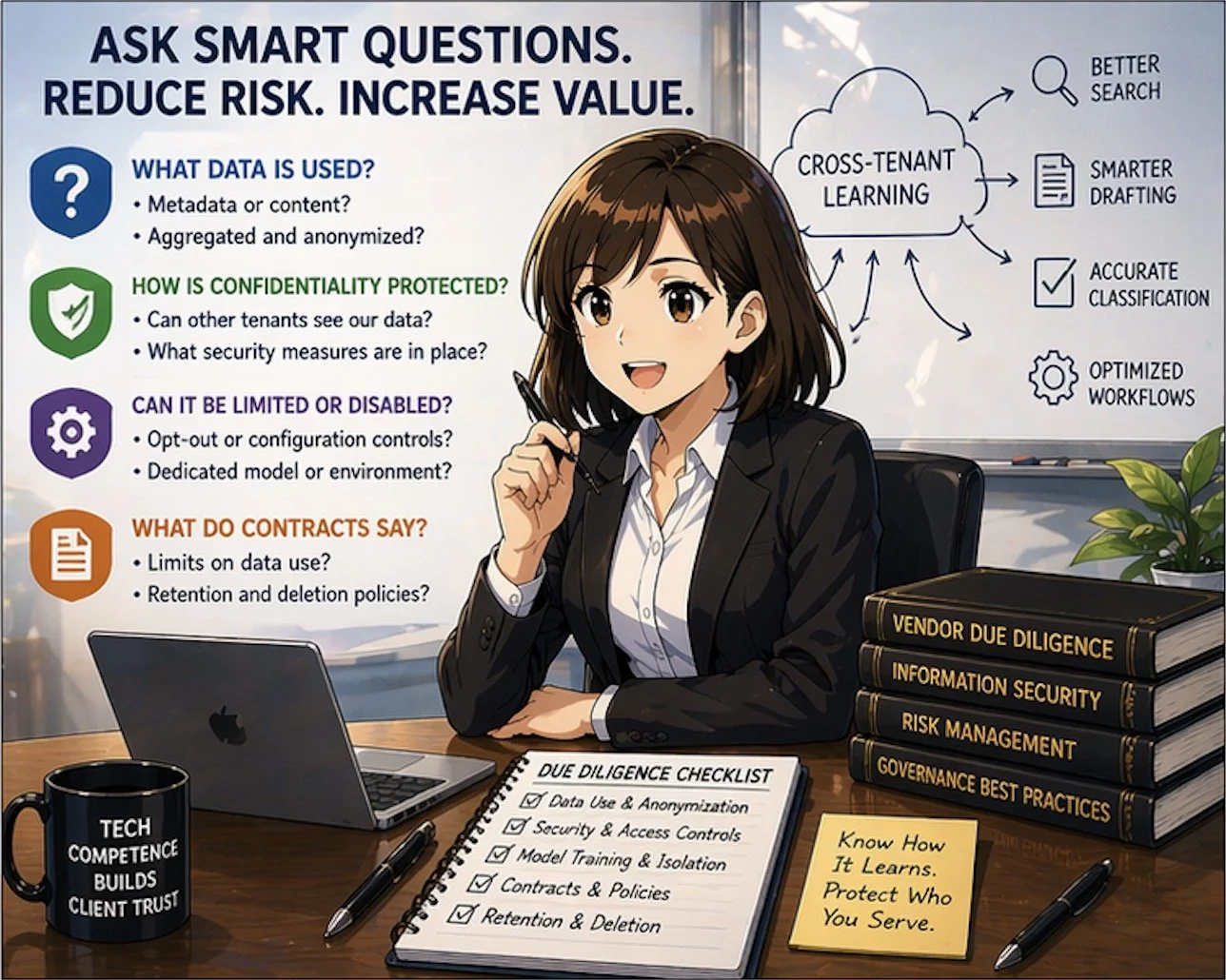
Smart vendor questions reduce risk in cross-tenant legal technology adoption

You do not need to reject cross‑tenant learning to protect your clients. Instead, you should approach it as a powerful capability that demands informed oversight. When well‑implemented, cross‑tenant learning can help your firm deliver faster, more consistent, and more cost‑effective legal services, while still honoring confidentiality and ethical duties. When poorly explained or loosely governed, it becomes an unnecessary and avoidable risk.

Understanding how your tools learn—and from whom—is now part of competent, modern legal practice. ⚖️💡

MTC: PornHub Breach: Cybersecurity Wake-Up Call for Lawyers

Lawyers are the first line defenders for their clientS’ pii.

It's the start of the New Year, and as good a time as any to remind the legal profession of their cybersecurity obligations! The recent PornHub data exposure reveals critical vulnerabilities every lawyer must address under ABA ethical obligations. Third-party analytics provider Mixpanel suffered a breach compromising user email addresses, triggering targeted sextortion campaigns. This incident illuminates three core security domains for legal professionals while highlighting specific duties under ABA Model Rules 1.1, 1.6, 5.1, 5.3, and Formal Opinion 483.

Understanding the Breach and Its Legal Implications

The PornHub incident demonstrates how failures by third-party vendors can lead to cascading security consequences. When Mixpanel's systems were compromised, attackers gained access to email addresses that now fuel sextortion schemes. Criminals threaten to expose purported adult site usage unless victims pay cryptocurrency ransoms. For law firms, this scenario is not hypothetical—your practice management software, cloud storage providers, and analytics tools present identical vulnerabilities. Each third-party vendor represents a potential entry point for attackers targeting your client data.

ABA Model Rule 1.1: The Foundation of Technology Competence

ABA Model Rule 1.1 requires lawyers to provide competent representation, and Comment 8 explicitly extends this duty to technology: "To maintain the requisite knowledge and skill, a lawyer should keep abreast of changes in the law and its practice, including the benefits and risks associated with relevant technology". This is not a suggestion—it is an ethical mandate. Thirty-one states have adopted this technology competence requirement into their professional conduct rules.

What does this mean practically? You must understand the security implications of every technology tool your firm uses. Before onboarding any platform, conduct due diligence on the vendor's security practices. Require SOC 2 compliance, cyber insurance verification, and detailed security questionnaires. The "reasonable efforts" standard does not demand perfection, but it does require informed decision-making. You cannot delegate technology competence entirely to IT consultants. You must understand enough to ask the right questions and evaluate the answers meaningfully.

ABA Model Rule 1.6: Safeguarding Client Information in Digital Systems

Rule 1.6 establishes your duty of confidentiality, and Comment 18 requires "reasonable efforts to prevent [the inadvertent or unauthorized] access or disclosure” to information relating to the representation of a client. This duty extends beyond privileged communications to all client-related information stored digitally.

The PornHub breach illustrates why this matters. Your firm's email system, document management platform, and client portals contain information criminals actively target. The "reasonable efforts" analysis considers the sensitivity of information, likelihood of disclosure without additional safeguards, cost of safeguards, and difficulty of implementation. For most firms, this means mandatory multi-factor authentication (MFA) on all systems, encryption for data at rest and in transit, and secure file-sharing platforms instead of email attachments.

You must also address third-party vendor access under Rule 1.6. When you grant a case management platform access to client data, you remain ethically responsible for protecting that information. Your engagement letters should specify security expectations, and vendor contracts must include confidentiality obligations and breach notification requirements.

ABA Model Rules 5.1 and 5.3: Supervisory Responsibilities Extend to Technology

lawyers need to stay up to date on the security protocOls for their firm’s software!

Rule 5.1 imposes duties on partners and supervisory lawyers to ensure the firm has measures giving "reasonable assurance that all lawyers in the firm conform to the Rules of Professional Conduct". Rule 5.3 extends this duty to nonlawyer assistants, which courts and ethics opinions have interpreted to include technology vendors and cloud service providers.

If you manage a firm or supervise other lawyers, you must implement technology policies and training programs. This includes security awareness training, password management requirements, and incident reporting procedures. You cannot assume your younger associates understand cybersecurity best practices—they need explicit training and clear policies.

For nonlawyer assistance, you must "make reasonable efforts to ensure that the person's conduct is compatible with the professional obligations of the lawyer". This means vetting your IT providers, requiring them to maintain appropriate security certifications, and ensuring they understand their confidentiality obligations. Your vendor management program is an ethical requirement, not just a business best practice.

ABA Formal Opinion 483: Data Breach Response Requirements

ABA Formal Opinion 483 establishes clear obligations when a data breach occurs. Lawyers have a duty to monitor for breaches, stop and mitigate damage promptly, investigate what occurred, and notify affected clients. This duty arises from Rules 1.1 (competence), 1.6 (confidentiality), and 1.4 (communication).

The Opinion requires you to have a written incident response plan before a breach occurs. Your plan must identify who will coordinate the response, how you will communicate with affected clients (including backup communication methods if email is compromised), and what steps you will take to assess and remediate the breach. You must document what data was accessed, whether malware was used, and whether client information was taken, altered, or destroyed.

Notification to clients is mandatory when a breach involves material client confidential information. The notification must be prompt and include what happened, what information was involved, what you are doing in response, and what clients should do to protect themselves. This duty extends to former clients in many circumstances, as their files may still contain sensitive information subject to state data breach laws.

Three Security Domains: Personal, Practice, and Client Protection

Your Law Practice's Security
Under Rules 5.1 and 5.3, you must implement reasonable security measures throughout your firm. Conduct annual cybersecurity risk assessments. Require MFA on all systems. Implement data minimization principles—only share what vendors absolutely need. Establish incident response protocols before breaches occur. Your supervisory duties require you to ensure that all firm personnel, including non-lawyer staff, understand and follow the firm's security policies.

Client Security Obligations
Rule 1.4 requires you to keep clients reasonably informed, which includes advising them on security matters relevant to their representation. Clients experiencing sextortion need immediate, informed guidance. Preserve all threatening emails with headers intact. Document timestamps and demands. Advise clients never to pay or respond—payment confirms active monitoring and often leads to additional demands. Report incidents to the FBI's IC3 unit and local cybercrime divisions. For family law practitioners, understand that sextortion often targets vulnerable individuals during contentious proceedings. Criminal defense attorneys must recognize these threats as extortion, not embarrassment issues. Your competence under Rule 1.1 requires you to understand these threats well enough to provide effective guidance.

Personal Digital Hygiene
Your personal email account is your digital identity's master key. Enable MFA on all professional and personal accounts. Use unique, complex passwords managed through a password manager. Consider pseudonymous email addresses for sensitive subscriptions. Separate your litigation communications from personal browsing activities. The STOP framework applies: Slow down, Test suspicious contacts, Opt out of high-pressure conversations, and Prove identities through independent channels. Your personal security failures can compromise your professional obligations under Rule 1.6.

Practical Implementation Steps

THere are five Practical Implementation Steps lawyers can do today to get their practice cyber compliant!

First, conduct a technology audit to map every system that stores or accesses client information. Identify all third-party vendors and assess their security practices against industry standards.

Second, implement MFA across all systems immediately—this is one of the most effective and cost-efficient security controls available.

Third, develop written security policies covering password management, device encryption, remote work procedures, and incident response.

Fourth, train all firm personnel on these policies and conduct simulated phishing exercises to test awareness.

Fifth, review and update your engagement letters to include technology provisions and breach notification procedures.

Conclusion

The PornHub breach is not an isolated incident—it is a template for how modern attacks occur through third-party vendors. Your ethical duties under ABA Model Rules require proactive cybersecurity measures, not reactive responses after a breach. Technology competence under Rule 1.1, confidentiality protection under Rule 1.6, supervisory responsibilities under Rules 5.1 and 5.3, and breach response obligations under Formal Opinion 483 together create a comprehensive framework for protecting your practice and your clients. Cybersecurity is no longer an IT issue delegated to consultants; it is a core professional competency that affects your license to practice law. The time to act is before your firm appears in a breach notification headline.