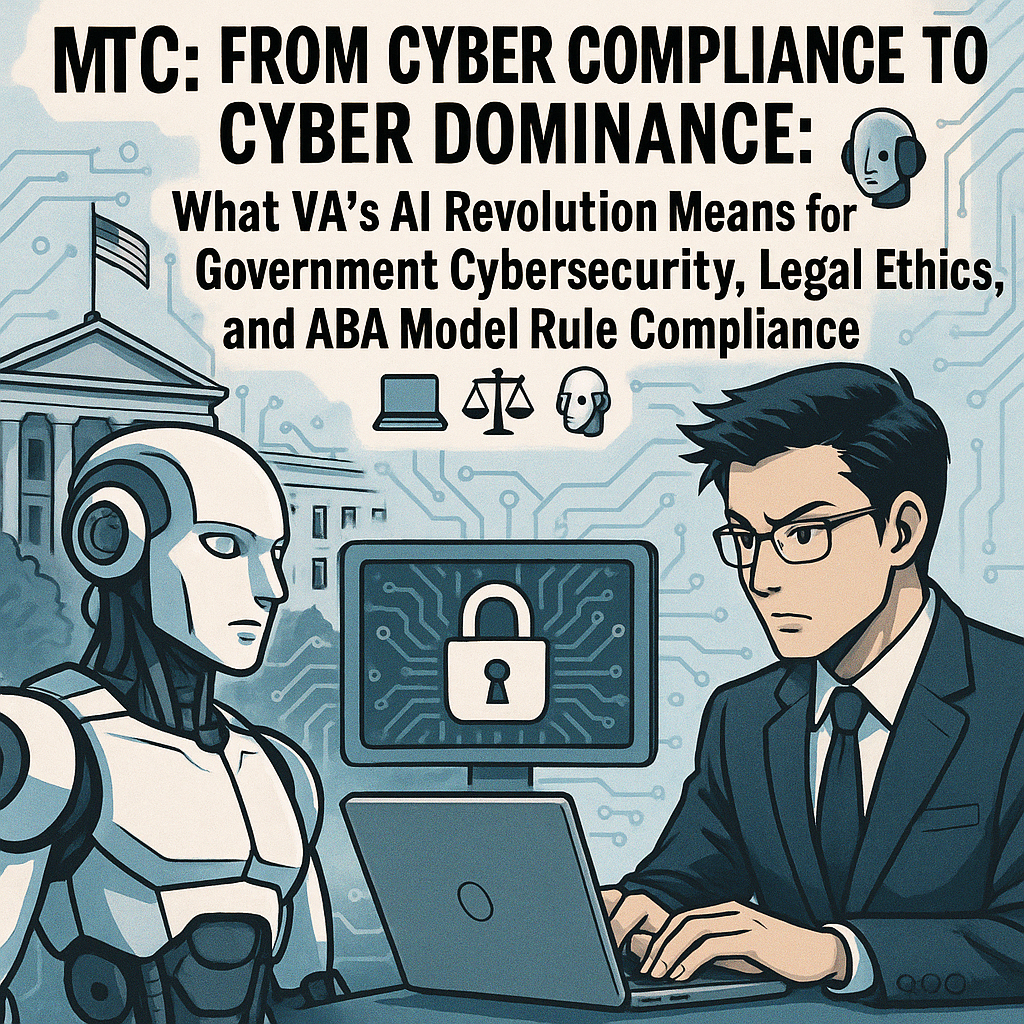
MTC: From Cyber Compliance to Cyber Dominance: What VA’s AI Revolution Means for Government Cybersecurity, Legal Ethics, and ABA Model Rule Compliance 💻⚖️🤖

In the age of cyber dominance, “I did not understand the technology” is increasingly unlikely to serve as a safe harbor.

🚨 🤖 👩🏻‍💼👨‍💼

In the age of cyber dominance, “I did not understand the technology” is increasingly unlikely to serve as a safe harbor. 🚨 🤖 👩🏻‍💼👨‍💼

Government technology is in the middle of a historic shift. The Department of Veterans Affairs (VA) stands at the center of this transformation, moving from a check‑the‑box cybersecurity culture to a model of “cyber dominance” that fuses artificial intelligence (AI), zero trust architecture (a security model that assumes no user or device is trusted by default, even inside the network), and continuous risk management. 🔐

For lawyers who touch government work in any way—inside agencies, representing contractors, handling whistleblowers, litigating Freedom of Information Act (FOIA) or privacy issues, or advising regulated entities—this is not just an IT story. It is a law license story. Under the American Bar Association (ABA) Model Rules, failing to grasp core cyber and AI governance concepts can now translate into ethical risk and potential disciplinary exposure. ⚠️

Resources such as The Tech-Savvy Lawyer.Page blog and podcast are no longer “nice to have.” They are becoming essential continuing education for lawyers who want to stay competent in practice, protect their clients, and safeguard their own professional standing. 🧠🎧

Where Government Agency Technology Has Been: The Compliance Era 🗂️

For decades, many federal agencies lived in a world dominated by static compliance frameworks. Security often meant passing audits and meeting minimum requirements, including:

  • Annual or periodic Authority to Operate (ATO, the formal approval for a system to run in a production environment based on security review) exercises

  • A focus on the Federal Information Security Modernization Act (FISMA) and National Institute of Standards and Technology (NIST) security control checklists

  • Point‑in‑time penetration tests

  • Voluminous documentation, thin on real‑time risk

The VA was no exception. Like many agencies, it grappled with large legacy systems, fragmented data, and a culture in which “security” was a paperwork event, not an operational discipline. 🧾

In that world, lawyers often saw cybersecurity as a box to tick in contracts, privacy impact assessments, and procurement documentation. The legal lens focused on:

  • Whether the required clauses were in place

  • Whether a particular system had its ATO

  • Whether mandatory training was completed

The result: the law frequently chased the technology instead of shaping it.

Where Government Technology Is Going: Cyber Dominance at the VA 🚀

The VA is now in the midst of what its leadership calls a “cybersecurity awakening” and a shift toward “cyber dominance”. The message is clear: compliance is not enough, and in many ways, it can be dangerously misleading if it creates a false sense of security.

Key elements of this new direction include:

  • Continuous monitoring instead of purely static certification

  • Zero trust architecture (a security model that assumes no user, device, or system is trusted by default, and that every access request must be verified) as a design requirement, not an afterthought

  • AI‑driven threat detection and anomaly spotting at scale

  • Integrated cybersecurity into mission operations, not a separate silo

  • Real‑time incident response and resilience, rather than after‑the‑fact blame

“Cyber dominance” reframes cybersecurity as a dynamic contest with adversaries. Agencies must assume compromise, hunt threats proactively, and adapt in near real time. That shift depends heavily on data engineering, automation, and AI models that can process signals far beyond human capacity. 🤖

For both government and nongovernment lawyers, this means that the facts on the ground—what systems actually do, how they are monitored, and how decisions are made—are changing fast. Advocacy and counseling that rely on outdated assumptions about “IT systems” will be incomplete at best and unethical at worst.

The Future: Cybersecurity Compliance, Cybersecurity, and Cybergovernance with AI 🔐🌐

The future of government technology involves an intricate blend of compliance, operational security, and AI governance. Each element increasingly intersects with legal obligations and the ABA Model Rules.

1. Cybersecurity Compliance: From Static to Dynamic ⚙️

Traditional compliance is not disappearing. The FISMA, NIST standards, the Federal Risk and Authorization Management Program (FedRAMP), the Health Insurance Portability and Accountability Act (HIPAA), and other frameworks still govern federal systems and contractor environments.

But the definition of compliance is evolving:

  • Continuous compliance: Automated tools generate near real‑time evidence of security posture instead of relying only on annual snapshots.

  • Risk‑based prioritization: Not every control is equal; agencies must show how they prioritize high‑impact cyber risks.

  • Outcome‑focused oversight: Auditors and inspectors general care less about checklists and more about measurable risk reduction and resilience.

Lawyers must understand that “we’re compliant” will no longer end the conversation. Decision‑makers will ask:

  • What does real‑time monitoring show about actual risk?

  • How quickly can the VA or a contractor detect and contain an intrusion?

  • How are AI tools verifying, logging, and explaining security‑related decisions?

2. Cybersecurity as an Operational Discipline 🛡️

The VA’s push toward cyber dominance relies on building security into daily operations, not layering it on top. That includes:

  • Secure‑by‑design procurement and contract terms, which require modern controls and realistic reporting duties

  • DevSecOps (development, security, and operations) pipelines that embed automated security testing and code scanning into everyday software development

  • Data segmentation and least‑privilege access across systems, so users and services only see what they truly need

  • Routine red‑teaming (simulated attacks by ethical hackers to test defenses) and table‑top exercises (structured discussion‑based simulations of incidents to test response plans)

For government and nongovernment lawyers, this raises important questions:

  • Are contracts, regulations, and interagency agreements aligned with zero trust principles (treating every access request as untrusted until verified)?

  • Do incident response plans meet regulatory and contractual notification timelines, including state and federal breach laws?

  • Are representations to courts, oversight bodies, and counterparties accurate in light of actual cyber capabilities and known limitations?

3. Cybergovernance with AI: The New Frontier 🌐🤖

Lawyers can no longer sit idlely by their as cyber-ethic responsibilities are changing!

AI will increasingly shape how agencies, including the VA, manage cyber risk:

  • Machine learning models will flag suspicious behavior or anomalous network traffic faster than humans alone.

  • Generative AI tools will help triage incidents, search legal and policy documents, and assist with internal investigations.

  • Decision‑support systems may influence resource allocation, benefit determinations, or enforcement priorities.

These systems raise clear legal and ethical issues:

  • Transparency and explainability: Can lawyers understand and, if necessary, challenge the logic behind AI‑assisted or AI‑driven decisions?

  • Bias and fairness: Do algorithms create discriminatory impacts on veterans, contractors, or employees, even if unintentional?

  • Data governance: Is sensitive, confidential, or privileged information being exposed to third‑party AI providers or trained into their models?

Blogs and podcasts like Tech-Savvy Lawyer.Page blog and podcast often highlight practical workflows for lawyers using AI tools safely, along with concrete questions to ask vendors and IT teams. Those insights are particularly valuable as agencies and law practices both experiment with AI for document review, legal research, and compliance tracking. 💡📲

What Lawyers in Government and Nongovernment Need to Know 🏛️⚖️

Lawyers inside agencies such as the VA now sit at the intersection of mission, technology, and ethics. Under ABA Model Rule 1.1 (Competence) and its comment on technological competence, agency counsel must acquire and maintain a basic understanding of relevant technology that affects client representation.

For government lawyers and nongovernment lawyers who advise, contract with, or litigate against agencies such as the VA, technological competence now has a common core. It requires enough understanding of system architecture, cybersecurity practices, and AI‑driven tools to ask the right questions, spot red flags, and give legally sound, ethics‑compliant advice on how those systems affect veterans, agencies, contractors, and the public. ⚖️💻

For government lawyers and nongovernment lawyers who interact with agencies such as the VA, this includes:

  • Understanding the basic architecture and risk profile of key systems (for example, benefits, health data, identity, and claims platforms), so you can evaluate how failures affect legal rights and obligations. 🧠

  • Being able to ask informed questions about zero trust architecture, encryption, system logging, and AI tools used by the agency or contractor.

  • Knowing the relevant incident response plans, data breach notification obligations, and coordination pathways with regulators and law enforcement, whether you are inside the agency or across the table. 🚨

  • Ensuring that policies, regulations, contracts, and public statements about cybersecurity and AI reflect current technical realities, rather than outdated assumptions that could mislead courts, oversight bodies, or the public.

Model Rules 1.6 (Confidentiality of Information) and 1.13 (Organization as Client) are especially important. Government lawyers must:

  • Guard sensitive data, including classified, personal, and privileged information, against unauthorized disclosure or misuse.

  • Advise the “client” (the agency) when cyber or AI practices present significant legal risk, even if those practices are popular or politically convenient.

If a lawyer signs off on policies or representations about cybersecurity that they know—or should know—are materially misleading, that can implicate Rule 3.3 (Candor Toward the Tribunal) and Rule 8.4 (Misconduct). The shift to cyber dominance means that “we passed the audit” will no longer excuse ignoring operational defects that put veterans or the public at risk. 🚨

What Lawyers Outside Government Need to Know 🏢⚖️

Lawyers representing contractors, vendors, whistleblowers, advocacy groups, or regulated entities cannot ignore these changes at the VA and other agencies. Their clients operate in the same new environment of continuous oversight and AI‑informed risk management.

Key responsibilities for nongovernmental lawyers include:

  • Contract counseling: Understanding cybersecurity clauses, incident response requirements, AI‑related representations, and flow‑down obligations in government contracts.

  • Regulatory compliance: Navigating overlapping regimes (for example, federal supply chain rules, state data breach statutes, HIPAA in health contexts, and sector‑specific regulations).

  • Litigation strategy: Incorporating real‑time cyber telemetry and AI logs into discovery, privilege analyses, and evidentiary strategies.

  • Advising on AI tools: Ensuring that client use of generative AI in government‑related work does not compromise confidential information or violate procurement, export control, or data localization rules.

Under Model Rule 1.1 (Competence), outside counsel must be sufficiently tech‑savvy to spot issues and know when to bring in specialized expertise. Ignoring cyber and AI governance concerns can:

  • Lead to inadequate or misleading advice.

  • Misstate risk in negotiations, disclosures, or regulatory filings.

  • Expose clients to enforcement actions, civil liability, or debarment.

  • Expose lawyers to malpractice claims and disciplinary complaints.

ABA Model Rules: How Cyber and AI Now Touch Your License 🧾⚖️

Several American Bar Association (ABA) Model Rules are directly implicated by the VA’s evolution from compliance to cyber dominance and by the broader adoption of artificial intelligence (AI) in government operations:

  • Rule 1.1 – Competence

    • Comment 8 recognizes a duty of technological competence.

    • Lawyers must understand enough about cyber risk and AI systems to represent clients prudently.

  • Rule 1.6 – Confidentiality of Information

    • Lawyers must take reasonable measures to safeguard client information, including in cloud environments and AI‑enabled workflows.

    • Uploading sensitive or privileged content into consumer‑grade AI tools without safeguards can violate this duty.

  • Rule 1.4 – Communication

    • Clients should be informed—in clear, non‑technical terms—about significant cyber and AI risks that may affect their matters.

  • Rules 5.1 and 5.3 – Responsibilities of Partners, Managers, and Supervisory Lawyers; Responsibilities Regarding Nonlawyer Assistance

    • Law firm leaders must ensure that policies, training, vendor selection, and supervision support secure, ethical use of technology and AI by lawyers and staff.

  • Rule 1.13 – Organization as Client

    • Government and corporate counsel must advise leadership when cyber or AI governance failures pose substantial legal or regulatory risk.

  • Rules 3.3, 3.4, and 8.4 – Candor, Fairness, and Misconduct

    • Misrepresenting cyber posture, ignoring known vulnerabilities, or manipulating AI‑generated evidence can rise to ethical violations and professional misconduct.

In the age of cyber dominance, “I did not understand the technology” is increasingly unlikely to serve as a safe harbor. Judges, regulators, and disciplinary authorities expect lawyers to engage these issues competently.

Practical Next Steps for Lawyers: Moving from Passive to Proactive 🧭💼

To meet this moment, lawyers—both in government and outside—should:

  • Learn the language of modern cybersecurity:

    • Zero trust (a model that treats every access request as untrusted until verified)

    • Endpoint detection and response (EDR, tools that continuously monitor and respond to threats on endpoints such as laptops, servers, and mobile devices)

    • Security Information and Event Management (SIEM, systems that collect and analyze security logs from across the network)

    • Security Orchestration, Automation, and Response (SOAR, tools that automate and coordinate security workflows and responses)

    • Encryption at rest and in transit (protecting data when it is stored and when it moves across networks)

    • Multi‑factor authentication (MFA, requiring more than one factor—such as password plus a code—to log in)

  • Understand AI’s role in the client’s environment: what tools are used, where data goes, how outputs are checked, and how decisions are logged.

  • Review incident response plans and breach notification workflows with an eye on legal timelines, cross‑jurisdictional obligations, and contractual requirements.

  • Update engagement letters, privacy notices, and internal policies to reflect real‑world use of cloud services and AI tools.

  • Invest in continuous learning through technology‑forward legal resources, including The Tech-Savvy Lawyer.Page blog and podcast, which translate evolving tech into practical law practice strategies. 💡

Final Thoughts: The VA’s journey from compliance to cyber dominance is more than an agency story. It is a case study in how technology, law, and ethics converge. Lawyers who embrace this reality will better protect their clients, their institutions, and their licenses. Those who do not will risk being left behind—by adversaries, by regulators, and by their own professional standards. 🚀🔐⚖️

Editor’s Note: I used the VA as my “example” because Veterans mean a lot to me. I have been a Veterans Disability Benefits Advocate for nearly two decades. Their health and welfare should not be harmed by faulty tech compliance. 🇺🇸⚖️

MTC

MTC (Holiday Special🎁): Cyber Monday 2025: A Lawyer’s Defense Against Holiday Scams and ‘Bargain’ Tech Traps

The “Billable Hour” Defense: Why That $300 Laptop and "Urgent" Delivery Text Are Liabilities, Not Deals

That “deal” for a “cheaper” computer may not be worth the lack of performance issues that come with a “cheap” computer!

As legal professionals, we are trained to spot inconsistencies in testimony, identify hidden clauses in contracts, and anticipate risks before they manifest. Yet, when the holiday shopping season arrives, the same skepticism that protects our clients often evaporates in the face of a 70% off sticker.

During Cyber Mondays, lawyers must tread carefully. The digital landscape is not just a marketplace; it is a hunting ground. For a law practice, the risks of holiday shopping go beyond a wasted purchase. A compromised device or a clicked phishing link can breach attorney-client privilege, trigger ethical violations, and lock down firm operations with ransomware.

Before you open your wallet or click that “track package” link, consider this your final briefing on the threats lurking behind the holiday hype.

The "Bargain" Trap: Why Cheap Tech is Expensive for Lawyers

We all love a deal. But in the world of legal technology, there is a profound difference between "inexpensive" and "cheap."

You may see "doorbuster" deals for laptops priced under $300. The marketing copy promises they are perfect for "light productivity" or "students." You might be tempted to pick one up for a paralegal, a home office, or even a law student family member.

Resist this impulse.

Tech experts and consumer watchdogs, including Lifehacker and PCMag, consistently warn about these "derivative" holiday models. Manufacturers often build specific units solely for Black Friday and Cyber Monday (SKUs [stock keeping unit] that do not exist the rest of the year). They achieve these rock-bottom prices by cutting corners that matter deeply to legal professionals:

  • The Processor Bottleneck: Many of these bargain laptops run on Celeron or Pentium chips (or older generations of Core i3). For a lawyer running practice management software, multiple PDF contracts, and video conferencing simultaneously, these processors are insufficient. The resulting lag isn't just annoying; it costs billable time.

  • The Screen Resolution Hazard: To save costs, these laptops often feature 1366 x 768 (720p) screens. In 2025, this is unacceptable for reviewing documents. The low resolution makes text pixelated and reduces the amount of a contract you can see on screen at once, increasing eye strain and the likelihood of missing a critical detail in a clause.

  • The RAM Deficit: 4GB of RAM is common in these deals. In a modern Windows environment, the operating system alone consumes nearly that much. Once you open a web browser with your firm's research tabs, the system will crawl.

  • Security Longevity: Perhaps most critically for a law firm, these bargain-bin devices often reach their "End of Service" life much faster. They may not support the latest secure operating systems or encryption standards required by your firm’s compliance insurance.

The Verdict: A $300 laptop that frustrates your staff and cannot handle encryption is not an asset; it is e-waste in the making. Stick to business-class hardware (Lenovo, HP, Dell, Apple, inter alia.) purchased through verified channels, even if it costs more. Your peace of mind is worth the premium.

BONUS: Price Tracking Tools

Successful online shopping during promotional periods requires distinguishing genuine discounts from artificial markups. Price tracking tools provide historical data that reveals authentic savings opportunities.

CamelCamelCamel tracks Amazon price history, creating visual charts showing price fluctuations over weeks, months, and years. This free tool sends email notifications when products drop below specified price thresholds and monitors both Amazon-direct and third-party seller pricing.

Honey extends beyond its widely-known coupon functionality to offer robust price tracking across multiple retailers through its "Droplist" feature. The browser extension automatically applies discount codes during checkout and compares prices across competing stores.

Keepa provides similar Amazon-focused price tracking with browser integration that displays historical pricing directly on Amazon product pages. The tool's detailed charts reveal seasonal patterns and help identify optimal purchase timing.

For legal professionals managing firm purchasing, enterprise-grade solutions such as Prisync, Price2Spy, and Competera offer comprehensive competitor monitoring, automated pricing adjustments, and real-time market data. These platforms serve businesses tracking multiple products across various marketplaces, but require subscription fees.

The Scam Landscape 2025: You Are a High-Value Target

Be wary when purchasing items online - always use a vpn when using public wifi!

According to Malwarebytes’ 2025 Holiday Scam report, shoppers are increasingly mobile, fast, and distracted. For lawyers, who are often managing high-stress caseloads alongside holiday obligations, this distraction is dangerous.

Scammers know that law firms move money. They know we manage sensitive data. And they know that during the holidays, our guards are down. Here are the three specific vectors attacking legal professionals this season.

1. The "Urgent Delivery" Smishing Attack
We all have packages in transit. You likely receive legitimate texts from Amazon, FedEx, or UPS daily. Scammers exploit this by sending "Smishing" (SMS phishing) messages claiming a package is "delayed" or "requires a delivery fee."

For a lawyer waiting on a court transcript or a client file, the instinct to "fix" the delivery issue is strong. But clicking that link often downloads malware or leads to a credential-harvesting site that looks identical to the courier’s login page.

  • The Defense: Never click a tracking link in a text message. Copy the tracking number and paste it directly into the courier’s official app or website. If the text doesn’t have a tracking number, it’s a scam.

2. The "Malvertising" Minefield
You are searching for a specific piece of hardware—perhaps a new scanner or ergonomic chair for the office. You see an ad on Google or social media for the exact item at a beat-to-beat price.

Malwarebytes warns that "Malvertising" (malicious advertising) is surging. Scammers buy ad space on legitimate platforms. When you click the ad, you aren't taken to the retailer; you are redirected to a cloned site designed to steal your credit card info, or worse, your firm’s login credentials.

  • The Defense: Treat ads as tips, not links. If you see a deal for a Dell monitor, close the ad and navigate manually to Dell.com or BestBuy.com to find it.

3. The "Gift Card" Emergency
This is a classic that has evolved. In the past, it was a fake email from the "Managing Partner" asking an associate to buy gift cards for a client. Now, it’s more sophisticated. Scammers may pose as court clerks or government officials, claiming a "fine" or "filing fee" must be paid immediately to avoid a bench warrant, and—due to a "system error"—they can only accept payment via gift cards or crypto.

  • The Defense: Courts do not accept gift cards. Period. If you receive an urgent financial demand via text or email, verify it by calling the person or entity on a known, public number.

The "Social" Threat: Marketplace Scams

Social media marketplaces (Facebook Marketplace, OfferUp) are now major hubs for holiday shopping. They are also unregulated.

A common scam involves a "seller" offering a high-demand item (like the latest iPad or game console) at a reasonable, but slightly low, price. They claim to be a local seller but then invent a reason why they can't meet up (e.g., "I'm deployed overseas," "I moved for work"). They ask for payment via Zelle or Venmo, promising to ship the item.

Once the money is sent, the seller vanishes. For a lawyer, the embarrassment of being defrauded is compounded by the potential exposure if you used a device or account linked to your firm.

Safeguarding the Firm: A Cyber Monday Protocol

The savings you made in buying the “cheaper” tech online may amount to the loss of much more, like the loss of client confidentiality and your license!

As you navigate the sales this week, apply the same rigor to your shopping as you do to your practice.

  1. Segregate Your Tech: Do not use your firm-issued laptop for personal holiday shopping. The risk of drive-by downloads from shady "deal" sites is too high.

  2. Credit, Not Debit: Always use a credit card, not a debit card. Credit cards offer robust fraud protection and do not expose your actual bank account funds.

  3. Two-Factor Everything: Ensure 2FA is enabled on your shopping accounts (Amazon, Walmart, etc.). If a scammer gets your password, 2FA is your last line of defense.

  4. The "Too Good to Be True" Rule: If a site you’ve never heard of is selling a MacBook for $500, it is a scam. Domain age checkers (like Whois) can reveal if a website was created yesterday—a sure sign of fraud.

Final Thoughts
Your data is your most valuable currency. No discount on a laptop or gadget is worth jeopardizing your firm’s integrity or your client’s trust. This Cyber Monday, shop smart, stay skeptical, and remember: if you wouldn't sign a contract without reading it, don't click a link without checking it.

Pixel 10 Review for Lawyers

the pixel 10 is a good phone but not without its tradeoffs.

On August 20, 2025, the Pixel 10 was revealed with a refined design, a highly capable camera system, and Google’s best AI integrations, packaging upgrades that matter for law practice workflows, mobile document management, and courtroom performance.

  • Display and Form Factor: The 6.3-inch Actua OLED display, protected by Gorilla Glass Victus 2, shines in courtroom and office lighting. Lawyers will appreciate the bright, color-accurate screen when reviewing evidence or video depositions on the go, but those who favor larger screens for multitasking may prefer Samsung’s S25 Ultra or the iPhone 16 Plus.

  • Security: Lawyers will welcome 7 years of OS, security, and Pixel Drop updates, the Titan M2 security coprocessor, and built-in VPN; these features help maintain client confidentiality and align with legal industry compliance. Android’s anti-phishing and anti-malware tools reinforce the phone’s robust defense against threats.

  • Document Capture & Communication: The triple camera system, led by a powerful 48MP wide, 13MP ultrawide, and a 10.8MP telephoto lens with 5x optical zoom, ensures legible document scans even in dim offices. Pixel’s signature Night Sight and Super Res Zoom help legal professionals snap critical case files, courtroom whiteboards, or contract amendments with superior clarity. That said, for lawyers who value top-tier video (for remote depositions), Samsung’s 8K capabilities and higher frame rates may have the edge.

  • AI Features: ‘Gemini’—Google’s advanced AI assistant—boosts search, summarization, and contextual replies in emails and messaging, expediting legal research and workflow automation from the palm of the hand. ‘Call Assist’ and Live Translate are advantageous for real-time communication with clients of diverse backgrounds, though Apple and Samsung both offer strong competition in translation and AI productivity tools - although note that at the time of the Pixel’s release Apple’s Apple Intelligence has been disappointing (but hopefully can only get better).

  • Battery and Charging: A 4,970mAh battery means over 24 hours of typical use and up to 100 hours in Extreme Battery Saver mode—critical for marathon trials or days at depositions. Wired charging up to 30W and wireless Qi2 up to 15W keep downtime minimal, although Samsung’s S25 Ultra bests Pixel in charging speed and battery size for power users.

  • Accessibility & Connectivity: Dual eSIM support, Wi-Fi 6E, Bluetooth 6, and NFC cover the connectivity needs of busy attorneys moving between offices, courtrooms, and remote client sites.

Comparison Table

Google’s Pixel 10 sets a new bar for productivity, privacy, and AI-powered features that appeal directly to lawyers and legal professionals, yet notable tradeoffs exist compared to Apple’s iPhone 16 and Samsung’s Galaxy S25 Ultra in August 2025.

📱

Google’s Pixel 10 sets a new bar for productivity, privacy, and AI-powered features that appeal directly to lawyers and legal professionals, yet notable tradeoffs exist compared to Apple’s iPhone 16 and Samsung’s Galaxy S25 Ultra in August 2025. 📱

Pros for Lawyers

  • Best-in-class security updates and built-in VPN.

  • Top-tier document and evidence capture with versatile camera system.

  • AI tools powerful for legal research, communications, and workflow efficiency.

  • Long battery life and robust durability—the all-aluminum frame and IP68 rating withstand the rigors of a law practice.

Cons for Lawyers

  • Display may be dwarfed by the S25 Ultra or iPhone 16 Pro Max, meaning less multitasking space.

  • Samsung offers superior video capture (8K, 120fps) for attorneys recording depositions or client interviews at the absolute highest quality.

  • Some legacy legal apps may still run better on iOS, and Apple’s closed ecosystem can be a compliance advantage for large law firms.

  • Although AI features are sophisticated, concerns over Google’s data handling may deter privacy-sensitive practices, whereas Apple maintains a firmer stance on local data processing.

Final Thoughts

the pixel 10 might be the right choice for lawyers starting out.

The Google Pixel 10 represents a compelling choice for legal professionals seeking robust security, AI-powered productivity, and exceptional document capture capabilities at a competitive price point. While the device excels in privacy protection with its built-in VPN, seven years of guaranteed security updates, and superior camera system for evidence documentation, attorneys must weigh these advantages against potential limitations in display size for multitasking and compatibility with legacy legal applications that may favor iOS ecosystems.

For solo practitioners and emerging law firms prioritizing cost-effectiveness without compromising security, the Pixel 10 delivers enterprise-grade protection and Google's advanced AI integration that can significantly enhance legal research workflows. However, established practices with existing Apple infrastructure or attorneys requiring the largest possible mobile screens for complex document review may find better value in the iPhone 16 Pro Max or Samsung Galaxy S25 Ultra alternatives.

The decision ultimately hinges on your firm's technology ecosystem, budget constraints, and specific workflow requirements. Legal professionals should evaluate their carrier compatibility, existing software integrations, and long-term technology strategy before making this significant productivity investment. The Pixel 10 proves that Google has created a legitimate professional tool worthy of serious legal practice consideration—not merely another consumer smartphone with legal applications as an afterthought.

Word of the Week: Synthetic Data 🧑‍💻⚖️

What Is Synthetic Data?

Synthetic data is information that is generated by algorithms to mimic the statistical properties of real-world data, but it contains no actual client or case details. For lawyers, this means you can test software, train AI models, or simulate legal scenarios without risking confidential information or breaching privacy regulations. Synthetic data is not “fake” in the sense of being random or useless—it is engineered to be realistic and valuable for analysis.

How Synthetic Data Applies to Lawyers

  • Privacy Protection: Synthetic data allows law firms to comply with strict privacy laws like GDPR and CCPA by removing any real personal identifiers from the datasets used in legal tech projects.

  • AI Training: Legal AI tools need large, high-quality datasets to learn and improve. Synthetic data fills gaps when real data is scarce, sensitive, or restricted by regulation.

  • Software Testing: When developing or testing new legal software, synthetic data lets you simulate real-world scenarios without exposing client secrets or sensitive case details.

  • Cost and Efficiency: It is often faster and less expensive to generate synthetic data than to collect, clean, and anonymize real legal data.

Lawyers know your data source; your license could depend on it!

📢

Lawyers know your data source; your license could depend on it! 📢

Synthetic Data vs. Hallucinations

  • Synthetic Data: Created on purpose, following strict rules to reflect real-world patterns. Used for training, testing, and developing legal tech tools. It is transparent and traceable; you know how and why it was generated.

  • AI Hallucinations: Occur when an AI system generates information that appears plausible but is factually incorrect or entirely fabricated. In law, this can mean made-up case citations, statutes, or legal arguments. Hallucinations are unpredictable and can lead to serious professional risks if not caught.

Key Difference: Synthetic data is intentionally crafted for safe, ethical, and lawful use. Hallucinations are unintentional errors that can mislead and cause harm.

Why Lawyers Should Care

  • Compliance: Using synthetic data helps you stay on the right side of privacy and data protection laws.

  • Risk Management: It reduces the risk of data breaches and regulatory penalties.

  • Innovation: Enables law firms to innovate and improve processes without risking client trust or confidentiality.

  • Professional Responsibility: Helps lawyers avoid the dangers of relying on unverified AI outputs, which can lead to sanctions or reputational damage.

Lawyers know your data source; your license could depend on it!

🎙️ Bonus Episode: TSL Lab’s Notebook.AI Commentary on June 23, 2025, TSL Editorial!

Hey everyone, welcome to this bonus episode!

As you know, in this podcast we explore the future of law through engaging interviews with lawyers, judges, and legal tech professionals on the cutting edge of legal innovation. As part of our Labs initiative, I am experimenting with AI-generated discussions—this episode features two Google Notebook.AI hosts who dive deep into our latest Editorial: "Lawyers, Generative AI, and the Right to Privacy: Navigating Ethics, Client Confidentiality, and Public Data in the Digital Age." If you’re a busy legal professional, join us for an insightful, AI-powered conversation that unpacks the editorial’s key themes, ethical challenges, and practical strategies for safeguarding privacy in the digital era.

Enjoy!

In our conversation, the "Bots" covered the following:

00:00 Introduction to the Bonus Episode

01:01 Exploring Generative AI in Law

01:24 Ethical Challenges and Client Confidentiality

01:42 Deep Dive into the Editorial

09:31 Practical Strategies for Lawyers

13:03 Conclusion and Final Thoughts

Resources:

Google Notebook.AI - https://notebooklm.google/

📖 Word(s) of the Week (Wow): "Service as a Service" (SaaS) & "Hardware as a Service" (HaaS)!

SaaS vs. HaaS: What Law Firms Need to Know About Service as a Service and Hardware as a Service in 2025 ⚖️💻

Exploring SaaS vs. HaaS in Legal Tech!

Legal practices are rapidly embracing cloud-based solutions, and two models stand out: Software as a Service (SaaS) and Hardware as a Service (HaaS). Understanding these models is essential for law firms seeking efficiency, security, and cost-effectiveness in 2025.

What is SaaS?
SaaS is a cloud-based software delivery model. Instead of buying software outright and installing it on each device, law firms subscribe to web-hosted applications. This means no more managing physical servers or complex installations. Leading SaaS providers handle updates, security, and maintenance, freeing attorneys to focus on clients and cases.

Benefits of SaaS for Law Firms:

  • Centralized, secure document management—enabling paperless workflows and real-time collaboration.

  • Cost savings by eliminating expensive hardware and IT support. Firms pay only for what they use and can scale up or down as needed.

  • Remote access to case files, calendars, and billing from anywhere, supporting hybrid and remote work environments.

  • Automatic updates and improved security, with providers responsible for compliance and data protection.

  • Specialized legal features, such as document automation, calendaring, and legal billing, tailored for law practices.

Legal Considerations for SaaS:
SaaS agreements replace traditional software licenses. They must clearly define service levels, data privacy, and compliance with regulations. SaaS lawyers play a crucial role in drafting contracts, protecting intellectual property, and ensuring regulatory compliance across jurisdictions.

What is HaaS?
HaaS provides physical hardware—like computers, servers, or networking equipment—on a subscription basis. Law firms avoid large upfront purchases and instead pay a monthly fee for access, support, and maintenance. HaaS often includes installation, configuration, troubleshooting, and ongoing monitoring.

Benefits of HaaS for Law Firms:

Knowing your SAAS and Haas agreement terms is essential to maintaining client confidentiality and security

  • Predictable budgeting with no surprise hardware expenses.

  • Up-to-date equipment and proactive maintenance, reducing downtime.

  • Comprehensive support agreements, including warranties and rapid response times.

  • Enhanced security and compliance, as providers manage device updates and data protection.

Legal Considerations for HaaS:
HaaS contracts should specify the scope of services, pricing, service-level agreements (SLAs), liability, data privacy, and dispute resolution. Clear terms protect both the law firm and the provider, ensuring accountability and compliance with industry standards.

Challenges Law Firms Face in Using SaaS and HaaS

Law firms adopting SaaS and HaaS face several notable challenges:

  • Security Vulnerabilities: SaaS platforms can be susceptible to misconfigured access controls, inadequate monitoring, and insufficient threat detection. These weaknesses make law firms prime targets for cyberattacks, such as unauthorized access and data breaches, as seen in high-profile incidents involving major firms.

  • Data Breaches and Compliance Risks: Sensitive client data stored in SaaS environments is at risk if proper security measures are not in place. Breaches can expose confidential information, leading to regulatory penalties, reputational damage, and class action lawsuits if firms fail to notify affected parties promptly.

  • Integration Challenges: As law firms rely on multiple SaaS vendors, integrating various software platforms can become complex. Poor integration may disrupt workflows and reduce efficiency, especially if systems do not communicate seamlessly.

  • Shared Responsibility Confusion: SaaS providers typically secure the platform, but law firms are responsible for data security and access controls. Many firms mistakenly believe vendor security alone is sufficient, which can leave critical data exposed.

  • Reliable and consistent internet access: Reliable and consistent internet access is essential for law firms using SaaS and HaaS, as these cloud-based solutions require an active connection to access software, documents, and case management tools; any internet outage or slow connectivity can disrupt workflows, limit access to critical information, and impact client service. (What if you are on travel and the airplane, hotel, or location does have (reliable) internet connection - how do you get your work done?)

  • Business Email Compromise (BEC): SaaS ecosystems increase the risk of BEC attacks. Compromised email accounts can be exploited for fraud, impersonation, and data theft, often going undetected for extended periods.

  • Data Classification and Visibility Issues: Rapid adoption of SaaS can lead to scattered data across multiple platforms. Without a formal data classification strategy, firms may lose track of where sensitive information resides, complicating compliance and incident response.

  • Legal and Contractual Complexities: SaaS contracts involve nuanced licensing agreements, third-party vendor relationships, and service level commitments. Discrepancies between vendor terms and client expectations can result in disputes and legal challenges.

  • Dependency on Providers: Both SaaS and HaaS models make firms dependent on external vendors for uptime, support, and updates. Service disruptions or vendor instability can directly impact firm operations.

  • Hardware Lifecycle Management: With HaaS, firms avoid upfront hardware costs but must rely on the provider for timely upgrades, maintenance, and support. Poor vendor performance can lead to outdated equipment, downtime, or security gaps.

  • Cost Over Time: While SaaS and HaaS reduce initial capital expenditures, ongoing subscription fees may add up, potentially exceeding the cost of traditional ownership in the long term if not carefully managed.

Lawyers need to know the pros and cons in using saas and haas products!

While SaaS and HaaS offer significant advantages, law firms must address these risks through robust security practices, careful contract negotiation, and ongoing vendor management to protect sensitive data and maintain operational integrity. This may be easier for large law firms but difficult if not nearly impossible for mid- to small- to solo-size law practices.

Why Law Firms Should Care
Both SaaS and HaaS offer flexibility, scalability, and security that traditional IT models cannot match. By leveraging these services, law firms can modernize operations, improve client service, and reduce risk. The right contracts and due diligence are critical to ensure business continuity and compliance in a rapidly evolving legal tech landscape.