MTC: Hidden AI, GEO, and the ABA Model Rules: What Every Lawyer Needs to Know Before Their Next Client Finds Them Online ⚖️🤖

Generative AI is already talking about you, your law firm, and your practice area—even if you have never opened ChatGPT. 😳 Clients ask AI tools legal questions in natural language, and those systems answer by pulling from whatever content they trust online. For lawyers, that raises two intertwined issues: “hidden AI” inside everyday tools and the rise of Generative Engine Optimization (GEO). Together, they sit squarely in the path of your duties under the ABA Model Rules.

Legal Ethics Meets GEO and Hidden AI!

Hidden AI is everywhere in modern law practice tools. Microsoft 365 suggests text, summarizes long email threads, and drafts documents. Zoom transcribes and sometimes “enhances” meetings. Practice‑management platforms now market AI assistants that review documents, summarize matters, and even suggest next steps. Much of this AI runs quietly in the background, so it is easy to forget it exists—or to assume it is “just another feature.” Yet under ABA Model Rule 1.1, technological competence now includes understanding the benefits and risks of the technology you choose for your clients’ work. You cannot competently supervise what you do not even realize is there.

At the same time, AI tools sit on the front end of client development. When a potential client types, “How does a New Jersey divorce work and when should I hire a lawyer?” into an AI chatbot, that system gives an answer based on content it considers reliable. GEO—Generative Engine Optimization—is about making your content understandable, quotable, and safe for those systems to lift into the response. Where SEO asks, “How do I rank in Google’s blue links?”, GEO asks, “How do I become the answer AI gives when someone in my jurisdiction asks a real client question?” 🧠

Where the ABA Model Rules Fit

GEO and hidden AI are not just marketing trends; they are ethics issues.

  • Model Rule 1.1 (Competence). Comment 8 extends competence to relevant technology. ABA guidance on AI (including Formal Opinion 512) explains that lawyers must understand how AI tools work in broad strokes, their limitations, and their failure modes. If you expect clients to find you through AI‑generated answers, you should know what those systems are likely to say about your area of law and how your own content feeds into that ecosystem. ⚖️

  • Model Rule 1.6 (Confidentiality). You do not need to paste client facts into AI tools to do GEO. Good GEO content relies on hypotheticals and public law, not on confidential stories. But when you use AI inside Word, your practice platform, or a browser‑based assistant, you must know where the data goes, whether it is used for training, and whether additional client consent or stronger safeguards are required. 🔐

  • Model Rule 1.4 (Communication). When AI tools materially affect how you handle a matter—such as drafting, research, or review—you may need to explain that to clients in clear, non‑technical terms. In marketing, that same communication duty supports honest disclaimers: your GEO‑optimized articles must state that they are general information, not legal advice, and that AI summaries of your content are no substitute for a direct attorney‑client consultation.

  • Model Rules 7.1–7.3 (Advertising and Solicitation). GEO content must still be truthful and non‑misleading. You cannot let AI‑targeted content slide into promises of “guaranteed results” or vague claims of being “the best.” The fact that you are writing for AI as well as humans does not relax your duties under the advertising rules—it amplifies them, because misstatements can get replicated and amplified by AI tools. 📢

Handled thoughtfully, GEO can actually help you satisfy these rules. It encourages you to publish accurate, current, and jurisdiction‑specific explanations that educate the public and reduce confusion. Done poorly, it can push you into ethically dangerous territory where AI retells your overbroad claims to countless readers you never see.

What Is “Hidden AI” in Law Practice?

How AI Shapes Legal Ethics and Client Discovery

For many lawyers with limited or moderate tech skills, the biggest risk is not exotic AI research—it is quiet defaults.

Examples:

  • Word processors that turn on AI‑assisted drafting by default.

  • Email services that summarize conversations using third‑party models.

  • Cloud DMS, i.e., a cloud-based document management system, or practice platforms that offer “smart” suggestions based on client documents.

These tools can be legitimate productivity boosts, but under Rules 1.1 and 1.6, you must understand enough about them to decide when and how to use them. That includes asking:

  • Does this feature send client content to an external provider?

  • Is that provider training on my data?

  • Can I turn that training off?

  • Is there a business or enterprise version with better confidentiality terms?

You do not need to become a software engineer. You do need to know the basic data‑flow story well enough to make an informed risk judgment and to explain that judgment if a client or disciplinary authority asks. 🙋‍♀️

Moving from SEO to GEO—Ethically

Traditional SEO still matters. You still want clear titles, descriptive meta tags, fast and mobile‑friendly pages, and basic schema markup so search engines can understand your site. GEO builds on that foundation and asks you to go one step further: write in a way that large language models can safely quote.

GEO‑friendly legal content usually has:

✅   An answer‑first summary at the top: a short, plain‑English overview of the main question.

✅   Strong jurisdiction signals: repeated references to the state, province, or country, relevant courts, and applicable statutes.

✅   Specific client questions: headings written in the same conversational style clients use (“How long do I have to sue after a car accident in Ohio?”).

✅   Trust signals: bylines, credentials, bar memberships, links to statutes and court sites, and recent update dates.

For example, if you serve veterans in disability benefits work, your GEO page might be titled “How VA Disability Claims Work for [Your State] Veterans” and open with a five‑sentence, answer‑first summary in plain English. You would clearly note that you practice in specific jurisdictions, link to the VA and governing statutes, and spell out when someone should seek legal counsel. An AI system looking for a safe, jurisdiction‑clear answer is more likely to treat that content as a reliable source.

From an ethics standpoint, this structure helps you:

  • Stay in your lane (Rule 1.1) by emphasizing your actual jurisdiction and practice scope.

  • Provide accurate, non‑misleading information (Rules 7.1–7.3).

  • Communicate clearly about what your content is—and is not (Rule 1.4).

Practical First Steps for Non‑Techy Lawyers

You do not need to rebuild your entire site this week. A focused, incremental approach works well, especially if you are still building your tech confidence. Here is a practical sequence that maintains compliance with the Model Rules:

Legal Ethics Meets GEO and Hidden AI

  1. Audit your “hidden AI.” With your IT provider or vendor reps, identify where AI is already in use in your stack: Microsoft 365, Google Workspace, Zoom, your case‑management system, research tools, and any browser extensions. Turn off any features you cannot yet explain to yourself in basic terms. 🛠️

  2. Pick one practice area to GEO‑optimize. Choose the area that drives most of your matters. List the 10 most common client questions you actually hear. Those are the headings for your first GEO page.

  3. Write answer‑first, jurisdiction‑specific content. Use short paragraphs and plain language, and embed jurisdiction cues and citations to official sources. Include clear disclaimers about general information, no legal advice, and the need for a consultation.

  4. Refresh and expand over time. Revisit that page whenever law or practice changes, add FAQs, and link related posts. This keeps content current for both search engines and AI tools.

  5. Document your choices. If you decide to use specific AI tools in drafting content or in client work, note your reasoning: confidentiality safeguards, vendor terms, and how you supervise outputs. This helps show that you approached AI use thoughtfully under Rules 1.1, 1.4, 1.6, 5.1, and 5.3. 📚

The core message is simple: you do not have to master every technical detail to be a tech‑savvy lawyer, but you do have to stop pretending that AI is optional. Your clients are already using it; your vendors are already embedding it; and AI systems are already shaping how clients find you. Taking a deliberate, ethics‑aware approach to hidden AI and GEO is no longer extra credit—it is part of protecting your clients, your reputation, and your license. 🚀⚖️

MTC
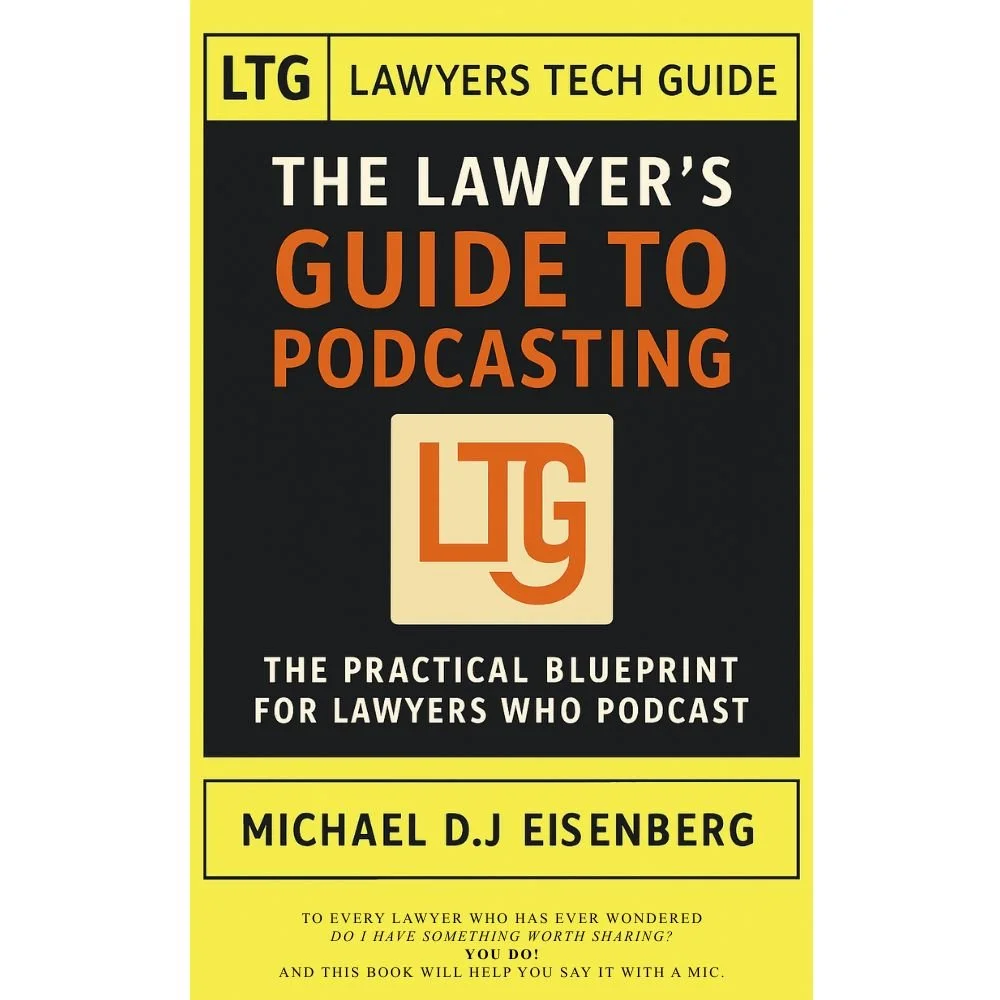
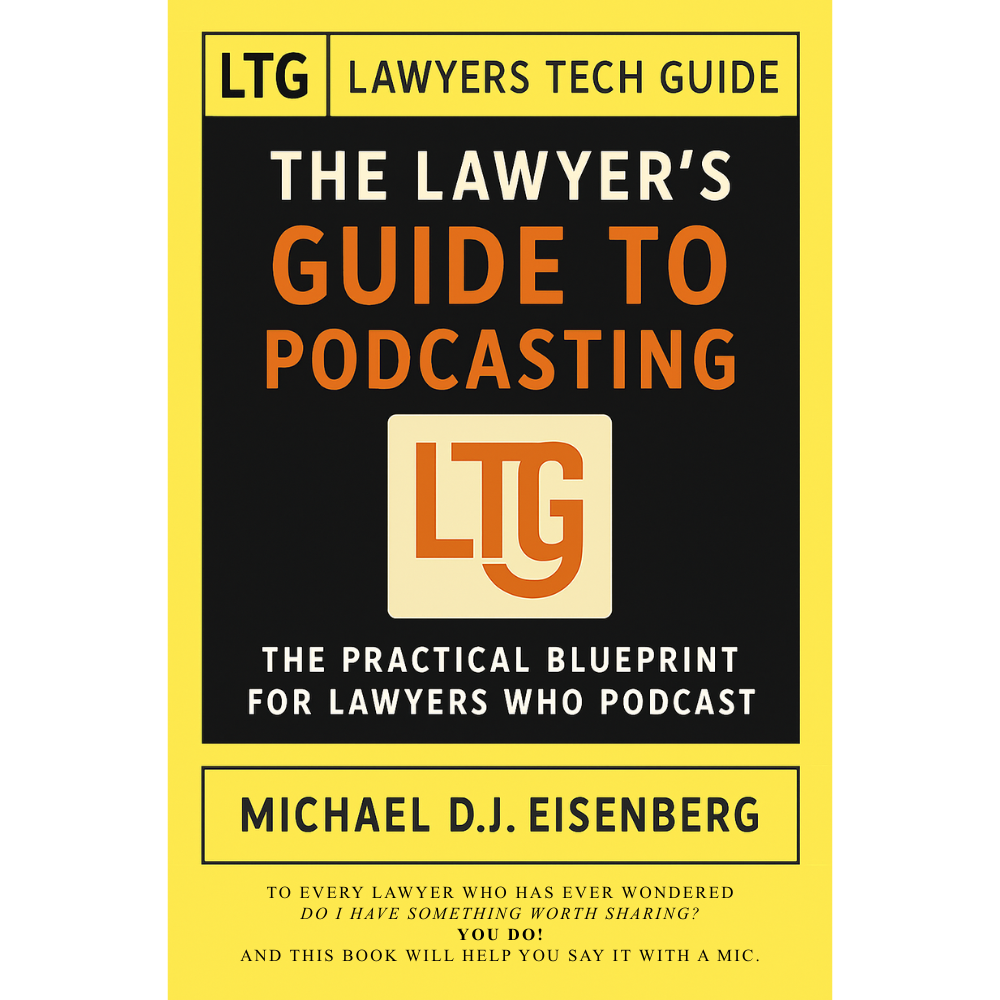
Exclusive ABA TECHSHOW 2026 Offer 🎙️⚖️ — $5 Off The Lawyer’s Guide to Podcasting (On-Site Only, While Supplies Last!) + Join Our Live Sessions on Podcasting and Video Presence

Hey ABA TECHSHOW 2026 Attendees! 🎉

I’m thrilled you’re joining us in Chicago to explore how technology can elevate modern law practice. ABA TECHSHOW is one of my favorite spaces for real-world conversations about legal tech, and this year I’m especially excited to connect with those of you who want to put your voice — and your expertise — to work through podcasting and video.

ABA TECHSHOW 2026 attendees get your discounted LTG: The Lawyer’s Guide to podcasting at the techshow while supplies last!!!

To celebrate TECHSHOW and support lawyers who are podcast-curious but not necessarily “tech experts,” I’m offering a special, in-person-only discount on my book, The Lawyer’s Guide to Podcasting. 📚🎙️ During ABA TECHSHOW 2026, attendees can purchase a physical copy on-site for $19.99, which is $5 off the regular $24.99 price, on-site only and while supplies last.

This book is written for lawyers with limited to moderate technology skills who want a clear, practical, ethics-aware roadmap to launching and sustaining a podcast. You don’t need a production team or a studio; you need a realistic workflow, the right level of tech, and an understanding of how the ABA Model Rules apply when your voice becomes part of your marketing and client-education strategy.

Join Me and My Co-Hosts at ABA TECHSHOW 2026 🎤

You’ll find me on the ABA TECHSHOW 2026 program in two sessions that sit right at the intersection of technology, communication, and professional responsibility.

🎧 Podcasting for Lawyers: The Truth Behind the Mic

In this session, I’ll be joined by a powerhouse group of legal podcasters and marketers:

  • Ruby L. Powers – A board-certified immigration attorney, law firm owner, legal innovator, and host of the Power Up Your Practice podcast, Ruby brings deep experience in law firm leadership, remote practice, and legal tech adoption.

  • Gyi Tsakalakis – A well-known legal marketing professional and podcast host, Gyi focuses on helping lawyers understand how digital marketing, SEO, and content (including podcasts) drive real-world client development.

  • Stephanie Everett – Co-author of The Small Firm Roadmap Revisited and host of The Lawyerist Podcast, Stephanie works with small firms on strategy, operations, and building sustainable, client-centered practices.

Together, we’ll discuss how, in a world crowded with blogs and social media, podcasting gives lawyers a unique way to build authority and connect with audiences on a more personal level. You’ll hear from lawyers and experts who actively run podcasts and work with law firms, and we’ll share the exact steps we’ve used to create compelling legal content that resonates, supports branding, and respects ethical boundaries.

🎥 Camera Ready Anywhere: Mastering Video Meetings with Clients, Courts, and Colleagues

In this session, I’ll be co-presenting with Temi Siyanbade:

  • Temi Siyanbade – An attorney, speaker, and author of Show Don’t Tell: How Lawyers Can Use Video to Stand Out, Create More Value, and Revolutionize Their Firms, Temi helps legal professionals strategically use video to build trust and communicate more effectively.

Virtual communication is now a permanent part of practice, whether you’re meeting with clients, negotiating with opposing counsel, or appearing before the court. In this session, Temi and I will share practical best practices for using Microsoft Teams and Zoom, including audio, video, lighting, framing, and on-screen presence, so your tech setup supports — rather than undermines — your advocacy and client service.

Ethics, ABA Model Rules, and Tech Competence ⚖️

Find me at the techshow to get your onsite discount and take home a great guide to get your podcast started!

Podcasting and video both touch directly on your professional responsibilities. In The Lawyer’s Guide to Podcasting, I connect the practical steps of planning, recording, and publishing to the ABA Model Rules of Professional Conduct, including:

I walk through how to use clear disclaimers, separate legal information from legal advice, and avoid inadvertently revealing confidential or identifying information. The goal is to help you become tech-savvy in a way that is realistic, ethical, and sustainable.

What You’ll Get from The Lawyer’s Guide to Podcasting 📘

Inside the book, you’ll find:

  • Plain-language tech guidance: realistic microphone, software, and hosting recommendations for busy lawyers.

  • Step-by-step workflows: planning, recording, editing, and publishing made manageable for your schedule.

  • Ethical “checkpoints”: where to pause and consider confidentiality, advertising rules, and jurisdiction-specific requirements.

  • Integration tips: how to embed your podcast on your website, share it in newsletters, and repurpose episodes for SEO and client education.

This is not a book about becoming a sound engineer; it’s about becoming a tech-savvy lawyer who uses podcasting thoughtfully.

On-Site Only, While Supplies Last 🛍️

Because this offer is tied to ABA TECHSHOW 2026, the $5 discount is available only for on-site purchases by attendees and only while physical copies last. I wanted this to be a tangible benefit for those who make the trip — and a practical next step if one of our sessions sparks your interest in podcasting.

Here’s how to take advantage of it:

  • Add “Podcasting for Lawyers: The Truth Behind the Mic” and “Camera Ready Anywhere: Mastering Video Meetings with Clients, Courts, and Colleagues” to your TECHSHOW schedule.

  • Bring your questions about tech, ethics, workflows, and content.

  • Find me on-site after the sessions or around the conference to pick up your discounted, signed copy of The Lawyer’s Guide to Podcasting for $19.99 (regularly $24.99), on-site only and while supplies last. 📚✍️

SEE YOU AT THE TECHSHOW!!!

ABA TECHSHOW is about practical innovation and ethical implementation. Podcasting and video live right at that intersection — modern tools that, when used thoughtfully and in line with the ABA Model Rules, can enhance your competence, your communication, and your client relationships.

If you’ve been thinking about starting a legal podcast — or want a structured way to decide whether podcasting fits your goals — I’d love for you to join our sessions and pick up the book during the show. 🎧⚖️

MTC: Everyday Tech, Extraordinary Evidence: How Lawyers Can Turn Smartphones, Dash Cams, and Wearables Into Case‑Winning Proof After the Minnesota ICE Shooting 📱⚖️

Smartphone evidence: Phone as Proof!

The recent fatal shooting of ICU nurse Alex Pretti by a federal immigration officer in Minneapolis has become a defining example of how everyday technology can reshape a high‑stakes legal narrative. 📹 Federal officials claimed Pretti “brandished” a weapon, yet layered cellphone videos from bystanders, later analyzed by major news outlets, appear to show an officer disarming him moments before multiple shots were fired while he was already on the ground. In a world where such encounters are documented from multiple angles, lawyers who ignore ubiquitous tech risk missing powerful, and sometimes exonerating, evidence.

Smartphones: The New Star Witness

In the Minneapolis shooting, multiple smartphone videos captured the encounter from different perspectives, and a visual analysis highlighted discrepancies between official statements and what appears on camera. One video reportedly shows an officer reaching into Pretti’s waistband, emerging with a handgun, and then, barely a second later, shots erupt as he lies prone on the sidewalk, still being fired upon. For litigators, this is not just news; it is a case study in how to treat smartphones as critical evidentiary tools, not afterthoughts.

Practical ways to leverage smartphone evidence include:

  • Identifying and preserving bystander footage early through public calls, client outreach, and subpoenas to platforms when appropriate.

  • Synchronizing multiple clips to create a unified timeline, revealing who did what, when, and from where.

  • Using frame‑by‑frame analysis to test or challenge claims about “brandishing,” “aggressive resistance,” or imminent threat, as occurred in the Pretti shooting controversy.

In civil rights, criminal defense, and personal‑injury practice, this kind of video can undercut self‑defense narratives, corroborate witness accounts, or demonstrate excessive force, all using tech your clients already carry every day. 📲

GPS Data and Location Trails: Quiet but Powerful Proof

The same smartphones that record video also log location data, which can quietly become as important as any eyewitness. Modern phones can provide time‑stamped GPS histories that help confirm where a client was, how long they stayed, and in some instances approximate movement speed—details that matter in shootings, traffic collisions, and kidnapping cases. Lawyers increasingly use this location data to:

Dash cam / cameras: Dashcam Truth!

  • Corroborate or challenge alibis by matching GPS trails with claimed timelines.

  • Reconstruct movement patterns in protest‑related incidents, showing whether someone approached officers or was simply present, as contested in the Minneapolis shooting narrative.

  • Support or refute claims that a vehicle was fleeing, chasing, or unlawfully following another party.

In complex matters with multiple parties, cross‑referencing GPS from several phones, plus vehicle telematics, can create a robust, data‑driven reconstruction that a fact‑finder can understand without a computer science degree.

Dash Cams and 360‑Degree Vehicle Video: Replaying the Scene

Cars now function as rolling surveillance systems. Many new vehicles ship with factory cameras, and after‑market 360‑degree dash‑cam systems are increasingly common, capturing impacts, near‑misses, and police encounters in real time. In a Minneapolis‑style protest environment, vehicle‑mounted cameras can document:

  • How a crowd formed, whether officers announced commands, and whether a driver accelerated or braked before an alleged assault.

  • The precise position of pedestrians or officers relative to a car at the time of a contested shooting.

  • Sound cues (shouts of “he’s got a gun!” or “where’s the gun?”) that provide crucial context to the video, like those reportedly heard in footage of the Pretti shooting.

For injury and civil rights litigators, requesting dash‑cam footage from all involved vehicles—clients, third parties, and law‑enforcement—should now be standard practice. 🚗 A single 360‑degree recording might capture the angle that police‑worn cameras miss or omit.

Wearables and Smartwatches: Biometrics as Evidence

GPS & wearables: Data Tells All!

Smartwatches and fitness trackers add a new dimension: heart‑rate, step counts, sleep data, and sometimes even blood‑oxygen metrics. In use‑of‑force incidents or violent encounters, this information can be unusually persuasive. Imagine:

  • A heart‑rate spike precisely at the time of an assault, followed by a sustained elevation that reinforces trauma testimony.

  • Step‑count and GPS data confirming that a client was running away, standing still, or immobilized as claimed.

  • Sleep‑pattern disruptions and activity changes supporting damages in emotional‑distress claims.

These devices effectively turn the body into a sensor network. When combined with phone video and location data, they help lawyers build narratives supported by objective, machine‑created logs rather than only human recollection. ⌚

Creative Strategies for Integrating Everyday Tech

To move from concept to courtroom, lawyers should adopt a deliberate strategy for everyday tech evidence:

  • Build intake questions that explicitly ask about phones, car cameras, smartwatches, home doorbell cameras, and even cloud backups.

  • Move quickly for preservation orders, as Minnesota officials did when a judge issued a temporary restraining order to prevent alteration or removal of shooting‑related evidence in the Pretti case.

  • Partner with reputable digital‑forensics professionals who can extract, authenticate, and, when needed, recover deleted or damaged files.

  • Prepare demonstrative exhibits that overlay video, GPS points, and timelines in a simple visual, so judges and juries understand the story without technical jargon.

The Pretti shooting also underscores the need to anticipate competing narratives: federal officials asserted he posed a threat, while video and witness accounts cast doubt on that framing, fueling protests and calls for accountability. Lawyers on all sides must learn to dissect everyday tech evidence critically—scrutinizing what it shows, what it omits, and how it fits with other proof.

Ethical and Practical Guardrails

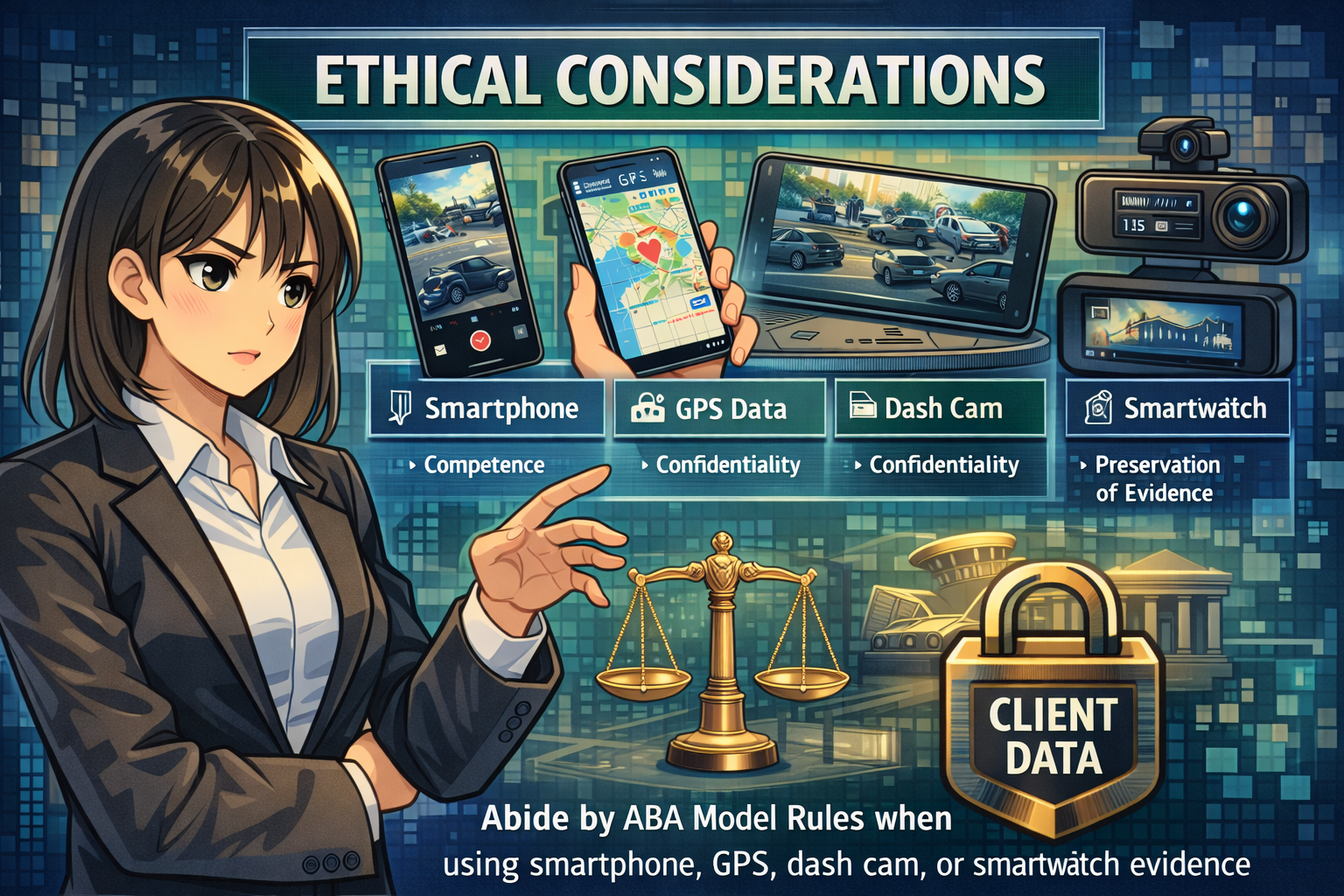
Ethics-focused image: Ethics First!

With this power comes real ethical responsibility. Lawyers must align their use of everyday tech with core duties under the ABA Model Rules of Professional Conduct.

  • Competence (ABA Model Rule 1.1)
    Rule 1.1 requires “competent representation,” and Comment 8 now expressly includes a duty to keep abreast of the benefits and risks of relevant technology. When you rely on smartphone video, GPS logs, or wearable data, you must either develop sufficient understanding yourself or associate with or consult someone who does.

  • Confidentiality and Data Security (ABA Model Rule 1.6)
    Rule 1.6 obligates lawyers to make reasonable efforts to prevent unauthorized access to or disclosure of client information. This extends to sensitive video, location trails, and biometric data stored on phones, cloud accounts, or third‑party platforms. Lawyers should use secure storage, limit access, and, where appropriate, obtain informed consent about how such data will be used and shared.

  • Preservation and Integrity of Evidence (ABA Model Rules 3.4, 4.1, and related e‑discovery ethics)
    ABA ethics guidance and case law emphasize that lawyers must not unlawfully alter, destroy, or conceal evidence. That means clients should be instructed not to edit, trim, or “clean up” recordings, and that any forensic work should follow accepted chain‑of‑custody protocols.

  • Candor and Avoiding Cherry‑Picking (ABA Model Rule 3.3, 4.1)
    Rule 3.3 requires candor toward the tribunal, and Rule 4.1 prohibits knowingly making false statements of fact. Lawyers should present digital evidence in context, avoiding selective clips that distort timing, perspective, or sound. A holistic, transparent approach builds credibility and protects both the client and the profession.

  • Respect for Privacy and Non‑Clients (ABA Model Rule 4.4 and related guidance)
    Rule 4.4 governs respect for the rights of third parties, including their privacy interests. When you obtain bystander footage or data from non‑clients, you should consider minimizing unnecessary exposure of their identities and, where feasible, seek consent or redact sensitive information.

FINAL THOUGHTS

Handled with these rules in mind, everyday tech can reduce factual ambiguity and support more just outcomes. Misused, it can undermine trust, compromise admissibility, and trigger disciplinary scrutiny. ⚖️

🎙️ Ep. 113 - How Seth Price Scaled a 50-Lawyer Firm and Digital Agency: Tech, Cloud, and the Future of Legal Marketing!

Seth Price, founding partner of Price Benowitz LLP and CEO of BluShark Digital, shares deep insights on leveraging technology to scale law firms. He highlights Salesforce, Clio, and Smart Advocate as essential tools, discussing their specific roles in case management and marketing automation. Seth outlines the evolution of digital marketing for lawyers, stressing the importance of content, links, and local reviews in SEO strategy. He offers tips for interpreting Google Analytics and staying ahead of algorithm changes. Concluding with advice on future-proofing practices, Seth urges law firm leaders to invest in adaptive tech stacks and remain inquisitive amid rapid innovation.

Join Seth and me as we discuss the following three questions and more!

  1. What are the top three pieces of tech, software, or hardware you use to scale price benefits from a two-person firm to over 50 attorneys?

  2. What are the top three ways you've seen digital marketing change for lawyers, and can you give us a tip for each one?

  3. What are your top three tips for law firm leaders looking to future-proof their practices amid rapid technological change?

In our conversation, we cover the following:

[01:23] Seth's Tech Setup

[09:50] Top Three Tech Tools for Scaling Price Benefits

[11:27] Detailed Explanation of Clio and SmartAdvocate

[12:40] Digital Marketing Changes for Lawyers

[16:09] Importance of Local Search and Reviews

[19:00] Tips for Understanding Google Analytics

[25:13] Final Tips for Future-Proofing Law Firms

Resources:

Connect with Seth:

Hardware mentioned in the conversation:

Software & Cloud Services mentioned in the conversation: