🚨 Last Day for Lawyer Podcasting Conference Early-Bird Pricing: Meet New Speaker Gordon Firemark, The Podcast Lawyer™ 🎙️

🎙️ Register for the Lawyers’ Podcasting Conference before midnight tonight.

🎉

🎙️ Register for the Lawyers’ Podcasting Conference before midnight tonight. 🎉
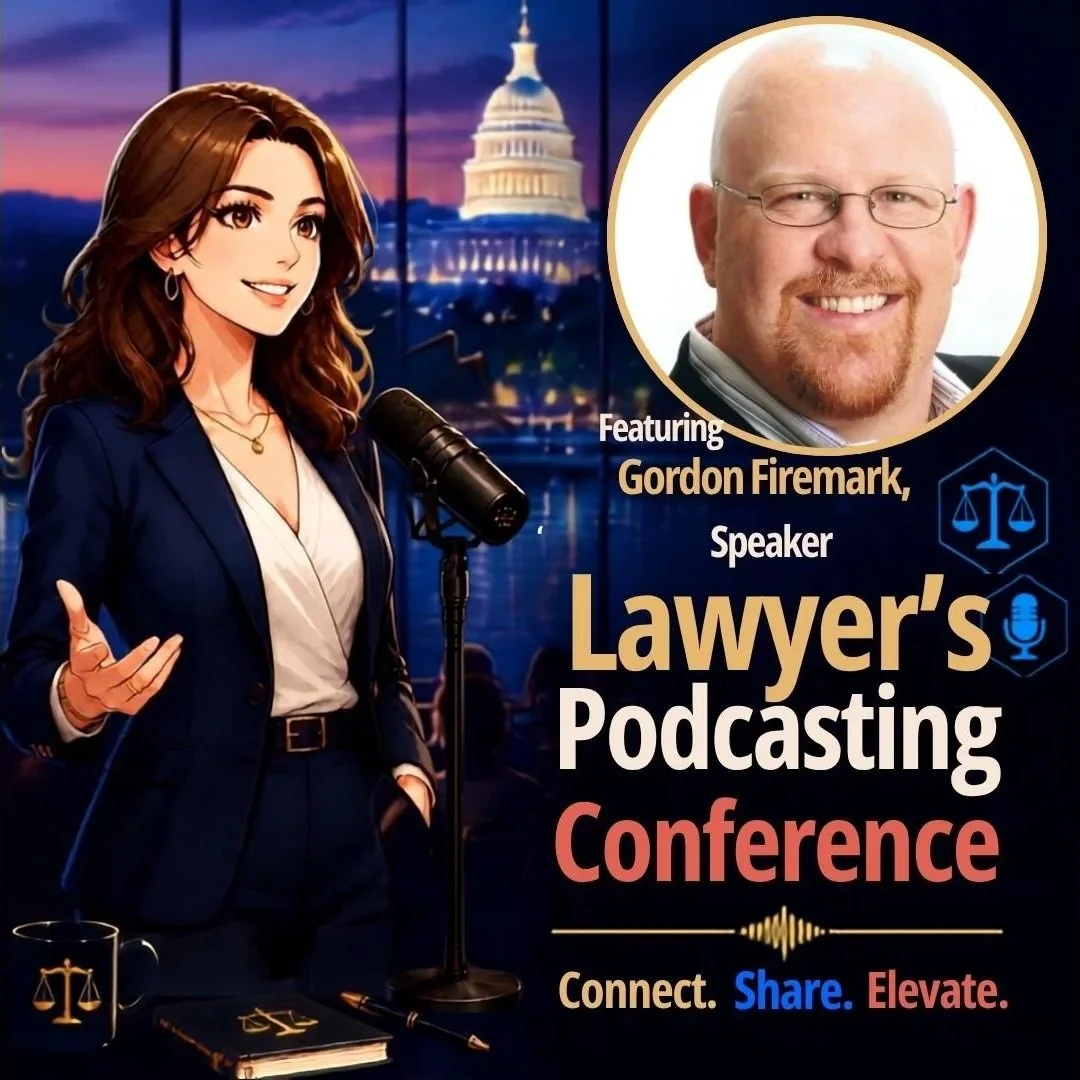
come learn from the podcast Laywer, Gordon Firemark, this november at LPC!

Today is the last day to claim early-bird pricing for The Tech-Savvy Lawyer’s Lawyers’ Podcasting Conference. Register by midnight tonight, Wednesday, September 30, 2026, to attend for 499.99—a $250 savings before the regular rate rises to $749.99. Register here.

I am also delighted to announce that Gordon Firemark—The Podcast Lawyer™—has joined our speaker lineup. 🎉 Gordon brings a rare and valuable perspective to this event: he is not only an experienced entertainment, media, and business lawyer, but also a working podcaster and the author of The Podcast, Blog & New Media Producer’s Legal Survival Guide.

The conference will be held in person on Friday, November 13, and Saturday, November 14, 2026, in McLean, Virginia. It is built as a practical working conference for lawyers who want to launch a podcast, improve an existing show, or make smarter and more responsible decisions about legal-media publishing.[5][6]

Podcasting Is a Professional Activity

Podcasting is no longer a fringe marketing experiment for lawyers. It is a durable publishing format. It gives lawyers a way to explain a developing area of law, share a point of view, build professional relationships, educate a niche audience, and create a searchable body of useful content over time.

But publishing a professional podcast involves more than buying a microphone and posting an episode.

A legal podcast can implicate confidentiality, advertising rules, supervision of vendors, intellectual-property rights, platform terms, AI tools, client expectations, and the line between general education and individualized legal advice. Those issues are manageable. They are also easier to manage when addressed before publication rather than after a problem appears. ⚖️

That is why the Lawyers’ Podcasting Conference is designed for lawyers—not generic content creators. The goal is not simply to help attendees make content. The goal is to help them develop a professional podcasting practice that is useful, credible, sustainable, and consistent with their ethical obligations.

Whether you are a solo practitioner hoping to become better known in a defined practice area, a small-firm lawyer building a referral network, or an established professional ready to create a clearer public voice, the conference will meet you where you are. You do not need to be an audio engineer. You do need a workable system.

Welcome, Gordon Firemark 🎧
Meet Gordon Firemark, The Podcast Lawyer™, Before Early-Bird Pricing Ends

Gordon Firemark is widely known as The Podcast Lawyer™, and his work sits directly at the intersection that many lawyer-podcasters must understand: law, media, intellectual property, business, and publishing.

His professional background spans entertainment law, digital media, intellectual property, business matters, and new-media production. He has advised creative professionals and media businesses, and he has hosted and produced the long-running Entertainment Law Update podcast. That combination matters. Gordon understands podcasting not as an abstract legal category, but as a real publishing business with contracts, rights, risks, relationships, and long-term strategic choices.[7][3]

For lawyers who are serious about podcasting, this is an important addition to the conference program.

A polished episode may sound informal. The legal and business decisions behind it should not be casual. A podcast can include original music, third-party clips, guest appearances, interviews, video excerpts, AI-generated elements, sponsorship messages, affiliate disclosures, and listener engagement. Each choice can create obligations.

Gordon’s participation will help attendees think beyond the mechanics of recording. You will be able to consider the business and legal infrastructure that supports a podcast worth continuing.

That includes questions such as:

  • Who owns the podcast name, artwork, episode recordings, and show notes?

  • What permissions should you obtain from guests?

  • When does “fair use” become an unreliable production plan?

  • What should a lawyer understand before using music, clips, images, or AI-generated assets?

  • How should sponsorships, affiliates, and endorsements be disclosed?

  • What publishing decisions are easier to make correctly at the beginning than to fix later?

These are not academic questions. They are practical issues that affect whether your podcast becomes a dependable professional asset or an unnecessary source of risk.

Ethics Belong in the Workflow
Register by September 30 for Gordon Firemark’s Legal Podcasting Insights

Lawyer podcasting is a form of public communication. That means ethics should be part of the production workflow—not an afterthought added to a disclaimer.

ABA Model Rule 1.1, including Comment 8, addresses a lawyer’s obligation to keep abreast of the benefits and risks associated with relevant technology. A lawyer does not need to master every audio platform, transcription service, hosting provider, or AI-editing tool. The lawyer does need enough understanding to make competent choices about those systems. 🎙️

For podcasters, that means asking practical questions before recording and publishing:

  • Where will audio and video files be stored?

  • Does an AI transcription or editing service retain training rights?

  • Who has access to raw recordings, transcripts, guest information, and unpublished episodes?

  • What is the review process before show notes, captions, clips, and promotional posts go live?

Model Rule 1.6 is equally important. A story can be compelling without identifying a client, but “anonymous” does not always mean unidentifiable. A combination of facts, timing, location, industry references, or unusual circumstances may reveal more than a lawyer intends. When a client story is recognizable or commercially useful, written informed consent is often the safer route.

Then there are Model Rules 7.1 through 7.3. A podcast can be a communication about a lawyer’s services. Statements about experience, results, specialization, fees, or client outcomes must not be false or misleading. Lawyers must also evaluate their own jurisdiction’s advertising and solicitation rules, including any disclaimers, filing requirements, or record-retention obligations that apply to the content they publish.

Model Rule 5.5 deserves attention when a local practice publishes to a national or global audience. Listeners may hear a helpful episode and then ask for individual advice through a comment, direct message, or intake form. A clear workflow for responding to those inquiries helps preserve the distinction between general educational content and an attorney-client relationship.

Finally, Model Rule 5.3 matters when lawyers delegate production work to editors, agencies, virtual assistants, or technology vendors. Delegation is smart. Supervision remains essential. Lawyers should set expectations, protect confidential information, review materials before publication, and retain final editorial judgment.

What You Will Build

The Lawyers’ Podcasting Conference is not a passive listening event. It is a two-day opportunity to develop a clearer plan for your show and your publishing process. 🛠️

You will work through the real decisions that make a podcast viable:

  • Defining an audience and premise that fit your legal practice.

  • Choosing a sustainable episode format and publishing cadence.

  • Creating a straightforward recording and editing workflow.

  • Using video, clips, transcripts, show notes, and distribution channels wisely.

  • Addressing legal ethics, client confidentiality, advertising, intellectual property, and vendor oversight.

  • Evaluating where AI can save time—and where human review remains nonnegotiable.

  • Building a professional podcast that supports reputation, relationships, education, and business development without becoming another unmanageable obligation.

Podcasting is especially powerful when it becomes part of a broader publishing system. One well-planned episode can generate an article, newsletter segment, LinkedIn discussion, short video clip, episode notes, and a resource page. That is not content for content’s sake. It is a deliberate way to make your professional knowledge easier for the right audience to discover and trust.

Our earlier post, “Questions About the Lawyer’s Podcasting Conference? Email Me Before Early-Bird Pricing Ends September 30, 2026,” explains the practical registration details. You can also read about Robert Ingalls of Lawpods joining the conference and our earlier speaker announcement for Carolyn Elefant.

Register Before Midnight
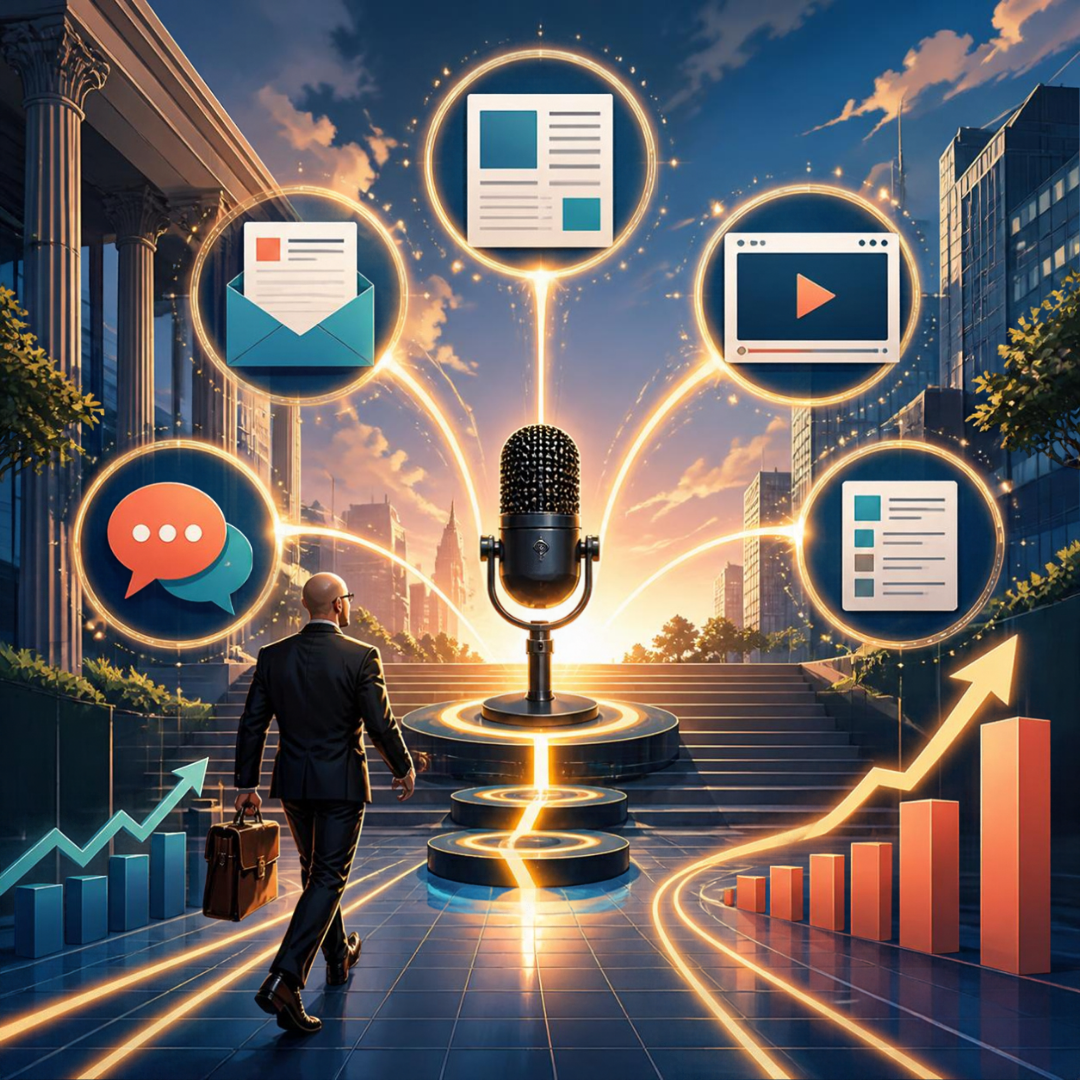
Build a Sustainable Legal Podcast With Ethics and Strategy

The early-bird deadline is not an artificial countdown. It is the final day to secure the conference for $499.99, before the regular registration rate becomes $749.99. Firms sending two attendees receive an additional $25 off per seat, and groups of four or more receive $50 off per seat during the early-bird period. Register here!

If you have been thinking about launching a legal podcast, rebooting a stalled show, or bringing more structure to a podcast that already exists, this is the time to commit. 📅

Join us in McLean this November. Learn from people who understand both the technology and the professional responsibilities that come with publishing as a lawyer. And now, learn from Gordon Firemark, The Podcast Lawyer™, about the legal and business decisions that help a podcast endure.

🎙️ Register for the Lawyers’ Podcasting Conference before midnight tonight.

MTC: Why My Ecamm Creator Camp 2026 Trip Is a Signal for Every Lawyer Podcaster to Up Their Game 🎙️

🏕️ Ecamm Creator Camp 2026: Where Lawyer Podcasters Level Up!

This week, I am heading to Portsmouth, New Hampshire, for Ecamm's flagship Creator Camp. 🏕️ It is a three-day, hands-on gathering of podcasters, live streamers, video creators, and presenters. Ecamm describes it as its original, fully immersive Creator Camp experience. I am going because the standard for professional audio and video keeps rising. Lawyers who podcast cannot afford to stand still.

Let me be clear about why this matters to you. My attendance is not a vacation photo op. It is a signal. 📡 The bar for lawyer podcasts has moved. Listeners, clients, referral sources, and even AI search tools now reward content that is clear, consistent, and well-produced. A muffled microphone and a shaky webcam once passed as "authentic." Today, they read as careless. That is a hard truth, but it is a fair one.

The Audience Has Raised Its Expectations 📈

🎤 Lawyers' Podcasting Conference, November 13–14, McLean, Virginia

Your prospective clients watch polished content every day. They listen to professionally mixed shows on their commute. They watch creators who understand lighting, framing, and pacing. When they find your podcast, they compare it to everything else in their feed. They do not grade on a "lawyer curve."

This is not about vanity. It is about trust. A clean, well-organized episode tells your audience that you respect their time. It suggests that you bring the same care to your legal work. A sloppy episode sends the opposite message, even when your substantive advice is excellent.

I explored the discovery side of this in MTC: Hidden AI, GEO, and the ABA Model Rules: What Every Lawyer Needs to Know Before Their Next Client Finds Them Online. Search engines and generative AI systems increasingly shape how people first encounter lawyers. Strong transcripts, useful show notes, and consistent publishing give those systems better material to find and summarize. 🔎 Production quality and discoverability now travel together.

What I Expect to Bring Home 🧰

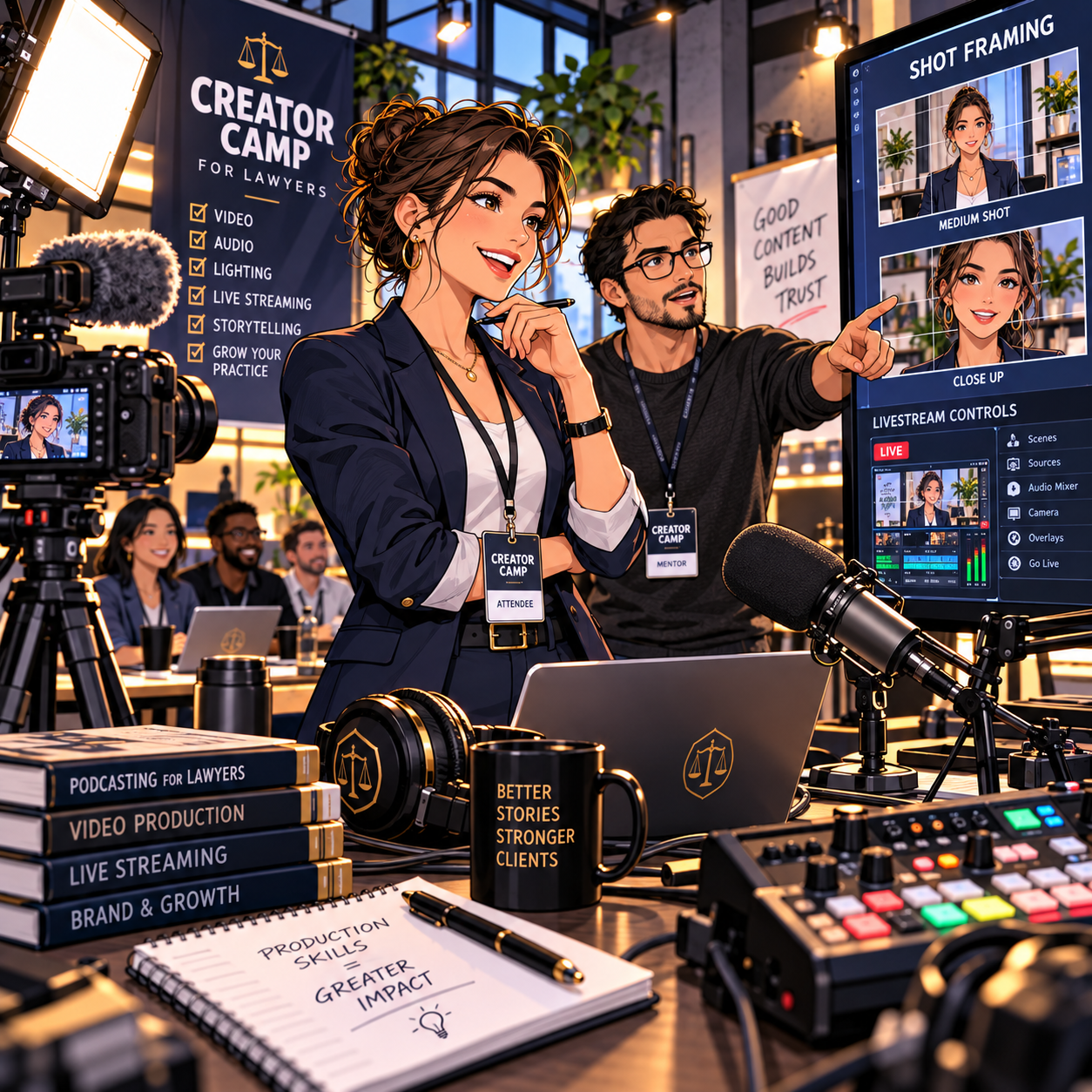
🎥 Shot Framing and Livestream Skills CAN Help Lawyer Podcasters Build Trust!

Creator Camp is built around learning by doing. Ecamm's programming centers on video creation, live production, podcasting, and presenting. I expect to sharpen skills in several areas that matter directly to lawyers:

  • 🎥 Video presence. Camera placement, lighting, and framing that look professional without a studio budget.

  • 🎧 Audio clarity. Microphone technique, room treatment, and cleaner recording habits.

  • 🔴 Live production. Running a live show or webinar smoothly, including guests, overlays, and screen shares.

  • ✂️ Efficient workflows. Recording once and repurposing that content into clips, posts, and articles.

  • 🗣️ On-camera delivery. Pacing, energy, and conversational structure that keep listeners engaged.

Ecamm is not new to this community. Katie Fawkes and Doc Rock of Ecamm joined Stephen Embry, Michael Potter, and me for a spontaneous bonus episode, "🎙️ Bonus Ep.: Why Lawyers Should Embrace Mac - Insights from MacStock 2025 Legal Tech Panel," recorded live from MacStock 2025. That conversation reminded me how much lawyers can learn from professional creators. Creator Camp takes that learning further. I will take notes with one question in mind: what can a busy lawyer realistically adopt this November? Techniques that require a production crew will not make my list. Techniques that save time and improve clarity will.

The Ethics Do Not Take a Day Off ⚖️

Better production must never come at the expense of professional responsibility. Every new skill I bring home runs through the ABA Model Rules first.

ABA Model Rule 1.1, and specifically Comment 8, requires lawyers to keep abreast of the benefits and risks of relevant technology. That duty covers recording software, AI-assisted editing, automated transcription, and live-streaming platforms. Learning these tools well is part of competence. It is not a hobby.

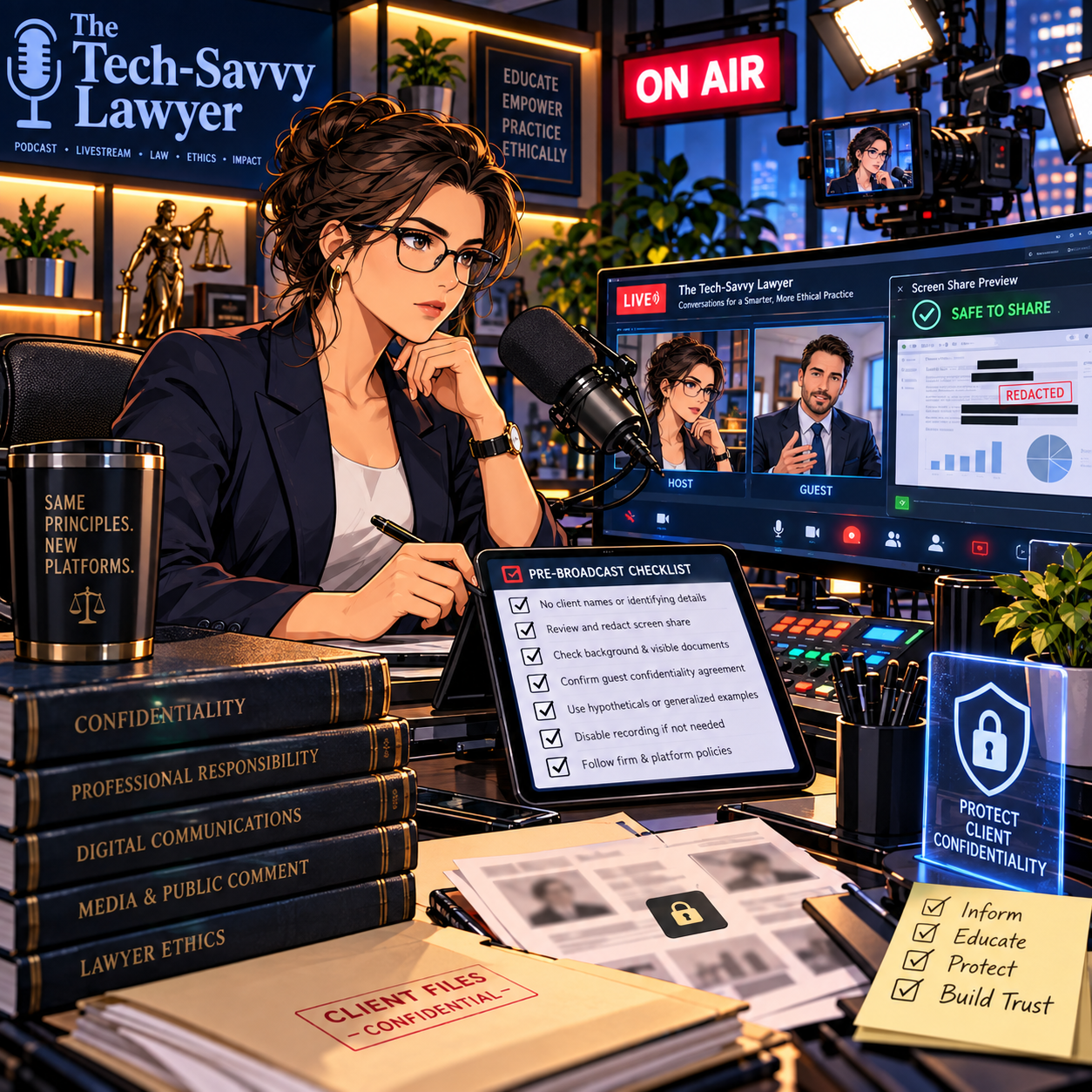
Rule 1.6 protects client confidentiality. Live shows raise the stakes. A guest can mention a detail on air that you cannot edit out afterward. A screen share can expose a client file in the background. 🔒 Good production habits, such as closing windows and briefing guests, protect clients as much as they polish the show.

Rules 7.1 through 7.3 matter because a lawyer's podcast may be a communication about legal services. Statements must not be false or misleading. Calls to action need care. Rule 5.5 deserves attention when your audience crosses state lines. Rule 5.3 applies when editors, producers, virtual assistants, or AI tools handle your content. You remain responsible for their work.

AI deserves its own warning. Creator tools increasingly offer AI captions, summaries, and even synthetic voice features. I addressed the verification duty in MTC: Even Though AI Hallucinations Are Down, Lawyers Still Must Verify AI, Guard PII, and Follow ABA Ethics Rules. An AI-generated transcript can misstate a case name. A summary can drop crucial context. You must review what goes out under your name. ✅

Could Not Make It to Creator Camp? Do Not Worry 🤝

🔒 ABA Rule 1.6: Protect Client Confidentiality Before Going Live!

Here is the good news. You do not need to travel to New Hampshire to benefit. I am bringing what I learn, hone, and improve at Creator Camp directly to The Tech-Savvy Lawyer.Page Lawyers' Podcasting Conference. It takes place November 13–14, 2026, in McLean, Virginia. 📍

I will translate creator-grade techniques into lawyer-ready workflows. That means filtering every tip through the realities of practice: confidentiality, advertising rules, limited time, and modest budgets. You will get the practical takeaways without the guesswork.

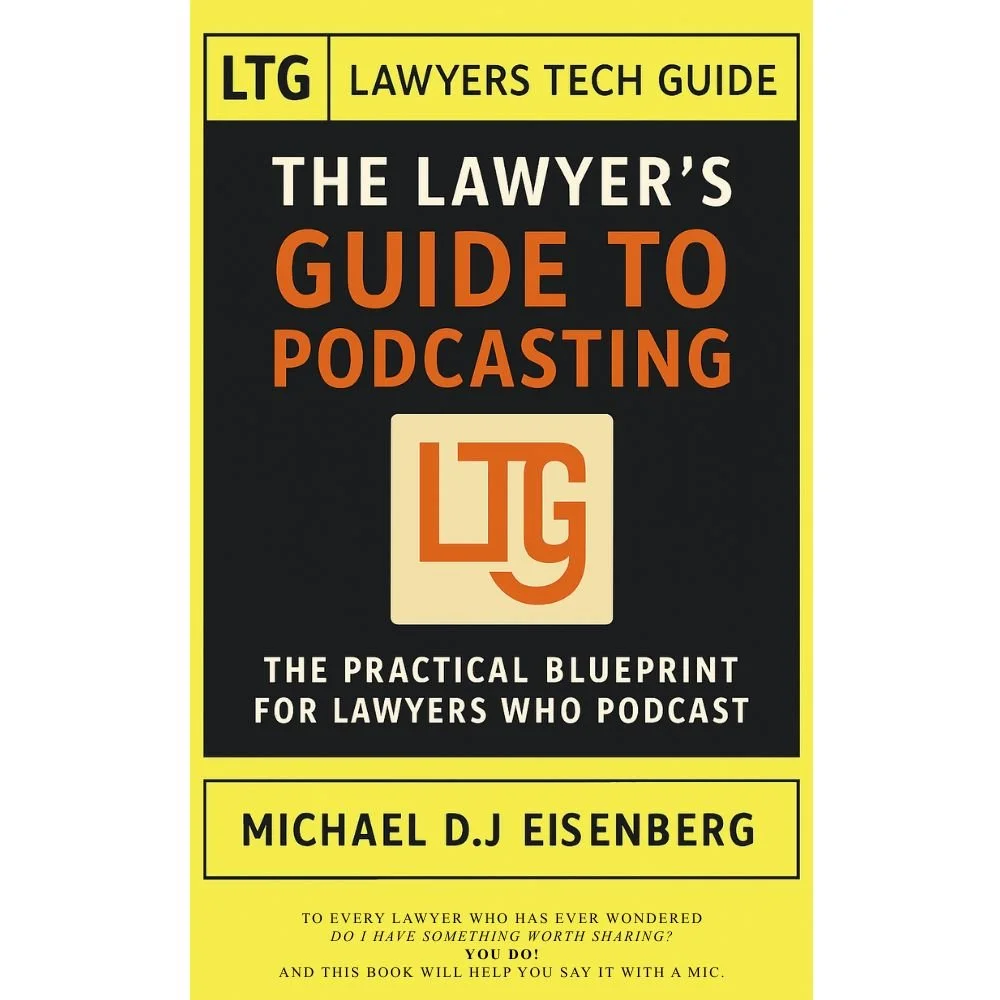
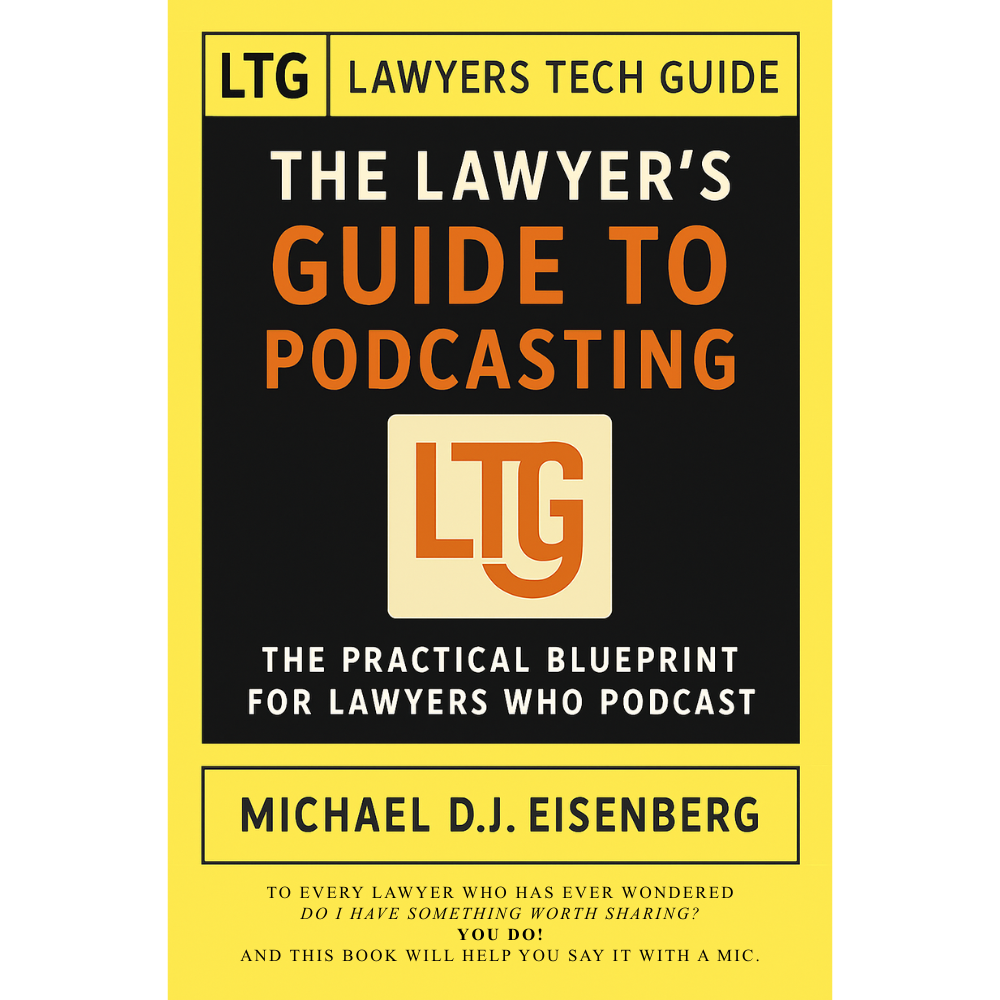
The conference builds on the framework in The Lawyer's Guide to Podcasting. I was honored when the Library of Congress accepted The Tech-Savvy Lawyer: Lawyer's Podcasting Guide for its collection. The conference takes that work further through demonstrations, hands-on labs, and implementation planning.

You will also learn from experienced voices. Carolyn Elefant of My Shingle is our first confirmed speaker. Robert Ingalls of Lawpods will join me as well. 🎤

Over two days, we will cover:

  • 🧭 Show strategy and format selection

  • 🎙️ Gear and recording workflows, including tools you already own

  • 🎛️ Production labs informed by my Creator Camp experience

  • 🔎 SEO and generative-engine optimization

  • 📡 Hosting, RSS ownership, and distribution

  • ♻️ Repurposing episodes into articles, clips, and social posts

  • ⚖️ A substantial ABA Model Rules ethics block

You should leave with a workable show concept, a production workflow, a publishing plan, and a jurisdiction-aware ethics checklist. The goal is implementation, not inspiration alone.

The Early Bird Special Ends Soon ⏳

🎙️ Lawyer Podcaster Heads to Creator Camp to Sharpen His Skills!

Now for the practical part. Early Bird registration is $499.99 through midnight on Wednesday, September 30, 2026. After that, the regular rate returns to $749.99. That is a meaningful difference for a solo or small-firm budget. 💡

My attendance at Creator Camp is my commitment to raising my own game. Your registration can be yours. The skills are coming to McLean. The ethics framework is coming with them. The only question is whether you will be in the room. 🙌

👉 Register for the Lawyers' Podcasting Conference before the Early Bird rate ends

Questions or hesitations? Email me directly at LPC@TheTechSavvyLawyer.Page. I read every message myself. ✉️

Happy Lawyering! 😊

MTC!

— Michael D.J. Eisenberg

🎙️ Robert Ingalls of Lawpods Joins Michael D.J. Eisenberg at The Tech-Savvy Lawyer.Page Podcasting Conference

Join us at the lawyers podcasting conference to learn from robert ingalls of lawpods!

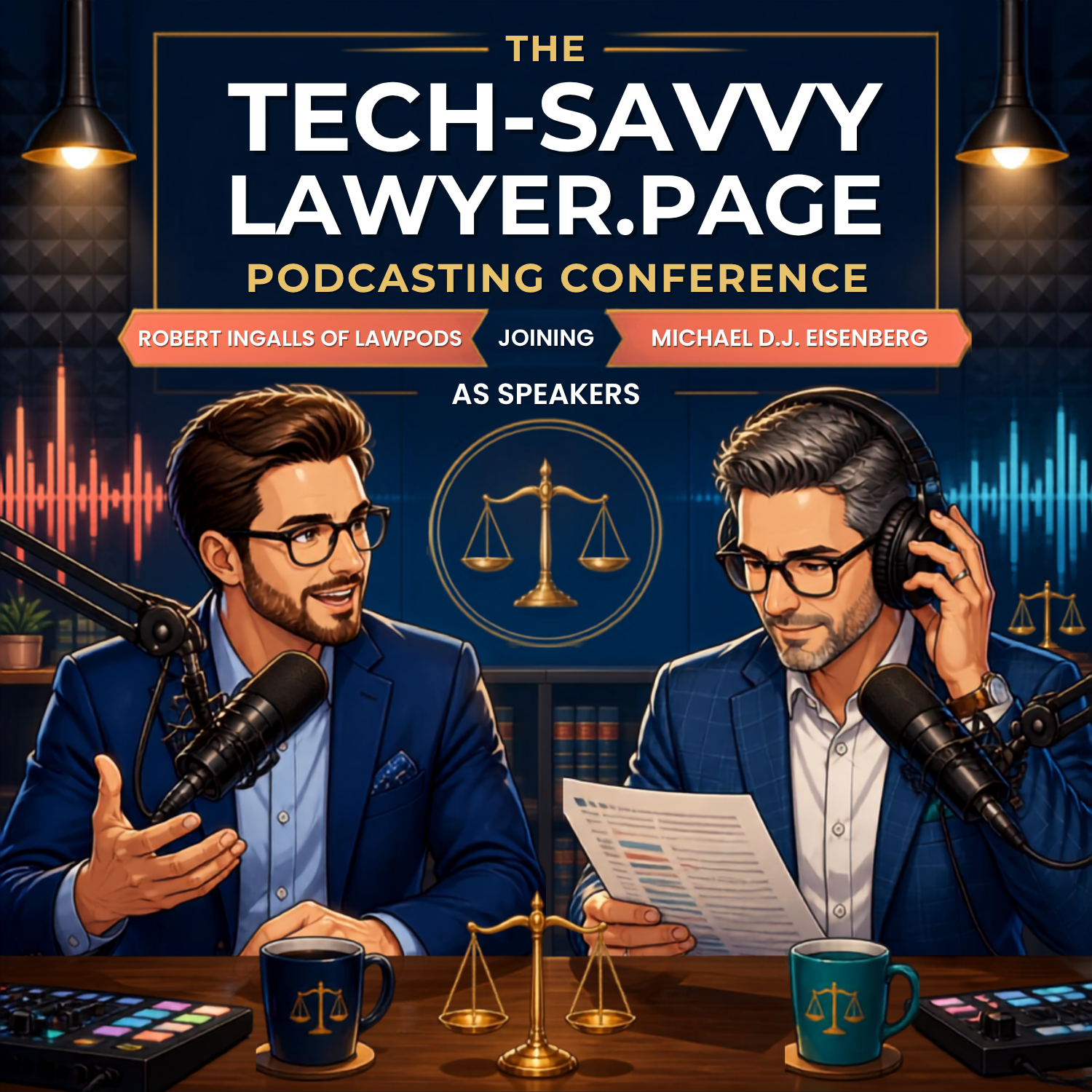
I am pleased to announce that Robert Ingalls of Lawpods will join me at The Tech-Savvy Lawyer.Page Podcasting Conference, November 13–14, 2026, in McLean, Virginia. 🎙️

Robert and I will tackle two questions that shape every successful legal podcast:

1. Why should lawyers podcast?

2. When should lawyers outsource production, and how much of the work should they delegate?

Those questions sound simple. They are not. A legal podcast can become a powerful professional asset. It can also become a half-finished project, an expensive hobby, or an ethical problem if a lawyer treats it as ordinary content marketing.

This conference is designed for the lawyer who wants to do it correctly. That includes solo practitioners, small-firm lawyers, in-house counsel, AI-curious professionals, and lawyers who have bought a microphone but have not yet published Episode One. ⚖️

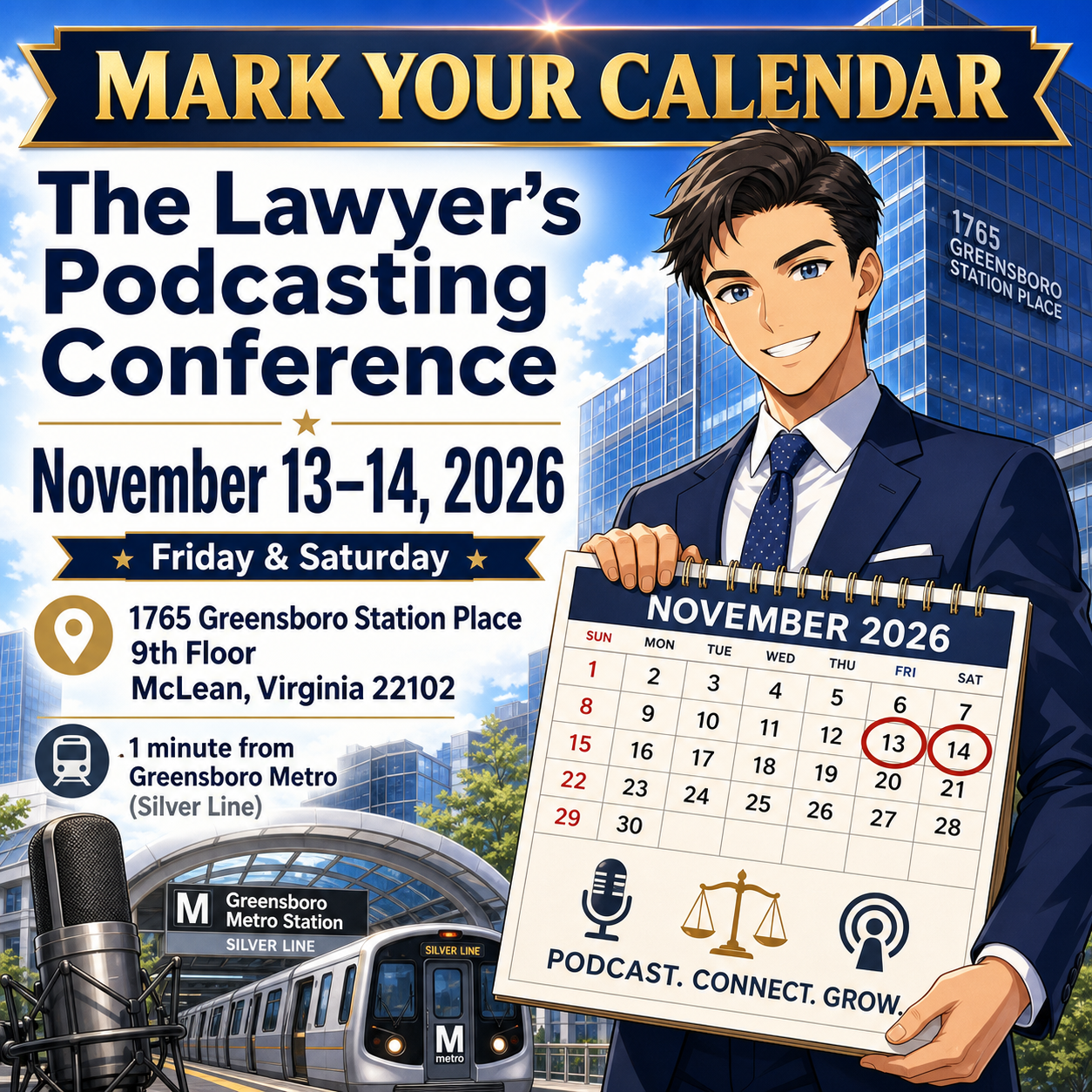
We will meet Friday, November 13, and Saturday, November 14, 2026, at 1765 Greensboro Station Place, 9th Floor, McLean, Virginia 22102. The venue is approximately one minute on foot from the Greensboro Metro station on the Silver Line. 🚇

WHY LAWYERS NEED TO PODCAST

Podcasting is not about becoming famous. It is about becoming known for useful work by the people who need to know you.

A prospective client may not understand your practice area. They may not know which legal term to search. They may not know how to distinguish one lawyer from another. But they understand a helpful voice explaining a difficult problem with clarity and restraint.

That is the strategic value of a well-run show.

A lawyer podcast can:

join your colleagues at the Legal Podcasting Conference: Build a Sustainable Lawyer-Led Show

• Demonstrate knowledge in a focused practice niche.

• Build trust before an initial consultation.

• Create meaningful relationships with guests and referral sources.

• Help lawyers stay current by requiring them to prepare and explain legal developments.

• Produce transcripts, show notes, clips, articles, and newsletter content.

• Improve traditional search visibility through structured, indexable content.

• Strengthen generative-engine visibility when AI systems look for credible, attributable answers. 🔎

A static biography tells the public where you went to school and how long you have practiced. A useful podcast lets people hear how you think.

That distinction matters.

In “The Lawyer’s Guide to Podcasting Is Here: A Practical, Ethical Launch Plan for Busy Lawyers”, I made the case for a practical, ethical approach to legal podcasting. The objective is not to produce a glossy entertainment program. It is to create a show that reaches a real audience, supports professional goals, and can survive a lawyer’s actual calendar.

Robert and I will explore that “why” on Day One. We will talk about identifying the right audience, choosing a workable format, developing a point of view, and setting a publishing cadence you can keep. 🎧

The best podcast is rarely the one with the most expensive gear. It is usually the one with a clear purpose and a host who publishes consistently.

THE PRODUCTION QUESTION

Then comes the question every busy lawyer eventually asks: “Do I really need to do all of this myself?”

The answer is no.

You may be able to handle every step. You can schedule guests, record interviews, edit audio, write show notes, produce social clips, publish the episode, and track analytics. You can also bill clients, prepare for hearings, manage staff, respond to emergencies, and attempt to have a life outside the office.

The more important question is whether you should do every production task yourself.

On Day Two, Robert will lead a practical discussion about outsourcing podcast production. We will examine the continuum between a fully do-it-yourself show and a fully managed production relationship.

A modern podcast workflow may include:

come learn How Lawyers Can Launch Better Podcasts Without Doing Everything!

  • Show strategy and topic planning.

  • Guest research, outreach, scheduling, and follow-up.

  • Pre-interview preparation and release forms.

  • Recording setup, backups, remote audio, and file handling.

  • Audio and video editing.

  • Transcript cleanup and accessibility review.

  • Show notes, chapters, timestamps, and citations.

  • Episode titles, artwork, clips, newsletters, and social content.

  • Hosting, distribution, analytics, and audience engagement. 📡

Some lawyers should begin by doing more of the work themselves. Basic production knowledge helps you make better decisions, recognize quality, and understand what you are paying for.

Other lawyers should outsource much earlier. If editing becomes the reason you miss publication dates, if an episode sits unedited for six weeks, or if the technical work keeps you from serving clients, delegation may be the responsible business decision.

The right model may be hybrid. You retain control over legal analysis, episode themes, client-sensitive material, guest selection, and final approval. A producer handles technical cleanup, publishing, transcripts, graphics, clips, and repeatable administrative tasks.

That division can make a show sustainable. It can also protect the part of the work only the lawyer should perform.

YOU MAY DELEGATE WORK, NOT RESPONSIBILITY

Outsourcing does not erase a lawyer’s professional duties. ⚖️

learn Why Lawyers Should Podcast and When to Outsource Production

ABA Model Rule 5.3 requires lawyers with managerial or supervisory authority to make reasonable efforts to ensure that nonlawyer assistance is compatible with the lawyer’s professional obligations. It also addresses lawyer responsibility when a lawyer orders, ratifies, or fails to mitigate conduct that would violate the Rules if the lawyer had done it personally.

For a podcast, Rule 5.3 can apply to an editor, producer, virtual assistant, transcription company, social-media contractor, marketing consultant, or AI-enabled production platform. If those people or systems handle files, draft descriptions, clip statements out of context, or publish material, the lawyer must establish appropriate expectations and supervision.

ABA Model Rule 1.6 belongs in the conversation before an audio file is uploaded. Client facts that appear anonymous may still identify a client. A producer does not need to know the name of a client to receive confidential information. The context itself may be enough. Lawyers should evaluate what they record, where they store it, what they send to vendors, and what consent is required before discussing any matter publicly.

ABA Model Rules 7.1 through 7.3 matter because a legal podcast often communicates about legal services. A producer should not be left to make unsupervised claims about results, specialties, comparisons, testimonials, endorsements, or invitations to hire the firm. Advertising rules differ by jurisdiction. A nationwide audience does not create a nationwide exemption.

Model Rule 1.1, read with Comment 8, requires lawyers to keep abreast of the benefits and risks associated with relevant technology. That means understanding the tools in your podcast workflow well enough to make informed choices. It does not mean becoming your firm’s full-time audio engineer.

And Model Rule 8.4(c) should guide lawyers who use AI-generated clips, synthetic voices, or automated text. Do not publish content that misleads a listener about what was said, who said it, or how it was created.

I have written about the same verification obligation in “MTC: Even Though AI Hallucinations Are Down, Lawyers Still Must Verify AI, Guard PII, and Follow ABA Ethics Rules”. Human review remains essential before publication. 🎯

A CONFERENCE BUILT FOR PUBLICATION

The Tech-Savvy Lawyer.Page Podcasting Conference follows the practical framework of “The Lawyer’s Guide to Podcasting”.

Day One addresses why lawyers should podcast, what they should talk about, who they should reach, what format fits their goals, and what gear they actually need.

Day Two addresses guests, preparation, recording, editing, show notes, hosting, distribution, promotion, ethics, and sustainable operations. The conference is designed to help attendees leave with a show premise, defined audience, format, realistic production workflow, initial gear plan, and ethical checklist. 📋

Robert’s contribution is particularly important because the production question is where many good ideas fail. Lawyers begin enthusiastically. Then client demands increase. Editing piles up. The hosting platform feels confusing. The social media calendar goes blank. The show stops.

A sensible production plan can prevent that outcome.

You may not need a full studio. You may not need to outsource every task. You do need a process that will still work when your practice becomes busy.

JOIN US IN MCLEAN

📅 Friday, November 13–Saturday, November 14, 2026

📍 1765 Greensboro Station Place, 9th Floor, McLean, VA 22102

🚇 About one minute from Greensboro Metro station on the Silver Line

Whether you are still considering a show, preparing to launch, or trying to make an existing podcast more manageable, this is the conversation you need to have.

Join Robert Ingalls and Michael Eisenberg for their discussions on Legal Podcasting!

Come ready to examine your audience, your workflow, your budget, and your ethical obligations. Bring the podcast idea you have been postponing. Leave with a plan that fits your practice. 🎤

📌 Program note: The Tech-Savvy Lawyer.Page Podcasting Conference schedule is being fine-tuned. Session order, timing, and length may shift as faculty confirmations and program needs develop. Speaker announcements will continue as faculty confirm, and the final agenda will reflect the strongest possible program for lawyer-podcasters.

Learn more and follow updates at https://www.thetechsavvylawyer.page/lpcinfo.

📢 Library of Congress Recognizes The Tech-Savvy Lawyer Podcasting Guide—and the Conversation Continues at The Tech-Savvy Lawyer.Page 🎙️

Excited and honored to share that the library of congress has accepted “The Tech-Savvy Lawyer, Lawyer’s guide to podcasting” into its collection!

I am pleased to announce that the Library of Congress has accepted The Tech-Savvy Lawyer: Lawyer’s Podcasting Guide for inclusion in its collection. I am honored for this recognition. It is a meaningful milestone for the guide, for The Tech-Savvy Lawyer, and for the growing community of lawyers who use podcasting to educate, connect, and contribute to the public conversation about law and technology. 📚

Library of Congress Control Number: 2026395311.

For years, The Tech-Savvy Lawyer has focused on practical technology issues that affect real law practices. The goal has never been technology for its own sake. It has been to help lawyers make sound decisions about tools that influence client service, confidentiality, competence, communication, efficiency, and professional judgment.

The Library of Congress acceptance of the Lawyer’s Podcasting Guide recognizes that lawyer-created educational content can have lasting value. A legal podcast may begin as a conversation, an interview, or a short practical lesson. Yet it can become something more durable: a resource for lawyers, clients, students, researchers, and members of the public who want to understand how the profession responds to changing technology.

That work continues at The Tech-Savvy Lawyer.Page. 💻

The site is designed as a practical home for lawyers who want clear guidance on legal technology, AI, cybersecurity, digital communications, ethics, and law-practice management. It is written for solo practitioners, small-firm attorneys, and legal professionals who do not need another abstract discussion of innovation. They need practical analysis that respects both their intelligence and their professional obligations.

Recent coverage has examined the growing risks of autonomous and agentic AI systems in legal practice. In “MTC: Claude Can Answer Your Emails. Why Lawyers Should Not Let AI Just Send Them Unreviewed”, I addressed the danger of allowing an AI system to send substantive communications without lawyer review. The issue is not merely whether a draft is grammatically polished. It is whether the message is accurate, confidential, authorized, and appropriate for the client’s matter.

The related challenge becomes even more serious when AI tools can act through connected systems. As discussed in the recent Tech-Savvy Lawyer analysis of AI agents, these systems may browse the web, access connected accounts, retrieve information, interact with software, and take multistep actions. That potential can improve a workflow, but it also expands the lawyer’s responsibility for access controls, supervision, confidentiality, and final review. 🔒

That is why the Lawyer’s Podcasting Guide is about more than microphones, recording software, and publishing platforms. It is about professional communication. It helps lawyers think through the decisions that make a podcast sustainable and trustworthy:

The library of congress has recognized, “The Tech-Savvy Lawyer, Lawyer’s guide to podcasting” , as a national resource - get your copy today!

  • Who is the intended audience?

  • What subject can the lawyer address with genuine experience and consistency?

  • What format serves listeners without consuming an unreasonable amount of practice time?

  • How can a lawyer promote educational content without creating unjustified expectations?

  • What safeguards protect client-related information during recording, transcription, editing, hosting, and promotion?

  • How should AI-assisted production tools be evaluated before they touch confidential or sensitive material?

Those are legal-technology questions. They are also ethics questions.

ABA Model Rule 1.1 requires competent representation. Comment provides that lawyers should keep abreast of the benefits and risks associated with relevant technology. A lawyer who uses a remote-recording service, transcription platform, cloud-hosting provider, AI-generated show-notes tool, or social-media distribution service should understand enough to make responsible decisions about that tool. The lawyer does not need to be an audio engineer or software developer. The lawyer does need to understand how the technology may affect the practice. ⚖️

ABA Model Rule 1.6 is equally important. It generally prohibits revealing information relating to representation without informed consent, implied authorization, or another applicable exception. It also requires reasonable efforts to prevent unauthorized disclosure or access. That duty does not disappear because a lawyer describes a matter as an “anonymous example” on a podcast. The combination of facts, timing, location, and context may reveal more than the lawyer intended.

The best legal podcasts recognize that responsibility. They do not use client matters as raw material. They use informed analysis, carefully selected hypotheticals, public sources, interviews, and professional experience to help listeners understand an issue.

The Library of Congress recognition also arrives at an important moment for legal podcasting. Lawyers are using audio and video formats to explain developing legal issues, discuss technology, spotlight access-to-justice efforts, and connect with colleagues across practice areas and jurisdictions. The medium is accessible. A lawyer can begin with a focused topic, basic equipment, a repeatable workflow, and a commitment to quality. 🎧

But starting is not the same as sustaining.

That is why I am especially excited to connect this announcement to the Lawyer’s Podcasting Conference. The conference will bring together lawyers, legal-technology professionals, podcasters, and communications leaders to discuss how attorneys can create ethical, effective, and enduring podcasts. Participants will explore strategy, content planning, recording, interviewing, editing, publishing, promotion, accessibility, AI-assisted workflows, and the professional-responsibility issues that shape every stage of the process.

The conference is intended to be practical. It will help lawyers move from “I have been thinking about starting a podcast” to “I have a responsible plan for launching one.” It will also help established podcasters improve their process, sharpen their audience focus, and evaluate emerging technology without sacrificing lawyer oversight. 🤝

For lawyers who are AI-curious, the discussion will be particularly timely. AI can assist with transcripts, summaries, episode outlines, clip selection, metadata, and workflow organization. It cannot replace the lawyer’s duty to verify accuracy, protect confidential information, supervise the work, or exercise professional judgment. The lawyer remains accountable for what is published and how client-related information is handled.

Find “The Tech-Savvy Lawyer, Lawyer’s guide to podcasting” in congress or get your own copy today!!!

The acceptance of the Lawyer’s Podcasting Guide by the Library of Congress is an honor. More importantly, it is an invitation to keep building. The legal profession needs more thoughtful voices. It needs clearer explanations of difficult subjects. It needs lawyers who can use technology with competence, care, and a commitment to public service.

Visit The Tech-Savvy Lawyer.Page to follow the latest analysis, learn more about the Lawyer’s Podcasting Conference, and maybe buy your copy of the Lawyer's Podcasting Guide today to get a head of the conference attendees! I hope you will join the conversation!!!

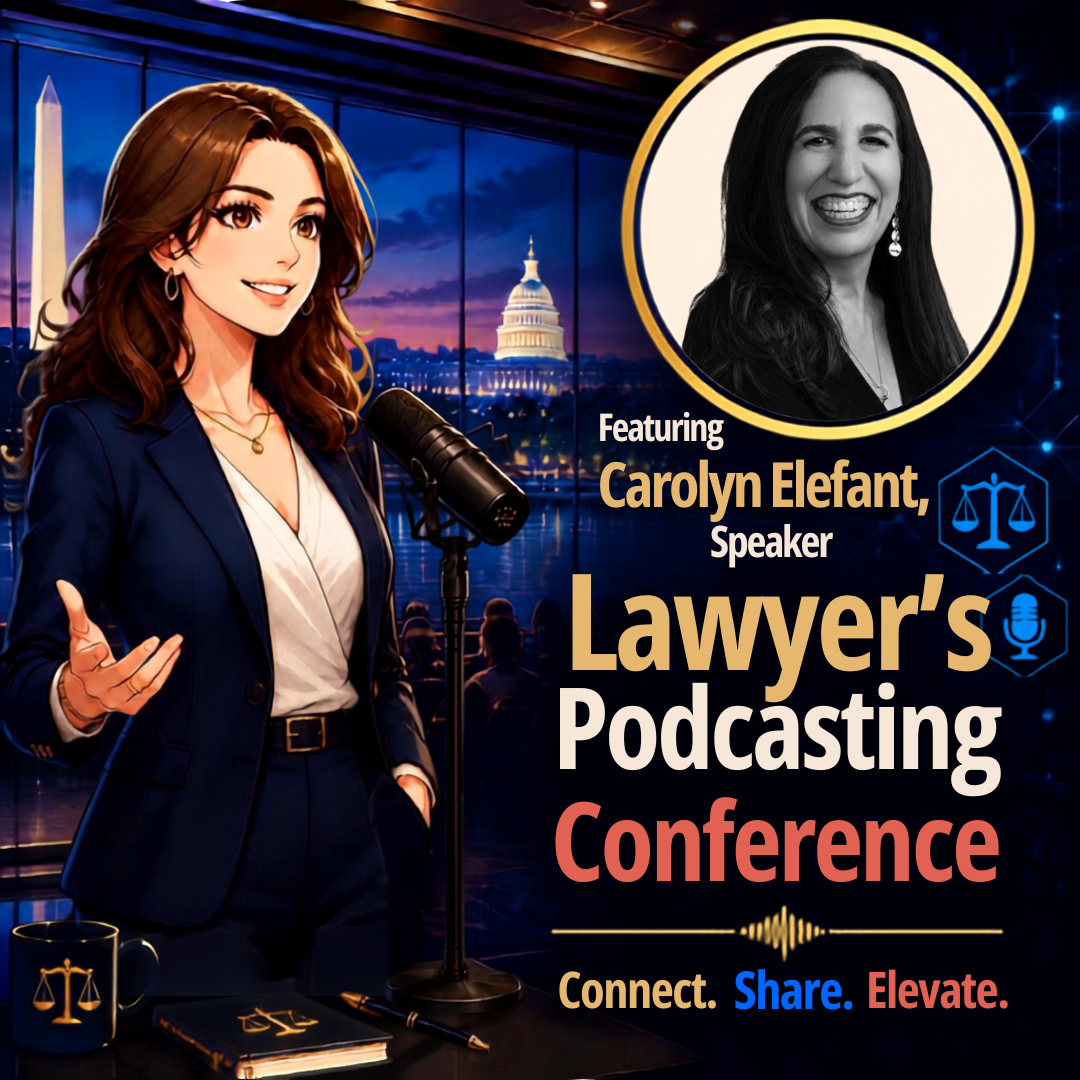
🎙️ Carolyn Elefant Confirmed as First Speaker for The Lawyer’s Podcasting Conference!

I am pleased to announce the first confirmed speaker for The Lawyer’s Podcasting Conference: Carolyn Elefant, the lawyer, author, mentor, and longtime force behind My Shingle. ⚖️

Carolyn will join us in McLean, Virginia, on Friday, November 13, and Saturday, November 14, 2026, for two days devoted to helping lawyers create podcasts that build authority, serve their audiences, and hold up under professional scrutiny.

The event will be held at 1765 Greensboro Station Place, 9th Floor, McLean, Virginia 22102, roughly one minute on foot from the Greensboro Metro station on the Silver Line. That means attendees can arrive from Dulles or Reagan National by train, walk to the venue, and spend their time thinking about their show rather than their rental car. 🚇

Carolyn is the first confirmed faculty member aside from me, your host and presenter, and I could not be more pleased to begin the speaker announcements with her.

Why Carolyn belongs in this room

For decades, Carolyn has provided independent lawyers with serious, practical guidance on building sustainable practices. Through My Shingle, her writing, and her work in the solo and small-firm legal community, she has consistently addressed the questions that arrive after the easy answers run out:

  • How do lawyers build an independent practice without compromising judgment?

  • How do we communicate our value without overselling?

  • How do we adopt new methods and technology without losing sight of professional duties?

  • How do we create work that is sustainable rather than merely busy?

Those questions sit at the center of lawyer podcasting.

A podcast can be a powerful professional platform. It can make a lawyer easier to find. It can demonstrate substantive knowledge. It can introduce a lawyer’s voice and judgment before a prospective client ever makes contact. It can strengthen referral relationships and build a library of useful, durable content.

But the same microphone that helps a lawyer reach an audience can also create ethical problems at scale. A casual client story can disclose more than intended. A promotional claim can travel across jurisdictions. A discussion of a pending matter can create risk. A contractor, editor, virtual assistant, or AI tool can introduce questions of supervision, confidentiality, and verification.

Carolyn’s perspective will help keep the conference grounded in the reality of independent practice. 🎧

The ethics session is the centerpiece

The conference’s ethics block is not an obligatory closing slide. It is being designed as a dedicated CLE-oriented session and working exercise.

We will examine the practical rules that lawyer-podcasters need to understand before they publish.

Model Rule 1.6 is where client stories begin. “Anonymous” does not always mean unidentifiable. Details that feel harmless in isolation can identify a client when assembled by someone who knows the matter. Written informed consent is often the safer choice when a story is recognizable or commercially useful.

Rules 7.1 through 7.3 matter because a podcast can be a communication about a lawyer’s services. The analysis does not stop at federal or ABA language. Lawyers must also examine the advertising and solicitation rules in the jurisdictions where they practice and where their content is directed.

Rule 5.5 matters the moment a locally focused show reaches a national audience. A podcast host should understand the line between legal education and individualized legal advice, especially when listeners begin asking questions in comments, direct messages, or follow-up calls.

Rule 1.1, including Comment 8, addresses technological competence. The duty is not to become an audio engineer. It is to understand the benefits and risks of the technology a lawyer uses. That includes recording platforms, hosting services, transcription tools, AI-assisted editing, synthetic media, and the systems that distribute content beyond the lawyer’s direct control.

Rule 5.3 applies when nonlawyers assist with production. An editor, assistant, agency, or technology vendor can make podcasting manageable. The lawyer still has obligations to choose, instruct, and supervise those providers appropriately. That includes reviewing transcripts and show notes before publication, protecting client information, and maintaining final judgment over the content.

As I discussed in MTC: Hidden AI, GEO, and the ABA Model Rules, the question is not whether AI or discoverability tools are arriving in legal marketing. They are here. The question is whether lawyers will use them with care, transparency, and professional discipline. 🔎

What attendees will build

The conference follows the practical spine of The Lawyer’s Guide to Podcasting, then takes the work beyond the page.

Day One focuses on the strategic foundation: why lawyers should podcast, choosing a viable topic and audience, selecting a format, understanding SEO and GEO, and choosing equipment that fits the lawyer’s actual goals and budget. We are also planning hands-on gear work and a live recording with a candid teardown. 🎛️

Day Two moves from recording to publication: guest preparation and releases, editing and human review, show notes, hosting, RSS ownership, directories, distribution, marketing, repurposing, and the systems that keep a show alive after the initial excitement fades.

Then comes the ethical and operational work. Attendees will identify the rules that govern their own practices, choose a sustainable cadence, and leave with a realistic first-ninety-days plan.

A lawyer with a static bio page is easy to overlook. A lawyer with a thoughtful body of episodes, transcripts, show notes, and professional judgment is building a record that clients, referral sources, search engines, and AI answer tools can discover. The work still must be accurate. It must be ethical. And it must sound like the lawyer behind it. 🎙️

Carolyn’s confirmation is an excellent beginning. More faculty announcements are coming as they are finalized. Registration will open soon.

For now, reserve November 13–14, 2026, and follow the conference updates. Bring the show you have been meaning to start.

🎙️ Save the Date: The Lawyer's Podcasting Conference Comes to the DC Metro Area November 13–14, 2026 ⚖️

Mark your calendar. 🗓️ The Lawyer's Podcasting Conference has dates, and it has an address.

save the date, the location is set, more to come!

We are gathering on Friday, November 13, and Saturday, November 14, 2026, at 1765 Greensboro Station Place, 9th Floor, McLean, Virginia 22102. The building sits roughly one minute on foot from the Greensboro Metro station on the Silver Line (Boro Station property details). Fly into Dulles or Reagan National, ride the train, walk to the ninth floor. No rental car. Whole Foods and a dozen restaurants sit within two minutes on foot, which matters when eighty lawyers need lunch at once. 🚇

I announced this event back in July, when the dates were still tentative (Announcing the Lawyer's Podcasting Conference). They are locked now. Reserve them.

Why a whole conference about lawyers and microphones? 🤔

Because the alternative is worse. Your prospective clients are asking an AI assistant, “Who handles their kind of problem?” That assistant answers from indexed, structured, attributable content. A lawyer with sixty published episodes, transcripts, and show notes is discoverable. A lawyer with a static bio page is a rumor.

I have written about this shift and its ethical edges before, in MTC: Hidden AI, GEO, and the ABA Model Rules. Generative engine optimization is not a marketing fad. It is the new front door to your practice. 🚪

Podcasting also does something a blog post cannot. It puts your voice in a client's ear during a commute. It builds the trust that converts a referral into a retainer. And it forces you to stay current, because you cannot record a coherent episode about a rule you have not read.

What the two days cover 🎧

lawyers, come learn the reasons, benefits, and steps to start your own podcast for your firm!

The program follows the spine of The Lawyer's Guide to Podcasting, and then goes further than a book can.

Day One answers why, what, and with what. We open with the business case for podcasting as thought leadership. We move into SEO and GEO for lawyer-podcasters. We work through choosing a topic and defining an audience, because "law" is not a niche. We cover the five show formats — solo commentary, interviews, panels, case-study storytelling, and educational series — and help you pick the one your calendar can actually sustain.

Then comes the gear. 🎛️ We will cover three honest tiers: the laptop-and-earbuds start, the credible upgrade, and the studio build. We will talk about recording inside a law office, where HVAC noise is a real problem and confidentiality is a design requirement. We hope to have hands-on labs to follow, so you hear the difference between rigs rather than reading about it and then a live episode recording with a full teardown afterward. 🍷

Day Two gets your show published. Guests, prep, and release forms. Editing, show notes, and the human review that AI-assisted production still requires. Hosting platforms, RSS ownership, and directory submissions. Marketing, repurposing, and audience growth.

One honest note. 📌 The schedule is still being fine-tuned. Session order, timing, and length will shift as faculty confirm, and I would rather adjust the grid than lock a weak lineup. I am in active discussions with additional speakers and panelists, and I will announce them as they sign on. Watch this space, and think of the outline above as the shape of the program rather than the final grid.

The ethics block is the centerpiece ⚖️

This is where too many legal podcasts go sideways, so we are giving it a dedicated session and designing it for CLE submission.

Rule 1.6 governs the client story you want to tell — anonymized facts can still identify a client, and informed consent belongs in writing. Rules 7.1 through 7.3 matter because a podcast is often a communication about your services, and the advertising rules vary meaningfully by jurisdiction. Rule 5.5 deserves attention the moment your audience crosses state lines. Rule 1.1, read with Comment 8, is why technological competence is not optional. Rule 5.3 covers your editor, your virtual assistant, and the AI tools handling your audio. And Rule 8.4(c) should govern how you disclose synthetic voice and AI-generated content. I have hammered on verification duties before (MTC: Even Though AI Hallucinations Are Down), and a published episode is no place to relax them.

We close the block with a working session where you pull your own jurisdiction's rules and mark the three that bind you most. 📋

Vendors and sponsors: let's talk 📣

come see and learn from those who know!

If you sell microphones, cameras, hosting, transcription, editing services, CRM, or practice-management software to lawyers, this room is your buyer. Solo and small-firm attorneys arrive ready to spend on gear and services within ninety days. Sponsorship tiers, demo tables, and lab-station placements are open now. Reach out early — the gear lab has limited stations.

Reserve the dates 🎙️

Registration opens soon, and speaker announcements start rolling out before then. Details, updates, and the sponsor prospectus as they go live on the conference information page – add your e-mail to stay up-to-date on fast-developing news! Put November 13–14, 2026 on your calendar today, stay tuned for the faculty reveal, and bring the show you have been meaning to start. 🎤

Exclusive ABA TECHSHOW 2026 Offer 🎙️⚖️ — $5 Off The Lawyer’s Guide to Podcasting (On-Site Only, While Supplies Last!) + Join Our Live Sessions on Podcasting and Video Presence

Hey ABA TECHSHOW 2026 Attendees! 🎉

I’m thrilled you’re joining us in Chicago to explore how technology can elevate modern law practice. ABA TECHSHOW is one of my favorite spaces for real-world conversations about legal tech, and this year I’m especially excited to connect with those of you who want to put your voice — and your expertise — to work through podcasting and video.

ABA TECHSHOW 2026 attendees get your discounted LTG: The Lawyer’s Guide to podcasting at the techshow while supplies last!!!

To celebrate TECHSHOW and support lawyers who are podcast-curious but not necessarily “tech experts,” I’m offering a special, in-person-only discount on my book, The Lawyer’s Guide to Podcasting. 📚🎙️ During ABA TECHSHOW 2026, attendees can purchase a physical copy on-site for $19.99, which is $5 off the regular $24.99 price, on-site only and while supplies last.

This book is written for lawyers with limited to moderate technology skills who want a clear, practical, ethics-aware roadmap to launching and sustaining a podcast. You don’t need a production team or a studio; you need a realistic workflow, the right level of tech, and an understanding of how the ABA Model Rules apply when your voice becomes part of your marketing and client-education strategy.

Join Me and My Co-Hosts at ABA TECHSHOW 2026 🎤

You’ll find me on the ABA TECHSHOW 2026 program in two sessions that sit right at the intersection of technology, communication, and professional responsibility.

🎧 Podcasting for Lawyers: The Truth Behind the Mic

In this session, I’ll be joined by a powerhouse group of legal podcasters and marketers:

  • Ruby L. Powers – A board-certified immigration attorney, law firm owner, legal innovator, and host of the Power Up Your Practice podcast, Ruby brings deep experience in law firm leadership, remote practice, and legal tech adoption.

  • Gyi Tsakalakis – A well-known legal marketing professional and podcast host, Gyi focuses on helping lawyers understand how digital marketing, SEO, and content (including podcasts) drive real-world client development.

  • Stephanie Everett – Co-author of The Small Firm Roadmap Revisited and host of The Lawyerist Podcast, Stephanie works with small firms on strategy, operations, and building sustainable, client-centered practices.

Together, we’ll discuss how, in a world crowded with blogs and social media, podcasting gives lawyers a unique way to build authority and connect with audiences on a more personal level. You’ll hear from lawyers and experts who actively run podcasts and work with law firms, and we’ll share the exact steps we’ve used to create compelling legal content that resonates, supports branding, and respects ethical boundaries.

🎥 Camera Ready Anywhere: Mastering Video Meetings with Clients, Courts, and Colleagues

In this session, I’ll be co-presenting with Temi Siyanbade:

  • Temi Siyanbade – An attorney, speaker, and author of Show Don’t Tell: How Lawyers Can Use Video to Stand Out, Create More Value, and Revolutionize Their Firms, Temi helps legal professionals strategically use video to build trust and communicate more effectively.

Virtual communication is now a permanent part of practice, whether you’re meeting with clients, negotiating with opposing counsel, or appearing before the court. In this session, Temi and I will share practical best practices for using Microsoft Teams and Zoom, including audio, video, lighting, framing, and on-screen presence, so your tech setup supports — rather than undermines — your advocacy and client service.

Ethics, ABA Model Rules, and Tech Competence ⚖️

Find me at the techshow to get your onsite discount and take home a great guide to get your podcast started!

Podcasting and video both touch directly on your professional responsibilities. In The Lawyer’s Guide to Podcasting, I connect the practical steps of planning, recording, and publishing to the ABA Model Rules of Professional Conduct, including:

I walk through how to use clear disclaimers, separate legal information from legal advice, and avoid inadvertently revealing confidential or identifying information. The goal is to help you become tech-savvy in a way that is realistic, ethical, and sustainable.

What You’ll Get from The Lawyer’s Guide to Podcasting 📘

Inside the book, you’ll find:

  • Plain-language tech guidance: realistic microphone, software, and hosting recommendations for busy lawyers.

  • Step-by-step workflows: planning, recording, editing, and publishing made manageable for your schedule.

  • Ethical “checkpoints”: where to pause and consider confidentiality, advertising rules, and jurisdiction-specific requirements.

  • Integration tips: how to embed your podcast on your website, share it in newsletters, and repurpose episodes for SEO and client education.

This is not a book about becoming a sound engineer; it’s about becoming a tech-savvy lawyer who uses podcasting thoughtfully.

On-Site Only, While Supplies Last 🛍️

Because this offer is tied to ABA TECHSHOW 2026, the $5 discount is available only for on-site purchases by attendees and only while physical copies last. I wanted this to be a tangible benefit for those who make the trip — and a practical next step if one of our sessions sparks your interest in podcasting.

Here’s how to take advantage of it:

  • Add “Podcasting for Lawyers: The Truth Behind the Mic” and “Camera Ready Anywhere: Mastering Video Meetings with Clients, Courts, and Colleagues” to your TECHSHOW schedule.

  • Bring your questions about tech, ethics, workflows, and content.

  • Find me on-site after the sessions or around the conference to pick up your discounted, signed copy of The Lawyer’s Guide to Podcasting for $19.99 (regularly $24.99), on-site only and while supplies last. 📚✍️

SEE YOU AT THE TECHSHOW!!!

ABA TECHSHOW is about practical innovation and ethical implementation. Podcasting and video live right at that intersection — modern tools that, when used thoughtfully and in line with the ABA Model Rules, can enhance your competence, your communication, and your client relationships.

If you’ve been thinking about starting a legal podcast — or want a structured way to decide whether podcasting fits your goals — I’d love for you to join our sessions and pick up the book during the show. 🎧⚖️

🚨🎙️📘 Three Days Left: The Lawyer’s Guide to Podcasting releases NEXT WEEK! 🥳🥳🥳

Inside title page of The Lawyer’s Guide to Podcasting, releasing January 19, 2026.

“The Lawyer’s Guide to Podcasting” will be released on Monday, January 19, 2026, through Amazon!!!

Designed for legal professionals, this book walks through every step of launching and sustaining an effective, ethically sound podcast that supports your practice and professional reputation.​

You will learn:

  • Show formats

  • Equipment needed

  • Show hosting platforms to use

  • Growing your audience

  • Maintaining Professional Ethics

  • Maybe earn some $Money$ too!

Want the release link the moment it’s live?
Email Admin@TheTechSavvyLawyer.Page with subject “Book Link.” I’ll send it on launch day. 🚀

🎙️📘 Quick reminder: The Lawyer’s Guide to Podcasting releases NEXT WEEK!

Inside title page of The Lawyer’s Guide to Podcasting, releasing January 19, 2026.

If you want a podcast that sounds professional without turning your week into a production project, this book is built for you. It’s practical. It’s workflow-first. It keeps ethics and confidentiality in view. 🔐⚖️

✅ Inside you’ll learn:

  • How to choose a podcast format that fits your goals 🎯

  • A simple, reliable setup that sounds credible 🎤

  • Recording habits that reduce editing time ⏱️

  • Repurposing steps so one episode powers your content plan ♻️

📩 Want the release link the moment it’s live? Email Admin@TheTechSavvyLawyer.Page with subject “Book Link.” I’ll send it on launch day. 🚀