

🎙️ Bonus Ep.: Why Lawyers Should Embrace Mac - Insights from MacStock 2025 Legal Tech Panel
/
Mac vs. PC for Attorneys - Live from MacStock 2025, Our Panel Shares Essential Tech Tools and Tips for Law Firms
Read MoreMac vs. PC for Attorneys - Live from MacStock 2025, Our Panel Shares Essential Tech Tools and Tips for Law Firms
Read MoreJoin us this Saturday, July 19, 2025, at 12 PM EST for Tech-Savvy Saturday!
Legal innovation meets technology with Matt Kerbis, founder of Subscription Attorney LLC. Matt leads the charge to end the billable hour by offering predictable, affordable legal services starting at $19.99/month. With expertise in AI tools like Paxton, NotebookLM Pro, Perplexity, and Descript, Matt empowers attorneys to embrace efficient, client-centered models. Matt hosts the Law Subscribed podcast and is celebrated by the ABA for innovation. Don’t miss this industry-changing session—unlock how to become your own “subscription attorney”!
“Don’t miss this industry-changing session—unlock how to become your own “subscription attorney”!”
👉 Sign up here for the free webinar!
👉 Sign up here to stay abreast of Tech-Savvy Saturdays News!
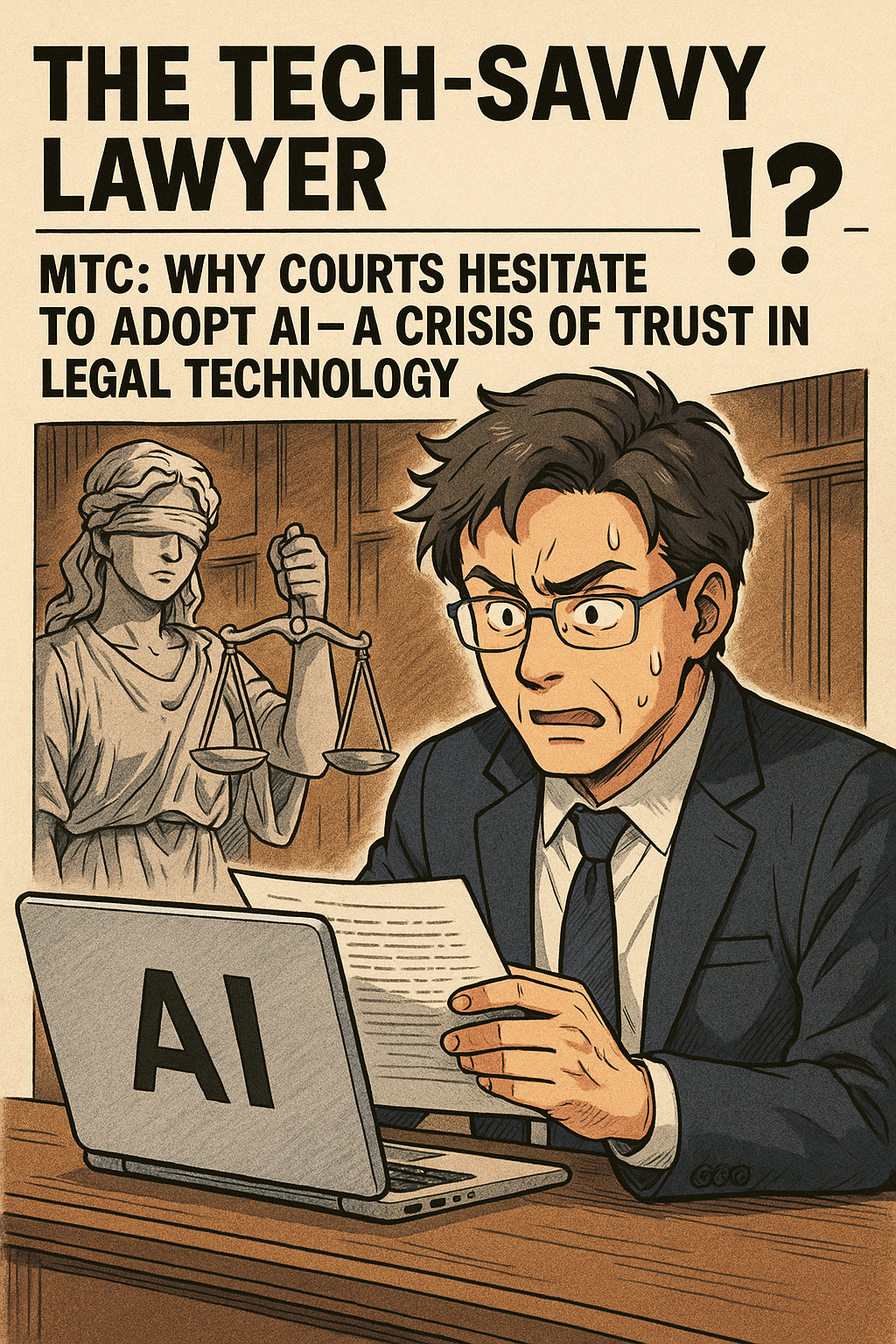
Despite facing severe staffing shortages and mounting operational pressures, America's courts remain cautious about embracing artificial intelligence technologies that could provide significant relief. While 68% of state courts report staff shortages and 48% of court professionals lack sufficient time to complete their work, only 17% currently use generative AI tools. This cautious approach reflects deeper concerns about AI reliability, particularly in light of recent (and albeit unnecessarily continuing) high-profile errors by attorneys using AI-generated content in court documents.
The Growing Evidence of AI Failures in Legal Practice
Recent cases demonstrate why courts' hesitation may be justified. In Colorado, two attorneys representing MyPillow CEO Mike Lindell were fined $3,000 each after submitting a court filing containing nearly 30 AI-generated errors, including citations to nonexistent cases and misquoted legal authorities. The attorneys admitted to using artificial intelligence without properly verifying the output, violating Federal Rule of Civil Procedure 11.
Similarly, a federal judge in California sanctioned attorneys from Ellis George LLP and K&L Gates LLP $31,000 after they submitted briefs containing fabricated citations generated by AI tools including CoCounsel, Westlaw Precision, and Google Gemini. The attorneys had used AI to create an outline that was shared with colleagues who incorporated the fabricated authorities into their final brief without verification.
These incidents are part of a broader pattern of AI hallucinations in legal documents. The June 16, 2025, Order to Show Cause from the Oregon federal court case Sullivan v. Wisnovsky, No. 1:21-cv-00157-CL, D. Or. (June 16, 2025) demonstrates another instance where plaintiffs cited "fifteen non-existent cases and misrepresented quotations from seven real cases" after relying on what they claimed was "an automated legal citation tool". The court found this explanation insufficient to avoid sanctions.
The Operational Dilemma Facing Courts

LAWYERS NEED TO BalancE Legal Tradition with Ethical AI Innovation
The irony is stark: courts desperately need technological solutions to address their operational challenges, yet recent AI failures have reinforced their cautious approach. Court professionals predict that generative AI could save them an average of three hours per week initially, growing to nearly nine hours within five years. These time savings could be transformative for courts struggling with increased caseloads and staff shortages.
However, the profession's experience with AI-generated hallucinations has created significant trust issues. Currently, 70% of courts prohibit employees from using AI-based tools for court business, and 75% have not provided any AI training to their staff. This reluctance stems from legitimate concerns about accuracy, bias, and the potential for AI to undermine the integrity of judicial proceedings.
The Technology Adoption Paradox
Courts have successfully adopted other technologies, with 86% implementing case management systems, 85% using e-filing, and 88% conducting virtual hearings. This suggests that courts are not inherently resistant to technology. But they are specifically cautious about AI due to its propensity for generating false information.
The legal profession's relationship with AI reflects broader challenges in implementing emerging technologies. While 55% of court professionals recognize AI as having transformational potential over the next five years, the gap between recognition and adoption remains significant. This disconnect highlights the need for more reliable AI systems and better training for legal professionals.
The Path Forward: Measured Implementation
The solution is not to abandon AI but to implement it more carefully. Legal professionals must develop better verification protocols. As one expert noted, "AI verification isn't optional—it's a professional obligation." This means implementing systematic citation checking, mandatory human review, and clear documentation of AI use in legal documents. Lawyers must stay up to date on the technology available to them, as required by the American Bar Association Model Rule of Professional Conduct 1.1[8], including the expectation that they use the best available technology currently accessible. Thus, courts too need comprehensive governance frameworks that address data handling, disclosure requirements, and decision-making oversight before evaluating AI tools. The American Bar Association's Formal Opinion 512 on Generative Artificial Intelligence Tools provides essential guidance, emphasizing that lawyers must fully consider their ethical obligations when using AI.
Final Thoughts

THE Future of Law: AI and Justice in Harmony!
Despite the risks, courts and legal professionals cannot afford to ignore AI indefinitely. The technology's potential to address staffing shortages, reduce administrative burdens, and improve access to justice makes it essential for the future of the legal system. However, successful implementation requires acknowledging AI's limitations while developing robust safeguards to prevent the types of errors that have already damaged trust in the technology.
The current hesitation reflects a profession learning to balance innovation with reliability. As AI systems improve and legal professionals develop better practices for using them, courts will likely become more willing to embrace these tools. Until then, the cautious approach may be prudent, even if it means forgoing potential efficiency gains.
The legal profession's experience with AI serves as a reminder that technological adoption in critical systems requires more than just recognizing potential benefits—it demands building the infrastructure, training, and governance necessary to use these powerful tools responsibly.
MTC
Our next guest is Jennifer Wondracek, Director of the Law Library and Professor of Legal Research and Writing at Capital University Law School. Jennifer shares her expertise as a legal technologist and ABA Women of Legal Tech Honoree. She addresses three vital questions: the top technological tools law students and lawyers should leverage, strategies to help new attorneys adapt to firm technologies, and ways law firms can automate routine tasks to prioritize high-value legal work. Drawing on her extensive experience in legal education and technology, Jennifer emphasizes practical solutions, the importance of transferable skills, and the increasing role of generative AI in modern legal practice.
Join Jennifer and me as we discuss the following three questions and more!
As Head Librarian at Capital University Law School, what are the top three technological tools or resources that you believe law students and practicing lawyers should be leveraging right now to enhance legal research and client service?
What are the top three strategies that lawyers can use to help law students clerking for a firm, or new attorneys, quickly adapt to become proficient with the technology platforms and tools used in their practice, particularly when these tools differ from what they learned in law school?
Beyond legal research, what are the top three ways law firms and solo practitioners can use technology to automate routine tasks and create more time for high-value legal work?
In our conversation, we cover the following:
[01:03] Jennifer’s Current Tech Setup
[06:27] Top Technological Tools for Law Students and Practicing Lawyers
[11:23] Case Management Systems and Generative AI
[23:15] Strategies for Law Students and New Attorneys to Adapt to Technology
[31:03] Permissions and Backup Practices
[34:20] Automating Routine Tasks with Technology
[39:41] Favorite Non-Legal AI Tools
Resources:
Connect with Jennifer:
LinkedIn: linkedin.com/in/jennifer-wondracek/
Mentioned in the episode:
Bloomberg (free ethics guidance & opinions list)
Charlotin’s AI Hallucinations Tracker (free)
RAILS chart (free-standing order/local rules tracker)
Ropes & Gray Map (free-standing order/local rules tracker)
Hardware mentioned in the conversation:
TCL NXTPAPER 11 Plus Tablet: tcl.com/global/en/tablets/tcl-nxtpaper-11-plus
Software & Cloud Services mentioned in the conversation:
Clio: clio.com/
CoCounsel: thomsonreuters.com/en/cocounsel
Daylite: daylite.app/
Fastcase / vLex: vlex.com/products/fastcase
Goblin Tools: goblin.tools/
IFTTT: ifttt.com/
LawDroid: lawdroid.com/
Legal Tech Hub: legaltechnologyhub.com/
LexisNexis: lexisnexis.com/en-us/gateway.page
PACER: pacer.uscourts.gov/
Procertas: procertas.com/
TheFormTool: theformtool.com/
Westlaw: legal.thomsonreuters.com/en/westlaw
Zapier: zapier.com/

AL Hallucinated cases are now shaping court decisions - what every lawyer and judge needs to know in 2025.
Artificial intelligence has transformed legal research, but a threat is emerging from chambers: hallucinated case law. On June 30, 2025, the Georgia Court of Appeals delivered a landmark ruling in Shahid v. Esaam that should serve as a wake-up call to every member of the legal profession: AI hallucinations are no longer just embarrassing mistakes—they are actively influencing court decisions and undermining the integrity of our judicial system.
The Georgia Court of Appeals Ruling: A Watershed Moment
The Shahid v. Esaam decision represents the first documented case where a trial court's order was based entirely on non-existent case law, likely generated by AI tools. The Georgia Court of Appeals found that the trial court's order denying a motion to reopen a divorce case relied upon two fictitious cases, and the appellee's brief contained an astounding 11 bogus citations out of 15 total citations. The court imposed a $2,500 penalty on attorney Diana Lynch—the maximum allowed under GA Court of Appeals Rule 7(e)(2)—and vacated the trial court's order entirely.
What makes this case particularly alarming is not just the volume of fabricated citations, but the fact that these AI-generated hallucinations were adopted wholesale without verification by the trial court. The court specifically referenced Chief Justice John Roberts' 2023 warning that "any use of AI requires caution and humility".
The Explosive Growth of AI Hallucination Cases
The Shahid case is far from isolated. Legal researcher Damien Charlotin has compiled a comprehensive database tracking over 120 cases worldwide where courts have identified AI-generated hallucinations in legal filings. The data reveals an alarming acceleration: while there were only 10 cases documented in 2023, that number jumped to 37 in 2024, and an astounding 73 cases have already been reported in just the first five months of 2025.
Perhaps most concerning is the shift in responsibility. In 2023, seven out of ten cases involving hallucinations were made by pro se litigants, with only three attributed to lawyers. However, by May 2025, legal professionals were found to be at fault in at least 13 of 23 cases where AI errors were discovered. This trend indicates that trained attorneys—who should know better—are increasingly falling victim to AI's deceptive capabilities.
High-Profile Cases and Escalating Sanctions
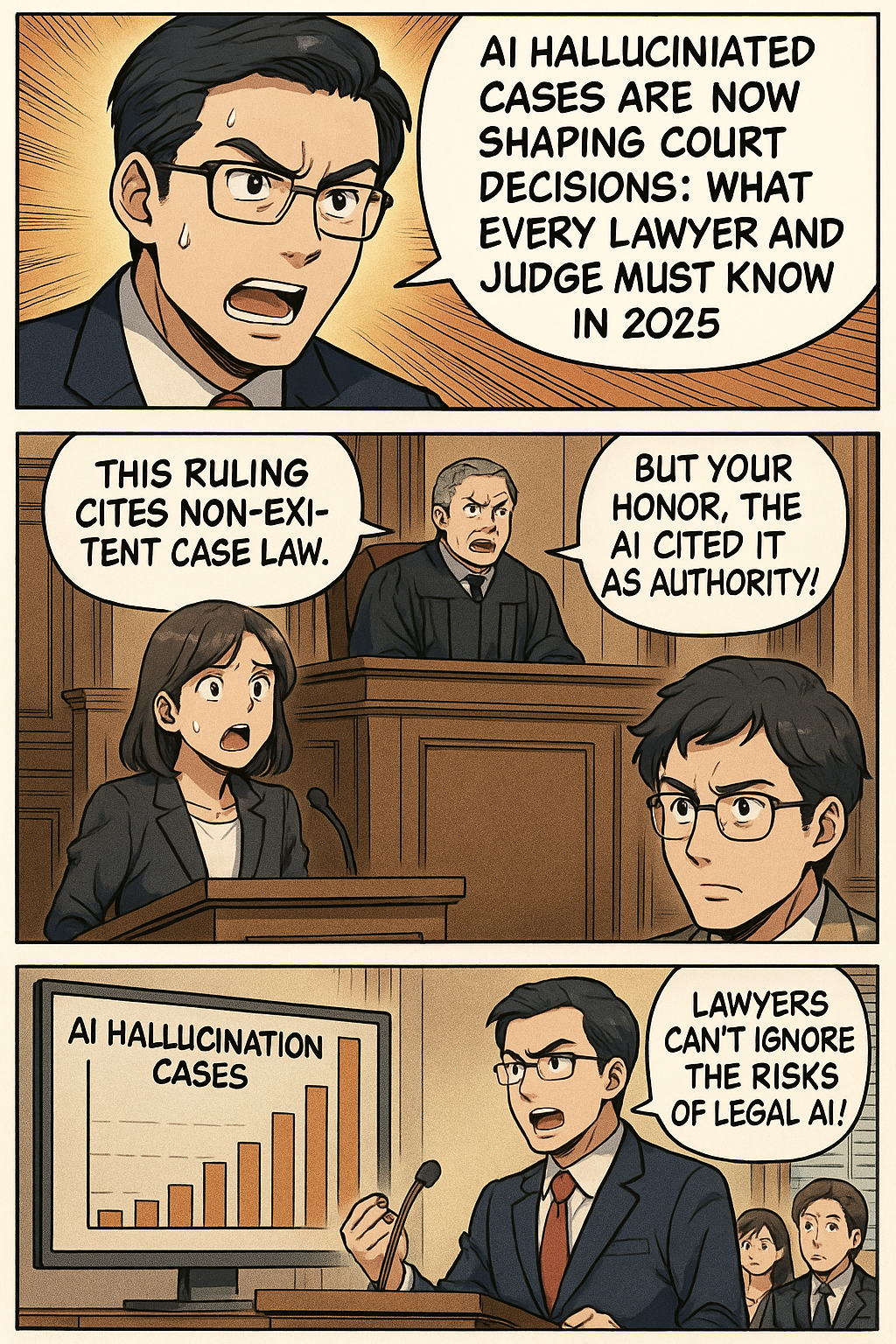
Always check your research - you don’t want to get in trouble with your client, the judge or the bar!
The crisis has intensified with high-profile sanctions. In May 2025, a special master in California imposed a staggering $31,100 sanction against law firms K&L Gates and Ellis George for what was termed a "collective debacle" involving AI-generated research4. The case involved attorneys who used multiple AI tools including CoCounsel, Westlaw Precision, and Google Gemini to generate a brief, with approximately nine of the 27 legal citations proving to be incorrect.
Even more concerning was the February 2025 case involving Morgan & Morgan—the largest personal injury firm in the United States—where attorneys were sanctioned for a motion citing eight nonexistent cases. The firm subsequently issued an urgent warning to its more than 1,000 lawyers that using fabricated AI information could result in termination.
The Tech-Savvy Lawyer.Page: Years of Warnings
The risks of AI hallucinations in legal practice have been extensively documented by experts in legal technology. I’ve been sounding the alarm at The Tech-Savvy Lawyer.Page Blog and Podcast about these issues for years. In a blog post titled "Why Are Lawyers Still Failing at AI Legal Research? The Alarming Rise of AI Hallucinations in Courtrooms," the editorial detailed how even advanced legal AI platforms can generate plausible but fake authorities.
My comprehensive coverage has included reviews of specific platforms, such as the November 2024 analysis "Lexis+ AI™️ Falls Short for Legal Research," which documented how even purpose-built legal AI tools can cite non-existent legislation. The platform's consistent message has been clear: AI is a collaborator, not an infallible expert.
International Recognition of the Crisis
The problem has gained international attention, with the London High Court issuing a stark warning in June 2025 that attorneys who use AI to cite non-existent cases could face contempt of court charges or even criminal prosecution. Justice Victoria Sharp warned that "in the most severe instances, intentionally submitting false information to the court with the aim of obstructing the course of justice constitutes the common law criminal offense of perverting the course of justice".
The Path Forward: Critical Safeguards
Based on extensive research and mounting evidence, several key recommendations emerge for legal professionals:
For Individual Lawyers:

Lawyers need to be diligent and make sure their case citations are not only accurate but real!
Never use general-purpose AI tools like ChatGPT for legal research without extensive verification
Implement mandatory verification protocols for all AI-generated content
Obtain specialized training on AI limitations and best practices
Consider using only specialized legal AI platforms with built-in verification mechanisms
For Courts:
Implement consistent disclosure requirements for AI use in court filings
Develop verification procedures for detecting potential AI hallucinations
Provide training for judges and court staff on AI technology recognition
FINAL THOUGHTS
The legal profession is at a crossroads. AI can enhance efficiency, but unchecked use can undermine the integrity of the justice system. The solution is not to abandon AI, but to use it wisely with appropriate oversight and verification. The warnings from The Tech-Savvy Lawyer.Page and other experts have proven prescient—the question now is whether the profession will heed these warnings before the crisis deepens further.
MTC
Happy Lawyering!
🎧 Can't find time to read lengthy legal tech editorials? We've got you covered.
As part of our Tech Savvy Lawyer Labs initiative, I've been experimenting with cutting-edge AI to make legal content more accessible. This bonus episode showcases how Notebook.AI can transform written editorials into engaging podcast discussions.
Our latest experiment takes the editorial "AI and Legal Research: The Existential Threat to Lexis, Westlaw, and Fastcase" and converts it into a compelling conversation between two AI hosts who discuss the content as if they've thoroughly analyzed the piece.
This Labs experiment demonstrates how AI can serve as a time-saving alternative for legal professionals who prefer audio learning or lack time for extensive reading. The AI hosts engage with the material authentically, providing insights and analysis that make complex legal tech topics accessible to practitioners at all technology skill levels.
🚀 Perfect for commutes, workouts, or multitasking—get the full editorial insights without the reading time.
Enjoy!

How does this ruling for anthropic change the business models legal information providers operate under?
MTC: The legal profession faces unprecedented disruption as artificial intelligence reshapes how attorneys access and analyze legal information. A landmark federal ruling combined with mounting evidence of AI's devastating impact on content providers signals an existential crisis for traditional legal databases.
The Anthropic Breakthrough
Judge William Alsup's June 25, 2025 ruling in Bartz v. Anthropic fundamentally changed the AI landscape. The court found that training large language models on legally acquired copyrighted books constitutes "exceedingly transformative" fair use under copyright law. This decision provides crucial legal clarity for AI companies, effectively creating a roadmap for developing sophisticated legal AI tools using legitimately purchased content.
The ruling draws a clear distinction: while training on legally acquired materials is permissible, downloading pirated content remains copyright infringement. This clarity removes a significant barrier that had constrained AI development in the legal sector.
Google's AI Devastates Publishers: A Warning for Legal Databases
The news industry's experience with Google's AI features provides a sobering preview of what awaits legal databases. Traffic to the world's 500 most visited publishers has plummeted 27% year-over-year since February 2024, losing an average of 64 million visits per month. Google's AI Overviews and AI Mode have created what industry experts call "zero-click searches," where users receive information without visiting original sources.
The New York Times saw its share of organic search traffic fall from 44% in 2022 to just 36.5% in April 2025. Business Insider experienced devastating 55% traffic declines and subsequently laid off 21% of its workforce. Major outlets like HuffPost and The Washington Post have lost more than half their search traffic.
This pattern directly threatens legal databases operating on similar information-access models. If AI tools can synthesize legal information from multiple sources without requiring expensive database subscriptions, the fundamental value proposition of Lexis, WestLaw, and Fastcase erodes dramatically.
The Rise of Vincent AI and Legal Database Alternatives
The threat is no longer theoretical. Vincent AI, integrated into vLex Fastcase, represents the emergence of sophisticated legal AI that challenges traditional database dominance. The platform offers comprehensive legal research across 50 states and 17 countries, with capabilities including contract analysis, argument building, and multi-jurisdictional comparisons—all often available free through bar association memberships.
Vincent AI recently won the 2024 New Product Award from the American Association of Law Libraries. The platform leverages vLex's database of over one billion legal documents, providing multimodal capabilities that can analyze audio and video files while generating transcripts of court proceedings. Unlike traditional databases that added AI as supplementary features, Vincent AI integrates artificial intelligence throughout its core functionality.
Stanford University studies reveal the current performance gaps: Lexis+ AI achieved 65% accuracy with 17% hallucination rates, while Westlaw's AI-Assisted Research managed only 42% accuracy with 33% hallucination rates. However, AI systems improve rapidly, and these quality gaps are narrowing.
Economic Pressures Intensify

Can traditional legal resources protect their proprietary information from AI?
Goldman Sachs research indicates 44% of legal work could be automated by emerging AI tools, targeting exactly the functions that justify expensive database subscriptions. The legal research market, worth $68 billion globally, faces dramatic cost disruption as AI platforms provide similar capabilities at fractions of traditional pricing.
The democratization effect is already visible. Vincent AI's availability through over 80 bar associations provides enterprise-level capabilities to solo practitioners and small firms previously unable to afford comprehensive legal research tools. This accessibility threatens the pricing power that has sustained traditional legal database business models.
The Information Ecosystem Transformation
The parallel between news publishers and legal databases extends beyond surface similarities. Both industries built their success on controlling access to information and charging premium prices for that access. AI fundamentally challenges this model by providing synthesized information that reduces the need to visit original sources.
AI chatbots have provided only 5.5 million additional referrals per month to publishers, a fraction of the 64 million monthly visits lost to AI-powered search features. This stark imbalance demonstrates that AI tools are net destroyers of traffic to content providers—a dynamic that threatens any business model dependent on information access.
Publishers describe feeling "betrayed" by Google's shift toward AI-powered search results that keep users within Google's ecosystem rather than sending them to external sites. Legal databases face identical risks as AI tools become more capable of providing comprehensive legal analysis without requiring expensive subscriptions.
Quality and Professional Responsibility Challenges
Despite AI's advancing capabilities, significant concerns remain around accuracy and professional responsibility. Legal practice demands extremely high reliability standards, and current AI tools still produce errors that could have serious professional consequences. Several high-profile cases involving lawyers submitting AI-generated briefs with fabricated case citations have heightened awareness of these risks.
However, platforms like Vincent AI address many concerns through transparent citation practices and hybrid AI pipelines that combine generative and rules-based AI to increase reliability. The platform provides direct links to primary legal sources and employs expert legal editors to track judicial treatment and citations.
Adaptation Strategies and Market Response

Is AI the beginning for the end of Traditional legal resources?
Traditional legal database providers have begun integrating AI capabilities, but this strategy faces inherent limitations. By incorporating AI into existing platforms, these companies risk commoditizing their own products. If AI can provide similar insights using publicly available information, proprietary databases lose their exclusivity advantage regardless of AI integration.
The more fundamental challenge is that AI's disruptive potential extends beyond individual products to entire business models. The emergence of comprehensive AI platforms like Vincent AI demonstrates this disruption is already underway and accelerating.
Looking Forward: Scenarios and Implications
Several scenarios could emerge from this convergence of technological and economic pressures. Traditional databases might successfully maintain market position through superior curation and reliability, though the news industry's experience suggests this is challenging without fundamental business model changes.
Alternatively, AI-powered platforms could continue gaining market share by providing comparable functionality at significantly lower costs, forcing traditional providers to dramatically reduce prices or lose market share. The rapid adoption of vLex Fastcase by bar associations suggests this disruption is already underway.
A hybrid market might develop where different tools serve different needs, though economic pressures favor comprehensive, cost-effective solutions over specialized, expensive ones.
Preparing for Transformation
The confluence of the Anthropic ruling, advancing AI capabilities, evidence from news industry disruption, and sophisticated legal AI platforms creates a perfect storm for the legal information industry. Legal professionals must develop AI literacy while implementing robust quality control processes and maintaining ethical obligations.
For legal database providers, the challenge is existential. The news industry's experience shows traffic declines of 50% or more would be catastrophic for subscription-dependent businesses. The rapid development of comprehensive AI legal research platforms suggests this disruption may occur faster than traditional providers anticipate.
The legal profession's relationship with information is fundamentally changing. The Anthropic ruling removed barriers to AI development, news industry data shows the potential scale of disruption, and platforms like Vincent AI demonstrate achievable sophistication. The race is now on to determine who will control the future of legal information access.
MTC
Hey everyone, welcome to this bonus episode!
As you know, in this podcast we explore the future of law through engaging interviews with lawyers, judges, and legal tech professionals on the cutting edge of legal innovation. As part of our Labs initiative, I am experimenting with AI-generated discussions—this episode features two Google Notebook.AI hosts who dive deep into our latest Editorial: "Lawyers, Generative AI, and the Right to Privacy: Navigating Ethics, Client Confidentiality, and Public Data in the Digital Age." If you’re a busy legal professional, join us for an insightful, AI-powered conversation that unpacks the editorial’s key themes, ethical challenges, and practical strategies for safeguarding privacy in the digital era.
Enjoy!
In our conversation, the "Bots" covered the following:
00:00 Introduction to the Bonus Episode
01:01 Exploring Generative AI in Law
01:24 Ethical Challenges and Client Confidentiality
01:42 Deep Dive into the Editorial
09:31 Practical Strategies for Lawyers
13:03 Conclusion and Final Thoughts
Resources:
Google Notebook.AI - https://notebooklm.google/

lawyers were your client’s pii hacked from your computers and software?
Lawyers across the nation need to take immediate action following the exposure of 16 billion login credentials—covering platforms from Apple and Google to Facebook and countless others—in what researchers describe as one of the largest exposures of sensitive data in history. While headlines have suggested a catastrophic, single-source breach, the reality is more nuanced but equally concerning for legal professionals. This leak is not a new, isolated hack of a major provider. Instead, it's a massive aggregation of credentials collected over years from various infostealer malware campaigns and previous breaches, now compiled and exposed in over 30 datasets.
What Is the Nature of This Breach? Is It "New"? 🕵️♂️
The so-called "16 billion password breach" is not the result of a single event. Instead, it's a compilation of old and some recent credentials, gathered from infostealer malware, credential stuffing lists, and previously leaked databases. Some datasets are fresh and weaponizable, including session tokens and cookies that can bypass multi-factor authentication, but much of the data is recycled or duplicated. The scale, however, means nearly every major online service is potentially implicated, and the risk of credential stuffing and account takeover is real—especially for those who reuse passwords or have not updated them in years.
Why Should Lawyers Care? ⚠️
Lawyers are high-value targets for cybercriminals due to the sensitive nature of client data and privileged communications. The legal profession has already seen significant cybersecurity challenges, with 29% of law firms encountering cybersecurity breaches in 2023, and the average cost of a data breach for law firms reaching $5.08 million. A compromised password can lead to unauthorized access to confidential files, emails, and client records, exposing firms to malpractice claims, regulatory penalties, and reputational harm. The legal sector's increasing reliance on cloud platforms and digital workflows makes robust credential management non-negotiable for lawyers.
What Should Lawyers Do Now? 🛡️
Immediate Steps:
Reset passwords for any account that may be affected, especially if you reuse passwords across sites.
Check your exposure using tools like "Have I Been Pwned" to see if your email or credentials are part of known breaches.
Enable Multi-Factor Authentication (MFA) on all accounts—this is the single most effective way to prevent unauthorized access, even if a password is leaked.
Long-Term Best Practices:
Adopt a password manager (such as 1Password* or similar) to generate and store unique, complex passwords for every account.
Educate your staff on phishing, social engineering, and the dangers of password reuse.
Implement passkeys and biometrics where possible, reducing reliance on passwords alone.
Regularly monitor for compromised credentials using security tools and services that alert you to new breaches.
Never store passwords in plaintext or unsecured documents; use encrypted vaults and secure delivery for sensitive credentials.
What Should Law Firms and Lawyers Be Doing to Stay Secure? 🏛️

Lawyers need to be active in protecting their client’s pii!
Review and update firm-wide password policies to mandate unique, strong passwords and regular changes.
Ensure all devices and cloud services used for legal work are protected with MFA and monitored for suspicious activity.
Consult with cybersecurity counsel or specialists to assess your firm's exposure and compliance with data protection regulations.
Stay informed about new threats and regularly audit your digital security posture.
Essential Resources from The Tech-Savvy Lawyer 📚🎧
For deeper insights into cybersecurity best practices for legal professionals, explore these valuable resources from The Tech-Savvy Lawyer.Page:
Blog Posts:
"🚨 BOLO: Zoom Remote Access Attacks – Critical Security Alert for Legal Professionals 🚨" - Learn about sophisticated cyberattacks targeting legal professionals through video conferencing platforms and how to protect your practice.
"BOLO: Is LastPass on its Last Leg?! 🧐 Is it time to get a new password manager? 😳" - Essential guidance on password manager security following the LastPass breach, with recommendations for alternative solutions like 1Password.
"🚨 BOLO: Apple's Latest Update Activates AI - Lawyers, Protect Your Clients' Data! 🚨" - Critical analysis of how automatic AI features can impact attorney-client privilege and data security.
Podcast Episodes:
🎙️ Ep. 104: The Importance of Data Backup & Cybersecurity w "Mr. Backup", Curtis Preston! - Expert insights on what lawyers are doing wrong with cybersecurity, e-discovery best practices, and ransomware response strategies.
🎙️ Ep. 106: "How Lawyers Can Protect Client Data in the Age of AI - A conversation with Erich Dylus!" - Essential guidance on maintaining client confidentiality while leveraging AI tools.
🎙️Episode 99: "Navigating the Intersection of Law Ethics and Technology with Jayne Reardon" - Practical insights for lawyers with limited to moderate tech skills on strategic legal tech adoption.
These resources provide actionable guidance specifically tailored for legal professionals navigating cybersecurity challenges while maintaining ethical obligations under the ABA Model Rules.
Lawyers Must Act Now - Your Practice's Security Is Your Clients' Trust 🔐

Follow The Tech-Savvy Lawyer.Page for breaking news and bolos that lawyers need to know!
The 16 billion password leak serves as a stark reminder that cybersecurity is not optional for today's legal professionals—it's an ethical imperative that lawyers cannot ignore. While this massive data aggregation may seem overwhelming, it presents an opportunity for lawyers to strengthen their firm's digital defenses and demonstrate their commitment to protecting client confidentiality.
Remember, as outlined in ABA Model Rule 1.1, Comment 8, lawyers must maintain reasonable competency in technology, including understanding "the benefits and risks associated with relevant technology". The steps outlined above are not just technical recommendations for lawyers—they're essential components of competent legal representation in the digital age.
By implementing robust password policies, enabling multi-factor authentication, and staying informed through resources like The Tech-Savvy Lawyer.Page, lawyers are not just protecting data—they're preserving the foundational trust that defines the attorney-client relationship. In an era where cyber threats evolve daily and law firms face increasing risks, lawyers' proactive approach to cybersecurity becomes a competitive advantage and a mark of professional excellence.
Lawyers must take action today. Your clients' trust—and your practice's future—depend on it.
Our next guest is Matthew Veale, a European patent attorney and Patsnap's Professional Systems team member. He introduces the AI-powered innovation intelligence platform, Patsnap. Matthew explains how Patsnap supports IP and R&D professionals through tools for patent analytics, prior art searches, and strategic innovation mapping.
Furthermore, Matthew highlights Patsnap's AI-driven capabilities, including semantic search and patent drafting support, while emphasizing its adherence to strict data security and ISO standards. He outlines three key ways lawyers can leverage AI—note-taking, document drafting, and creative ideation—while warning of risks like data quality, security, and transparency.
Join Matthew and me as we discuss the following three questions and more!
What are the top three ways IP and R&D lawyers can use Patsnap's AI to help them with their work?
What are the top three ways lawyers can use AI in their day-to-day work, regardless of the practice area?
What are the top three issues lawyers should be wary of when using AI?
In our conversation, we covered the following:
[01:07] Matthew Tech Setup
[04:43] Introduction to Pat Snap and Its Features
[13:17] Top Three Ways Lawyers Can Use AI in Their Work
[17:29] Ensuring Confidentiality and Security in AI Tools
[19:24] Transparency and Ethical Use of AI in Legal Practice
[22:13] Contact Information
Resources:
Connect with Matthew:
LinkedIn: linkedin.com/in/matthew-veale
Website: patsnap.com/
Hardware mentioned in the conversation:
Apple XDR Display: apple.com/pro-display-xdr/
Herman Miller Chair: hermanmiller.com/en_eur/products/seating/office-chairs/
Microsoft Surface: microsoft.com/en-us/surface
MuteMe Button: muteme.com
Samsung Curved Monitor: samsung.com/us/computing/monitors/curved/
Software & Cloud Services mentioned in the conversation:
Claude: claude.ai/
Google Patent: patents.google.com/
PatGPT: patgpt.ai/
PatSnap: patsnap.com/
Windows Copilot: copilot.microsoft.com/










MICHAEL D.J. EISENBERG IS A WASHINGTON, DC LEGAL PROFESSIONAL WHO LOVES HIS TECH.

I've spent decades helping lawyers—young and old—tackle their tech challenges. Now, I’m bringing that knowledge to a broader audience with this blog. My posts are inspired by real questions I’ve been asked and the trends shaping the future.
Whether you're a tech novice or a pro, you'll find practical insights here to streamline your legal practice and improve your daily life. Let’s make technology work for you, not against you. 😀
The Tech‑Savvy Lawyer.Page blog and podcast are for informational and educational purposes only. The content reflects the insights and opinions of a legal professional with extensive experience in law and technology. Nothing published on this site or shared through the podcast should be construed as legal advice, nor does it create any attorney‑client relationship.
Readers and listeners should consult a licensed attorney for legal advice tailored to their specific circumstances. References to software, services, or products are provided for discussion purposes only and do not constitute endorsements, guarantees, or warranties.
As required by the IRS and FTC, please note that this blog and podcast may include affiliate links. The Tech‑Savvy Lawyer.Page may earn a commission from qualifying purchases or referrals, at no additional cost to you.