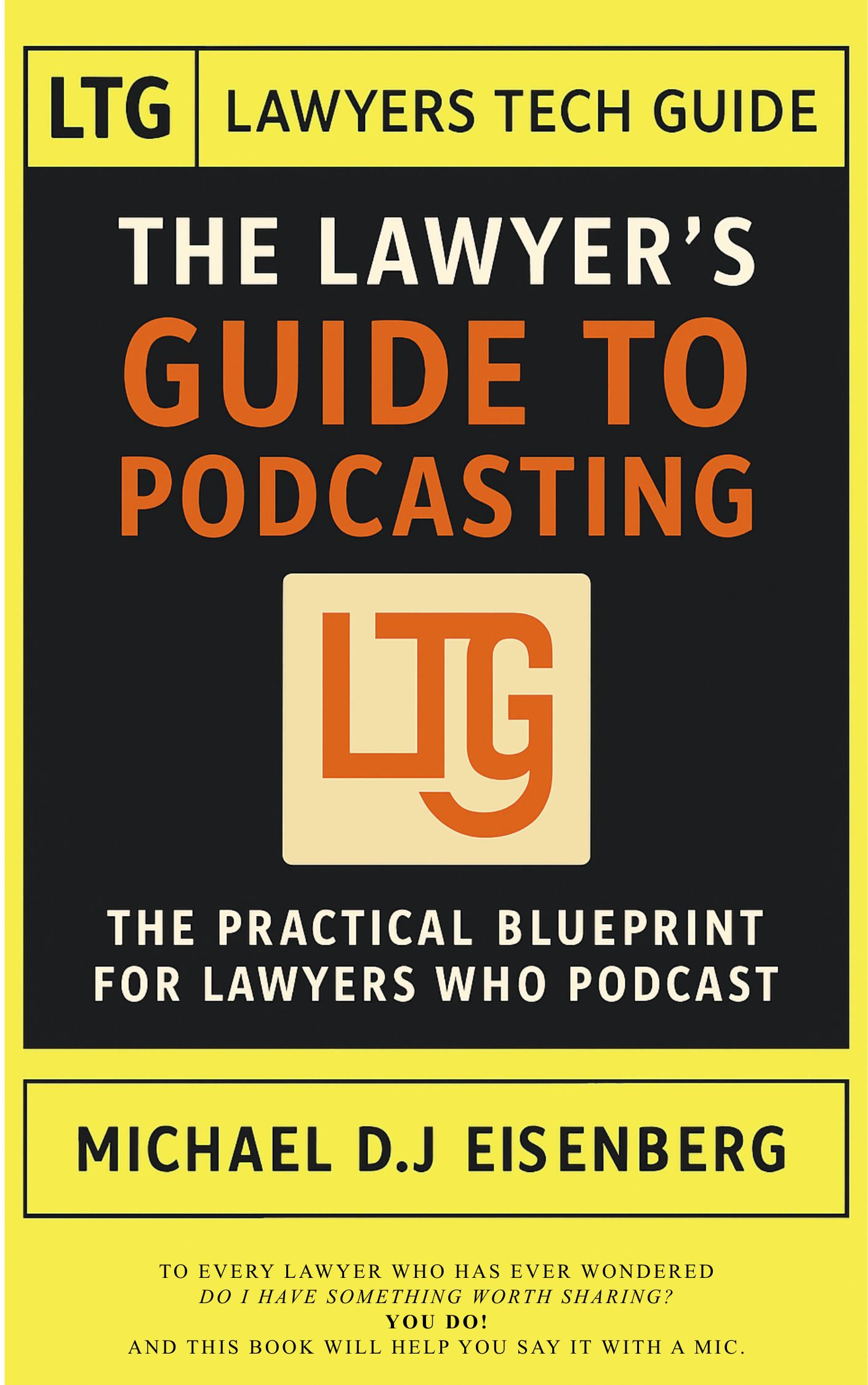
ANNOUNCEMENT (BOOK RELEASE): The Lawyer’s Guide to Podcasting: The Simple, Ethics-Aware Playbook to Launch a Professional Podcast (Release mid-January, 2026)

Anticipated release is mid-january 2026.

🎙️📘 Podcasting is still one of the fastest ways to build trust. It works for lawyers, legal professionals, and any expert who needs to explain complex topics in plain language.

On January 19, 2026, I’m releasing The Lawyer’s Guide to Podcasting. This book is designed for busy professionals who want a podcast that sounds credible, protects confidentiality, and fits into a real workflow. No studio required. No tech overwhelm.

✅ Inside the book, you’ll learn:

  • How to pick a podcast format that matches your goals 🎯

  • The “minimum viable setup” that sounds professional 🎤

  • Recording workflows that reduce editing time ⏱️

  • Practical ethics and risk habits for public content 🔐

  • Repurposing steps so one episode becomes a week of marketing ♻️

📩 Get the release link: Email Admin@TheTechSavvyLawyer.Page with the subject line “Podcasting Book Link” and I’ll send the link as soon as the book is released. 📩🎙️

MTC: 2025 Year in Review: The "AI Squeeze," Redaction Disasters, and the Return of Hardware!

As we close the book on 2025, the legal profession finds itself in a dramatically different landscape than the one we predicted back in January. If 2023 was the year of "AI Hype" and 2024 was the year of "AI Experimentation," 2025 has undeniably been the year of the "AI Reality Check."

Here at The Tech-Savvy Lawyer.Page, we have spent the last twelve months documenting the friction between rapid innovation and the stubborn realities of legal practice. From our podcast conversations with industry leaders like Seth Price and Chris Dralla to our deep dives into the ethics of digital practice, one theme has remained constant: Competence is no longer optional; it is survival.

Looking back at our coverage from this past year, three specific highlights stand out as defining moments for legal technology in 2025. These aren't just news items; they are signals of where our profession is heading.

Highlight #1: The "Black Box" Redaction Wake-Up Call

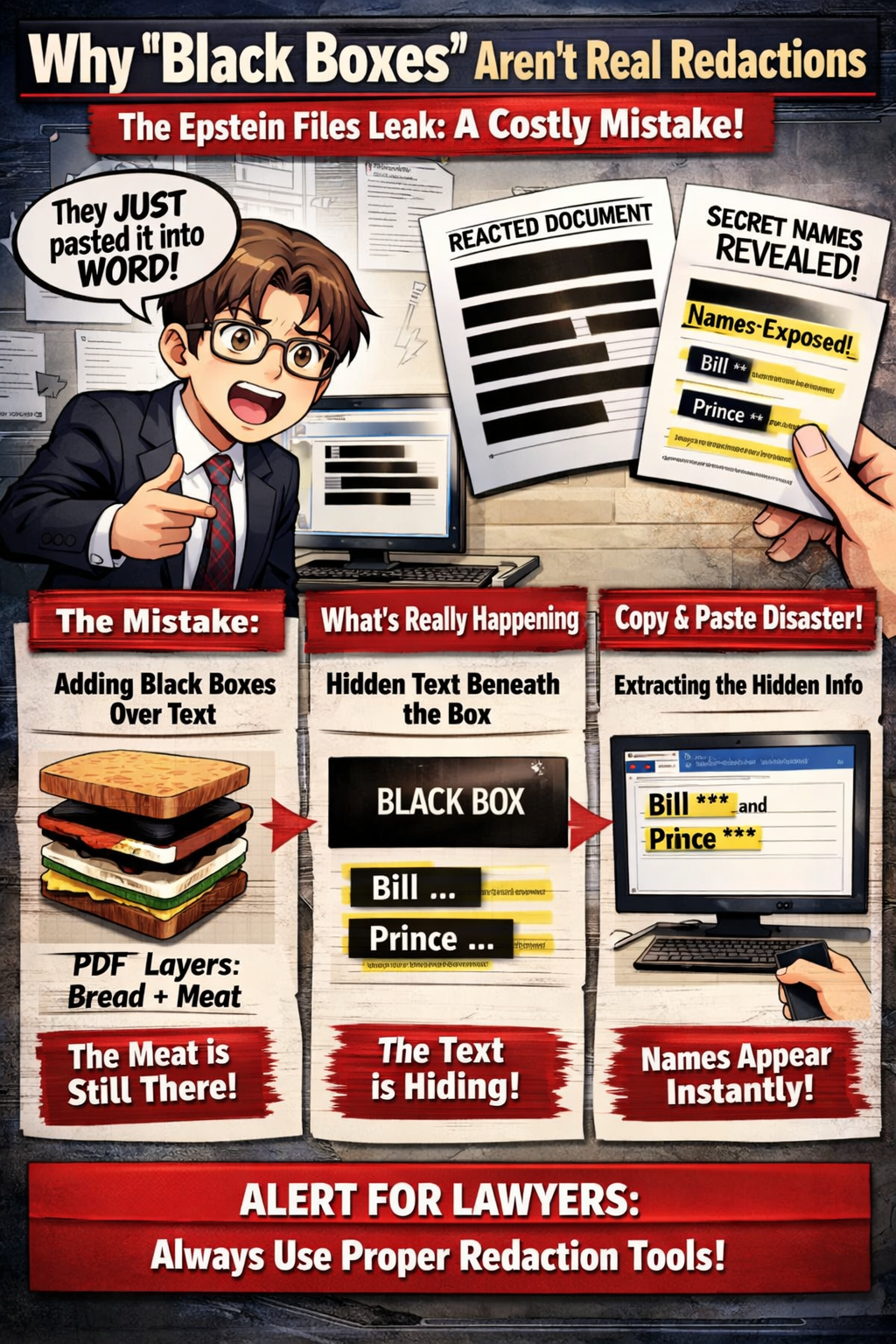
Just days ago, on December 23, 2025, the legal world learned of a catastrophic failure of basic technological competence. As we covered in our recent post, How To: Redact PDF Documents Properly and Recover Data from Failed Redactions: A Guide for Lawyers After the DOJ Epstein Files Release “Leak”, the Department of Justice’s release of the Jeffrey Epstein files became a case study in what not to do.

The failure was simple but devastating: relying on visual "masks" rather than true data sanitization. Tech-savvy readers—and let’s be honest, anyone with a basic knowledge of copy-paste—were able to lift the "redacted" names of associates and victims directly from the PDF.

Why this matters for you: This event shattered the illusion that "good enough" tech skills are acceptable in high-stakes litigation. In 2025, we learned that the duty of confidentiality (Model Rule 1.6) is inextricably linked to the duty of technical competence (Model Rule 1.1 and its Comment 8). As we move into 2026, firms must move beyond basic PDF tools and invest in purpose-built redaction software that "burns in" changes and scrubs metadata. If the DOJ can fail this publicly, your firm is not immune.

Highlight #2: The "AI Squeeze" on Hardware

Throughout the year, we’ve heard complaints about sluggish laptops and crashing applications. In our December 22nd post, The 2026 Hardware Hike: Why Law Firms Must Budget for the 'AI Squeeze' Now, we identified the culprit. It isn’t just your imagination—it’s the supply chain.

We are currently facing a global shortage of DRAM (Dynamic Random Access Memory), driven by the insatiable appetite of data centers powering the very AI models we use daily. Manufacturers like Dell and Lenovo are pivoting their supply to these high-profit enterprise clients, leaving consumer and business laptops with a supply deficit.

Why this matters for you: The era of the 16GB RAM laptop for lawyers is dead. Running local, privacy-focused AI models (a major trend in 2025) and heavy eDiscovery platforms now requires 32GB or even 64GB of RAM as a baseline (which means you may want more than the “baseline”). The "AI Squeeze" means that in 2026, hardware will be 15-20% more expensive and harder to find. The lesson? Buy now. If your firm has a hardware refresh cycle planned for Q2 2026, accelerate it to Q1. Budgeting for technology is no longer just about software subscriptions; it’s about securing the physical silicon needed to do your job.

Highlight #3: From "Chat" to "Doing" (The Rise of Agentic AI)

Earlier this year, on the Tech-Savvy Lawyer Podcast, we spoke with Chris Dralla of TypeLaw and discussed the evolution of AI tools. 2025 marked the shift from "Chatbot AI" (asking a bot a question) to "Agentic AI" (telling a bot to do a job).

Tools like TypeLaw didn't just "summarize" cases this year; they actively formatted briefs, checked citations against local court rules, and built tables of authorities with minimal human intervention. This is the "boring" automation we have always advocated for—technology that doesn't try to be a robot lawyer, but acts as a tireless paralegal.

Why this matters for you: The novelty of chatting with an LLM has worn off. The firms winning in 2025 were the ones adopting tools that integrated directly into Microsoft Word and Outlook to automate specific, repetitive workflows. The "Generalist AI" is being replaced by the "Specialist Agent."

Moving Forward: What We Can Learn Today for 2026

As we look toward the new year, the profession must internalize a critical lesson: Technology is a supply chain risk.

Whether it is the supply of affordable memory chips or the supply of secure software that properly handles redactions, you are dependent on your tools. The "Tech-Savvy" lawyer of 2026 is not just a user of technology but a manager of technology risk.

What to Expect in 2026:
Is your firm budgeted for the anticipated 2026 hardware price hike?

  1. The Rise of the "Hybrid Builder": I predict that mid-sized firms will stop waiting for vendors to build the perfect tool and start building their own "micro-apps" on top of secure, private AI models.

  2. Mandatory Tech Competence CLEs: rigorous enforcement of tech competence rules will likely follow the high-profile data breaches and redaction failures of 2025.

  3. The Death of the Billable Hour (Again?): With "Agentic AI" handling the grunt work of drafting and formatting, clients will aggressively push back on bills for "document review" or "formatting." 2026 will force firms to bill for judgment, not just time.

As we sign off for the last time in 2025, remember our motto: Technology should make us better lawyers, not lazier ones. Check your redactions, upgrade your RAM, and we’ll see you in 2026.

Happy Lawyering and Happy New Year!

🚨BOLO: Last-Minute Procurement Scams Targeting Firms on Christmas Eve🎄

It is Christmas Eve! The pressure to secure last-minute client gifts, finalize year-end office supply orders, or purchase personal items is at its peak. Scammers anticipate this desperation. They are currently flooding social media and search engines with "Out-of-Stock" Purchase Scams designed to exploit your urgency.

Whether you are ordering toner for year-end filings or a rush gift for a partner, the mechanism remains the same. You locate a vendor promising immediate delivery of a hard-to-find item. You purchase it. Minutes later, an email arrives claiming the item is "out of stock" due to holiday volume.

This notification is the trap. It promises an instant refund but requires you to click a link to "confirm" your details. This link does not lead to a payment processor; it leads to a credential-harvesting site. By trying to recoup your funds, you may inadvertently hand over firm credit card data or banking login credentials to a threat actor.

Immediate Risk Mitigation:

  • Verify the Vendor: If a deal appears for an item sold out everywhere else, it is likely a lure. Stick to established, major retailers today.

  • Isolate Transactions: Do not mix firm procurement with personal panic buying. Use a dedicated credit card for any new vendor.

  • Pause Before Clicking: If you receive a refund link, do not click it. Legitimate refunds happen automatically; they never require you to log in again.

Stay safe. Do not let a shipping deadline become a security breach. 🎄🔒

🎙️ Ep. #127: Mastering Legal Storytelling and AI Automation with Joshua Altman 🎙️⚖️

In Episode 127, I sit down with Joshua Altman, Managing Director of Beltway.Media, to decode the intersection of legal expertise and narrative strategy. 🏛️ We dive deep into the tech stack that powers a modern communications firm and explore how lawyers can leverage AI without losing their unique professional voice. Joshua shares actionable insights on using tools like Gumloop and Abacus.AI to automate workflows, the critical mistakes to avoid during high-stakes crisis management, and the real metrics you need to track to prove marketing ROI. 📊 Whether you are a solo practitioner or part of a large firm, this conversation bridges the gap between complex legal work and compelling public communication.

Join Joshua Altman and me as we discuss the following three questions and more!

  1. What are the top three technology tools or platforms you recommend that would help attorneys transform a single piece of thought leadership into multiple content formats across channels, and how can they use AI to accelerate this process without sacrificing their professional voice?

  2. What are the top three mistakes attorneys and law firms make when communicating during high-stakes situations—whether that’s managing negative publicity, navigating a client crisis, or pitching to potential investors—and how can technology help them avoid these pitfalls while maintaining their ethical obligations?

  3. What are the top three metrics for their online marketing technology investments that attorneys should actually be tracking to demonstrate return on investment, and what affordable technology solutions would you recommend to help them capture and analyze this data?

In our conversation, we cover the following:

  • [00:00] Introduction to Joshua Altman and Beltway.Media.

  • [01:06] Joshua’s current secure tech stack: From Mac setups to encrypted communications.

  • [03:52] Strategic content repurposing: Using AI as a tool, not a replacement for your voice.

  • [05:30] The "Human in the Loop" necessity: Why lawyers must proofread AI content.

  • [10:00] Tech Recommendation #1: using Abacus.AI and Root LLM for model routing.

  • [11:00] Tech Recommendation #2: Automating workflows with Gumloop.

  • [15:43] Tech Recommendation #3: The "Low Tech" solution of human editors.

  • [16:47] Crisis Communications: Navigating the Court of Public Opinion vs. the Court of Law.

  • [20:00] Using social listening tools for litigation support and witness tracking.

  • [24:30] Metric #1: Analyzing Meaningful Engagement (comments vs. likes).

  • [26:40] Metric #2: Understanding Impressions and network reach (1st vs. 2nd degree).

  • [28:40] Metric #3: Tracking Clicks to validate interest and sales funnels.

  • [31:15] How to connect with Joshua.

RESOURCES:

Connect with Joshua Altman

Mentioned in the episode

Hardware mentioned in the conversation

Software & Cloud Services mentioned in the conversation

  • Abacus.AI - AI platform mentioned for its "Root LLM" model routing feature.

  • ChatGPT - AI language model.

  • Claude - AI language model.

  • Constant Contact - Email marketing platform.

  • Gumloop - AI automation platform for newsletters and social listening.

  • LinkedIn - Professional social networking.

  • MailChimp - Email marketing platform.

  • Proton Mail - Encrypted email service.

  • Tresorit - End-to-end encrypted file sharing (secure Dropbox alternative).

MTC: The 2026 Hardware Hike: Why Law Firms Must Budget for the "AI Squeeze" Now!

Lawyers need to be ready for $prices$ in tech to go up next year due to increased AI use!

A perfect storm is brewing in the hardware market. It will hit law firm budgets harder than expected in 2026. Reports from December 2025 confirm that major manufacturers like Dell, Lenovo, and HP are preparing to raise PC and laptop prices by 15% to 20% early next year. The catalyst is a global shortage of DRAM (Dynamic Random Access Memory). This shortage is driven by the insatiable appetite of AI servers.

While recent headlines note that giants like Apple and Samsung have the supply chain power to weather this surge, the average law firm does not. This creates a critical strategic challenge for managing partners and legal administrators.

The timing is unfortunate. Legal professionals are adopting AI tools at a record pace. Tools for eDiscovery, contract analysis, and generative drafting require significant computing power to run smoothly. In 2024, a laptop with 16GB of RAM was standard. Today, running local privacy-focused AI models or heavy eDiscovery platforms makes 32GB the new baseline. 64GB is becoming the standard for power users.

Don’t just meet today’s AI demands—exceed them. Upgrade to 32GB or 64GB of RAM now, not later. AI adoption in legal practice is accelerating exponentially. The memory you think is “enough” today will be the bottleneck tomorrow. Firms that overspec their hardware now will avoid costly mid-cycle replacements and gain a competitive edge in speed and efficiency.
— 💡 PRO TIP: Future-Proof Your Firm's Hardware Now

We face a paradox. We need more memory to remain competitive, but that memory is becoming scarce and expensive. The "AI Squeeze" is real. Chipmakers are prioritizing high-profit memory for data center AI over the standard memory used in law firm laptops. This supply shift drives up the bill of materials for every new workstation (low end when you compare them “high-profit memory data centers) you plan to buy.

Update your firm’s tech budget for 2026 by prioritizing ram for your next technology upgrade.

Law firms should act immediately. First, audit your hardware refresh cycles. If you planned to upgrade machines in Q1 or Q2 of 2026, accelerate those purchases to the current quarter. You could save 20% per unit by buying before the price hikes take full effect.

Second, adjust your 2026 technology budget. A flat budget will buy you less power next year. You cannot afford to downgrade specifications. Buying underpowered laptops will frustrate fee earners and throttle the efficiency gains you expect from your AI investments.

Finally, prioritize RAM over storage. Cloud storage is cheap and abundant. Memory is not. When configuring new machines, allocate your budget to 32GB or 64GB (or more) of RAM rather than a larger hard drive.

The hardware market is shifting. The cost of innovation is rising. Smart firms will plan for this reality today rather than paying the premium tomorrow.

🧪🎧 TSL Labs Bonus Podcast: Open vs. Closed AI — The Hidden Liability Trap in Your Firm ⚖️🤖

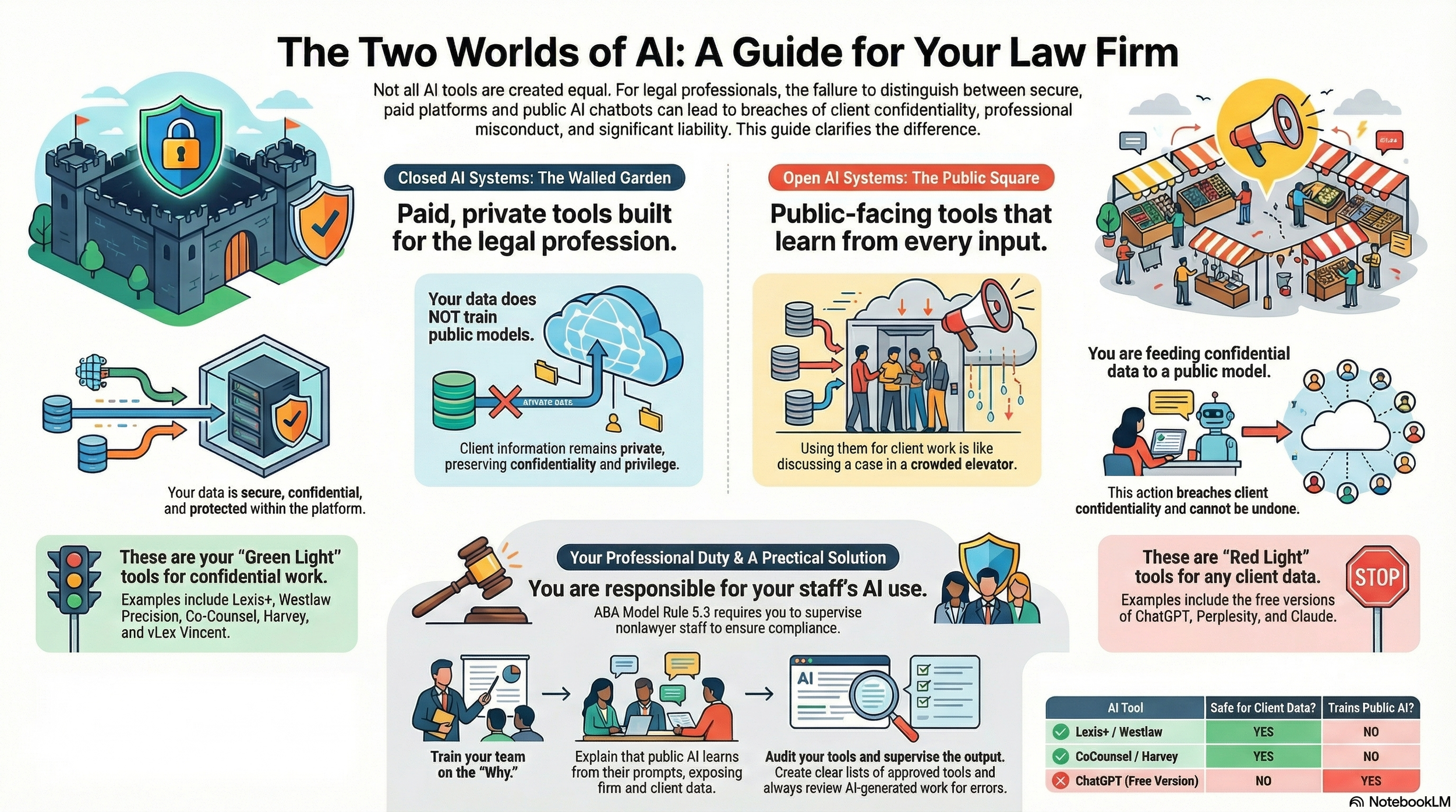
Welcome to TSL Labs Podcast Experiment. 🧪🎧 In this special "Deep Dive" bonus episode, we strip away the hype surrounding Generative AI to expose a critical operational risk hiding in plain sight: the dangerous confusion between "Open" and "Closed" AI systems.

Featuring an engaging discussion between our Google Notebook AI hosts, this episode unpacks the "Swiss Army Knife vs. Scalpel" analogy that every managing partner needs to understand. We explore why the "Green Light" tools you pay for are fundamentally different from the "Red Light" public models your staff might be using—and why treating them the same could trigger an immediate breach of ABA Model Rule 5.3. From the "hidden crisis" of AI embedded in Microsoft 365 to the non-negotiable duty to supervise, this is the essential briefing for protecting client confidentiality in the age of algorithms.

In our conversation, we cover the following:

  • [00:00] – Introduction: The hidden danger of AI in law firms.

  • [01:00] – The "AI Gap": Why staff confuse efficiency with confidentiality.

  • [02:00] – The Green Light Zone: Defining secure, "Closed" AI systems (The Scalpel).

  • [03:45] – The Red Light Zone: Understanding "Open" Public LLMs (The Swiss Army Knife).

  • [04:45] – "Feeding the Beast": How public queries actively train the model for everyone else.

  • [05:45]The Duty to Supervise: ABA Model Rules 5.3 and 1.1[8] implications.

  • [07:00] – The Hidden Crisis: AI embedded in ubiquitous tools (Microsoft 365, Adobe, Zoom).

  • [09:00] – The Training Gap: Why digital natives assume all prompt boxes are safe.

  • [10:00] – Actionable Solutions: Auditing tools and the "Elevator vs. Private Room" analogy.

  • [12:00] – Hallucinations: Vendor liability vs. Professional negligence.

  • [14:00] – Conclusion: The final provocative thought on accidental breaches.

RESOURCES

Mentioned in the episode

Software & Cloud Services mentioned in the conversation

MTC (Bonus): National Court Technology Rules: Finding Balance Between Guidance and Flexibility ⚖️

Standardizing Tech Guidelines in the Legal System

Lawyers and their staff needs to know the standard and local rules of AI USe in the courtroom - their license could depend on it.

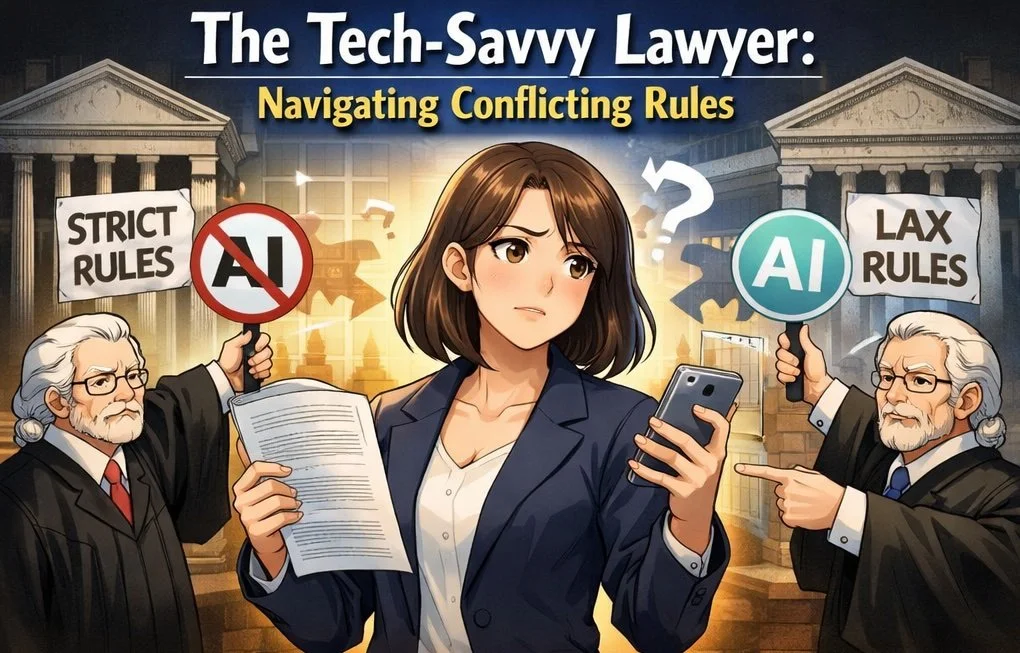
The legal profession stands at a critical juncture where technological capability has far outpaced judicial guidance. Nicole Black's recent commentary on the fragmented approach to technology regulation in our courts identifies a genuine problem—one that demands serious consideration from both proponents of modernization and cautious skeptics alike.

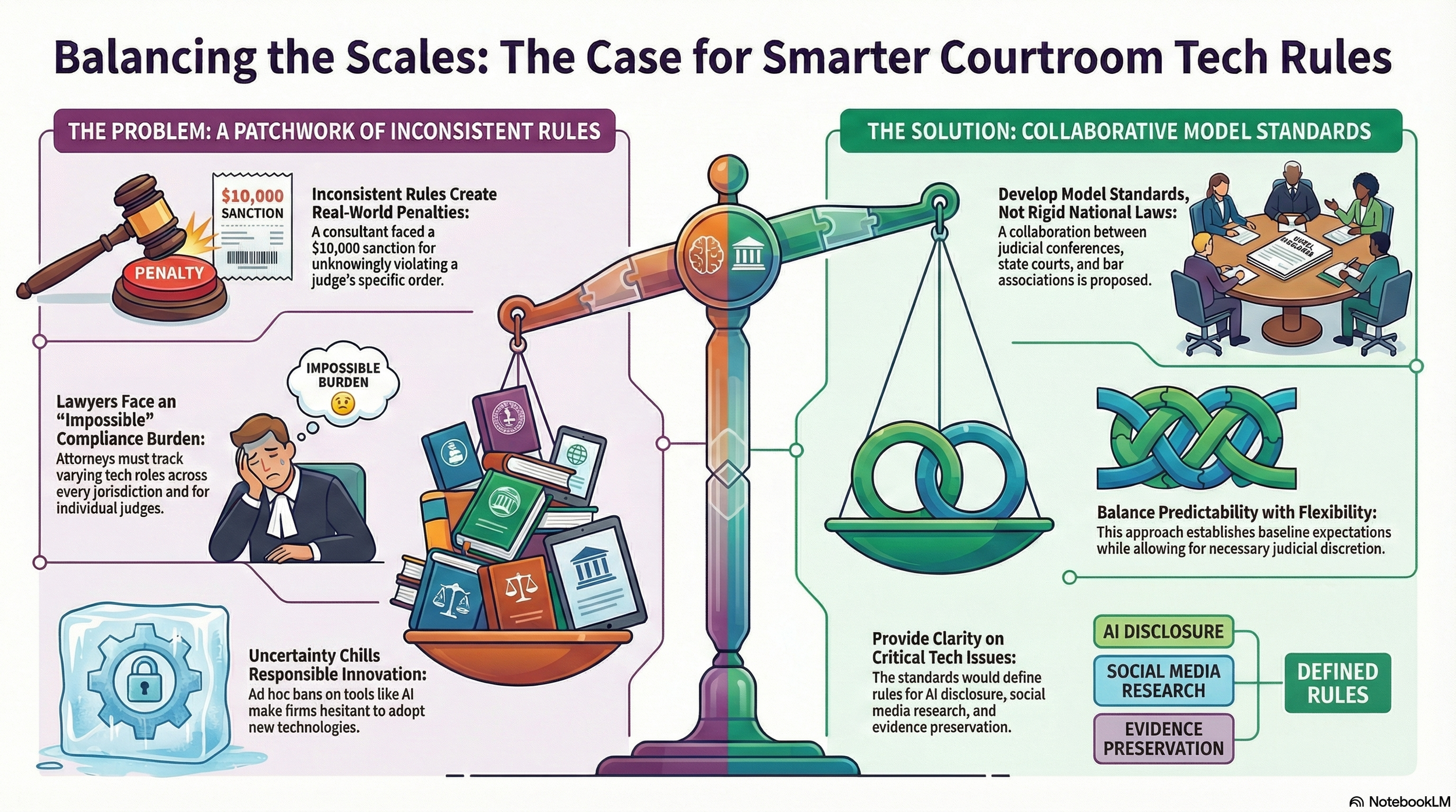
The core tension is understandable. Courts face legitimate concerns about technology misuse. The LinkedIn juror research incident in Judge Orrick's courtroom illustrates real risks: a consultant unknowingly violated a standing order, resulting in a $10,000 sanction despite the attorney's good-faith disclosure and remedial efforts. These aren't theoretical concerns—they reflect actual ethical boundaries that protect litigants and preserve judicial integrity. Yet the response to these concerns has created its own problems.

The current patchwork system places practicing attorneys in an impossible position. A lawyer handling cases across multiple federal districts cannot reasonably track the varying restrictions on artificial intelligence disclosure, social media evidence protocols, and digital research methodologies. When the safe harbor is simply avoiding technology altogether, the profession loses genuine opportunities to enhance accuracy and efficiency. Generative AI's citation hallucinations justify judicial scrutiny, but the ad hoc response by individual judges—ranging from simple guidance to outright bans—creates unpredictability that chills responsible innovation.

SHould there be an international standard for ai use in the courtroom

There are legitimate reasons to resist uniform national rules. Local courts understand their communities and case management needs better than distant regulatory bodies. A one-size-fits-all approach might impose burdensome requirements on rural jurisdictions with fewer tech-savvy practitioners. Furthermore, rapid technological evolution could render national rules obsolete within months, whereas individual judges retain flexibility to respond quickly to emerging problems.

Conversely, the current decentralized approach creates serious friction. The 2006 amendments to Federal Rules of Civil Procedure for electronically stored information succeeded partly because they established predictability across jurisdictions. Lawyers knew what preservation obligations applied regardless of venue. That uniformity enabled the profession to invest in training, software, and processes. Today's lawyers lack that certainty. Practitioners must maintain contact lists tracking individual judge orders, and smaller firms simply cannot sustain this administrative burden.

The answer likely lies between extremes. Rather than comprehensive national legislation, the profession would benefit from model standards developed collaboratively by the Federal Judicial Conference, state supreme courts, and bar associations. These guidelines could allow reasonable judicial discretion while establishing baseline expectations—defining when AI disclosure is mandatory, clarifying which social media research constitutes impermissible contact, and specifying preservation protocols that protect evidence without paralyzing litigation.

Such an approach acknowledges both legitimate judicial concerns and legitimate professional needs. It recognizes that judges require authority to protect courtroom procedures while recognizing that lawyers require predictability to serve clients effectively.

I basically agree with Nicole: The question is not whether courts should govern technology use. They must. The question is whether they govern wisely—with sufficient uniformity to enable compliance, sufficient flexibility to address local concerns, and sufficient clarity to encourage rather than discourage responsible innovation.

📖 WORD OF THE WEEK (WoW): Zero Trust Architecture ⚖️🔐

Zero Trust Architecture and ABA Model Rules Compliance 🛡️

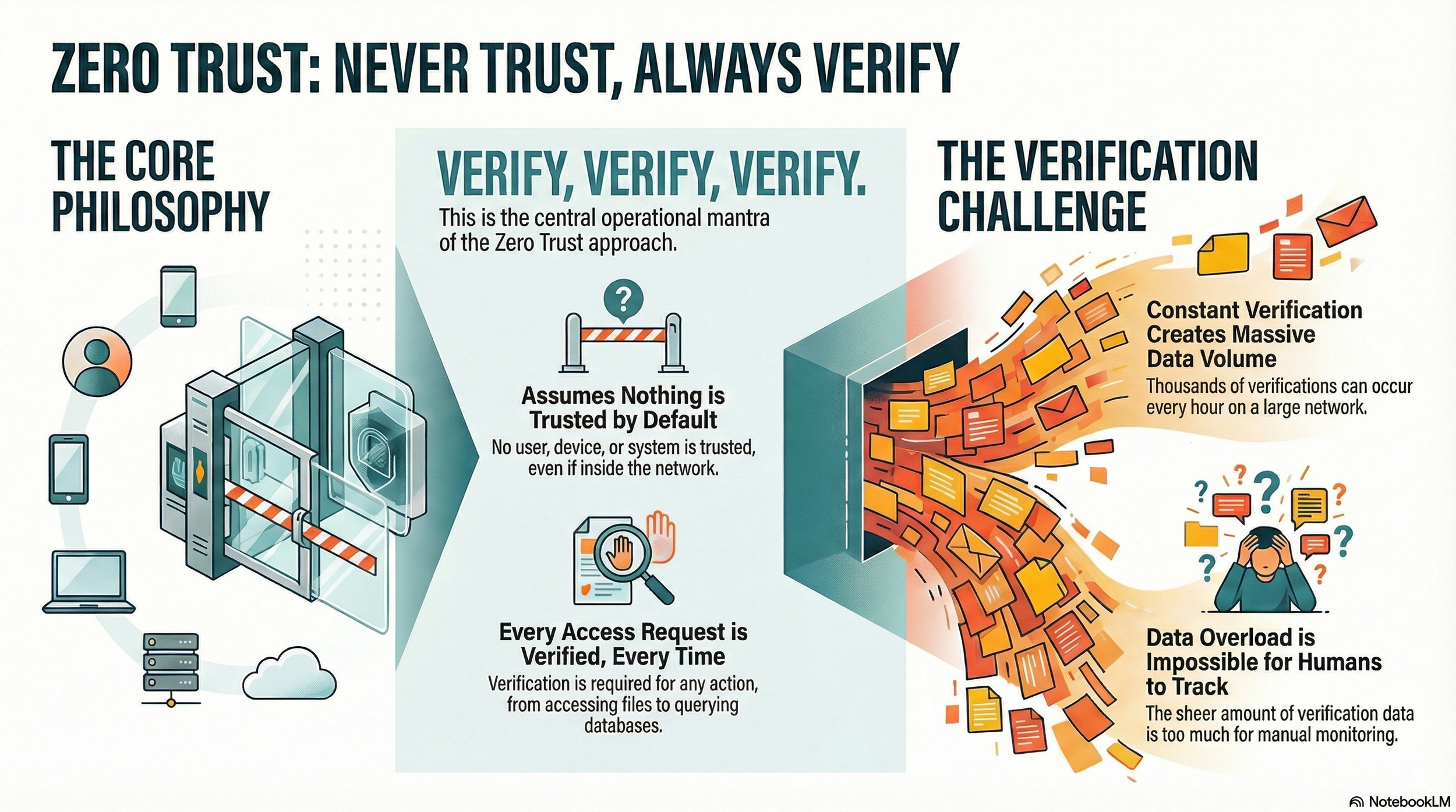
Lawyers need to "never trust, always verify" their network activity!

Zero Trust Architecture represents a fundamental shift in how law firms approach cybersecurity and fulfill ethical obligations. Rather than assuming that users and devices within a firm's network are trustworthy by default, this security model operates on the principle of "never trust, always verify." For legal professionals managing sensitive client information, implementing this framework has become essential to protecting confidentiality while maintaining compliance with ABA Model Rules.

The traditional security approach created a protective perimeter around a firm's network, trusting anyone inside that boundary. This model no longer reflects modern legal practice. Remote work, cloud-based case management systems, and mobile device usage mean that your firm's data exists across multiple locations and devices. Zero Trust abandons the perimeter-based approach entirely.

ABA Model Rule 1.6(c) requires lawyers to "make reasonable efforts to prevent the inadvertent or unauthorized disclosure of, or unauthorized access to, information relating to the representation of a client." Zero Trust Architecture directly fulfills this mandate by requiring continuous verification of every user and device accessing firm resources, regardless of location. This approach ensures compliance with the confidentiality duty that forms the foundation of legal practice.

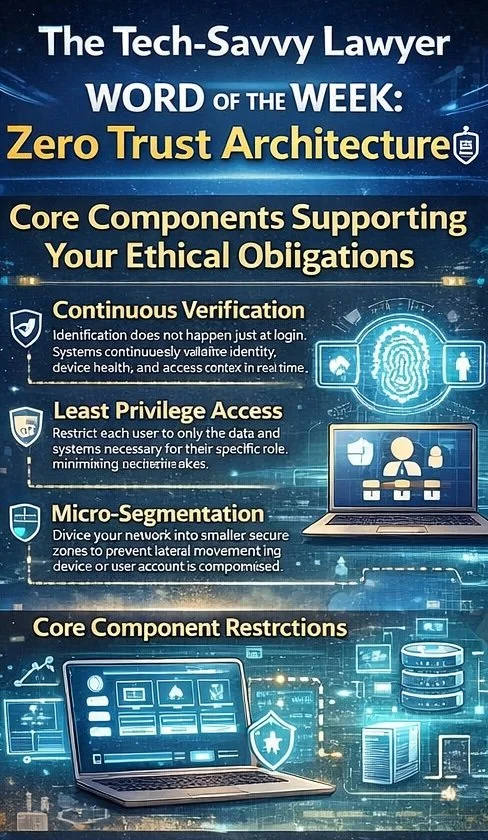
Core Components Supporting Your Ethical Obligations

Zero Trust Architecture operates through three interconnected principles aligned with ABA requirements.

legal professionals do you know the core components of modern cyber security?

  • Continuous verification means that authentication does not happen once at login. Instead, systems continuously validate user identity, device health, and access context in real time.

  • Least privilege access restricts each user to only the data and systems necessary for their specific role. An associate working on discovery does not need access to billing systems, and a paralegal in real estate does not need access to litigation files.

  • Micro-segmentation divides your network into smaller, secure zones. This prevents lateral movement, which means that if a bad actor compromises one device or user account, they cannot automatically access all firm systems.

ABA Model Rule 1.1, Comment 8 requires that lawyers maintain competence, including competence in "the benefits and risks associated with relevant technology." Understanding Zero Trust Architecture demonstrates that your firm maintains technological competence in cybersecurity matters. Additional critical components include multi-factor authentication, which requires users to verify their identity through multiple methods before accessing systems. Device authentication ensures that only approved and properly configured devices can connect to firm resources. End-to-end encryption protects data both at rest and in transit.

ABA Model Rule 1.4 requires lawyers to keep clients "reasonably informed about significant developments relating to the representation." Zero Trust Architecture supports this duty by protecting client information and enabling prompt client notification if security incidents occur.

ABA Model Rules 5.1 and 5.3 require supervisory lawyers and managers to ensure that subordinate lawyers and non-lawyer staff comply with professional obligations. Implementing Zero Trust creates the framework for effective supervision of cybersecurity practices across your entire firm.

Addressing Safekeeping Obligations

ABA Model Rule 1.15 requires lawyers to "appropriately safeguard" property of clients, including electronic information. Zero Trust Architecture provides the security infrastructure necessary to meet this safekeeping obligation. This rule mandates maintaining complete records of client property and preserving those records. Zero Trust's encryption and access controls ensure that stored records remain protected from unauthorized access.

Implementation: A Phased Approach 📋

Implementing Zero Trust need not happen all at once. Begin by assessing your current security infrastructure and identifying sensitive data flows. Establish identity and access management systems to control who accesses what. Deploy multi-factor authentication across all applications. Then gradually expand micro-segmentation and monitoring capabilities as your systems mature. Document your efforts to demonstrate compliance with ABA Model Rule 1.6(c)'s requirement for "reasonable efforts."

Final Thoughts

Zero Trust Architecture transforms your firm's security posture from reactive protection to proactive verification while ensuring compliance with essential ABA Model Rules. For legal practices handling confidential client information, this security framework is not optional. It protects your clients, your firm's reputation, and your ability to practice law with integrity.