Word of the Week: "Constitutional AI" for Lawyers - What It Is, Why It Matters for ABA Rules, and How Solo & Small Firms Should Use It!

Constitutional AI’s ‘helpful, harmless, honest’ standard is a solid starting point for lawyers evaluating AI platforms.

The term “Constitutional AI” appeared this week in a Tech Savvy Lawyer post about the MTC/PornHub breach as a cybersecurity wake‑up call for lawyers 🚨. That article used it to highlight how AI systems (like those law firms now rely on) must be built and governed by clear, ethical rules — much like a constitution — to protect client data and uphold professional duties. This week’s Word of the Week unpacks what Constitutional AI really means and explains why it matters deeply for solo, small, and mid‑size law firms.

🔍 What is Constitutional AI?

Constitutional AI is a method for training large language models so they follow a written set of high‑level principles, called a “constitution” 📜. Those principles are designed to make the AI helpful, honest, and harmless in its responses.

As Claude AI from Anthropic explains:
“Constitutional AI refers to a set of techniques developed by researchers at Anthropic to align AI systems like myself with human values and make us helpful, harmless, and honest. The key ideas behind Constitutional AI are aligning an AI’s behavior with a ‘constitution’ defined by human principles, using techniques like self‑supervision and adversarial training, developing constrained optimization techniques, and designing training data and model architecture to encode beneficial behaviors.” — Claude AI, Anthropic (July 7th, 2023).

In practice, Constitutional AI uses the model itself to critique and revise its own outputs against that constitution. For example, the model might be told: “Do not generate illegal, dangerous, or unethical content,” “Be honest about what you don’t know,” and “Protect user privacy.” It then evaluates its own answers against those rules before giving a final response.

Think of it like a junior associate who’s been given a firm’s internal ethics manual and told: “Before you send that memo, check it against these rules.” Constitutional AI does that same kind of self‑checking, but at machine speed.

🤝 How Constitutional AI Relates to Lawyers

For lawyers, Constitutional AI is important because it directly shapes how AI tools behave when handling legal work 📚. Many legal AI tools are built on models that use Constitutional AI techniques, so understanding this concept helps lawyers:

  • Judge whether an AI assistant is likely to hallucinate, leak sensitive info, or give ethically problematic advice.

  • Choose tools whose underlying AI is designed to be more transparent, less biased, and more aligned with professional norms.

  • Better supervise AI use in the firm, which is a core ethical duty under the ABA Model Rules.

Solo and small firms, in particular, often rely on off‑the‑shelf AI tools (like chatbots or document assistants). Knowing that a tool is built on Constitutional AI principles can give more confidence that it’s designed to avoid harmful outputs and respect confidentiality.

⚖️ Why It Matters for ABA Model Rules
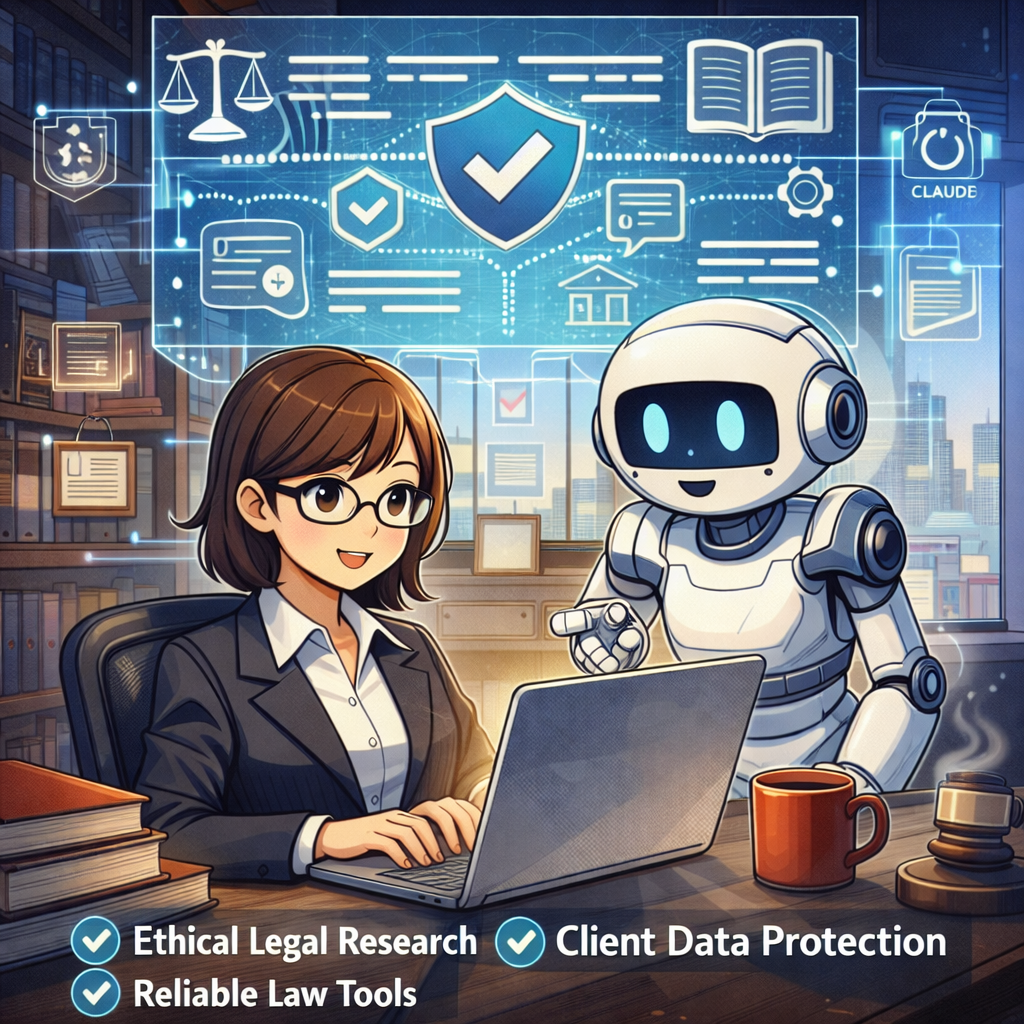
For solo and small firms, asking whether an AI platform aligns with Constitutional AI’s standards is a practical first step in choosing a trustworthy tool.

The ABA’s Formal Opinion 512 on generative AI makes clear that lawyers remain responsible for all work done with AI, even if an AI tool helped draft it 📝. Constitutional AI is relevant here because it’s one way that AI developers try to build in ethical guardrails that align with lawyers' obligations.

Key connections to the Model Rules:

  • Rule 1.1 (Competence): Lawyers must understand the benefits and risks of the technology they use. Knowing that a tool uses Constitutional AI helps assess whether it’s reasonably reliable for tasks like research, drafting, or summarizing.

  • Rule 1.6 (Confidentiality): Constitutional AI models are designed to refuse to disclose sensitive information and to avoid memorizing or leaking private data. This supports the lawyer’s duty to make “reasonable efforts” to protect client confidences.

  • Rule 5.1 / 5.3 (Supervision): Managing partners and supervising attorneys must ensure that AI tools used by staff are consistent with ethical rules. A tool built on Constitutional AI principles is more likely to support, rather than undermine, those supervisory duties.

  • Rule 3.3 (Candor to the Tribunal): Constitutional AI models are trained to admit uncertainty and avoid fabricating facts or cases, which helps reduce the risk of submitting false or misleading information to a court.

In short, Constitutional AI doesn’t relieve lawyers of their ethical duties, but it can make AI tools safer and more trustworthy when used under proper supervision.

🛡️ The “Helpful, Harmless, and Honest” Principle

The three pillars of Constitutional AI — helpful, harmless, and honest — are especially relevant for lawyers:

  • Helpful: The AI should provide useful, relevant information that advances the client’s matter, without unnecessary or irrelevant content.

  • Harmless: The AI should avoid generating illegal, dangerous, or unethical content, and should respect privacy and confidentiality.

  • Honest: The AI should admit when it doesn’t know something, avoid fabricating facts or cases, and not misrepresent its capabilities.

For law firms, this “helpful, harmless, and honest” standard is a useful mental checklist when using AI:

  • Is this AI output actually helpful to the client’s case?

  • Could this output harm the client (e.g., by leaking confidential info or suggesting an unethical strategy)?

  • Is the AI being honest (e.g., not hallucinating case law or pretending to know facts it can’t know)?

If the answer to any of those questions is “no,” the AI output should not be used without significant human review and correction.

🛠️ Practical Takeaways for Law Firms

For solo, small, and mid‑size firms, here’s how to put this into practice:

Lawyers need to screen AI tools and ensure they are aligned with ABA Model Rules.

  1. Know your tools. When evaluating a legal AI product, ask whether it’s built on a Constitutional AI–style model (e.g., Claude). That tells you it’s designed with explicit ethical constraints.

  2. Treat AI as a supervised assistant. Never let AI make final decisions or file work without a lawyer’s review. Constitutional AI reduces risk, but it doesn’t eliminate the need for human judgment.

  3. Train your team. Make sure everyone in the firm understands that AI outputs must be checked for accuracy, confidentiality, and ethical compliance — especially when using third‑party tools.

  4. Update your engagement letters and policies. Disclose to clients when AI is used in their matters, and explain how the firm supervises it. This supports transparency under Rule 1.4 and Rule 1.6.

  5. Focus on “helpful, honest, harmless.” Use Constitutional AI as a mental checklist: Is this AI being helpful to the client? Is it honest about its limits? Is it harmless (no bias, no privacy leaks)? If not, don’t rely on it.


MTC: The 2026 Hardware Hike: Why Law Firms Must Budget for the "AI Squeeze" Now!

Lawyers need to be ready for $prices$ in tech to go up next year due to increased AI use!

A perfect storm is brewing in the hardware market. It will hit law firm budgets harder than expected in 2026. Reports from December 2025 confirm that major manufacturers like Dell, Lenovo, and HP are preparing to raise PC and laptop prices by 15% to 20% early next year. The catalyst is a global shortage of DRAM (Dynamic Random Access Memory). This shortage is driven by the insatiable appetite of AI servers.

While recent headlines note that giants like Apple and Samsung have the supply chain power to weather this surge, the average law firm does not. This creates a critical strategic challenge for managing partners and legal administrators.

The timing is unfortunate. Legal professionals are adopting AI tools at a record pace. Tools for eDiscovery, contract analysis, and generative drafting require significant computing power to run smoothly. In 2024, a laptop with 16GB of RAM was standard. Today, running local privacy-focused AI models or heavy eDiscovery platforms makes 32GB the new baseline. 64GB is becoming the standard for power users.

“Don’t just meet today’s AI demands—exceed them. Upgrade to 32GB or 64GB of RAM now, not later. AI adoption in legal practice is accelerating exponentially. The memory you think is “enough” today will be the bottleneck tomorrow. Firms that overspec their hardware now will avoid costly mid-cycle replacements and gain a competitive edge in speed and efficiency.”
— 💡 PRO TIP: Future-Proof Your Firm's Hardware Now

We face a paradox. We need more memory to remain competitive, but that memory is becoming scarce and expensive. The "AI Squeeze" is real. Chipmakers are prioritizing high-profit memory for data center AI over the standard memory used in law firm laptops. This supply shift drives up the bill of materials for every new workstation (low end when you compare them “high-profit memory data centers) you plan to buy.

Update your firm’s tech budget for 2026 by prioritizing ram for your next technology upgrade.

Law firms should act immediately. First, audit your hardware refresh cycles. If you planned to upgrade machines in Q1 or Q2 of 2026, accelerate those purchases to the current quarter. You could save 20% per unit by buying before the price hikes take full effect.

Second, adjust your 2026 technology budget. A flat budget will buy you less power next year. You cannot afford to downgrade specifications. Buying underpowered laptops will frustrate fee earners and throttle the efficiency gains you expect from your AI investments.

Finally, prioritize RAM over storage. Cloud storage is cheap and abundant. Memory is not. When configuring new machines, allocate your budget to 32GB or 64GB (or more) of RAM rather than a larger hard drive.

The hardware market is shifting. The cost of innovation is rising. Smart firms will plan for this reality today rather than paying the premium tomorrow.

🧪🎧 TSL Labs Bonus Podcast: Open vs. Closed AI — The Hidden Liability Trap in Your Firm ⚖️🤖

Welcome to TSL Labs Podcast Experiment. 🧪🎧 In this special "Deep Dive" bonus episode, we strip away the hype surrounding Generative AI to expose a critical operational risk hiding in plain sight: the dangerous confusion between "Open" and "Closed" AI systems.

Featuring an engaging discussion between our Google Notebook AI hosts, this episode unpacks the "Swiss Army Knife vs. Scalpel" analogy that every managing partner needs to understand. We explore why the "Green Light" tools you pay for are fundamentally different from the "Red Light" public models your staff might be using—and why treating them the same could trigger an immediate breach of ABA Model Rule 5.3. From the "hidden crisis" of AI embedded in Microsoft 365 to the non-negotiable duty to supervise, this is the essential briefing for protecting client confidentiality in the age of algorithms.

In our conversation, we cover the following:

  • [00:00] – Introduction: The hidden danger of AI in law firms.

  • [01:00] – The "AI Gap": Why staff confuse efficiency with confidentiality.

  • [02:00] – The Green Light Zone: Defining secure, "Closed" AI systems (The Scalpel).

  • [03:45] – The Red Light Zone: Understanding "Open" Public LLMs (The Swiss Army Knife).

  • [04:45] – "Feeding the Beast": How public queries actively train the model for everyone else.

  • [05:45] – The Duty to Supervise: ABA Model Rules 5.3 and 1.1[8] implications.

  • [07:00] – The Hidden Crisis: AI embedded in ubiquitous tools (Microsoft 365, Adobe, Zoom).

  • [09:00] – The Training Gap: Why digital natives assume all prompt boxes are safe.

  • [10:00] – Actionable Solutions: Auditing tools and the "Elevator vs. Private Room" analogy.

  • [12:00] – Hallucinations: Vendor liability vs. Professional negligence.

  • [14:00] – Conclusion: The final provocative thought on accidental breaches.

RESOURCES

Mentioned in the episode

Software & Cloud Services mentioned in the conversation

MTC: The Hidden Danger in Your Firm: Why We Must Teach the Difference Between “Open” and “Closed” AI!

Does your staff understand the difference between “free” and “paid” aI? Your license could depend on it!

I sit on an advisory board for a school that trains paralegals. We meet to discuss curriculum. We talk about the future of legal support. In a recent meeting, a presentation by a private legal research company caught my attention. It stopped me cold. The topic was Artificial Intelligence. The focus was on use and efficiency. But something critical was missing.

The lesson did not distinguish between public-facing and private tools. It treated AI as a monolith. This is a dangerous oversimplification. It is a liability waiting to happen.

We are in a new era of legal technology. It is exciting. It is also perilous. The peril comes from confusion. Specifically, the confusion between paid, closed-system legal research tools and public-facing generative AI.

Your paralegals, law clerks, and staff use these tools. They use them to draft emails. They use them to summarize depositions. Do they know where that data goes? Do you?

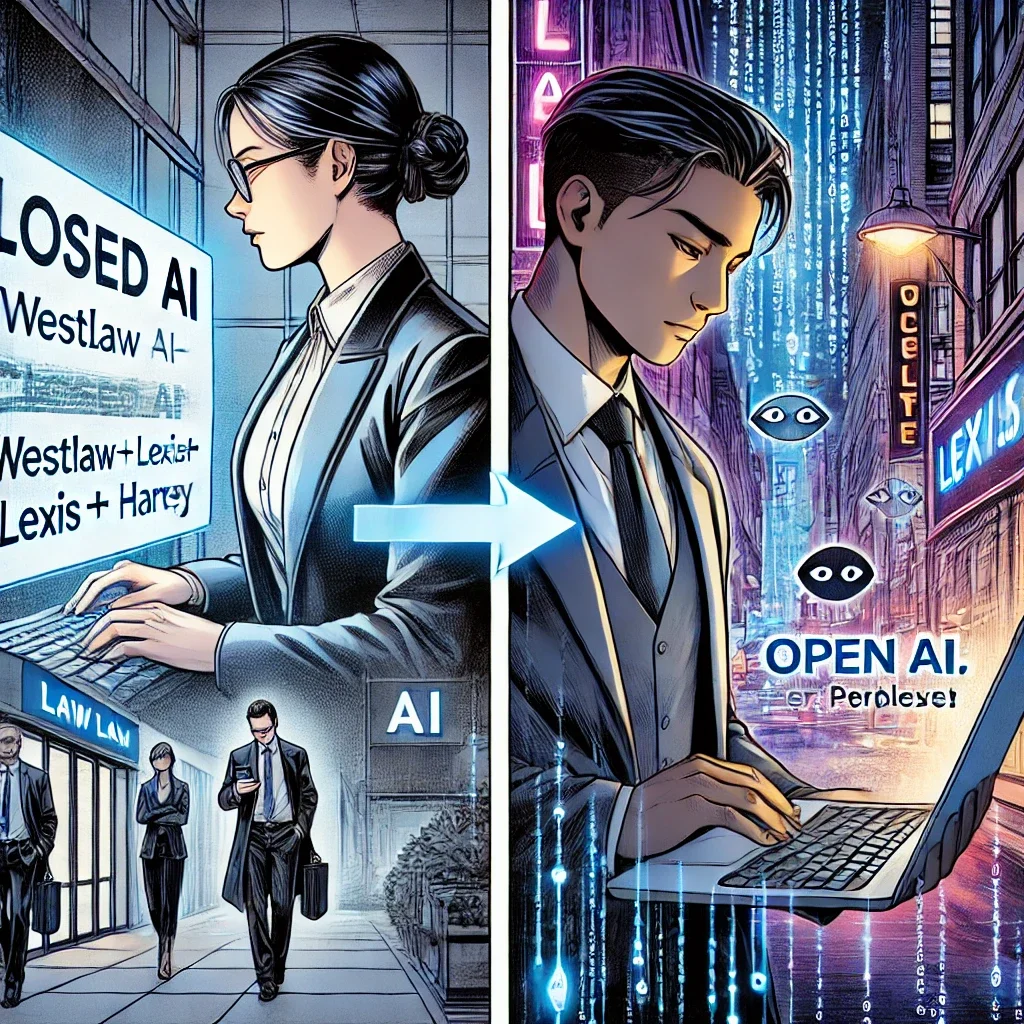
The Two Worlds of AI

There are two distinct worlds of AI in our profession.

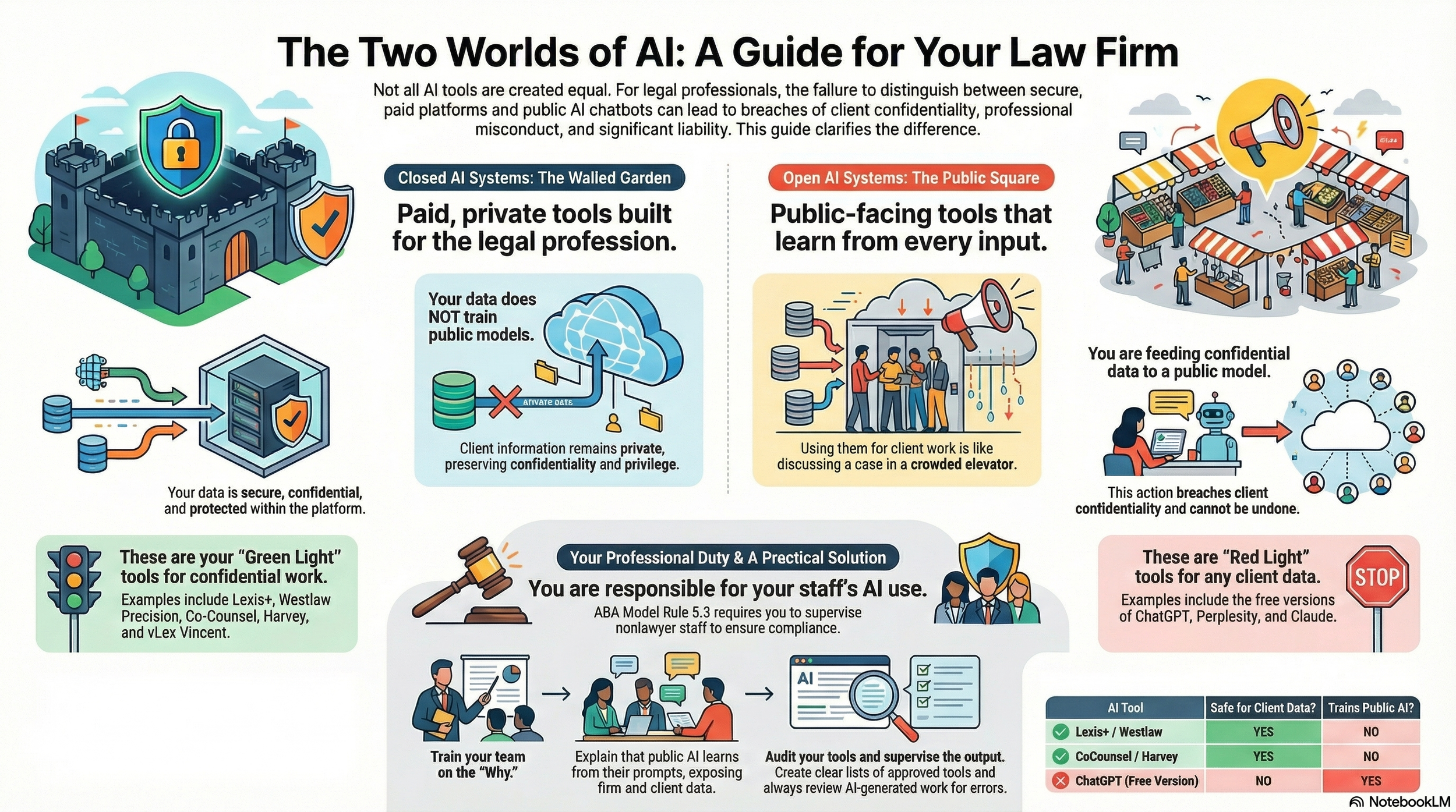
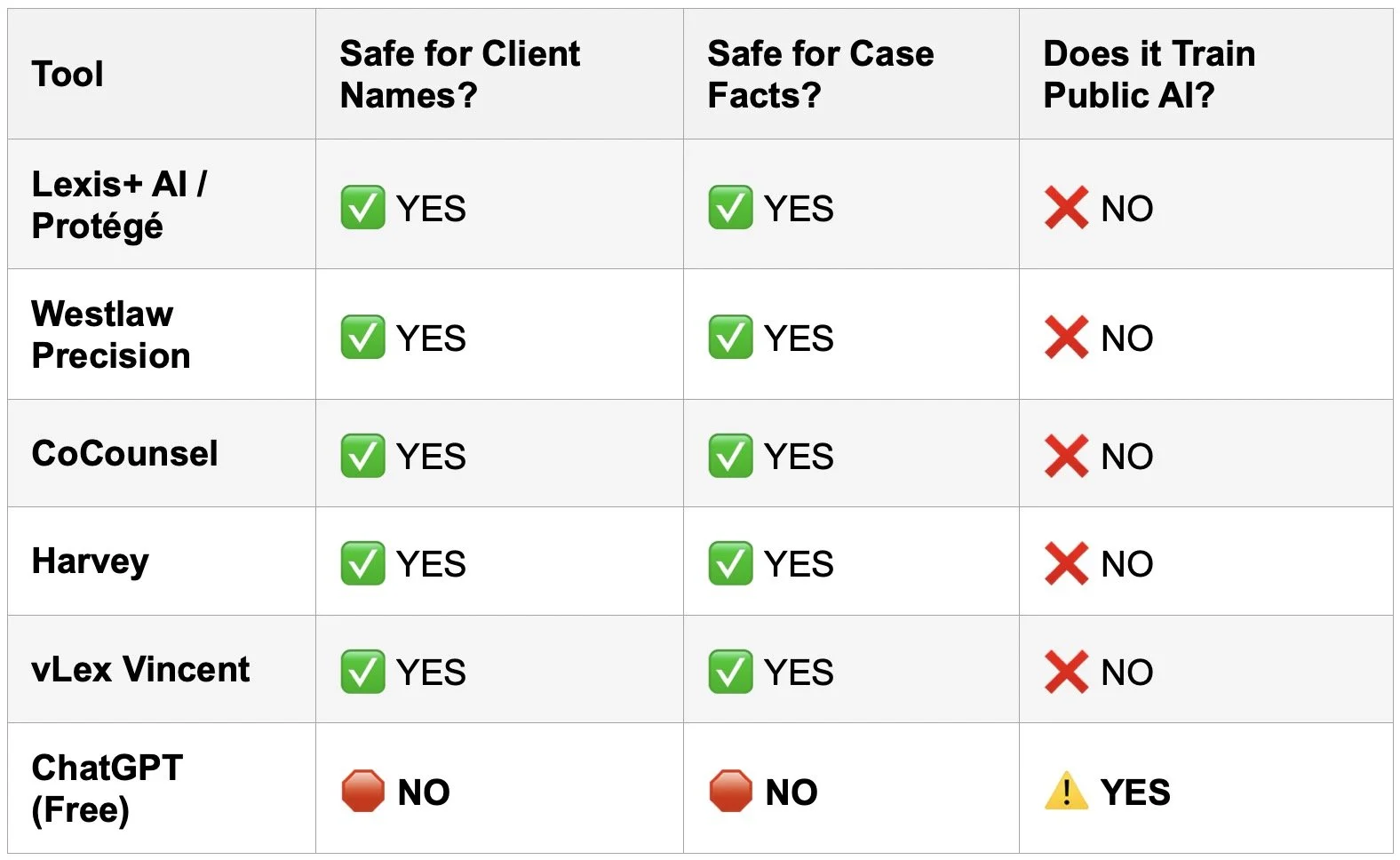
First, there is the world of "Closed" AI. These are the tools we pay for - i.e., Lexis+/Protege, Westlaw Precision, Co-Counsel, Harvey, vLex Vincent, etc. These platforms are built for lawyers. They are walled gardens. You pay a premium for them. (Always check the terms and conditions of your providers.) That premium buys you more than just access. It buys you privacy. It buys you security. When you upload a case file to Westlaw, it stays there. The AI analyzes it. It does not learn from it for the public. It does not share your client’s secrets with the world. The data remains yours. The confidentiality is baked in.

Then, there is the world of "Open" or "Public" AI. This is ChatGPT. This is Perplexity. This is Claude. These tools are miraculous. But they are also voracious learners.

When you type a query into the free version of ChatGPT, you are not just asking a question. You are training the model. You are feeding the beast. If a paralegal types, "Draft a motion to dismiss for John Doe, who is accused of embezzlement at [Specific Company]," that information leaves your firm. It enters a public dataset. It is no longer confidential.

This is the distinction that was missing from the lesson plan. It is the distinction that could cost you your license.

The Duty to Supervise

Do you and your staff know when you can and can’t use free AI in your legal work?

You might be thinking, "I don't use ChatGPT for client work, so I'm safe." You are wrong.

You are not the only one doing the work. Your staff is doing the work. Your paralegals are doing the work.

Under the ABA Model Rules of Professional Conduct, you are responsible for them. Look at Rule 5.3. It covers "Responsibilities Regarding Nonlawyer Assistance." It is unambiguous. You must make reasonable efforts to ensure your staff's conduct is compatible with your professional obligations.

If your paralegal breaches confidentiality using AI, it is your breach. If your associate hallucinates a case citation using a public LLM, it is your hallucination.

This connects directly to Rule 1.1, Comment 8. This represents the duty of technology competence. You cannot supervise what you do not understand. You must understand the risks associated with relevant technology. Today, that means understanding how Large Language Models (LLMs) handle data.

The "Hidden AI" Problem

I have discussed this on The Tech-Savvy Lawyer.Page Podcast. We call it the "Hidden AI" crisis. AI is creeping into tools we use every day. It is in Adobe. It is in Zoom. It is in Microsoft 365.

Public-facing AI is useful. I use it. I love it for marketing. I use it for brainstorming generic topics. I use it to clean up non-confidential text. But I never trust it with a client's name. I never trust it with a very specific fact pattern.

A paid legal research tool is different. It is a scalpel. It is precise. It is sterile. A public chatbot is a Swiss Army knife found on the sidewalk. It might work. But you don't know where it's been.

The Training Gap

The advisory board meeting revealed a gap. Schools are teaching students how to use AI. They are teaching prompts. They are teaching speed. They are not emphasizing the where.

The "where" matters. Where does the data go?

We must close this gap in our own firms. You cannot assume your staff knows the difference. To a digital native, a text box is a text box. They see a prompt window in Westlaw. They see a prompt window in ChatGPT. They look the same. They act the same.

They are not the same.

One protects you. The other exposes you.

A Practical Solution

I have written about this in my blog posts regarding AI ethics. The solution is not to ban AI. That is impossible. It is also foolish. AI is a competitive advantage.

* Always check the terms of use in your agreements with private platforms to determine if your client confidential data and PII are protected.

The solution is policies and training.

  1. Audit Your Tools. Know what you have. Do you have an enterprise license for ChatGPT? If so, your data might be private. If not, assume it is public.

  2. Train on the "Why." Don't just say "No." Explain the mechanism. Explain that public AI learns from inputs. Use the analogy of a confidential conversation in a crowded elevator versus a private conference room.

  3. Define "Open" vs. "Closed." Create a visual guide. List your "Green Light" tools (Westlaw, Lexis, etc.). List your "Red Light" tools for client data (Free ChatGPT, personal Gmail, etc.).

  4. Supervise Output. Review the work. AI hallucinates. Even paid tools can make mistakes. Public tools make up cases entirely. We have all seen the headlines. Don't be the next headline.

The Expert Advantage

The line between “free” and “paid” ai could be a matter of keeping your bar license!

On The Tech-Savvy Lawyer.Page, I often say that technology should make us better lawyers, not lazier ones.

Using Lexis+/Protege, Westlaw Precision, Co-Counsel, Harvey, vLex Vincent, etc. is about leveraging a curated, verified database. It is about relying on authority. Using a public LLM for legal research is about rolling the dice.

Your license is hard-earned. Your reputation is priceless. Do not risk them on a free chatbot.

The lesson from the advisory board was clear. The schools are trying to keep up. But the technology moves faster than the curriculum. It is up to us. We are the supervisors. We are the gatekeepers.

Take time this week. Gather your team. Ask them what tools they use. You might be surprised. Then, teach them the difference. Show them the risks.

Be the tech-savvy lawyer your clients deserve. Be the supervisor the Rules require.

The tools are here to stay. Let’s use them effectively. Let’s use them ethically. Let’s use them safely.

MTC

🎙️Ep. 126: AI and Access to Justice With Pearl.com Associate General Counsel Nick Tiger

Our next guest is Nick Tiger, Associate General Counsel at Pearl.com, Nick shares insights on integrating AI into legal practice. Pearl.com champions AI and human expertise for professional services. He outlines practical uses such as market research, content creation, intake automation, and improved billing efficiency, while stressing the need to avoid liability through robust human oversight.

Nick is a legal leader at Pearl.com, partnering on product design, technology, and consumer-protection compliance strategy. He previously served as Head of Product Legal at EarnIn, an earned-wage access pioneer, building practical guidance for responsible feature launches, and as Senior Counsel at Capital One, supporting consumer products and regulatory matters. Nick holds a J.D. from the University of Missouri–Kansas City, lives in Richmond, Virginia, and is especially interested in using technology to expand rural community access to justice.

During the conversation, Nick highlights emerging tools, such as conversation wizards and expert-matching systems, that enhance communication and case preparation. He also explains Pearl AI's unique model, which blends chatbot capabilities with human expert verification to ensure accuracy in high-stakes or subjective matters.

Nick encourages lawyers to adopt human-in-the-loop protocols and consider joining Pearl's expert network to support accessible, reliable legal services.

Join Nick and me as we discuss the following three questions and more!

  1. What are the top three most impactful ways lawyers can immediately implement AI technology in their practices while avoiding the liability pitfalls that have led to sanctions in recent high-profile cases?

  2. Beyond legal research and document review, what are the top three underutilized or emerging AI applications that could transform how lawyers deliver value to clients, and how should firms evaluate which technologies to adopt?

  3. What are the top three criteria Pearl uses to determine when human expert verification is essential versus when AI alone is sufficient? How can lawyers apply this framework to develop their own human-in-the-loop protocols for AI-assisted legal work, and how is Perl different from its competitors?

In our conversation, we cover the following:

[00:56] Nick's Tech Setup

[07:28] Implementing AI in Legal Practices

[17:07] Emerging AI Applications in Legal Services

[26:06] Pearl AI's Unique Approach to AI and Legal Services

[31:42] Developing Human-in-the-Loop Protocols

[34:34] Pearl AI's Advantages Over Competitors

[36:33] Becoming an Expert on Pearl AI

Resources:

Connect with Nick:

Nick's LinkedIn: linkedin.com/in/nicktigerjd

Pearl.com Website: pearl.com

Pearl.com Expert Application Portal: era.justanswer.com/

Pearl.com LinkedIn: linkedin.com/company/pearl-com

Pearl.com X: x.com/Pearldotcom

ABA Resources:

ABA Formal Opinion 512: https://www.americanbar.org/content/dam/aba/administrative/professional_responsibility/ethics-opinions/aba-formal-opinion-512.pdf

Hardware mentioned in the conversation:

Anker Backup Battery / Power Bank: anker.com/collections/power-banks

Software & Cloud Services mentioned in the conversation:

🎙️TSL Labs! MTC: The Hidden AI Crisis in Legal Practice: Why Lawyers Must Unmask Embedded Intelligence Before It's Too Late!

📌 Too Busy to Read This Week's Editorial?

Join us for a professional deep dive into essential tech strategies for AI compliance in your legal practice. 🎙️ This AI-powered discussion unpacks the November 17, 2025, editorial, MTC: The Hidden AI Crisis in Legal Practice: Why Lawyers Must Unmask Embedded Intelligence Before It's Too Late! with actionable intelligence on hidden AI detection, confidentiality protocols, ethics compliance frameworks, and risk mitigation strategies. Artificial intelligence has been silently operating inside your most trusted legal software for years, and under ABA Formal Opinion 512, you bear full responsibility for all AI use, whether you knowingly activated it or it came as a default software update. The conversation makes complex technical concepts accessible to lawyers with varying levels of tech expertise—from tech-hesitant solo practitioners to advanced users—so you'll walk away with immediate, actionable steps to protect your practice, your clients, and your professional reputation.

In Our Conversation, We Cover the Following

00:00:00 - Introduction: Overview of TSL Labs initiative and the AI-generated discussion format

00:01:00 - The Silent Compliance Crisis: How AI has been operating invisibly in your software for years

00:02:00 - Core Conflict: Understanding why helpful tools simultaneously create ethical threats to attorney-client privilege

00:03:00 - Document Creation Vulnerabilities: Microsoft Word Co-pilot and Grammarly's hidden data processing

00:04:00 - Communication Tools Risks: Zoom AI Companion and the cautionary Otter.ai incident

00:05:00 - Research Platform Dangers: Westlaw and Lexis+ AI hallucination rates between 17-33%

00:06:00 - ABA Formal Opinion 512: Full lawyer responsibility for AI use regardless of awareness

00:07:00 - Model Rule 1.6 Analysis: Confidentiality breaches through third-party AI systems

00:08:00 - Model Rule 5.3 Requirements: Supervising AI tools with the same diligence as human assistants

00:09:00 - Five-Step Compliance Framework: Technology audits and vendor agreement evaluation

00:10:00 - Firm Policies and Client Consent: Establishing protocols and securing informed consent

00:11:00 - The Verification Imperative: Lessons from the Mata v. Avianca sanctions case

00:12:00 - Billing Considerations: Navigating hourly versus value-based fee models with AI

00:13:00 - Professional Development: Why tool learning time is non-billable competence maintenance

00:14:00 - Ongoing Compliance: The necessity of quarterly reviews as platforms rapidly evolve

00:15:00 - Closing Remarks: Resources and call to action for tech-savvy innovation

Resources

Mentioned in the Episode

Software & Cloud Services Mentioned in the Conversation

🎙️ Ep. # 124: AI Governance Expert Nikki Mehrpoo Shares the Triple E Protocol for Implementing Responsible AI and Legal Practice While Maintaining Ethical Compliance and Protecting Client Data.

My next guest is Nikki Mehrpoo. She is a nationally recognized leader in AI governance for law practices, known for her practical, ethical, and innovation-focused strategies. Today, she details her Triple-E Protocol and shares key steps for safely leveraging AI in legal work.

Join Nikki Mehrpoo and me as we discuss the following three questions and more!

  1. Based on your pioneering work with “Govern Before You Automate,” what are the top three foundational steps every lawyer should take to implement AI responsibly, and what are the top three mistakes lawyers make with AI?

  2. What are your top three tips or tricks when using AI in your work?

  3. When assessing the next AI platform from a service provider, what are the top three questions lawyers should be asking?

In our conversation, we cover the following:

  • 00:00:00 – Welcome and guest’s background 🌟

  • 00:01:00 – Current tech setup and cloud-based workflows ☁️

  • 00:02:00 – Privacy and IP management, not client confidentiality 🔐

  • 00:03:00 – Document deduplication with Effingo 📄

  • 00:04:00 – Hardware: HP Omni Book 7 Laptop, HP monitors, iPhone 💻📱

  • 00:05:00 – Efficiency tools: Text Expander, personal workflow shortcuts ⌨️

  • 00:06:00 – Balancing technology innovation and risk management ⚖️

  • 00:07:00 – Adapting to change, ongoing legal tech education 🧑‍💻

  • 00:08:00 – Triple-E Framework: Educate, Empower, Elevate 🚀

  • 00:09:00 – Governance, supervision duties, policy setting 🛡️

  • 00:10:00 – Human verification as a standard for all legal AI output 🧑‍⚖️

  • 00:12:00 – Real-world examples: AI hallucinations, bias, and due diligence ⚠️

  • 00:13:00 – IT vs. AI expertise, communicating across teams 🛠️

  • 00:14:00 – Chief AI Governance Officer, governance in legal innovation 🏛️

  • 00:15:00 – Global compliance, EU AI Act, international standards 🌐

  • 00:16:00 – Hidden AI in legacy software, policy gaps 🔎

  • 00:17:00 – Education as continuous legal responsibility 📚

  • 00:18:00 – Better results through prompt engineering 🔤

  • 00:19:00 – Verify, verify, verify: never trust without review ✔️

  • 00:20:00 – ABA Formal Opinion 512: standards for responsible legal AI 📜

  • 00:21:00 – Nikki’s Triple-E Protocol, governance best practices 📊

  • 00:22:00 – Data origin, bias, and auditability in legal AI systems 🧩

  • 00:23:00 – Frameworks for “govern before you automate” in legal workflows 🔒

  • 00:24:00 – Importance of internal hosting and zero retention policies 🏢

  • 00:25:00 – Maintaining confidentiality with third-party AI and HIPAA compliance 🤫

  • 00:26:00 – Where to find Nikki and connect 🌐

Resources

Connect with Nikki Mehrpoo

Mentioned in the episode

Hardware mentioned in the conversation

Software & Cloud Services mentioned in the conversation

MTC (Bonus): The Critical Importance of Source Verification When Using AI in Legal Practice 📚⚖️

The Fact-Checking Lawyer vs. AI Errors!

Legal professionals face an escalating verification crisis as AI tools proliferate throughout the profession. A recent conversation I had with an AI research assistant about AOL's dial-up internet shutdown perfectly illustrates why lawyers must rigorously fact-check AI outputs. In preparing my editorial for earlier today (see here), I came across a glaring error.  And when I corrected the AI's repeated date errors—it incorrectly cited 2024 instead of 2025 for AOL's September 30 shutdown—this highlighted the dangerous gap between AI confidence and AI accuracy that has resulted in over 410 documented AI hallucination cases worldwide. (You can also see my previous discussions on the topic here).

This verification imperative extends beyond simple date corrections. Stanford University research reveals troubling accuracy rates across legal AI tools, with some systems producing incorrect information over 34% of the time, while even the best-performing specialized legal AI platforms still generate false information approximately 17% of the time. These statistics underscore a fundamental truth: AI tools are powerful research assistants, not infallible oracles.

AI Hallucinations in the Courtroom are not a good thing!

Editor's Note: The irony was not lost on me that while writing this editorial about AI accuracy problems, I had to correct the AI assistant multiple times for contradictory statements about error rates in this very paragraph. The AI initially claimed Westlaw had 34% errors while specialized legal platforms had only 17% errors—ignoring that Westlaw IS a specialized legal platform. This real-time experience of catching AI logical inconsistencies while drafting an article about AI verification perfectly demonstrates the critical need for human oversight that this editorial advocates.

The consequences of inadequate verification are severe and mounting. Courts have imposed sanctions ranging from $2,500 to $30,000 on attorneys who submitted AI-generated fake cases. Recent cases include Morgan & Morgan lawyers sanctioned $5,000 for citing eight nonexistent cases, and a California attorney fined $10,000 for submitting briefs where "nearly all legal quotations ... [were] fabricated". These sanctions reflect judicial frustration with attorneys who fail to fulfill their gatekeeping responsibilities.

Legal professionals face implicit ethical obligations that demand rigorous source verification when using AI tools. ABA Model Rule 1.1 (Competence) requires attorneys to understand "the benefits and risks associated with relevant technology," including AI's propensity for hallucinations. Rule 3.4 (Fairness to Opposing Party and Tribunal) prohibits knowingly making false statements of fact or law to courts. Rule 5.1 (Responsibilities Regarding Nonlawyer Assistance) extends supervisory duties to AI tools, requiring lawyers to ensure AI work product meets professional standards. Courts consistently emphasize that "existing rules impose a gatekeeping role on attorneys to ensure the accuracy of their filings".

The Tech-Savvy Lawyer should have AI Verification Protocols.

The legal profession must establish verification protocols that treat AI as sophisticated but fallible technology requiring human oversight (perhaps a comment to Rule 1.1(8). This includes cross-referencing AI citations against authoritative databases, validating factual claims through independent sources, and maintaining detailed records of verification processes. Resources like The Tech-Savvy Lawyer blog and podcast provide valuable guidance for implementing these best practices. As one federal judge warned, "the duty to check their sources and make a reasonable inquiry into existing law remains unchanged" in the age of AI.

Attorneys who embrace AI without implementing robust verification systems risk professional sanctions, client harm, and reputational damage that could have been prevented through diligent fact-checking practices.  Simply put - check your work when using AI.

MTC

MTC: Small Firm AI Revolution: When Your Main Street Clients Start Expecting Silicon Valley Service 📱⚖️

The AI revolution isn't just transforming corporate legal departments - it's creating unprecedented expectations among everyday clients who are increasingly demanding the same efficiency and innovation from their neighborhood attorneys. Just as Apple's recent automation ultimatum to suppliers demonstrates how tech industry pressures cascade through entire business ecosystems, the AI transformation is now reaching solo practitioners, small firms, and their individual clients in surprising ways.

The Expectation Shift Reaches Main Street

While corporate clients have been early adopters in demanding AI-powered legal services, individual consumers and small business owners are rapidly catching up. Personal injury clients who experience AI-powered customer service from their insurance companies now question why their attorney's document review takes weeks instead of days. Small business owners who use AI for bookkeeping and marketing naturally wonder why their legal counsel hasn't adopted similar efficiency tools.

The statistics reveal a telling gap: 72% of solo practitioners and 67% of small firm lawyers are using AI in some capacity, yet only 8% of solo practices and 4% of small firms have adopted AI widely or universally. This hesitant adoption creates a vulnerability, as client expectations continue to evolve at a faster pace than many smaller firms can adapt to.

Consumer-Driven Demand for Legal AI

Today's clients arrive at law offices with unprecedented technological literacy (and perhaps some unrealistic expectations - think a jury’s “CSI” expectation during a long trial). They've experienced AI chatbots for customer service, used AI-powered apps for financial planning, and watched AI streamline other professional services. This exposure creates natural expectations for similar innovation in legal representation. The shift is particularly pronounced among younger clients who view AI integration not as an optional luxury but as basic professional competence.

Small firms report that clients increasingly ask direct questions about AI use in their cases. Unlike corporate clients, who focus primarily on cost reduction, individual clients emphasize speed, transparency, and improvements in communication. They want faster responses to emails, quicker document turnaround, and more frequent case updates - all areas where AI excels.

The Competitive Reality for Solo and Small Firms

The playing field is rapidly changing. Solo practitioners using AI tools can now deliver services that historically required teams of associates. Document review, which once consumed entire weekends, can now be completed in hours with the assistance of AI, allowing attorneys to focus on high-value client counseling and strategic work. This transformation enables smaller firms to compete more effectively with larger practices while maintaining personalized service relationships.

AI adoption among small firms is creating clear competitive advantages. Firms that began using AI tools early are commanding higher fees, earning recognition as innovative practitioners, and becoming indispensable to their clients. The technology enables solo attorneys to handle larger caseloads without sacrificing quality, effectively multiplying their capacity without the need to hire additional staff.

Technology Competence as Client Expectation

Legal ethics opinions increasingly recognize technology competence as a professional obligation. Clients expect their attorneys to understand and utilize available tools that can enhance the quality and efficiency of their representation. This expectation extends beyond simple awareness to active implementation of appropriate technologies for client benefit.

The ethical landscape supports this evolution. State bar associations from California to New York are providing guidance on the responsible use of AI, emphasizing that lawyers should consider AI tools when they can enhance client service. This regulatory support validates client expectations for technological sophistication from their legal counsel.

The Efficiency Promise Meets Client Budget Reality

AI implementation offers particular value for small firm clients who historically faced difficult choices between quality legal representation and affordability. AI tools enable attorneys to reduce routine task completion time by 50-67%, allowing them to offer more competitive pricing while maintaining service quality. This efficiency gain directly benefits clients through faster turnaround times and potentially lower costs.

The technology is democratizing access to legal services. AI-powered document drafting, legal research, and client communication tools allow small firms to deliver sophisticated services previously available only from large firms with extensive resources. Individual clients benefit from this leveling effect through improved service quality at traditional small firm pricing.

From Reactive to Proactive Service Delivery

Small firms using AI are transforming from reactive service providers to proactive legal partners. AI-powered client intake systems operate 24/7, ensuring potential clients receive immediate responses regardless of office hours. Automated follow-up systems keep clients informed about the progress of their cases, while AI-assisted research enables attorneys to identify potential issues before they become problems.

This proactive approach particularly resonates with small business clients who appreciate preventive legal guidance. AI tools enable solo practitioners to monitor regulatory changes, track compliance requirements, and alert clients to relevant legal developments - services that smaller firms previously couldn't provide consistently.

The Risk of Falling Behind

Small firms that delay AI adoption face increasing competitive pressure from both larger firms and more technologically sophisticated solo practitioners. Clients comparing legal services increasingly favor attorneys who demonstrate technological competence and efficiency. The gap between AI-enabled and traditional practices continues widening as early adopters accumulate experience and refine their implementations.

The risk extends beyond losing new clients to losing existing ones. As clients experience AI-enhanced service from other professionals, their expectations for legal representation naturally evolve. Attorneys who cannot demonstrate similar efficiency and responsiveness risk being perceived as outdated or less competent.

Strategic Implementation for Small Firms

Successful AI adoption in small firms focuses on tools that directly enhance the client experience, rather than simply reducing attorney effort. Document automation, legal research enhancement, and client communication systems provide immediate value that clients can appreciate and experience directly. These implementations create positive feedback loops where improved client satisfaction leads to referrals and practice growth.

The key is starting with client-facing improvements rather than back-office efficiency alone. When clients see faster document production, more thorough legal research, and improved communication, they recognize the value of technological investment and often become advocates for the firm's innovative approach.

🧐 Final Thoughts: The Path Forward for Small Firm Success

clients who see lawyers using ai will be more confident that lawyers are using ai behind the scenes.

Just as Apple's suppliers must invest in automation to maintain business relationships, solo practitioners and small firms must embrace AI to meet evolving client expectations. The technology has moved from an optional enhancement to a competitive necessity. The question is no longer whether to adopt AI, but how quickly and effectively to implement it.

The legal profession's AI transformation is creating unprecedented opportunities for small firms willing to embrace change. Those who recognize client expectations and proactively adopt appropriate technologies will thrive in an increasingly competitive marketplace. The future belongs to attorneys who view AI not as a threat to traditional practice, but as an essential tool for delivering superior client service in the modern legal landscape.  Remember what previous podcast guest, Michigan Supreme Court Chief Judge (ret.) Bridget Mary McCormick shared with us in #65: Technologies impact on access to justice with Bridget Mary McCormick, lawyers who don’t embrace AI will be left behind by those who do!

MTC

MTC: Judicial Warnings - Courts Intensify AI Verification Standards for Legal Practice ⚖️

Lawyers always need to check their work - AI is not infalable!

The legal profession faces an unprecedented challenge as federal courts nationwide impose increasingly harsh sanctions on attorneys who submit AI-generated hallucinated case law without proper verification. Recent court decisions demonstrate that judicial patience for unchecked artificial intelligence use has reached a breaking point, with sanctions extending far beyond monetary penalties to include professional disbarment recommendations and public censure. The August 2025 Mavy v. Commissioner of SSA case exemplifies this trend, where an Arizona federal judge imposed comprehensive sanctions including revocation of pro hac vice status and mandatory notification to state bar authorities for fabricated case citations.

The Growing Pattern of AI-Related Sanctions

Courts across the United States have documented a troubling pattern of attorneys submitting briefs containing non-existent case citations generated by artificial intelligence tools. The landmark Mata v. Avianca case established the foundation with a $5,000 fine, but subsequent decisions reveal escalating consequences. Recent sanctions include a Wyoming federal court's revocation of an attorney's pro hac vice admission after discovering eight of nine cited cases were AI hallucinations, and an Alabama federal court's decision to disqualify three Butler Snow attorneys from representation while referring them to state bar disciplinary proceedings.

The Mavy case demonstrates how systematic citation failures can trigger comprehensive judicial response. Judge Alison S. Bachus found that of 19 case citations in attorney Maren Bam's opening brief, only 5 to 7 cases existed and supported their stated propositions. The court identified three completely fabricated cases attributed to actual Arizona federal judges, including Hobbs v. Comm'r of Soc. Sec. Admin., Brown v. Colvin, and Wofford v. Berryhill—none of which existed in legal databases.

Essential Verification Protocols

Lawyers if you fail to check your work when using AI, your professional career could be in jeopardy!

Legal professionals must recognize that Federal Rule of Civil Procedure 11 requires attorneys to certify the accuracy of all court filings, regardless of their preparation method. This obligation extends to AI-assisted research and document preparation. Courts consistently emphasize that while AI use is acceptable, verification remains mandatory and non-negotiable.

The professional responsibility framework requires lawyers to independently verify every AI-suggested citation using official legal databases before submission. This includes cross-referencing case numbers, reviewing actual case holdings, and confirming that quoted material appears in the referenced decisions. The Alaska Bar Association's recent Ethics Opinion 2025-1 reinforces that confidentiality concerns also arise when specific prompts to AI tools reveal client information.

Best Practices for Technology Integration 📱

Technology-enabled practice enhancement requires structured verification protocols. Successful integration involves implementing retrieval-based legal AI systems that cite original sources alongside their outputs, maintaining human oversight for all AI-generated content, and establishing peer review processes for critical filings. Legal professionals should favor platforms that provide transparent citation practices and security compliance standards.

The North Carolina State Bar's 2024 Formal Ethics Opinion emphasizes that lawyers employing AI tools must educate themselves on associated benefits and risks while ensuring client information security. This competency standard requires ongoing education about AI capabilities, limitations, and proper implementation within ethical guidelines.

Consequences of Non-Compliance ⚠️

Recent sanctions demonstrate that monetary penalties represent only the beginning of potential consequences. Courts now impose comprehensive remedial measures including striking deficient briefs, removing attorneys from cases, requiring individual apology letters to falsely attributed judges, and forwarding sanction orders to state bar associations for disciplinary review. The Arizona court's requirement that attorney Bam notify every judge presiding over her active cases illustrates how sanctions can impact entire legal practices.

Professional discipline referrals create lasting reputational consequences that extend beyond individual cases. The Second Circuit's decision in Park v. Kim established that Rule 11 duties require attorneys to "read, and thereby confirm the existence and validity of, the legal authorities on which they rely". Failure to meet this standard reveals inadequate legal reasoning and can justify severe sanctions.

Final Thoughts - The Path Forward 🚀

Be a smart lawyer. USe AI wisely. Always check your work!

The ABA Journal's coverage of cases showing "justifiable kindness" for attorneys facing personal tragedies while committing AI errors highlights judicial recognition of human circumstances, but courts consistently maintain that personal difficulties do not excuse professional obligations. The trend toward harsher sanctions reflects judicial concern that lenient approaches have proven ineffective as deterrents.

Legal professionals must embrace transparent verification practices while acknowledging mistakes promptly when they occur. Courts consistently show greater leniency toward attorneys who immediately admit errors rather than attempting to defend indefensible positions. This approach maintains client trust while demonstrating professional integrity.

The evolving landscape requires legal professionals to balance technological innovation with fundamental ethical obligations. As Stanford research indicates that legal AI models hallucinate in approximately one out of six benchmarking queries, the imperative for rigorous verification becomes even more critical. Success in this environment demands both technological literacy and unwavering commitment to professional standards that have governed legal practice for generations.

MTC